Hello, I’m Dr. Kim Hyung-taek of Kowon Plastic Surgery.
Because rhinoplasty corrects shape using various materials such as silicone, ear cartilage, and autologous rib cartilage,
careful management and follow-up are important not only immediately after surgery but also over time.
In particular, if the nose becomes swollen, hard, or painful several months later,
this may not be temporary and could be a symptom of a post-rhinoplasty complication.
If inflammation persists for a long time, the internal tissue can harden and contract,
and in such cases, simple treatment may have limitations, making revision surgery for a contracted nose necessary.
During consultations, I try to accurately diagnose the symptoms the patient is experiencing
and suggest a realistic treatment direction that allows for safe recovery.
Today, based on an actual patient case, I’d like to discuss why symptoms of post-rhinoplasty complications occur and
the key management points you should know when considering revision surgery for a contracted nose.
Q.
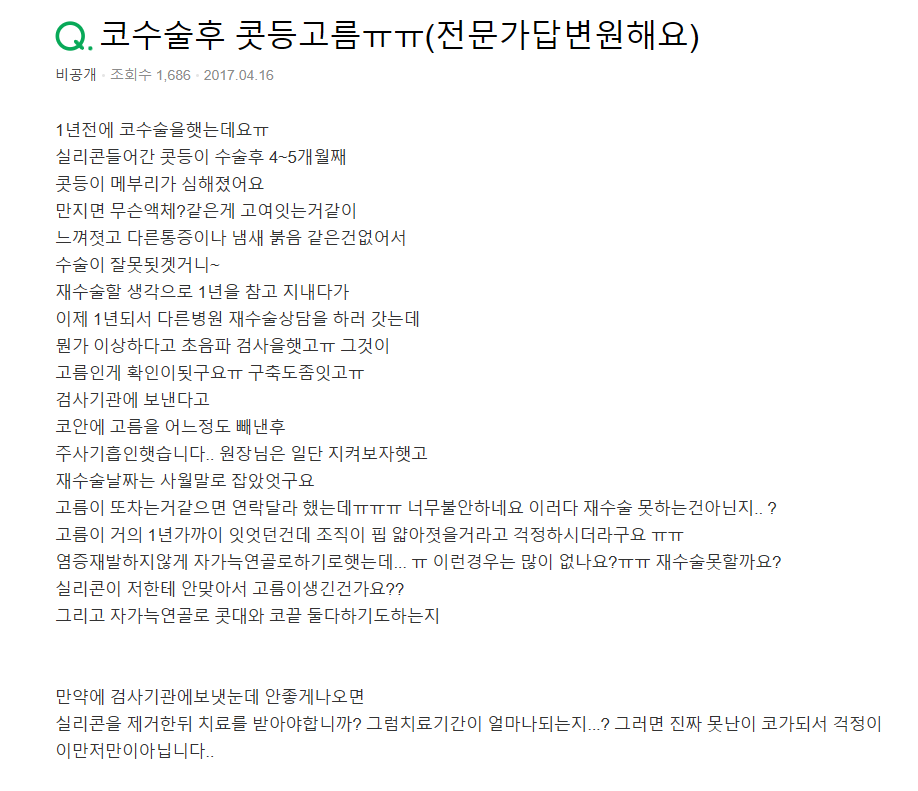
I had nose surgery a year agoㅠ
About 4 to 5 months after the surgery, the bridge area where the silicone was placed developed a pronounced hump, and when I touched it with my hand, it felt like something liquid was pooling there.
There was no pain, redness, or smell, but I was worried, so I ended up thinking it was a post-rhinoplasty complication and held out for a year.
Recently, I had an ultrasound at another hospital, and they found pus and said revision surgery for a contracted nose might be necessary.
The doctor said to observe it for now, aspirated the pus with a syringe, and sent it to a testing lab.
But it feels like the pus is building up again, and I’m so worried.
Is this because silicone doesn’t suit me, causing these symptoms after nose surgery?
And I’d like to know whether revision surgery for a contracted nose, replacing both the bridge and the tip with autologous rib cartilage, is possible.
If the test results come back unfavorable, I also want to know whether the silicone should be removed and treatment should come first.
If so, how long would the treatment period be?
I’m also worried that the shape of my nose might change a lot...
#PostRhinoplastyComplicationSymptoms #RevisionSurgeryForContractedNose #KowonPlasticSurgery
A.
Hello. I’m Dr. Kim Hyung-taek of Kowon Plastic Surgery.
Based on what you described, it appears to be a post-rhinoplasty complication, specifically a chronic inflammatory state.
If the symptoms have continued since around 4 to 5 months after surgery, it is likely that inflammation has been present for a long time.
In such cases, the first step is to accurately determine the degree of inflammation and the extent of tissue damage.
This is because the treatment plan changes depending on the pattern of the post-rhinoplasty complication.
After confirming the inflamed area and the severity of the contraction through an in-person examination, the timing for revision surgery for a contracted nose should be decided.
Since you have already had pus testing done, once the type of bacteria is identified,
the important thing is to first control the inflammation with the appropriate antibiotic treatment.
If the inflammation does not improve with antibiotics, the silicone is removed and the area is washed out,
and then revision surgery for a contracted nose is sometimes performed after a recovery period of at least 6 months.
For a nose that has had inflammation, the rule is to use autologous tissue instead of silicone.
In particular, using autologous rib cartilage or autologous dermis offers high biocompatibility,
and can help prevent post-rhinoplasty complications that may occur later.
It is possible to perform surgery on both the bridge and the tip using autologous rib cartilage, and if the contraction is not severe,
a relatively quick recovery may also be expected.
Revision surgery for a contracted nose is not performed for a simple cosmetic purpose; functional recovery must also be considered,
so it is safest to proceed only after the inflammation has completely subsided.
You may be anxious now, but if treatment and management are done properly, a good result is certainly possible.
I hope your revision surgery and recovery both go well. Thank you.
Hello. I’m Kim Hyung-taek, CEO doctor of Kowon Plastic Surgery, a men’s rhinoplasty clinic that completes three-dimensional harmony.
Today, I’d like to introduce a case of male rhinoplasty using autologous rib cartilage for a patient who visited us for revision surgery for a contracted nose.
About a year after surgery, contraction symptoms appeared, making the nose feel pulled and look elevated, so the patient came to our clinic.
Because the nose had become shorter and the nostrils had turned upward, making it look like a pug nose,
we decided to proceed with revision surgery after sufficient consultation, imaging, and a close check of the tissue condition.
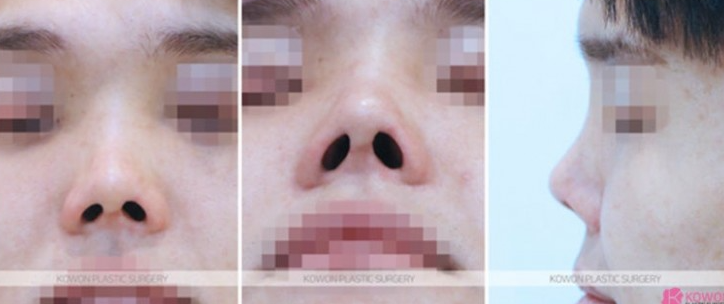
As you can see in the photo, the tip of the nose is turned upward, and the overall balance of the face seems somewhat far from natural.
Such contraction can appear as a complication after nose surgery,
and in particular, it may occur depending on each person’s tissue reaction when silicone implants are used.
In other words, because it does not occur the same way in every patient,
revision surgery for a contracted nose must be approached carefully based on an accurate analysis of the cause.
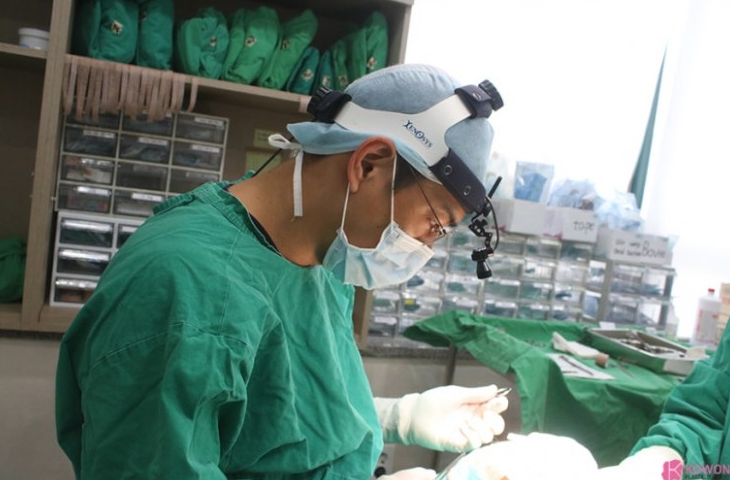
During surgery, it is important for the medical team to avoid excessively inserting implants
in order to minimize tissue rejection.
If the nose is raised too aggressively or synthetic materials are used too much,
an immune reaction can occur in the body, leading to a situation where revision surgery for a contracted nose becomes necessary.
In this case as well, because the contraction caused by silicone was severe,
our men’s rhinoplasty clinic recommended surgery using autologous tissue.
The options that can be chosen instead of artificial implants are
a method using donated rib cartilage and autologous rib cartilage rhinoplasty, which uses cartilage harvested from your own ribs.
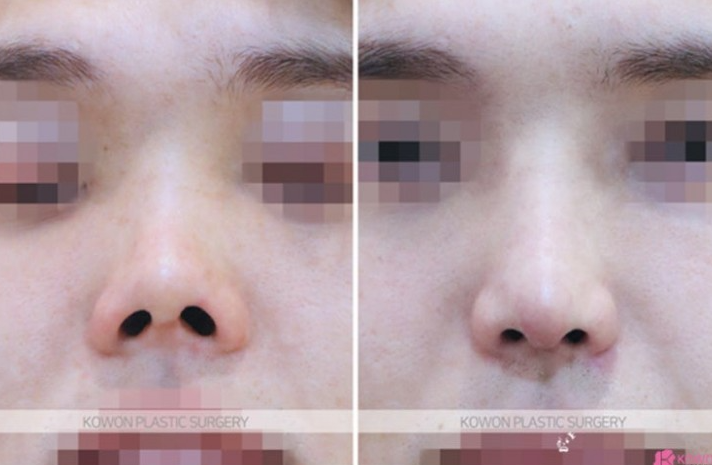
Now let’s look at the before-and-after photos of revision surgery for a contracted nose.
Donated rib cartilage uses specially processed cartilage from another person’s ribs,
while autologous rib cartilage rhinoplasty uses cartilage taken directly from the patient’s own ribs.
Looking at the preoperative photo (left), the nose is bent to the right,
and there were also symptoms of a deviated septum and rhinitis.
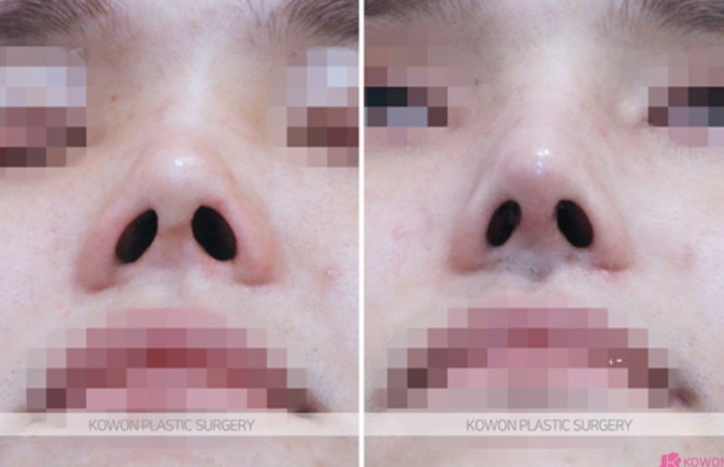
After surgery, the crooked nasal line was corrected,
and the hardened tissue at the tip was released so that the length of the nose could be naturally extended.
As a result, the revision surgery for the contracted nose was carried out very successfully,
and as the tip gently lowered into place, the overall impression became more natural.
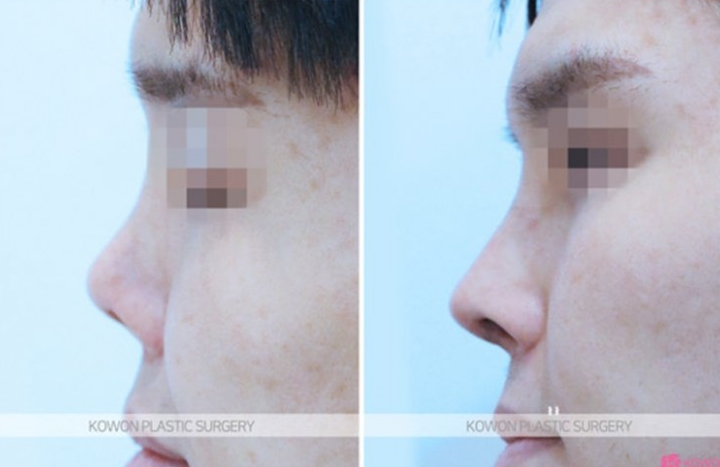
As you can see in the photo, the nostrils that were asymmetrical before surgery
were brought into symmetry, completing a beautiful nasal line.
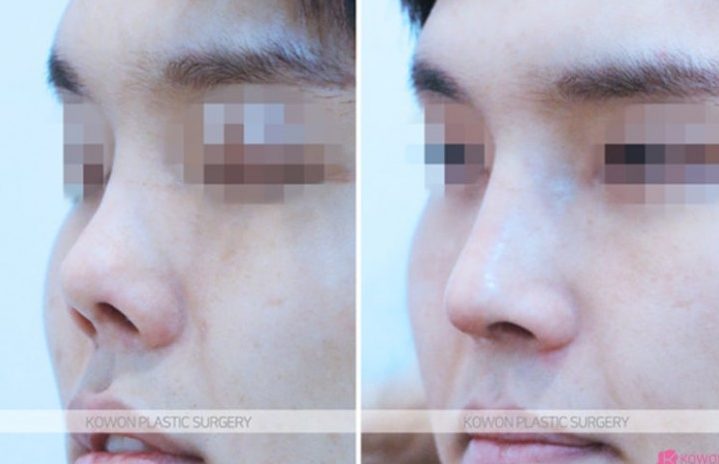
The photo below is a before-and-after comparison image taken at the men’s rhinoplasty clinic.
From a 45-degree angle, the previous view showed the tip of the nose turned up with the nostrils visible,
but after surgery it was corrected to a stable position, showing a much more natural nasolabial angle.
The balance of the lip line and the entire face was also arranged to look smoother and more comfortable.
Many people think that autologous rib cartilage rhinoplasty requires general anesthesia,
but at our men’s rhinoplasty clinic, it can be performed sufficiently under sedative anesthesia as well.
The harvest time is not long either,
and only a small scar of about 2 cm remains at the donor site,
so it is barely noticeable in daily life.
Revision surgery for a contracted nose requires accurate diagnosis and a careful surgical plan,
so if you have related symptoms or concerns, we hope you can receive the safest and most satisfactory result through a consultation.
Make an appointment for a Kowon consultation!
If you’d like to see more cases, click the link below!