
Hello, this is Director Kim Hyung-taek of Kowon Plastic Surgery.
Rhinoplasty requires delicate care because it affects the impression of the center of the face.
In particular, changes that may be mistaken for complications after tip surgery are often temporary and occur during the recovery process.
Also, in the case of non-incisional alar reduction, the shape may change depending on facial expressions or muscle movement during the initial period of the non-incisional alar reduction maintenance period.
Today, through a real inquiry case, we’ll look at the points you should check when you feel that your nose shape has changed after surgery.

Q.
I had tip surgery and non-incisional alar reduction.
Starting a week after the surgery, I met people and kept smiling.
My nose felt tight, but I didn’t pay much attention to it,
and now, two weeks later, my nose seems lower than it was at first, and my nostrils feel wider again.
Could it be because I was smiling? 😢
#tip-surgery-complications #non-incisional-alar-reduction-maintenance-period #KowonPlasticSurgery
A.
Hello. This is Kim Hyung-taek, a consulting physician at Hidoc-Naver Knowledge iN.
An accurate judgment requires directly checking the condition before and after surgery,
but in the case of non-incisional alar reduction, even if the nostrils look narrower right after surgery,
if you smile a lot or talk a lot in daily life, the tissue may loosen and
the nostrils may spread somewhat.
This type of change can commonly appear in the early stage of the non-incisional alar reduction maintenance period.
Also, the phenomenon of the tip looking pulled downward when smiling is
caused by the action of the depressor septi nasi muscle (a muscle that pulls the tip downward).
Because of this, the tip moves toward the mouth and
may give the impression that the tip is lower than immediately after surgery.
Some people mistake this for a complication after tip surgery,
but in most cases it is closer to a temporary change during the early recovery process.
Since it has only been about two weeks since the surgery,
the tissue is still settling,
so it is better to avoid exaggerated facial expressions or smiling too much
so that the changes do not become too large during the non-incisional alar reduction maintenance period.
If the shape has not changed to the extent that a complication after tip surgery is suspected,
there is no need to worry too much.
Once the tissue stabilizes, both the tip and the nostrils will gradually recover.
However, if discomfort continues or the change in shape feels severe,
we recommend visiting the hospital where you had the surgery for an in-person examination.
About one month after surgery, it becomes possible to comprehensively evaluate the progress of the non-incisional alar reduction maintenance period,
so it would be good to check again at that time.
I hope you have a good result.

Hello. I’m Kim Hyung-taek, the chief director of Kowon Plastic Surgery.
Today, I’d like to introduce a case of a female patient who changed to a natural and refined impression through tip lifting, bulbous nose surgery, and a no-implant rhinoplasty.
This patient had long been under psychological stress because of a bent nose and a bulbous nose that looked wide since childhood, and said that facing other people was burdensome.
After sufficient consultation, she proceeded with surgery.
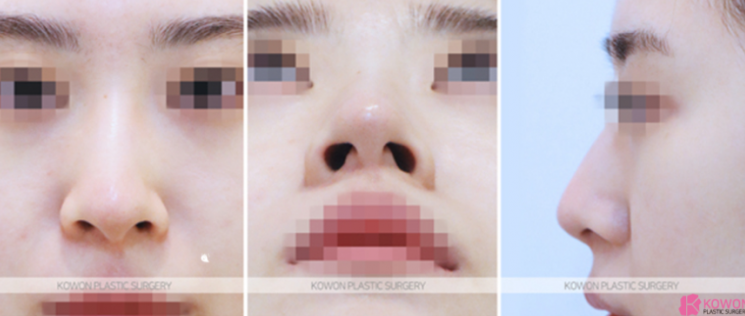
Looking at the left photo, the bridge of the nose is bent toward the right,
and the tip looked spread out, so bulbous nose surgery was needed.
Accordingly, osteotomy was planned, and at the same time tip lifting was also performed.
In the view from below, the nasal tip cartilages were found to be spread outward.
Through tip lifting, the low and round-looking tip was refined,
and the downward-looking impression from the front was improved with depressor septi nasi correction.
Since this patient’s nasal bridge was not completely low,
we chose a no-implant rhinoplasty instead of silicone
to complete a natural line.
As a result, it was a successful case in which the combination of bulbous nose surgery, tip lifting, and no-implant rhinoplasty transformed the face into a softer and more balanced impression.
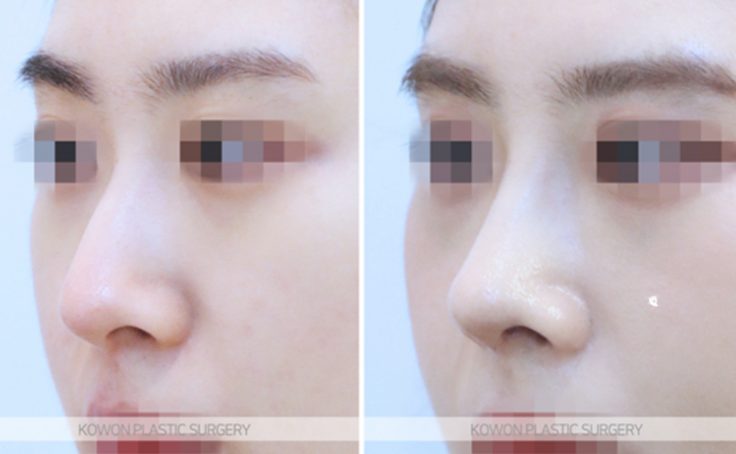
This is a before-and-after photo taken at a 45-degree angle.
The irregular bridge line seen from the side was smoothed out after tip lifting,
and the patient was very satisfied with the results of the bulbous nose surgery and no-implant rhinoplasty.
They said, “It became more defined without being excessive,”
and gave feedback that the overall impression became brighter thanks to the natural change.
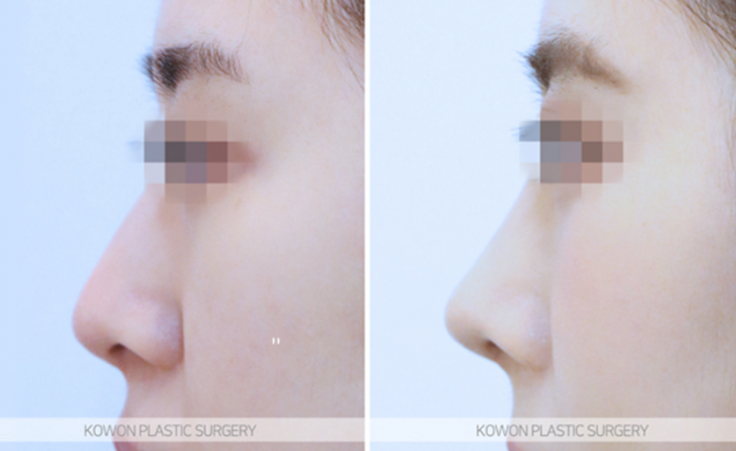
The surgical effect is also clearly visible from the side.
Before surgery, the mouth appeared protruded,
but after no-implant rhinoplasty and bulbous nose surgery,
the height and angle of the nose were harmonized, creating the impression that the lips naturally moved inward.
In this way, tip lifting is not just about the shape of the nose,
but an important factor that determines the proportions and balance of the entire face.
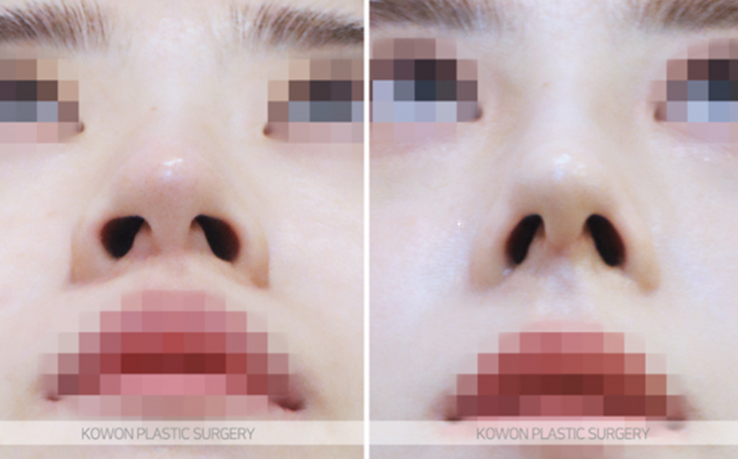
From the view from below, you can see that the nose tip, which looked wide to the sides,
was refined through tip lifting and bulbous nose surgery.
Many people think that alar reduction must be done together, but in reality,
there are many cases where improvement is possible simply by tying the nasal tip cartilages together or through no-implant rhinoplasty alone.
This case is also characterized by the fact that it was naturally corrected into the desired shape without unnecessary incisions.
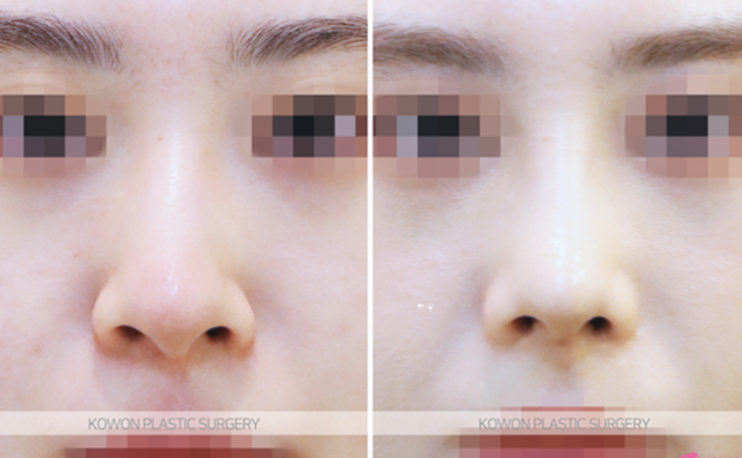
Looking at the final front-facing photo,
you can see that after tip lifting, a neat and straight nasal bridge has taken shape impressively.
With the synergy of bulbous nose surgery and no-implant rhinoplasty,
the overall impression changed to be more refined and three-dimensional.
Today, we introduced a real surgical case performed at Kowon Plastic Surgery.
If you are worried about the shape of your nasal tip or bridge,
please refer to tip lifting, bulbous nose surgery, and no-implant rhinoplasty methods
to check the surgical direction that is right for you.
Make a consultation reservation at Kowon!
Source
https://kin.naver.com/qna/detail.nhn?d1id=7&dirId=70110&docId=260100346&page=1#answer3
If you’d like to see more diverse cases, click the link below!