
Hello, I’m Director Kim Hyung-taek of Kown Plastic Surgery.
The nose is a key area that determines facial harmony, so even a small change can greatly alter the overall impression.
In particular, because the nose involves cartilage, skin, and implants working together, fine changes or discomfort can appear over time, which often worries many people.
Surgical procedures involving structural changes, such as post-jaw surgery nose surgery or correction of a bulbous nose, require even more careful judgment.
Today, based on real consultation cases, I will clearly explain what differences can arise depending on cartilage selection and surgical direction.

Q.
I had double-jaw surgery, so I have little septal cartilage left in my nose.
Some places say that because the septal cartilage is insufficient, donor rib cartilage should be used,
while others say to use the remaining septal cartilage and harvest ear cartilage to make up the shortage.
I have heard negative things about rib cartilage, so if possible, I would prefer to use my own cartilage.
Septal cartilage must also have an important function,
so if almost all of it is used for surgery, what side effects could occur?
The surgery is intended to improve a bulbous nose, where the nostrils are very visible.
-
The function of septal cartilage and side effects from excessive harvesting
-
Problems with using ear cartilage immediately because the septum is insufficient
-
I would like to know whether using donor rib cartilage would be a good choice in my case.
#BulbousNoseSurgery #PostJawSurgeryNoseSurgery #KownPlasticSurgery
A.
Hello. I’m Kim Hyung-taek, a plastic surgery specialist at Hidoc-Naver Knowledge iN.
For patients whose septal cartilage has become reduced after double-jaw surgery,
I receive this question very often regarding bulbous nose surgery or post-jaw surgery nose surgery.
In conclusion, it is not possible to say that one material is definitively better than another.
The most accurate approach is to decide after checking the current shape of the nose, the degree of upturned appearance, the support strength of the septum, and the overall structure.
- Septal cartilage function and side effects from excessive harvesting
Septal cartilage serves as the central support of the nose.
It is a particularly important structure in cases of post-jaw surgery nose surgery.
Therefore, if too much septal cartilage is harvested,
there is a risk that the tip support weakens, causing the nasal tip to droop or the shape to become distorted.
For this reason, excessive harvesting is absolutely not done in rhinoplasty either.
If there is not enough, it must be supplemented with other cartilage.
- Whether there are problems with immediately harvesting ear cartilage because the septum is insufficient
Using ear cartilage is not a problem.
In fact, it is a very common method in bulbous nose surgery and post-jaw surgery nose surgery.
Many cases with insufficient septal cartilage use ear cartilage as an auxiliary material.
It is harvested safely so that there is no problem with the ear shape, so there is no need to worry too much.
- Whether donor rib cartilage is a good option
Donor rib cartilage has both advantages and disadvantages.
Advantages
-
No need to harvest additional ear cartilage or septal cartilage
-
Strong structural support, making it highly useful in bulbous nose surgery
Disadvantages
- Because it is not autologous tissue, there are slight but existing drawbacks such as the possibility of absorption and the risk of infection
However, this does not mean it is "bad."
In particular, in cases like the one above where septal support has weakened,
donor rib cartilage can also be a good alternative.
Ultimately, the key is which material is optimal depending on the current condition of your nose.
I hope you get a good result.
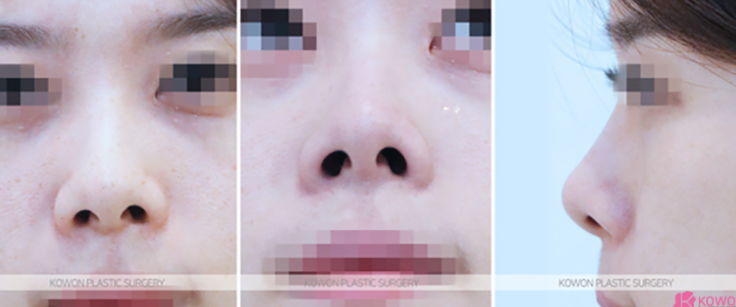
From the front, this was a short nose with nostrils very visible, and from the side, the tip was turned up, making it a typical case requiring correction of a bulbous nose.
The bridge itself was relatively high, but since the patient had previously undergone filler treatment, we first performed filler removal (dissolution).
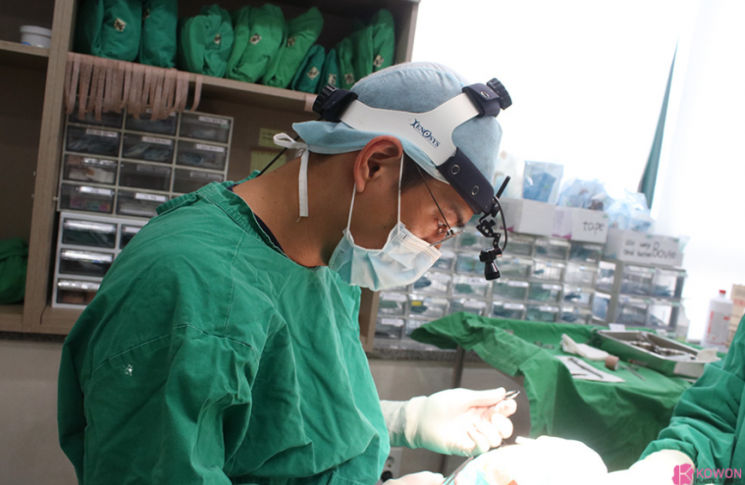
The patient wanted a natural line without an overly artificial look during bulbous nose correction, so we used 4 mm silicone to shape the bridge.
Because septal cartilage alone was not enough in quantity, ear cartilage was also added as reinforcement, and a small, subtle hump on the center of the nasal bridge was gently filed down and refined.
The short nasal tip was lengthened sufficiently by stacking multiple layers of cartilage, creating a stable nasal tip structure.
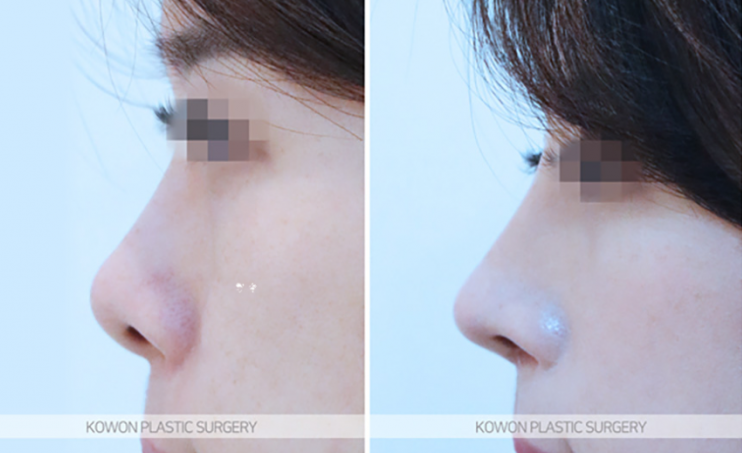
In the short nose surgery review photos, before the bulbous nose correction, the short nasal tip disrupted the overall balance, but after surgery, the naturally lengthened tip created a much more stable and brighter facial impression.
After the bulbous nose correction, once the image was neatly refined, the patient’s satisfaction was also very high.
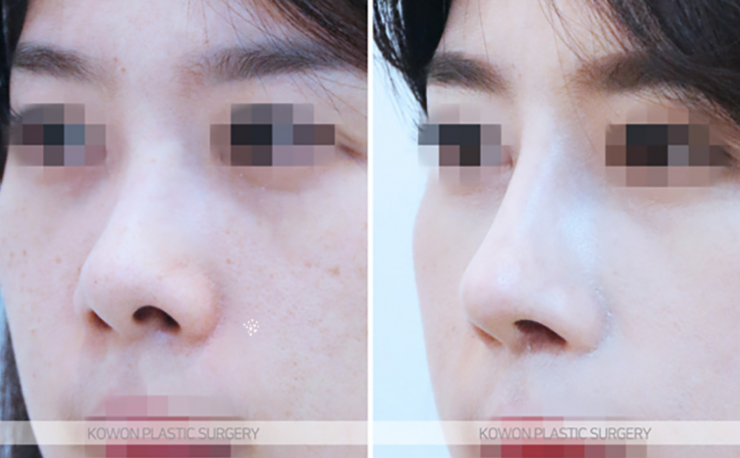
Looking from another angle makes the effect of the bulbous nose correction even clearer.
The short, upturned nasal tip was lowered at a natural angle, creating a much more refined facial impression.
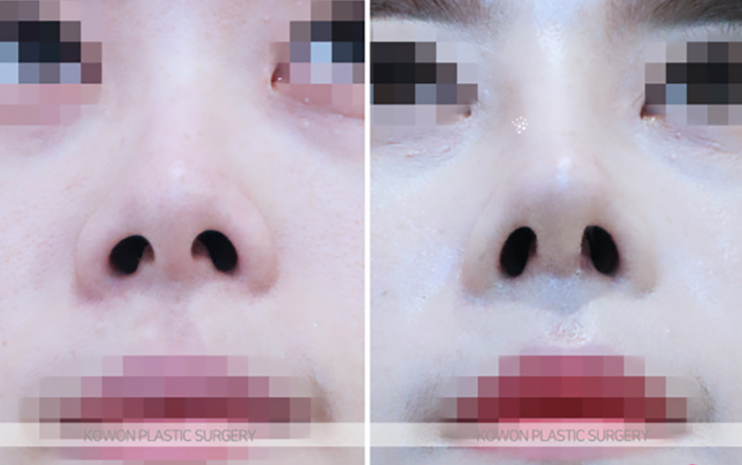
From the view below, the change is even more obvious.
The narrowed and refined nasal tip, the more defined line, and the tidier nostril shape stand out.
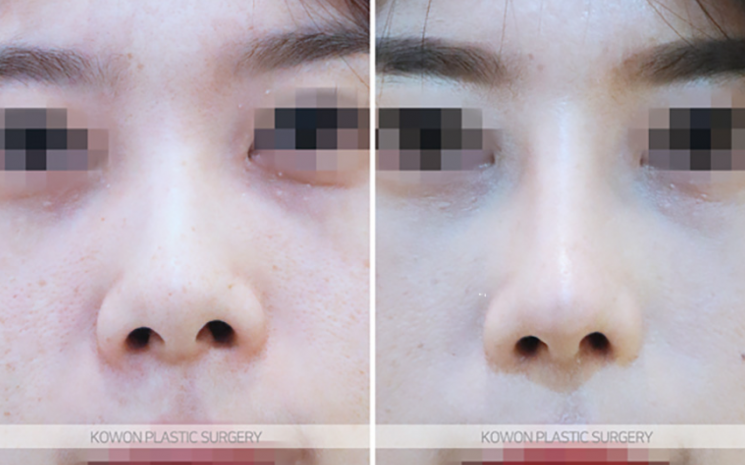
The slight difference in nostril size seen from the front is a common feature of deviated septum.
While perfect correction is difficult, as in cases of bulbous nose correction surgery, the visible degree was reduced enough to improve it to a level that does not cause discomfort in daily life.
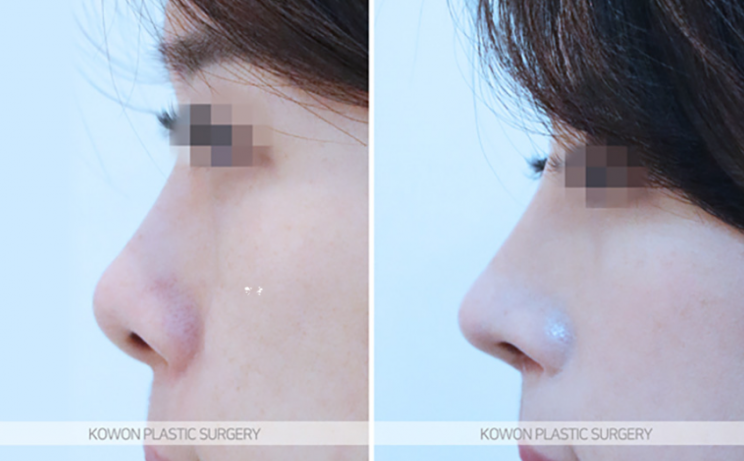
In conclusion, this female patient secured the necessary nasal tip length through bulbous nose correction and completed a natural line. Today, I introduced a nose surgery case in which bulbous nose improvement was performed for a woman who had both nostril asymmetry and a bulbous nose.