If you are considering nostril reduction surgery, it can be confusing because each clinic explains the method differently. In particular, many people wonder how the shape of the nostrils changes after surgery depending on the extent of the incision.
Today, based on a question about nostril incision methods, I will calmly organize the differences according to the surgical method.

Q.
While looking into several clinics, I learned that there are two ways to reduce the nostrils. One is a method that only makes an incision along the bottom of the nostril, and the other is a method that widens the incision range a little more from the bottom toward the side. I’m wondering whether I understood correctly because the shape of the nostrils after surgery seems different depending on the method.
In my view, Method 1 seemed to cut and reattach only the bottom area, causing the tissue to gather downward and create a rounder-looking nostril. Method 2 seemed to extend the incision about 2–3 mm more toward the side, pulling both downward and outward so that the nostrils looked slimmer and more elongated. My nostrils are naturally round, so if possible I would prefer the slimmer shape like Method 2, but if there is actually no big difference, I’m also wondering whether Method 1, with the shorter incision line, might be better.
A.
Before deciding on surgery, it is very commendable to carefully understand the methods and results. The better you understand the process in advance and can predict the outcome, the higher your satisfaction after surgery may be.
The Method 1 you mentioned is likely something the clinic explained not as “nostril reduction” in a strict sense, but as a way to reduce the width of the nose, meaning a method that reduces the tissue in the area between the nostrils and the columella at the base. In fact, a simple excision only at the bottom of the nostril is not commonly used because the degree of change is not very large.
On the other hand, Method 2 is a relatively commonly used approach, with the advantage of reducing the volume of the alar cartilage itself and making the nose appear to gather inward. However, as the incision range extends farther to the side, you should consider that a scar may remain on the outer side.
In addition, if the overall nose width is wide rather than the nostrils themselves being large, a method that reduces the tissue at the base between the nostrils and the columella may be more suitable. There are also various options, such as a method that gathers the alar cartilage using thread or a method that lifts drooping alar cartilage upward. Among these different types of nose surgery, the appropriate method depends on directly evaluating the current nostril size, skin thickness, and overall nasal proportions. After 충분히 알아보신 뒤, it is best to choose the method that suits your own nasal condition.
#코수술종류 #코원성형외과
 This image was used with the model’s consent.
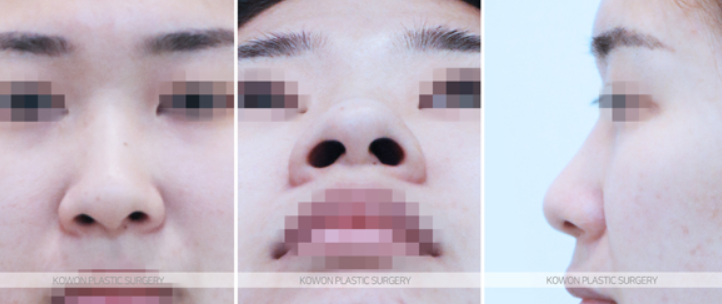
The nasal tip cartilage was spread apart to the left and right, so in the photo taken from below, the nostrils appeared flattened and spread outward on both sides. Since the patient wanted the most natural possible appearance, we used nasal tip cartilage suturing to gently refine the tip without overcorrection and to improve the height.
From the front, the nasal bridge was low and not very prominent, but the septum was observed to be shifted to one side, which corresponds to a mild deviated septum. In such cases, it is necessary to correct it during surgery as well, because when the bridge is low, the deviation may not be very visible, but once the nose is raised, it often becomes more noticeable.
 This image was used with the model’s consent.
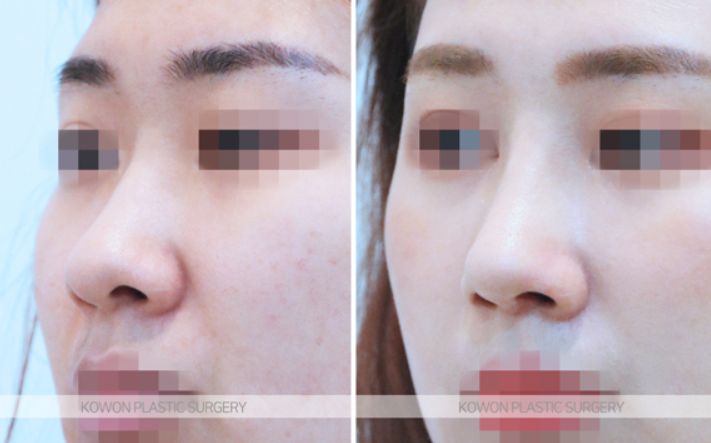
A 4 mm silicone implant with a moderate height was used for the nasal bridge to achieve overall balance. Because the nose structure was small and low, septal cartilage alone did not provide enough support, so ear cartilage was additionally used.
 This image was used with the model’s consent.
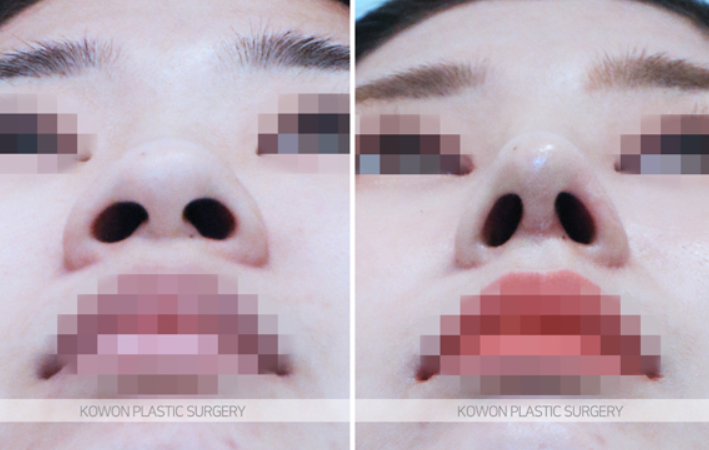
In addition to the issue of spread-out nasal tip cartilage, the nostrils were also widely flared left and right, so non-incisional nostril reduction was performed at the same time. This was a method chosen to reduce the width of the nose while minimizing strain on facial expressions.
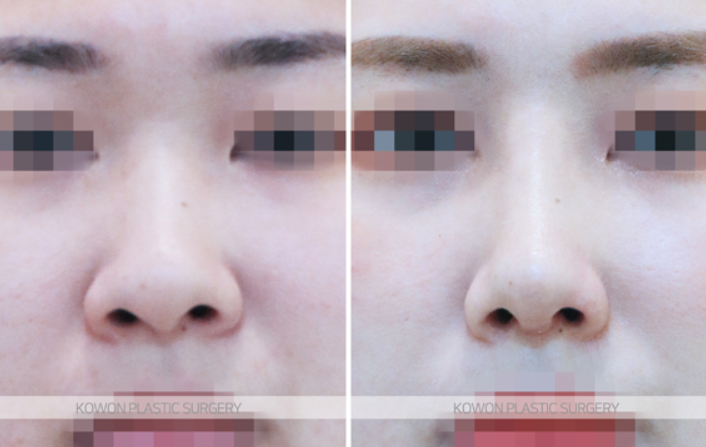 This image was used with the model’s consent.
When viewed from the front, the width of the nose was reduced compared with before, giving the overall face a much more refined appearance.
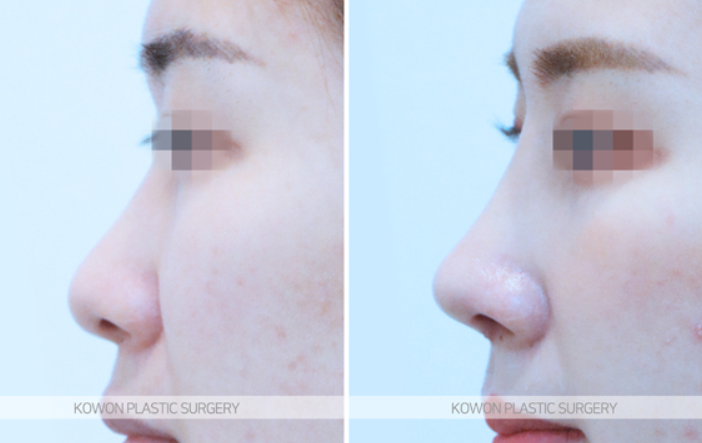 This image was used with the model’s consent.
Many people think that bulbous noses must be treated with nostril reduction, but in actual cases, there are many examples in which nasal tip cartilage suturing alone is enough to improve the appearance. Some people worry that nostril reduction will make smiling look unnatural or leave scars, but an incision-based method is not necessary in every case, and a non-incisional method that reduces the burden of scarring can also be chosen.
Also, even with an incision-based method, depending on the surgical technique and suture placement, there are many cases where recovery is not overly noticeable, so there is no need to worry more than necessary.