[Introduction]
Hello, I am Kim Hyung-taek, director of Kowon Plastic Surgery.
When discussing hump nose surgery, I often hear questions like this:
“Will it look natural if I simply smooth down the protruding area a little?”
In reality, a person’s impression is often determined by more than just one curve on the nasal bridge. It is important to consider together whether the tip points downward, whether the nose looks long, and how the angle around the mouth appears.
In particular, with a male hump nose, making it too soft can reduce the masculine impression, while emphasizing only a straight line can make the face look too strong.
That is why, when I explain before-and-after male rhinoplasty results, I focus first on whether the flow from the nasal bridge to the tip suits the face, rather than simply discussing how much the height has changed.
“Will the drooping appearance of the tip improve as well?”
In my view, it depends on the case.
If drooping of the tip is also contributing to the hump appearing prominent, addressing only the nasal bridge may actually make the direction of the tip more noticeable.
In such cases, it is important to assess the bridge and tip separately while planning them so that the final result connects as one continuous line.
Used with the model’s consent.
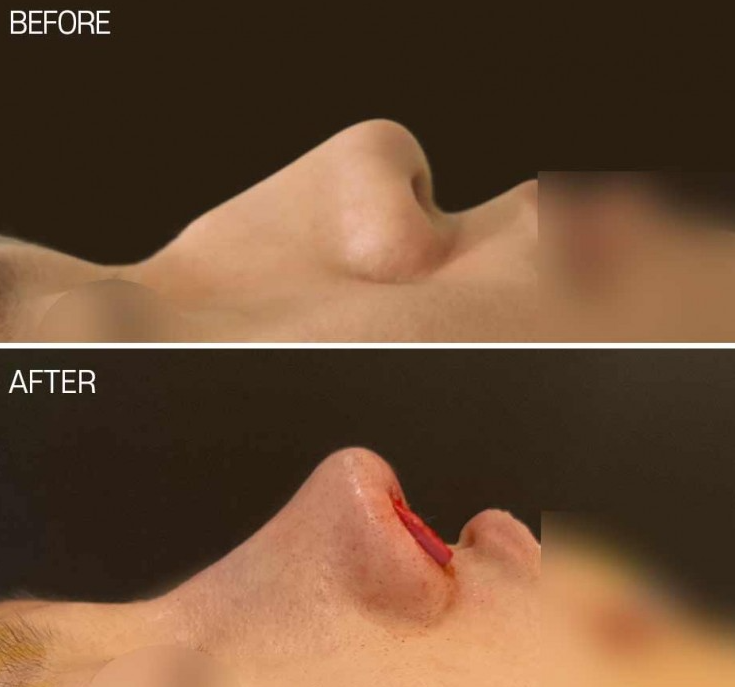
Surgical plan for this case
The patient had an uneven-looking nasal bridge line due to the hump, and the entire nose appeared long because the tip drooped downward.
In consultations, people with this type of nose often feel that their profile looks darker or heavier than their frontal appearance. Simply smoothing the hump may not be enough to sufficiently change the overall impression.
Therefore, the surgical plan was to smooth the flow of the nasal bridge by refining the hump and to establish a moderate, straight line as the foundation while taking the characteristics of a male nose into account.
However, not every man suits an approach that makes the nose unconditionally high and straight simply because it is a male nose. In my experience, depending on the overall atmosphere of the face, a subtle curve at the end may be needed even within a straight line.
For the tip, the downward direction was improved through repositioning and binding of the tip cartilages.
A supporting structure was also placed between the tip cartilages, with an emphasis on providing stability so that the tip would not gradually begin to droop again over time.
This process is not simply about the visible height of the tip. It is closer to adjusting the direction in which the tip stands on the face.
“Does a male nose always have to be completely straight?”
I do not see it that way.
In this case as well, the straight nasal bridge was used as the foundation, while a very subtle curve was added to the tip to reduce the stronger impression and create a softer, more refined appearance.
What is important in before-and-after male rhinoplasty is not eliminating the masculine image, but restoring facial balance by refining elements that made the nose look unnecessarily long and droopy.
Immediately after surgery, before swelling has fully set in, the structural changes to the nasal bridge and tip can be seen relatively clearly.
As swelling subsides and the tissues stabilize during recovery, the line settles into a somewhat softer shape.
The timing of stabilization and the extent of changes in shape may vary depending on skin thickness, the condition of the cartilage, and the existing nasal structure.
More surgical journals by the director
Used with the model’s consent.
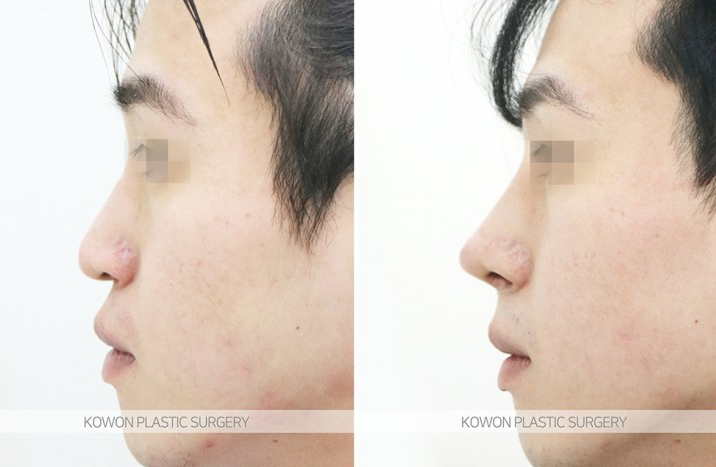
Changes seen in a reference case
As in the surgical journal discussed above, a hump nose does not occur only when the nasal bridge is high and large.
In consultations, I often see cases where the nose is not particularly large, but there is a curve in the middle of the nasal dorsum and the tip drops downward, creating an overall depressed or tired impression.
If these aspects are overlooked when comparing before-and-after male rhinoplasty results, the hump may be corrected while the nose still feels excessively long.
The key point in this reference case was the position of the tip rather than the hump itself.
The patient wanted to slightly raise the tip to reduce the drooping appearance and create a smooth line without a hump.
“Is it possible to raise only the tip if I am satisfied with the height of the nasal bridge?”
In such cases, rather than making an immediate judgment about whether it is possible, we first check whether raising the tip would make the existing hump more prominent.
When the central point of the tip changes, the visible shape of the nostrils and the sides of the nose may change as well. Thus, even a seemingly small change can sometimes create a noticeably different overall impression.
Therefore, I examine preoperative photographs from multiple angles to identify which area is actually the main concern.
Used with the model’s consent.
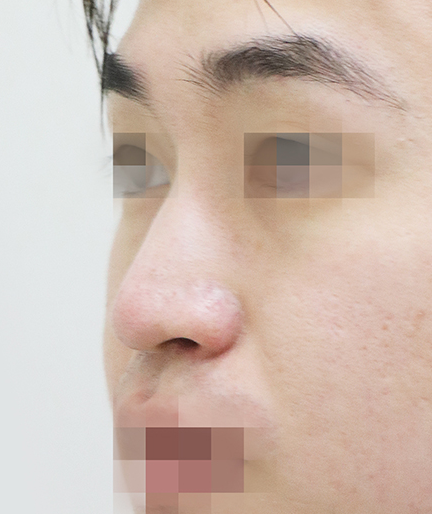
Criteria checked from the front and side
At a 45-degree angle, some people have a downward-pointing tip that makes the nose look long, while the nostrils appear relatively elevated.
In the reference case, the downward pulling force on the tip was relatively strong, so simply binding the tip cartilages might not have provided sufficient lasting support. In such cases, the influence of the muscles that pull the tip downward must also be considered.
From the front, the tip may look compressed, while the sides of the nose may appear to spread outward.
In some cases, the tip appears spread to both sides because it is drooping and compressed. Simply straightening the tip can therefore make the sides of the nose appear relatively more gathered. This is why frontal changes are important when reviewing before-and-after male rhinoplasty results.
“Do the sides of the nose have to be reduced if they look wide?”
In my view, the first step is to check the support and direction of the tip.
Reducing the nasal wings or sides directly may be necessary in some cases, but it does not apply to everyone.
If the structure is spread because the tip is compressed, as in the reference case, binding the tip cartilages and establishing support for the columella can raise the center and relieve the congested appearance from the front.
However, lasting support must be considered realistically. The tip is continuously affected over time by the skin, cartilage, and facial expression muscles. Therefore, when planning surgery, I do not look only at the shape immediately after surgery; I also consider how to establish a supporting structure so that the direction remains stable after recovery.
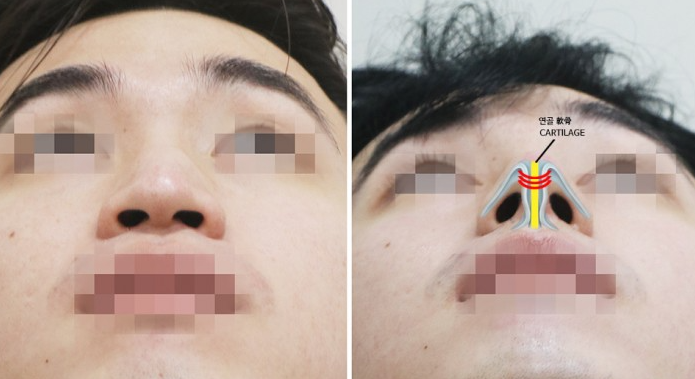
Used with the model’s consent.
Why the tip and nasolabial angle matter
From the side, a hump nose and drooping tip can also affect the impression around the mouth.
In the reference case, the mouth was not actually significantly protruding, but the angle between the philtrum and lips created the impression that it projected outward.
These aspects may appear more balanced as the direction of the tip and the nasolabial angle change.
Although the mouth itself does not move, improving the angle where the tip and philtrum meet can make the area around the mouth appear less prominent in profile. Therefore, in hump nose surgery, it is necessary to examine not only the curve of the nasal dorsum but also the angle between the tip and the lips.
Although the patient was not particularly dissatisfied with the height of the nasal bridge, it was necessary to slightly refine the hump and add one thin layer of an implant so that the line from the glabella to the tip would connect naturally without a hump.
The important point here is not to increase the height substantially, but to connect the uneven flow smoothly. In before-and-after male rhinoplasty, this is the type of case where naturally refining the line can feel more satisfying than making an excessive change.
Some people also ask about the marks that may remain after an open approach when viewed from below. Scarring varies according to an individual’s skin characteristics and care. It tends to fade over time, but it cannot be guaranteed that it will be completely invisible.
I also explain these aspects in advance during consultations. This allows patients to view the recovery process with realistic expectations about the results.
Used with the model’s consent.
The criteria I consider important
What I have come to feel through my practice is that the most important criterion in male hump nose surgery is not how much the nose has been raised.
Even if the hump is refined, a long and congested impression may remain if the tip continues to point downward. Conversely, raising only the tip may make the curve of the nasal bridge appear more awkward. That is why I consider the nasal bridge, tip, nasolabial angle, and overall facial proportions together.
These days, not every man wants the exact same straight line simply because it is a male nose.
For some people, a neat straight line suits them, while for others, a very subtle softness at the tip is needed for the impression to look natural.
When planning surgery, rather than simply following the changes shown in photographs, it is necessary to calmly determine which features look heavy on the individual’s face.
“Would smoothing only the hump be enough for my nose?”
Whenever I receive this question, I first examine the direction of the tip as well. A hump nose is difficult to assess based solely on one protruding area on the nasal dorsum. When a drooping tip, a long-nose impression, or an imbalance in the nasolabial angle is also present, the surgical plan changes.
I believe it is more important to accurately identify the adjustments needed for the current structure than to promise an excessive transformation.
A post worth referring to for male rhinoplasty
“Why Male Bulbous Nose Surgery Should Correct the Hump Nose and Wide Nasal Sides Together for a Natural Result.”