Hello, I am Dr. Kim Hyeong-taek of Kowon Plastic Surgery.
During consultations, some people say that their nasal tip appears turned upward, making their nostrils visible, while also feeling that their nose looks long and droopy.
At first, these may seem like contradictory concerns. In reality, however, these impressions can appear together when the direction and support of the nasal tip cartilage, as well as the angle where the columella and philtrum meet, are unstable at the same time.
When looking at before-and-after results, it is not enough to simply check whether the nasal tip has been narrowed or whether it looks slimmer from the front.
In general, it is important to consider together which direction the nasal tip is oriented, whether nostril exposure has been reduced naturally, and whether the angle between the nasal tip and philtrum continues in a stable way from the side. This allows the results to be assessed more realistically.
"If the tip looks turned up, why does the nose look long?"
This is a natural question.
In such cases, the sensation of the nasal tip being turned upward and the impression of it drooping downward may be mixed within the same area. Rather than approaching the issue by simply raising or binding the tip, it is necessary to examine the three-dimensional balance of the entire face together with the structure of the nasal tip.
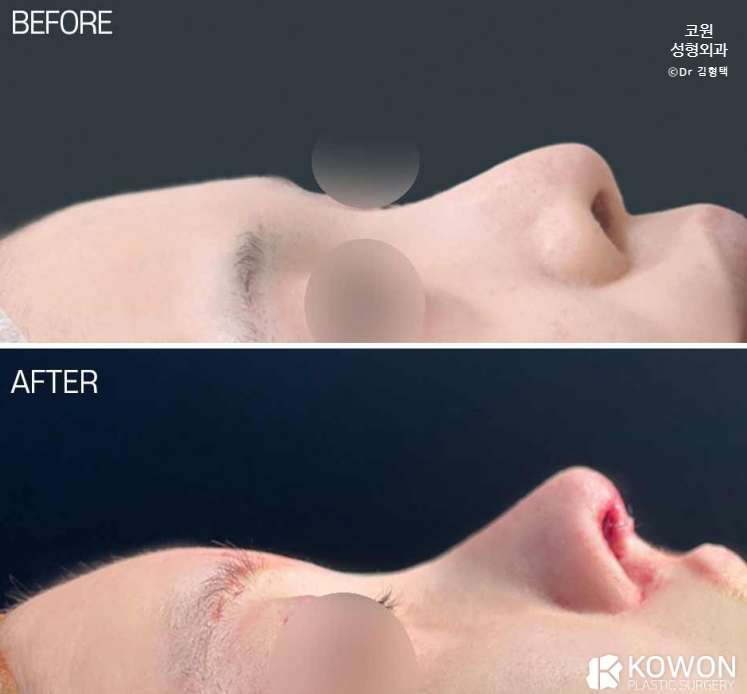
The photo is used with the model's consent.
The focus of this surgical case study was a case in which the nasal tip was turned upward like an upturned nose, exposing the nostrils, while also drooping downward and creating a long, awkward impression from both the front and side.
This is exactly what needs to be examined in nasal tip cartilage binding.
The important point was not simply whether the tip had been narrowed, but whether a structure had also been created to steadily lower its upward direction and support it so that it would not droop.
Another notable feature was that the forehead lacked volume and sloped backward.
In general, the transition from the forehead to the glabella and then to the nasal bridge should be smooth for the nose line to appear natural. If this connection is weak, the nose may look separate from the rest of the face even if it has been refined. In fact, among people who want a refined nose line, those with a thin and flat face may find that changing only the nose makes the overall appearance feel more awkward.
In this case, the plan was to stabilize and adjust the upward direction of the nasal tip through tip cartilage repositioning and nasal tip cartilage binding, while placing a support between the tip cartilages to reduce the force pulling the tip downward.
This helped reduce nostril exposure and establish a balance in which the nasal tip continued naturally within the overall face.
Correction of the columella and the nasolabial angle was also considered.
In my view, whether the nasal bridge, nasal tip, and philtrum line connect naturally in profile is an important standard for judging a refined impression.
Forehead fat grafting was also performed to supplement the insufficient forehead volume, allowing the nasal bridge to look harmonious within the overall three-dimensional balance of the face rather than standing out excessively.
"I want a refined nose, but I am worried about whether it will suit my face."
Whenever I hear this, I explain that we should not consider the shape of the nose separately. In reality, the angle of the nasal tip, the transition between the forehead and glabella, the nasolabial angle, and the volume of the face all need to be balanced together for the change to look natural and refined.
More Surgical Case Studies
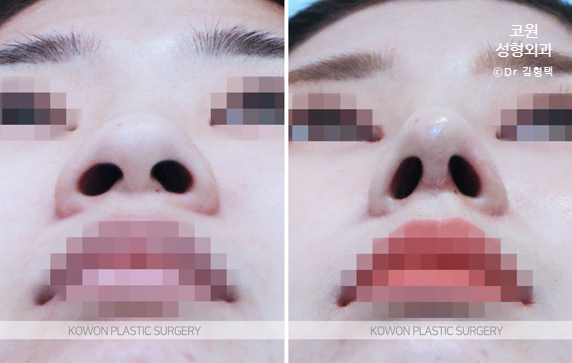
The photo is used with the model's consent.
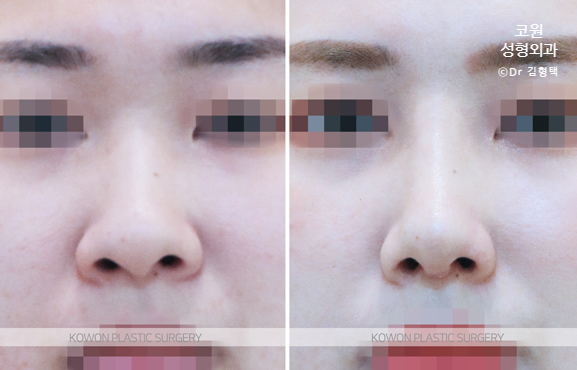
The photo is used with the model's consent.
[Introduction to a Reference Case]
As in the previous surgical case study, where the direction and support of the nasal tip were considered together, it was important in this reference case to first examine the shape of the tip cartilage.
When comparing the results before and after nasal tip cartilage binding, looking only at the frontal change can make it easy to focus on how much the tip has been narrowed. However, if the nostrils lie outward on both sides when viewed from below, or if the tip cartilage is spread widely, the correction plan becomes more detailed.
The reference case involved a nose that was generally low and small, with a blunt and wide nasal tip.
Rather than raising this type of nose excessively, it is more stable to naturally bring together the spread cartilage while creating the amount of height and shape needed at the tip.
In many cases, some refinement can be achieved with nasal tip cartilage binding alone. However, additional adjustments may be needed depending on the strength of the cartilage, skin thickness, and degree of nostril flare.
"If only the tip is bound, will the bulbous appearance also be reduced?"
When I receive this question, I first examine the shape of the nostrils from below together with the width of the tip seen from the front.
In reality, the approach differs depending on whether the bluntness is caused by spread nasal tip cartilage or whether the nostrils themselves are widely flared.
Therefore, during the consultation, it is necessary to distinguish the cause of the nasal tip from multiple angles rather than making a decision based on a single photograph.
The photo is used with the model's consent.
[In Summary]
In my clinical practice, what I consider more important is the direction in which the nasal tip is positioned, whether nostril exposure has been naturally refined, and whether the angle between the columella and philtrum is harmonious with the entire face.
A nasal tip that looks both turned up and droopy is often not simply a matter of shape; structural and directional issues may be intertwined.
In general, people want to resolve all their concerns with a single procedure.
In practice, however, it is necessary to consider nasal tip cartilage repositioning, cartilage binding, support formation, columella correction, nasolabial angle correction, and, when needed, supplementation of forehead volume together to achieve a result that comes closer to looking natural.
Especially when seeking a refined line, the process of finding a height and angle that suit the face should come before simply making the nose more prominent.
"Would binding only my nasal tip be enough?"
This question is difficult to answer definitively based on photographs alone.
During a consultation, we examine the structure of the nasal tip from the front, side, and below, while also considering skin thickness, cartilage strength, nostril width, and the transition between the forehead and glabella.
Only after this process can a realistic plan be established for how much to narrow the nasal tip, which direction to position it in, and how much support it needs.
When explaining nasal tip surgery, I place greater importance on stable balance than on the size of the change.
An excessively elevated or aggressively reduced nose may be noticeable at first, but if it eventually looks disconnected from the face, it can be difficult for satisfaction to last.
Through a thorough consultation, we separate the causes of the current nasal concerns and find an approach that continues naturally within the individual's face. This is the standard I pursue for nasal tip correction.