Hello. I am Dr. Kim Hyeong-taek of Kowon Plastic Surgery.
When consulting with patients about hump nose surgery, I often meet people who focus only on the bump visible on the bridge of the nose. Since the uneven line seen in photos is usually their biggest concern, it is easy to assume that removing just that area will immediately make the overall impression softer.
However, the important consideration in female hump nose surgery is not simply how much of the hump should be shaved down.
In practice, we need to consider the existing height of the nasal bridge, the degree to which the tip droops, the width of the bridge, how much of the nostrils is visible from the front, and the impression the patient wants to maintain.
“Won’t completely removing the hump make my nose look too obviously operated on?”
This is a question I hear quite often.
From my perspective, removing the hump and refining it to suit the face are slightly different matters.
A nearly smooth, straight line may suit some people, while others maintain a more comfortable and natural impression when a slight sense of the original strength of the bridge is preserved.
Used with the model’s consent
Female Hump Nose Surgery
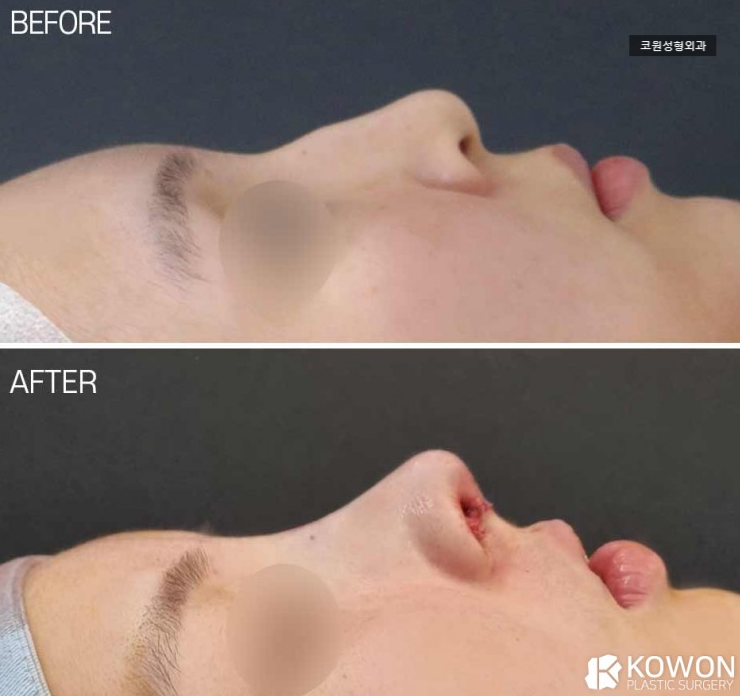
This case from the surgical log involved a low hump nose with a slight protrusion in the middle of the nasal bridge, along with an upward-turned nose in which the nostrils were excessively visible from the front.
Unlike a simple upturned nasal tip, the outer portions of the alar were curled upward, causing the nostrils to be exposed outwardly.
In such cases, the nasal tip may look short from the front, and the center of the nose may appear to float awkwardly overall.
In addition, when the nasal bridge itself is not high and only the hump stands out relatively prominently, the line of the bridge may not flow smoothly and the nose may appear to lack dimension.
When I assess this type of nose, I do not approach it by shaving down only the hump or raising only the tip. The relationship between the nasal bridge, tip, alar, and nostrils is interconnected, so changing just one area may leave awkwardness in another.
For the surgery, we planned to refine the hump naturally in proportion to the face and create a smoother flow from the nasal bridge to the tip.
The tip was brought together through repositioning and suturing of the nasal tip cartilages, then naturally elevated using the patient’s own cartilage. We also considered stability by creating a supporting structure between the tip cartilages so that the elevated tip would be less likely to drop easily.
In particular, when the outer alar are lifted and the nostrils are exposed, lowering only the tip may not be sufficient.
In this case, nostril-lowering surgery was performed at the same time so that the line beneath the alar could be lowered naturally.
Nostril-lowering surgery is not simply a process of covering the nostrils. It is closer to balancing the alar, columella, and tip to reduce the amount of exposure seen from the front and create a more stable impression.
We also assessed the columella, nasolabial angle, and philtrum line together, adjusting them so that the side profile from the tip to the mouth would connect smoothly. Through this process, we aimed to make the mouth appear less protruding than before surgery and create a more orderly flow around the nose and mouth.
Source
https://kowonps.com/right-after-rhinoplasty/530?page=3
#FemaleHumpNoseSurgery
More Surgical Case Logs
Used with the model’s consent
[Reference Case Introduction]
Source
https://kowonps.com/surgery-log/72?wvd=3
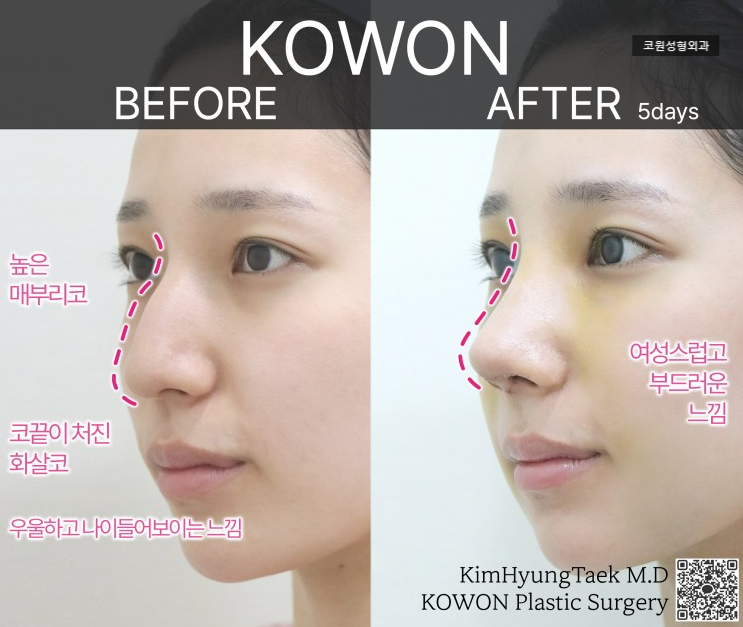
When planning hump nose surgery, the width of the nasal bridge viewed from a 45-degree angle is also an important consideration.
As in the reference case, when the bridge is wide and the nose looks large overall, simply lowering the protruding hump may not be sufficient. The bridge width may need to be narrowed through osteotomy, with the height adjusted to suit the face, for the line to flow more naturally.
“Will my nose look smaller if only the hump is shaved down?”
When I receive this question during consultations, I usually explain that the nose should be assessed from both the front and the side.
Even if the hump appears reduced from the side, the nose may still feel prominent if the bridge remains wide from the front. Conversely, narrowing it excessively can place a burden on the structures involved in breathing, so balance is necessary.
Some people with hump noses also report symptoms of rhinitis or nasal congestion.
If the internal structures of the nose are deviated or there is enlarged tissue, breathing may be uncomfortable regardless of the external appearance.
In such cases, the internal structures should be examined through CT imaging, and functional correction should also be planned when necessary.
When changing the shape of the nose, I do not consider function separately.
The nose is both an aesthetic structure at the center of the face and an organ used for breathing. This is why, even while refining the hump and narrowing the bridge, we check whether the internal space is being maintained in a stable condition.

Used with the model’s consent
[In Summary]
Understanding hump nose surgery solely as an operation that removes a large amount of protruding bone makes the approach overly simple.
In reality, a low hump accompanied by nostril exposure requires a completely different plan from a large, long hump nose with a wide nasal bridge. Even among people with hump noses, the key may be the balance between the tip and alar for some, while osteotomy and examination of the internal structures may be more important for others.
“Would a smooth line suit my face better, or would it be better to leave a slight amount of the hump?”
It is difficult to answer this question based on a single photograph.
Usually, we need to assess the length of the face, the angle from the forehead to the nasal bridge, the direction of the tip, the degree of prominence around the mouth, and the atmosphere the patient wants to create. In my experience, a natural result is not determined by one standard; it is created when multiple elements flow together without forcing them.
During consultations, I first consider “where the nasal bridge should flow naturally without looking awkward on this face,” rather than how much of the hump should be removed.
Some faces suit a smooth line, while others maintain a more comfortable original impression when a very subtle curve is left behind. If functional discomfort is also present, the external appearance and internal structures need to be assessed together rather than separately.
Nose surgery is not about reproducing a line exactly as it appears in a photograph. It is closer to finding an appropriate direction that does not look excessive within each person’s face.
I believe that through a thorough consultation, confirming the current structure and organizing the desired changes together with the image the patient wants to maintain can help create a line that is not excessive yet remains comfortable to look at over time.
Female Hump Nose Surgery
A post that may be helpful to read in connection with the above content is:
“Three Reasons to Consider a Female Hump Nose and a Bulbous Nose Together.”