Hello. This is Kowon Plastic Surgery.
In consultations, quite a few people say they are concerned not so much that their nose is low, but that it seems to lack presence within the face.
This is especially true with a bulbous nose, where the tip looks rounded and spread out. Simply raising the bridge does not immediately make the overall impression look more refined, so from the beginning, I tend to assess both the sense of central balance in the face and the direction of the nasal tip.
People usually say they want a natural-looking nose, but when we discuss it in more detail, many actually hope for a line that is not too plain while still blending naturally with the face rather than standing apart from it.
This is often described as a natural yet refined nose line. It is important to first examine whether structural refinement, including tip cartilage repositioning, is needed and whether the connection between the bridge and tip can be made sufficiently smooth.
"Would the bulbous appearance be reduced if I raised only the tip a little?"
This is also a common question in actual consultations.
In my view, it is important to consider not only the height of the tip but also its width, the degree to which the cartilage has splayed, skin thickness, the columella and nasolabial angle, and the three-dimensional presence the nose creates within the face. Looking at all of these factors together can lead to a result that is natural without appearing indistinct.
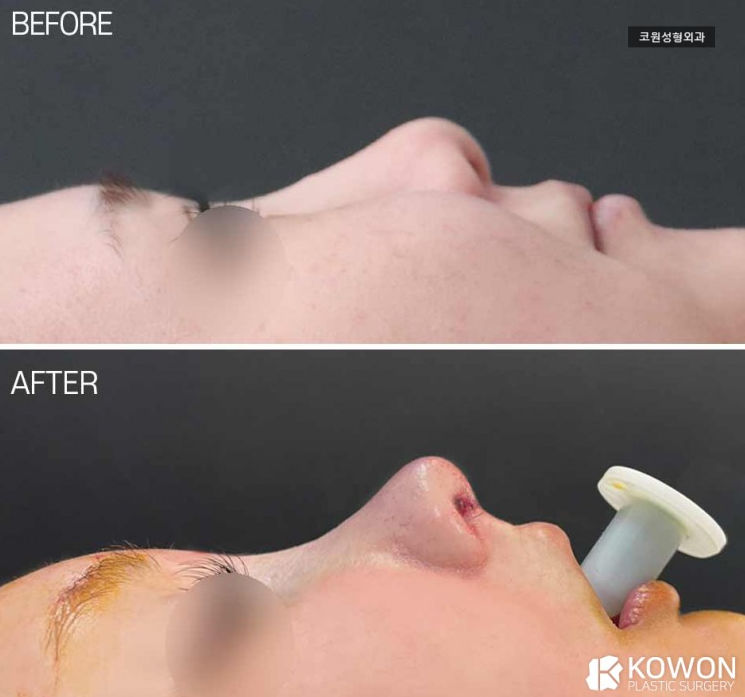
Used with the model's consent.
This case shows photographs taken immediately after surgery, when the direction of the structural changes to the tip and bridge could be seen relatively clearly, before swelling had fully set in.
Before surgery, the tip had a bulbous shape that looked rounded and spread out. The bridge and tip also lacked three-dimensional definition, giving the impression that the nose was somewhat lost within the face.
In such cases, a plan focused simply on raising the nose is not sufficient. In practice, it is necessary to consider the width and direction of the tip, the characteristic volume of a bulbous nose, the continuity from the bridge to the tip, and the three-dimensional definition the nose creates at the center of the face.
Approaching the procedure only by trying to make the nose excessively high can make the nose appear to project forward on its own or create a feeling that it does not harmonize with the overall mood of the face.
The surgical plan involved creating bridge height suited to the facial proportions. For the tip, we considered tip cartilage repositioning, tip cartilage suturing, refinement of the soft tissue at the tip, and the formation of a tip support using the patient's own cartilage.
The key was to balance the reduction of the tip's spread-out volume while avoiding an overly sharp appearance, so that it would look more refined and structurally defined.
We also focused on securing structural support between the tip cartilages to help reduce the tendency for the tip to spread out or become lower over time.
A bulbous nose is not resolved simply by reducing its width. It is important to bring the center of the tip together and create a flow that connects naturally with the bridge.
This is ultimately why tip cartilage repositioning may be needed: not to forcefully press down the shape of the tip, but to refine the splayed structure in accordance with the facial proportions.
With a bulbous nose, it is common for the skin to be thick and for there to be a substantial amount of soft tissue.
In such cases, rather than simply lifting the tip, the soft tissue needs to be appropriately refined and the tip needs to be stably supported so that its width can be adjusted more naturally.
In this case as well, the plan was to preserve the existing soft impression while bringing out the nose's sense of central balance and three-dimensional definition.
At the same time, we also considered the line extending through the columella, nasolabial angle, and philtrum.
I consider it important not only for the tip to look attractive, but also for the entire side profile to flow smoothly. For this reason, I adjusted the transition from the tip down toward the mouth so that it would not look awkward, designing it to give the impression of a more balanced facial center rather than simply making the nose look higher.
Source
https://kowonps.com/right-after-rhinoplasty/529?page=3
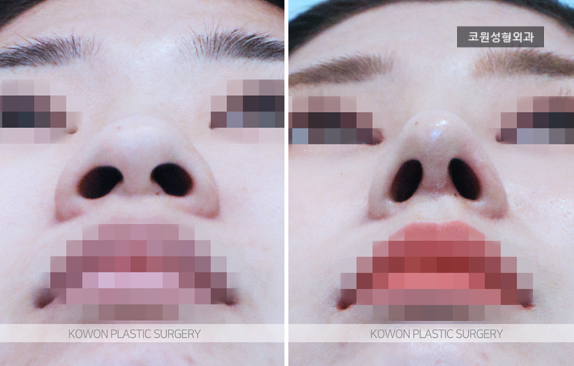
Used with the model's consent.
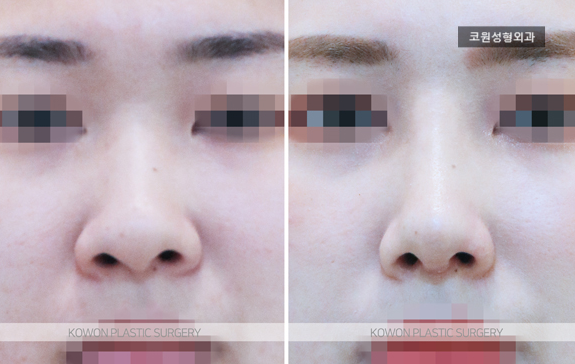
Used with the model's consent.
Introduction to a Reference Case
In another case involving a low, small bulbous nose that can be considered for comparison along similar lines, the key issue was that the tip cartilages had splayed outward on both sides.
When the nostrils appear to lie outward on both sides when viewed from below, it is first necessary to assess whether the splayed cartilages should be brought together and their direction corrected, rather than simply raising the tip.
"I only want a natural result. Will the tip become too pointed?"
This is something many people wonder about during their initial consultation.
People often assume that wanting a natural result means the tip must always be kept low. In reality, however, if the center of the tip is not well defined, the nose may still look blunt and wide even when it is low.
In such cases, tip cartilage repositioning can be used to refine the splayed structure. When appropriate, tip cartilage suturing can also be performed to establish the center of the tip while reducing an overly pronounced appearance.
The same principle applies when the three-dimensional definition at the center of the face is lacking, as in the reference case.
If the tip does not provide central balance within the face, the overall line may not look distinct even if the bridge is raised. In these cases, I first assess the direction in which the tip is spreading and how firmly the cartilage can provide support, rather than focusing only on the tip's height.
Source
https://kowonps.com/surgery-log/52?wvd=3

[In Closing]
A natural yet refined nose line is not simply a matter of choosing a midpoint between a dramatic and a natural appearance.
What I have come to feel through my practice is that it is important to first determine what role the nose should play at the center of the face.
For some people, more three-dimensional definition in the bridge is needed. For others, refining the spread of the tip is more important. In still other cases, the flow of the columella and nasolabial angle must also be adjusted for the overall impression to look balanced.
Ultimately, the key point of this surgical case log was not an excessively high change, but the process of allowing a nose that had seemed lost within the face to naturally establish central balance.
This approach can be an important option for refining the structure of the tip, but it is not applied to everyone in the same way or to the same extent. This is because skin thickness, cartilage strength, alar width, the axis of the bridge, and the desired image all differ from person to person.
In my experience, achieving a satisfying result in rhinoplasty does not begin by copying the line in a single photograph. It begins by finding the point at which the nose can look harmonious and natural on the individual's own face.
During consultations, I consider it important to listen carefully to the desired impression and explain together what is possible based on the actual structure, as well as the aspects that require caution.
For a change that is natural without being plain, and for a nose line that continues to harmonize comfortably with the face over time, a thorough consultation and assessment of the individual's condition should come first.
More Surgical Case Logs