
Hello, I am Kim Hyeong-taek, director of Kowon Plastic Surgery.
When discussing a dorsal hump, some people focus only on the protruding area in the middle of the nasal bridge. In reality, quite a few people also have a drooping nasal tip that makes the entire nose look longer.
This implant-free rhinoplasty case involved refining the hump along the nasal bridge while also adjusting the position and direction of the drooping tip. Many people assume that lowering only the hump will make the bridge look smooth, but if the tip continues to point downward, a long-nose appearance or a stronger-looking impression may remain.
“Could the nose look shorter if only the hump is refined?”
In my view, this question can only be answered by considering the curvature of the nasal bridge, the rotational direction of the tip, and the vertical proportions of the entire face together.
Therefore, before surgery, I first check how the length of the nose appears from the front, side, and 45-degree angles.
Used with the model’s consent
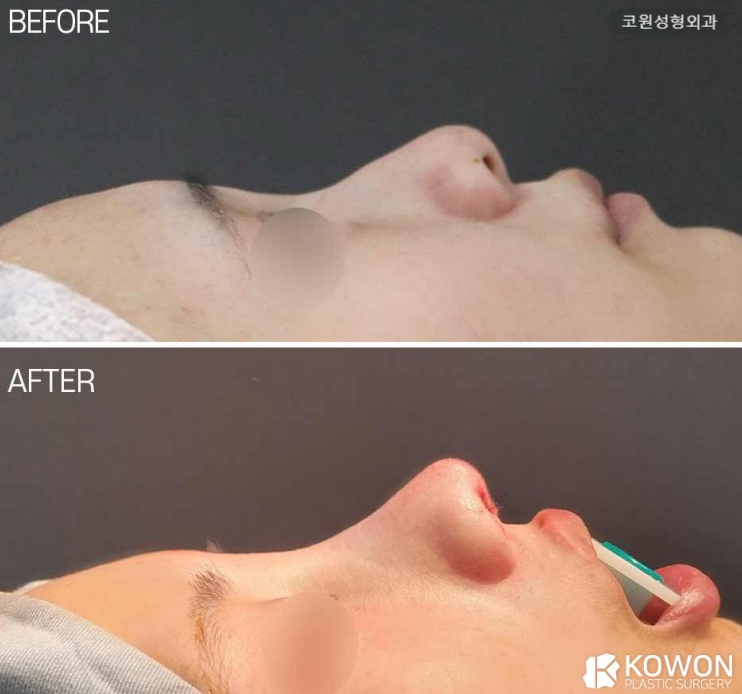
This patient had a clearly protruding hump in the middle of the nasal bridge, along with a drooping tip that made the nose look longer.
Overall, the patient’s expression looked somewhat downcast, and a stronger impression was more noticeable than a gentle facial atmosphere.
In such cases, it can be difficult to achieve the desired change by refining only the hump. During consultation, I consider not only how much to smooth the protruding area of the bridge, but also the position at which the tip should be stably maintained so that the facial proportions look natural.
During surgery, I first refined the uneven line of the nasal bridge so that it would connect smoothly.
Because the existing bridge already had a certain amount of height, the plan focused on preserving a natural height within a range that suited the face rather than adding excessive height.
Because this was a case involving a dorsal hump, the nasal bridge was relatively high, so the procedure was performed as implant-free rhinoplasty without using silicone. In practice, not using an implant does not automatically result in a low or flat line. How the existing structures are refined and connected is important.
For the tip, the downward direction was improved through repositioning and suturing of the tip cartilages. When a dorsal hump is present, the tip is often drooping as well, and the tendency for it to move downward again over time after surgery must also be considered.
For this reason, a supporting structure was created between the tip cartilages so that the tip could remain in a stable position. I do not view this simply as a process of raising the tip. I see it as a structural process that corrects the drooping direction, reduces the flow that made the nose look longer, and allows the bridge and tip to connect smoothly.
In particular, when a more feminine atmosphere is desired, it is important to leave a subtle curve in the flow from the bridge to the tip rather than creating only a strong, straight line.
In this case as well, the line was adjusted to create a natural yet refined impression rather than emphasizing it excessively.
Used with the model’s consent
[Reference Case Introduction]
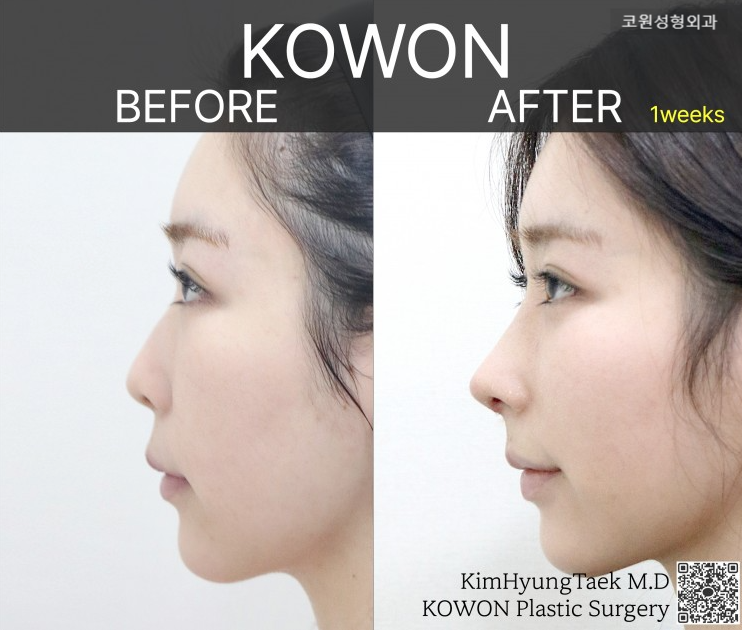
As in the previous surgical case, people with a dorsal hump often already have a certain amount of height in the nasal bridge. In the reference case, the possibility of using silicone was also explained during the initial consultation, but because the patient preferred to avoid an implant if possible, the plan focused on creating a natural line within the feasible range.
When considering implant-free rhinoplasty, the first things I check are the existing height of the nasal bridge and the thickness of the skin. Generally, the bridge needs to provide a certain amount of support for the line extending to the tip to look natural, and the tip’s changes tend to be expressed more clearly when the skin is not excessively thick.
“Can the nasal bridge connect smoothly without silicone?”
Rather than answering this question with an unconditional yes, I explain based on the current height of the bridge, the degree of hump protrusion, and the sense of continuity from the area between the eyes to the tip. As in the previous dorsal hump and long-nose case, if the bridge is already relatively high, smoothing the line while refining the protruding area may be a realistic option.
In the reference case, the nose was originally small and somewhat low, but the overall facial impression had the potential to benefit from a slightly more defined nose, improving the mature feel and three-dimensional appearance of the face. Even in such cases, it is important to first establish a range that suits the entire face rather than aiming for an excessively high line.

Used with the model’s consent
[The Director’s Note]
When a dorsal hump and a long-nose appearance occur together, it is difficult to create a surgical plan by looking at only one area. Reducing the bridge’s protrusion, raising the drooping tip, and softening the flow that makes the nose look long are all interconnected.
In my experience, people who want nasal surgery without an implant often place the greatest importance on a natural result.
However, “natural” does not mean that the change is minimal. It is closer to finding a stable direction that does not go beyond what is appropriate for the existing facial structure.
In consultations, some people first prefer an implant-free approach because they feel concerned about silicone, while others want to know what materials may be needed to achieve their desired height and line.
In these situations, rather than deciding on a specific method in advance, I first check the existing height of the bridge, the support of the tip, and the condition of the skin, and then explain the available options.
As in this surgical case, if the height of the bridge associated with the dorsal hump can be utilized and the tip can be structurally supported, a natural line can be planned without an implant.
However, the same approach is not suitable for everyone, so it is necessary to directly assess the condition rather than reaching a conclusion based only on photographs.
With nasal surgery, the direction of the change is often more important than its size.
Through a thorough consultation, checking the individual conditions of your nose and finding a line that suits the entire face rather than increasing the height excessively can lead to a much calmer and more natural-looking change when correcting a dorsal hump and long-nose appearance.