
Hello, I’m Director Kim Hyeong-taek.
When men visit for a consultation about an upturned or short nose, they are usually most concerned about how much of their nostrils can be seen from the front. However, on closer examination, several factors are often interconnected: the upward direction of the nasal tip, the short-looking length of the nose, and the broad appearance of the tip.
Correcting an upturned nose in male rhinoplasty cannot be assessed simply by lowering the nasal tip. When I conduct a consultation, I focus on whether the tip has sufficient support, whether the skin can accommodate the change, and whether the bridge and tip can connect naturally within the proportions of the entire face.
“Wouldn’t my nostrils be less visible if the tip were lowered just a little?”
In such cases, it is important to assess not only the angle but also the position of the tip cartilage and the supporting structure so that the result can be maintained more reliably.
In particular, men tend to have thicker, more elastic skin at the nasal tip. If only the direction is changed too forcefully, residual tension may pull the tip upward again.
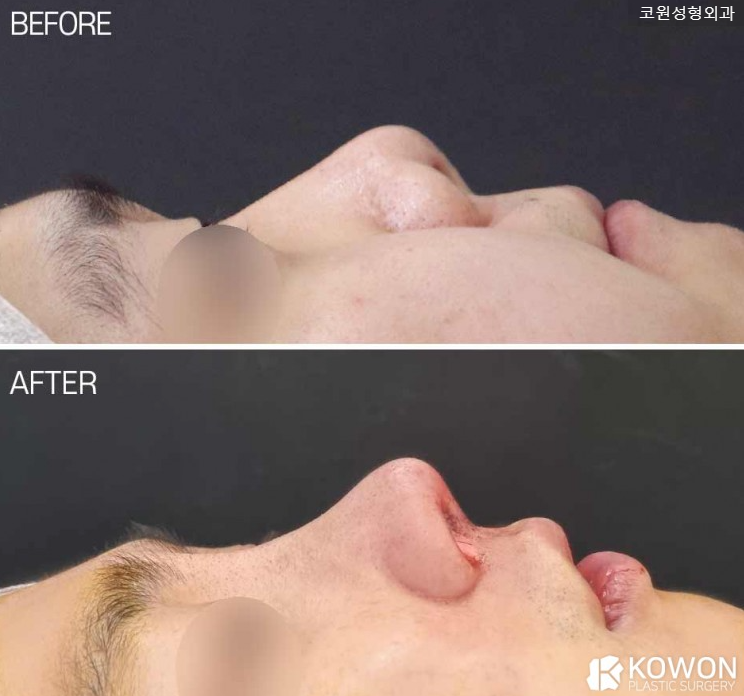
Used with the model’s consent
Male Rhinoplasty Before and After
In this surgical case, the nasal tip was turned upward, exposing the nostrils. The nose also appeared short, and the tip had a broad, bulbous appearance. Overall, the nose looked small and upturned, making the center of the face appear somewhat light. The patient was concerned that the appearance seemed somewhat weak rather than masculine.
In male rhinoplasty, this type of case is difficult to address sufficiently by simply lowering the nasal tip.
I plan the procedure by considering the length of the nose, the direction of the tip, and the shape of the broadened cartilage together, with the goal of balancing the overall proportions. Lowering only the upturned angle may appear to improve one aspect, but if the tip lacks support, it is also necessary to consider the possibility that the nose may look short again over time.
During surgery, the broadened tip was refined through repositioning and suturing of the tip cartilage. A support strut was also placed between the tip cartilages to reinforce the structure and help the tip remain stably directed downward. In this way, the elevated tip angle was lowered naturally while the short-looking length of the nose was supplemented.
In men, the skin is generally relatively thick and firm. When the nasal tip is lengthened and its direction is changed, the skin may not immediately adapt, and forces that pull the tip upward again may act on it. For this reason, the structure supporting the tip is important. When necessary, materials with sufficient strength and support, such as autologous rib cartilage, may be considered.
In this case, we also determined that the broadened tip would naturally come together during the process of lengthening it, and that the width of the alar base would be refined as well.
Therefore, a separate alar reduction procedure was not performed. Alar reduction can be helpful when necessary, but because it involves an incision, minor scarring or an awkward appearance when smiling must be considered. I therefore recommend it selectively and only when it is truly needed.
As a result, the focus was placed on first refining the overall structure, reducing the volume of the tip, and creating a balanced flow between the bridge and the tip. The procedure aimed to soften the small, upturned appearance of the male nose and create a calmer, more balanced impression.
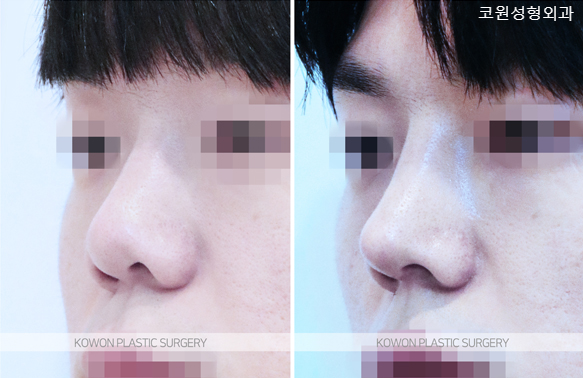
Used with the model’s consent
Male Rhinoplasty Before and After
[Introduction to a Reference Case]
In the reference case, the tip was distinctly short, so it was necessary to sufficiently lengthen it through a septal extension procedure. In such cases, creating an axis that can maintain the position of the tip is more important than simply making the tip appear to point downward.
Another aspect that must be assessed is changes in facial expression.
During the evaluation, the force pulling the nasal tip downward when smiling appeared strong. Because this movement was judged capable of affecting the position of the tip after surgery, depressor septi muscle removal was performed as well. In practice, planning based only on the appearance of the nose at rest can be insufficient, so I also examine its movement when the patient smiles and speaks.
In male rhinoplasty, skin thickness, the strength of the facial expression muscles, and the degree to which the tip cartilages have spread all work together. Therefore, the detailed plan is adjusted by securing the broadened tip with tip-cartilage suturing, using the septum as the main graft material, and supplementing it with a small amount of ear cartilage when needed.
“Won’t the nasal tip become upturned again after surgery?”
In such cases, it is necessary to predict not only the shape immediately after surgery but also the forces acting on the tip over time. Particularly when a short nose and an upturned nose occur together, the structure that supports the tip in its position is a more important criterion than the technique used to lower it.

Used with the model’s consent
[The Director’s Perspective]
Correcting an upturned or short nose in men is not merely a matter of the visible angle of the nasal tip. During consultations, attention is sometimes focused only on lowering the tip. In reality, however, the plan becomes clearer when the length of the nose, skin thickness, cartilage strength, and movement associated with facial expressions are all considered together.
When planning this type of surgery, I prioritize a structure that can be maintained without excessive strain over time rather than focusing first on dramatic changes. I believe it is more important to determine why the tip was upturned and what forces could pull it upward again than to focus on a temporary change in which the tip appears lowered.
The same applies to additional procedures such as alar reduction. They can certainly be helpful when needed, but if the width is likely to become more refined through tip lengthening and cartilage reshaping alone, I first assess and predict that change. Reducing unnecessary incisions and concentrating structural support where it is needed often leads to a more natural result.
Ultimately, a good consultation does not end with simply listening to the desired shape.
It is necessary to assess the nose’s current structure and skin conditions, as well as the proportions of the entire face, and then realistically determine the range of possible changes.
If you are concerned about an upturned or short nose, it would be advisable to discuss not only how much the tip should be lowered, but also what kind of structure can stabilize it in that position.
A post worth referring to in connection with the above:
“Why the Direction of the Nasal Tip Should Be Considered First When the Nostrils Are Highly Visible from the Front During Upturned Nose Surgery.”
#MaleRhinoplastyBeforeAndAfter