Hello, I am Dr. Hyung-taek Kim of Kowon Plastic Surgery.
The case I recently encountered involved a low, mildly hooked nose with a slight prominence in the middle of the nasal bridge, along with an upturned outer alar rim that caused excessive nostril exposure when viewed from the front.
This type differs from a typical upturned nose. Because the nasal alae themselves were curled upward and the outer nostrils were noticeably exposed, the nose tip tended to look short and somewhat awkward from the front.
Moreover, the overall nasal bridge was relatively low, which made the hump appear much more prominent. As a result, the nasal contour looked uneven and lacked three-dimensional definition.
Cases with these characteristics have clear limitations when approached simply by shaving down the hump, raising the tip, or narrowing the nostril width alone. The entire structure must be carefully addressed by examining the relationships among the nasal bridge, tip, alae, and nostrils.
At Kowon Plastic Surgery, we designed the hump area to be smoothly refined in proportion to the overall face, allowing the nasal bridge line to flow naturally. Rather than forcing the bridge to be excessively high, we adjusted it so that it would transition naturally into the nasal tip.
For the nasal tip procedure, the cartilage was gathered through cartilage repositioning and binding, then supplemented with the patient’s own cartilage to create an ideal sense of height. A firm supporting strut was placed between the structures to create a stable framework and help prevent the tip from collapsing over time.
In particular, when the outer alar rims are retracted and the nostrils are exposed as in this case, simply pulling the tip downward may not be sufficient. We therefore performed nostril-lowering as well, correcting the structure so that the lower alar line would settle naturally downward.
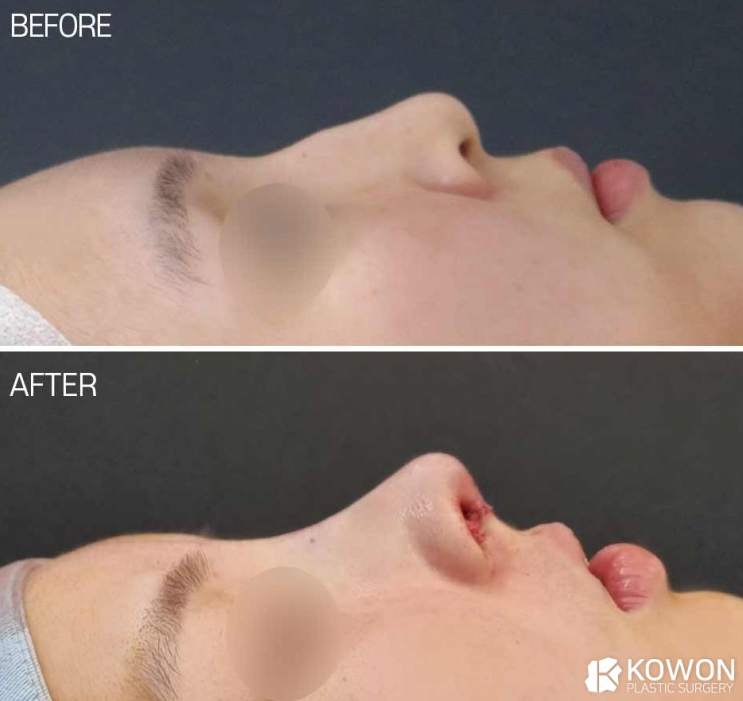
These before-and-after photos are used with the patient’s consent.
Nostril-lowering is not simply a procedure that covers the nostrils. It is a key step in finding the ideal proportion between the columella and nasal tip, reducing the degree of frontal nostril exposure, and creating a more balanced and refined appearance.
It is not enough to merely pull the alae downward. Separate cartilage tissue must be grafted and firmly secured so that the alae do not contract and retract upward again. Only then can a highly refined result be achieved.
We also carefully refined the columellar angle, nasolabial angle, and the curve leading toward the philtrum, guiding the transition from the nasal tip to the mouth to flow smoothly. As a result, the previously prominent mouth area appeared more settled, and the side profile was improved to look much more natural and sophisticated.
Recent trends focus not on making the nose unnecessarily high, but on creating a line that blends into the overall character of the face while preserving detailed aesthetics. In particular, cases involving an upturned nose or nostril exposure require especially thorough consideration of alar balance.
In this case as well, we avoided excessive changes and prioritized the individual’s character and harmony above all else. By incorporating Kowon Plastic Surgery’s precise expertise in nostril-lowering, we found the most natural and refined shape for the patient.
[Related Case Study]
I would like to introduce an actual improvement case related to raising the nasal bridge. The patient chose surgery for an upturned nose in order to define and refine the nasal bridge line and visited Kowon Plastic Surgery.
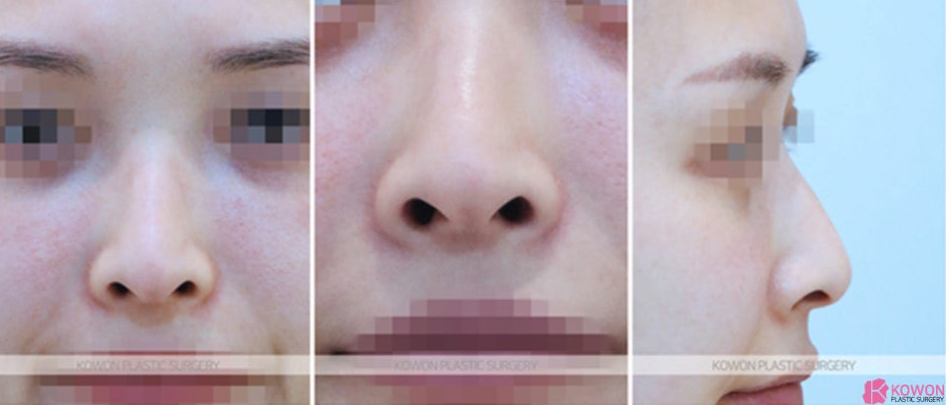
This preoperative photo is used with the patient’s consent.
A careful examination of the preoperative appearance from the front, bottom, and side showed a hump in the middle of the nasal dorsum. Although the overall nasal height was relatively adequate, the nasal dorsum had a narrow structure.
In particular, when viewed from the front, the nasal tip was slightly upturned, giving the impression that the nostrils were somewhat prominent.
A slight deviation of the centerline of the nasal bridge to one side was also observed. Some degree of asymmetry is common in the nasal bridge, but in this case it was more noticeable because it was accompanied by a hump. The nasal bridge was not extremely low even before surgery, but the narrow dorsum and somewhat depressed area between the eyes left room for improvement.
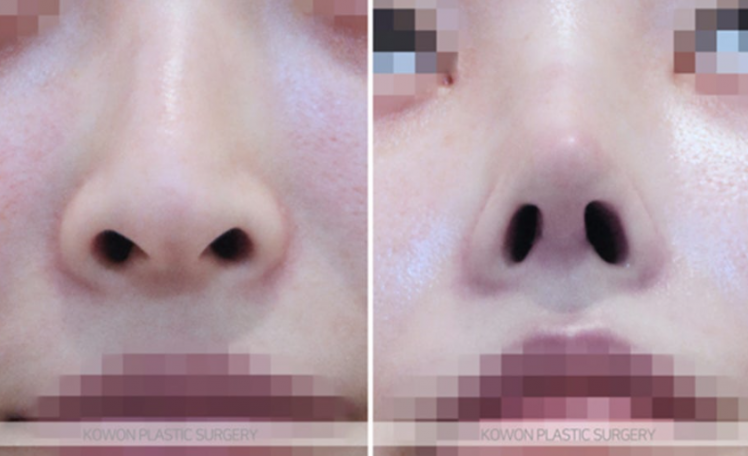
These before-and-after photos are used with the patient’s consent.
This patient had previously undergone procedures using filler and dissolvable threads. Therefore, for a more stable and refined nasal bridge augmentation, we decided to completely remove the existing filler and threads before proceeding with the upturned-nose surgery.
Accordingly, when raising the nasal bridge, we excluded excessive changes and focused on balancing the overall structure by using only a small amount of thin silicone. By reducing the burden associated with potential complications while improving stability, the nostril exposure that had spread outward gradually decreased over time, and the twisted appearance from the front was softened into a more comfortable and natural result.
[The Doctor’s Note]
As in this case, when a hooked nose, upturned nose, and nostril exposure occur together, it is difficult to achieve a satisfying result simply by raising the nose or applying a uniform technique. At Kowon Plastic Surgery, rather than pursuing excessive changes, we carefully analyze each person’s anatomical structure and alar balance, completing the most harmonious and natural-looking line through delicate nostril-lowering and customized design.

Focusing solely on each individual’s anatomical structure and balance,
we promise a natural appearance that remains unchanged over time.
We also take great care to correct previous procedures and even subtle asymmetries without overlooking any details, so that a more stable and refined appearance can be maintained over time. If you are curious about the ideal nasal harmony that best suits your face, please feel free to contact us at any time.