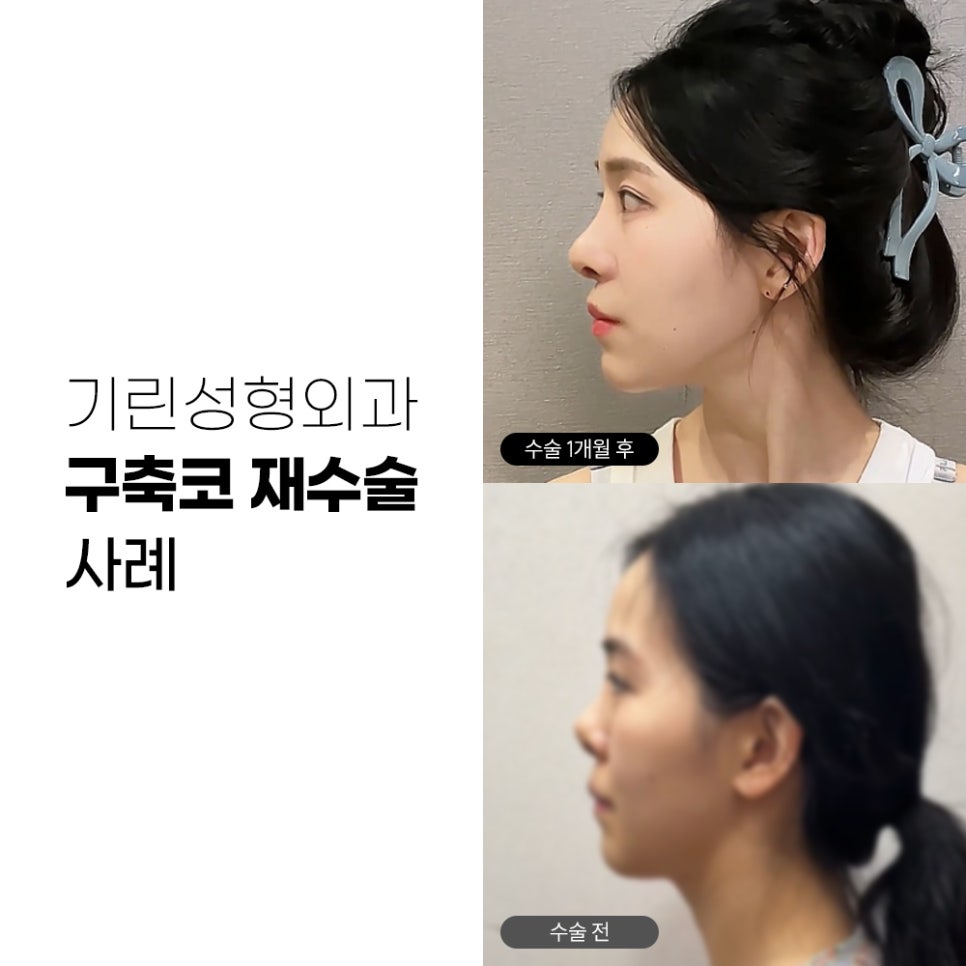
Before-and-after comparison of nose surgery at Girin Plastic Surgery
Girin Plastic Surgery
Is contracted nose surgery possible?
"I'm only in my early 20s, but I'm so stressed.
The nose is an area where many nerves pass through,
so it requires advanced surgical skill.
In the case of revision surgery,
we are dealing with a major goal:
healing the patient's mind as well.
Today, through the case of a patient who had nose surgery in their teens
but underwent revision surgery at Girin Plastic Surgery
because of severe deformity,
we would like to look at the importance of accurate diagnosis and surgical planning.
The silicone implant used to raise the bridge of the nose
is a material that is safe for the human body,
but depending on the surgical environment
or post-surgery lifestyle habits,
it can cause discomfort and become a factor in contraction, deformity, and visibility.
In particular, if removal is delayed after inflammation develops,
it can lead to an upturned nose or a short nose.
This patient had surgery 6 years ago,
but unfortunately developed contraction
and came to Girin Plastic Surgery.
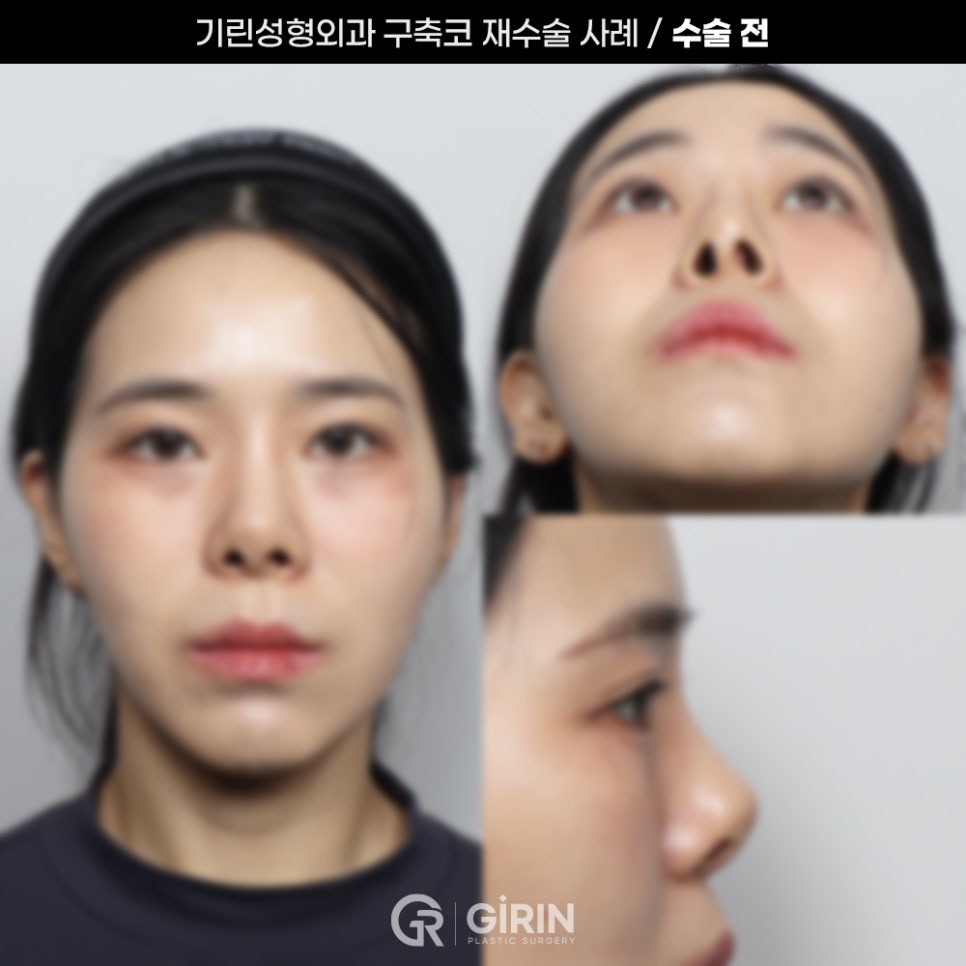
The patient's nose after deforming into an upturned shape
The woman in her 20s had already been feeling pain for 3 to 4 years,
and through a diagnosis at another hospital,
she learned that she had developed side effects after nose surgery.
She also said she heard many hurtful comments
because of the deformity in the center of her face.
"All I can see is your nose."
"Didn't your nose surgery fail?"
"Your nostrils are different sizes," and so on.
Repeated remarks from people around her caused extreme stress.
(I could not even imagine how deeply hurt she must have been
by hearing such things from people around her,
when she herself already knew better and was struggling.
It was truly heartbreaking.)
However, fear of revision surgery failure,
concerns about choosing a hospital,
and the burden of cost delayed the process,
and during that time the upturn at the tip became worse,
especially with the columellar axis becoming severely twisted.
The patient said that when viewed from the front,
she wanted her nostrils to be as invisible as possible.
Nostril exposure is a classic symptom of contraction.
After nose surgery, cartilage, skin, fascia, and other tissues
can go through inflammation, infection, and absorption-related complications,
which pull the nose upward and shorten its length.
Girin Plastic Surgery
What tests are performed before nose surgery?
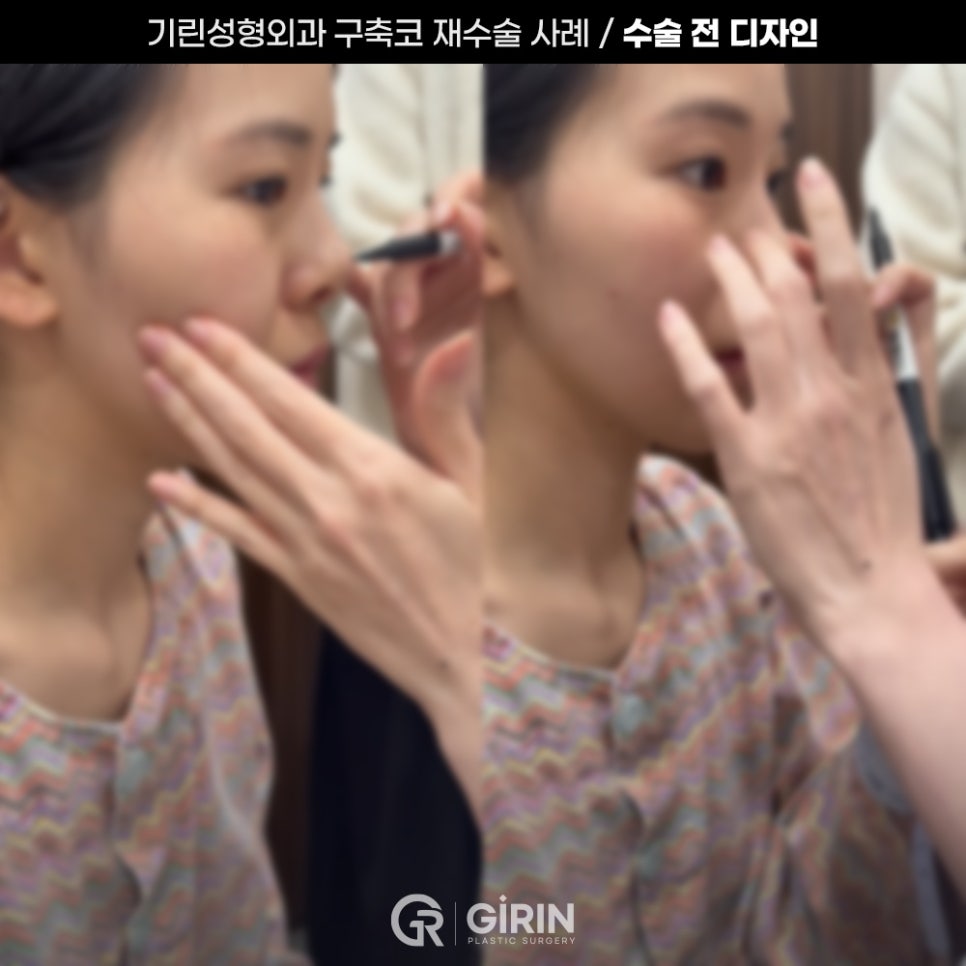
Before revision surgery, the plan is made based on analysis results and sufficient discussion with the patient
Basic problem analysis
Using a 3D CT scan dedicated to facial bones,
we accurately diagnosed the shape of the nose
and analyzed the anatomical structure inside the nose.
In addition, we first checked for nasal conditions such as a deviated septum and sinusitis.
The patient had previously undergone surgery 6 years ago,
with silicone used for the bridge and ear cartilage used for the tip.
She had both causes of tip upturning at the same time.
Nasal contraction not only causes external deformity,
but can also affect the internal cartilage,
leading to problems with nasal function.
The CT scan showed that the skin and soft tissue were severely adherent,
and that the support structure needed to fix the nasal tip
was damaged, with the septal cartilage greatly bent.
Revision surgery plan
For now, the implant and the silicone capsule had to be removed,
and the hardened tissue caused by contraction had to be released.
The septal cartilage also needed lengthening and reconstruction using autologous rib cartilage.
A dramatic improvement was judged to be too difficult in the current condition.
If the three-dimensional effect is increased,
the twisted axis becomes more noticeable,
and if it is raised too aggressively,
the already thinned nasal tip skin may not be able to withstand it,
which could cause contraction again.
Even when autologous dermis is used,
considering the possibility of absorption,
the surgery was performed with the goal of preventing the tip from turning up
and achieving the most natural result possible.
Girin Plastic Surgery nose reconstruction case details
- Performed with an open approach
- Removal of the existing silicone implant
- Slimming the nose through alar reduction
- Lowering the tip while releasing the contraction, using ear cartilage for the tip
- Autologous rib cartilage used
*Rib cartilage is autologous cartilage that can serve as a strong support structure
and helps reconstruct the bridge of the nose.
Because there is an abundant amount of cartilage,
it has the advantage of being usable for both the nasal tip and the bridge.
Before-and-after comparison and results
(one week, one month)
Because this was a nose surgery undertaken again with great determination,
and because good material was obtained through autologous cartilage,
it had to be used properly to produce a good result.
To minimize scarring at the donor site,
the incision was kept small,
and the suturing and other steps were carried out carefully.
The hardened cartilage, mucosa,
and skin of the nose were all lengthened.
The adherent soft tissues were released and dissected,
and the surrounding scar tissue was handled delicately.
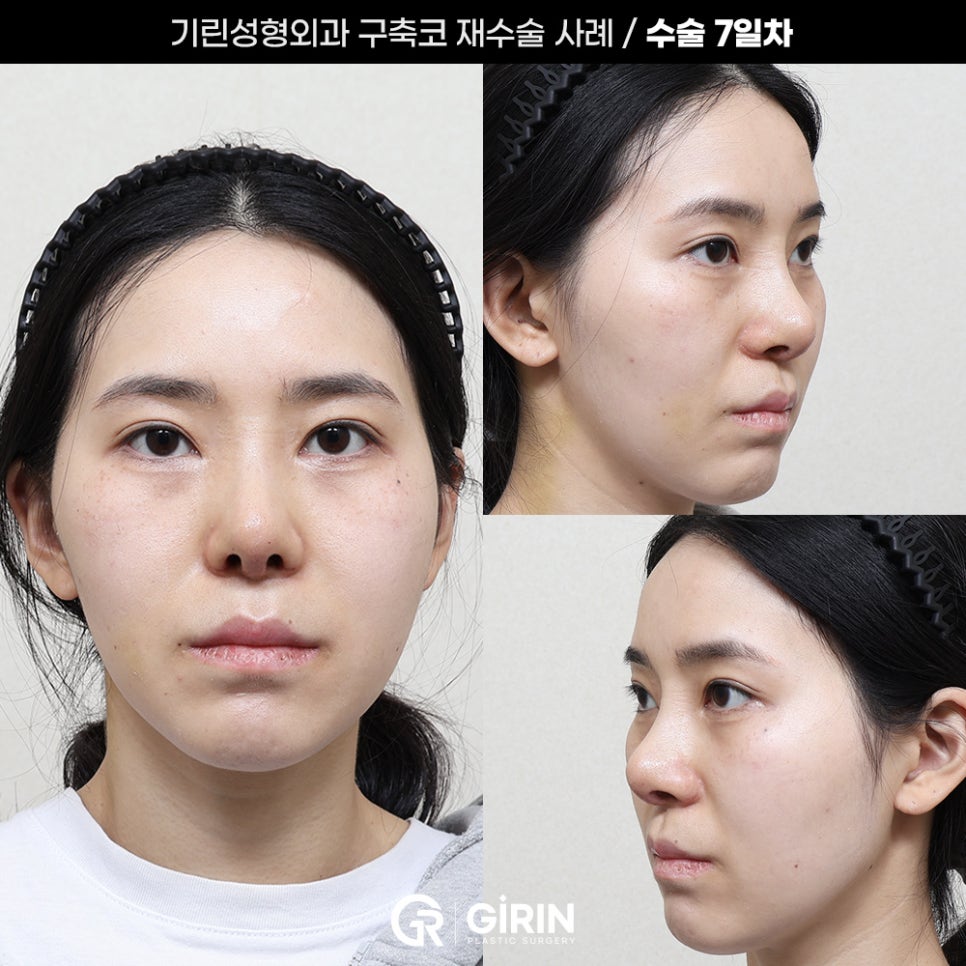
The appearance immediately after removing the splint one week after surgery
This is the condition one week after surgery, when the patient visited to have the splint removed.
There is still swelling,
but the length of the nose has increased a lot,
and the tip has extended naturally.
The symptom in which the nostrils were exposed vertically from the front,
which the patient considered her biggest complex,
has improved.
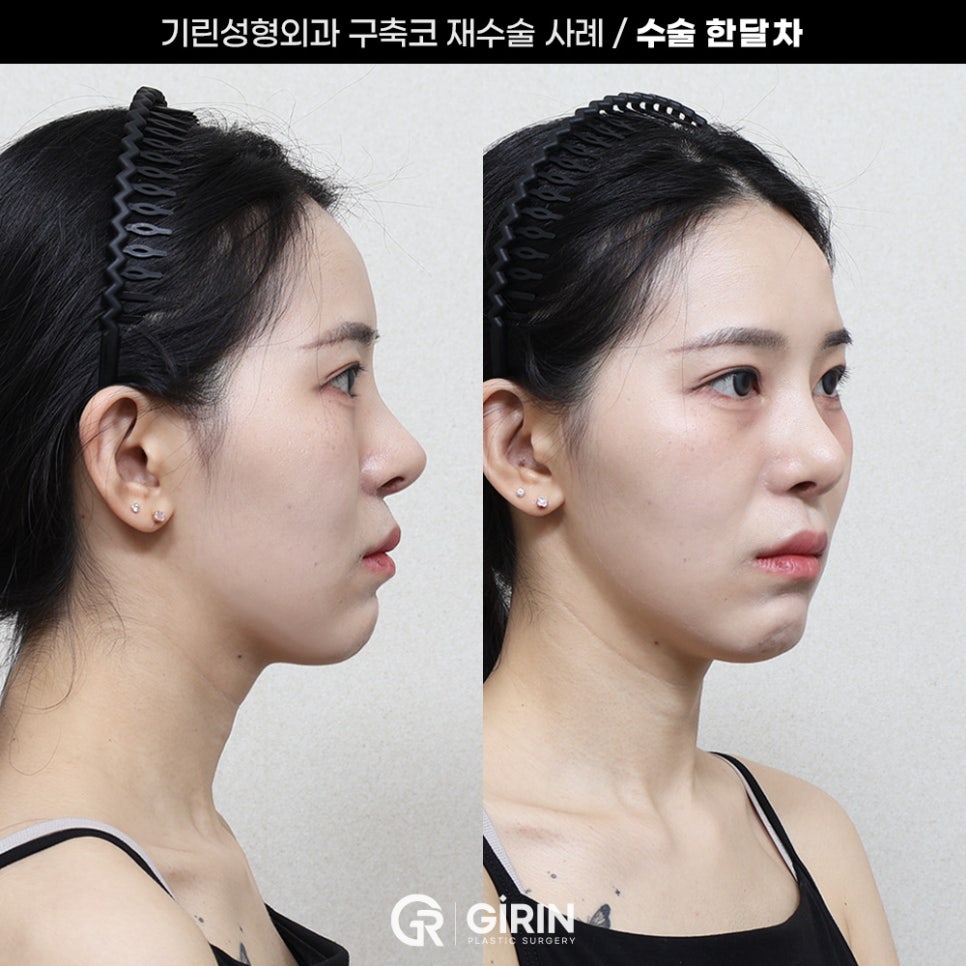
The appearance one month after nose surgery at Girin Plastic Surgery
This is the appearance when the patient visited Girin Plastic Surgery one month after surgery for follow-up.
Compared with week one, the swelling has gone down significantly.
The swelling around the eyes has also subsided, giving a clearer impression.
What are the precautions after nose surgery?
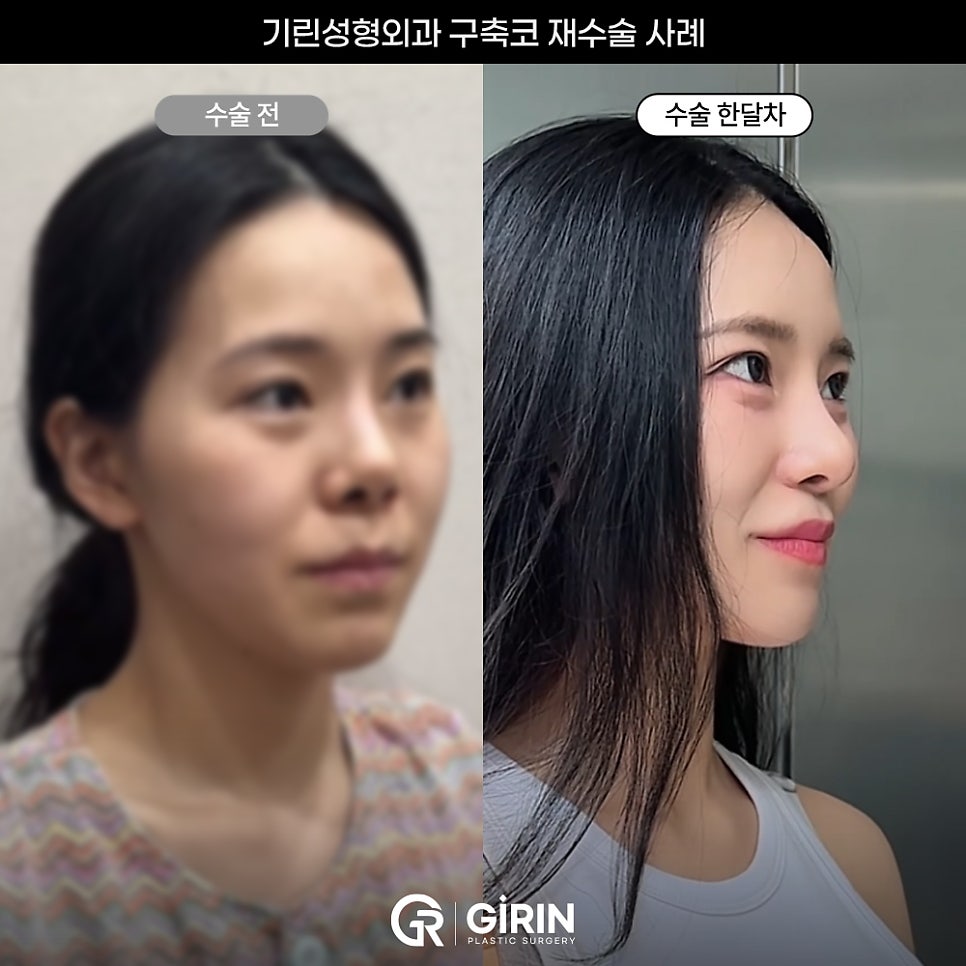
A natural smile and confidence that show the patient's changed appearance
Because the nose is an area with many nerves,
you should not habitually touch your nose or the inside of your nose.
In particular, inflammation must be avoided,
and blowing your nose is also prohibited.
In addition, actions that put pressure on the outside of the nose
should also be avoided.
In particular, peel-off nose packs may alter the shape of the nose,
so caution is needed.
For up to 3 months, the nose may feel firm,
and this is a period when scarring does not improve easily.
The bridge of the nose may seem to settle quickly,
but the tip is an area where swelling goes down more slowly,
so for one month you should avoid drinking alcohol, smoking, strenuous exercise, and saunas.
Smoking is especially very bad.
Also, until everything settles, it is better to sleep facing upward.
How can nose surgery be performed safely?
- The most important point
is to prioritize the functional aspects of the nose.
Surgery that places too much strain on the structure,
such as using too much septal cartilage to raise the nose,
can ultimately cause side effects such as bending and nasal congestion.
- Depending on your own goals for change,
you should be able to choose between open and closed approaches.
This means that when you fully understand the data from CT scans,
consultation with a specialist, and the changes you want,
you can decide which surgical method is appropriate,
leading to a safer, wiser choice and the result that follows.
- Choose a specialist who performs surgery that matches your individual facial proportions and image.
Girin Plastic Surgery performs "image-based plastic surgery,"
correcting the height of the nasal bridge and tip while considering each person's soft tissue thickness and fat.
It also creates symptom-specific plans to reduce the risk of revision surgery.

You can see that the tip has become longer in the upturned, short-nose condition.
We end this post with a photo showing the patient's confident appearance.
Thank you for reading this long post.
Girin Plastic Surgery aims for safe surgery and beautiful results based on accurate diagnosis,
from first-time nose surgery to revision surgery and high-difficulty reconstructive surgery.
We provide customized procedures such as
△ premium implants
△ alar reduction
△ cleft lip and palate nose surgery
△ functional rhinoplasty
△ Jelly Nose (natural cartilage injection)
and more.