
Hyperbaric oxygen therapy helps improve the recovery environment by supplying enough oxygen to tissues after surgery.
A procedure, or even surgery, can be said to have reached its “final result” only when recovery management is also complete. In this sense, hyperbaric oxygen therapy is drawing attention as a way to design better outcomes because it helps damaged tissue receive enough oxygen and recover more quickly. Hyperbaric oxygen chambers are often used by athletes to quickly remove fatigue-causing substances and waste products such as reactive oxygen species and lactic acid. Here, we have summarized the principle of how the body recovers when entering one of these chambers.
The Concept of Hyperbaric Oxygen Therapy

Hyperbaric oxygen therapy, performed in a 3-atmosphere environment, works differently from ordinary oxygen supply.
Does breathing more oxygen speed up recovery? The answer, to begin with, is no. Then why is hyperbaric oxygen therapy recommended? Because hyperbaric oxygen therapy is not a treatment that increases the amount of oxygen; it focuses on changing the body’s oxygen environment.
Hyperbaric oxygen therapy supplies 100% oxygen to the entire body, inducing a state in which far more oxygen is present in the body than usual. Normally, at 1 atmosphere, even when we breathe, oxygen is carried by red blood cells. There is a limit to this amount.
Hyperbaric oxygen therapy supplies 100% oxygen in a high-pressure environment of 2 to 3 atmospheres, inducing a high-oxygen state in the body. In this process, oxygen does not bind only to hemoglobin; it also dissolves directly into the liquid component of blood, the “plasma.” As a result, the body becomes more saturated with oxygen. In this sense, hyperbaric oxygen therapy is a treatment that changes not the amount of oxygen alone, but the body’s oxygen environment and delivery method itself.
Why Is “High” Pressure Important?

According to Henry’s law, the higher the pressure, the greater the amount of oxygen dissolved in the blood.
This is due to Henry’s law. It is the principle that the higher the pressure, the more gas dissolves in a liquid. You can think of cola or carbonated drinks. When the lid has not been opened, a large amount of carbon dioxide in gaseous form is dissolved in the water, but when the lid is removed, the pressure drops and the gas escapes—what we commonly call “going flat” is exactly due to Henry’s law.
Applied to the human body, the amount of oxygen dissolved in the plasma of the blood increases significantly. Hyperbaric oxygen therapy uses this principle to dissolve much more oxygen into the blood than usual so that it can be delivered deep into oxygen-requiring tissues.
Why is it important for oxygen to dissolve deeply into the plasma? Because the places oxygen actually needs to reach are not only large blood vessels, but also capillaries and the delicate tissues around them.

In a high-pressure environment, oxygen dissolves directly into the plasma and is delivered to deeper tissues.
Ordinary oxygen transport is centered on red blood cells carrying hemoglobin. However, red blood cells have a structural size, and in environments with poor microcirculation, oxygen delivery efficiency may be insufficient. On the other hand, the more oxygen dissolves in plasma, the more easily it can diffuse in smaller units, making it advantageous for reaching relatively deep and narrow areas.
This is exactly what connects to “recovery” after plastic surgery. After surgery, various responses occur within the skin, including △microedema △reduced blood flow △inflammatory reactions. For this reason, simply having oxygen present in the blood vessels may not be enough. For rapid recovery, oxygen must reach the tissues that actually need repair, and hyperbaric oxygen therapy helps compensate through its plasma oxygen delivery system.
In conclusion, rather than saying hyperbaric oxygen simply increases oxygen, it is more accurate to understand it as increasing the likelihood that oxygen can reach each tissue, such as the skin, fat layer, and ischemic areas.
Changes at the Cellular Level
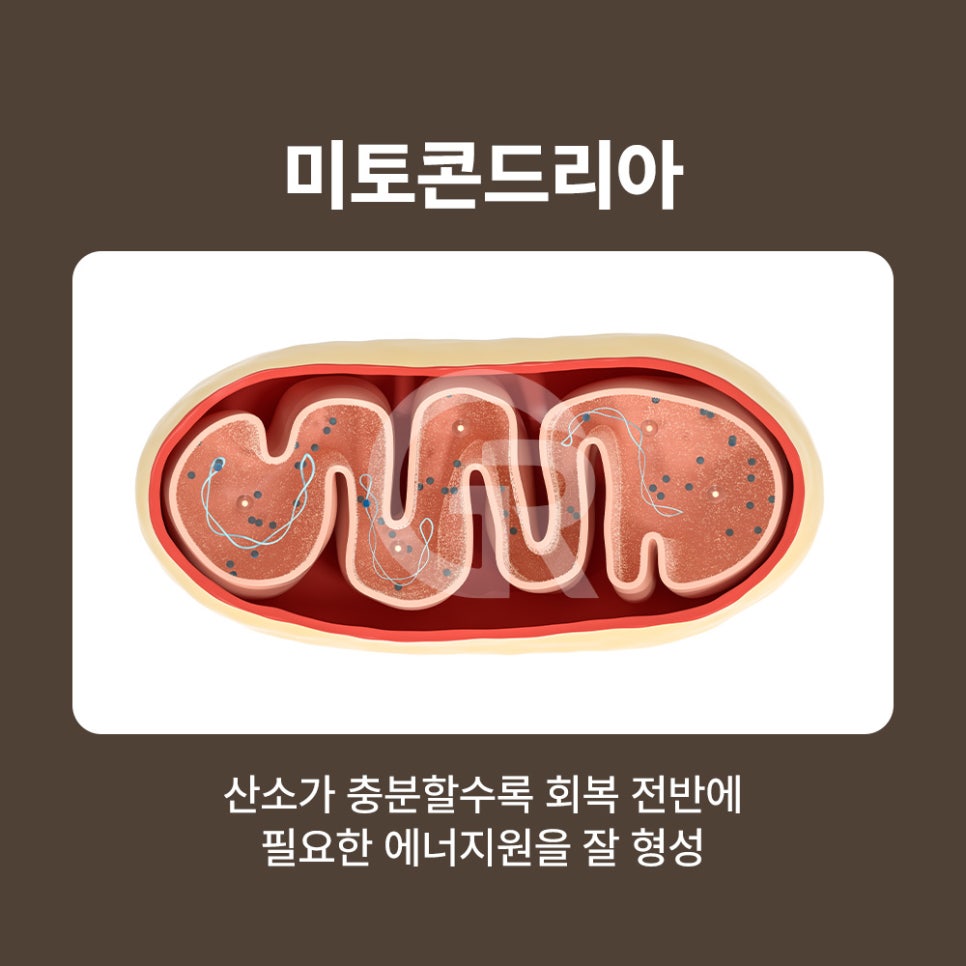
Mitochondrial activation and increased ATP production improve the cellular recovery environment.
Under the 1-atmosphere conditions in which we normally breathe, the amount of oxygen dissolved in the blood is small. The most widely used hyperbaric oxygen therapy devices operate at around “2 atmospheres.” When pressure is increased from 1 to 2 atmospheres, the amount of dissolved oxygen in plasma increases by about 14.7 times. In fact, this alone can already greatly help recovery after surgery or procedures. In a 3-atmosphere environment, the difference becomes even more dramatic. At 3 atmospheres, the amount of dissolved oxygen in plasma increases up to 22.7 times, allowing oxygen to be delivered much more deeply and powerfully throughout the body.
When enough oxygen is supplied to the body, cells can produce energy more efficiently, and the “mitochondria” play a key role. Mitochondria, known as the cell’s energy factories, actively produce ATP when oxygen is sufficient. ATP is the energy source needed across recovery processes such as △wound healing △cell regeneration △protein synthesis △inflammation control, so an increase in ATP means a stronger foundation for tissue recovery.
Therefore, saying that hyperbaric oxygen therapy helps rapid recovery is, more precisely, saying that it creates an environment in which cells can produce the energy needed for recovery more efficiently. In other words, it can be defined as a treatment that changes the foundation and environment so that cells can better perform the work required for recovery and regeneration.
When you understand this mechanism, you can see that hyperbaric oxygen therapy is more than simple “management”; it is a reorganization of the system. In addition, when oxygen concentration increases, regenerative responses such as △collagen production △immune function enhancement △angiogenesis are also activated. This reduces unnecessary fluid movement, thereby decreasing swelling, and helps improve the quality of recovery by maintaining oxygen while reducing puffiness.
The Effects of Hyperbaric Oxygen Therapy

Tissues with insufficient oxygen supply after surgery may recover more slowly.
-
Hyperbaric oxygen therapy is effective for post-surgical recovery and tissue regeneration. After surgery, tissues are temporarily damaged and blood flow decreases, resulting in insufficient oxygen supply. This can slow recovery and cause swelling and bruising to persist. In such situations, hyperbaric oxygen therapy increases the oxygen supplied to tissues and may help improve graft survival in cases where tissue or cells need to survive, such as △fat grafting △skin grafting △stem cell therapy.
-
If blood flow is insufficient after plastic surgery, an “ischemic state” can progress, increasing the risk that tissue may advance to necrosis. In this case, hyperbaric oxygen therapy can help lower the risk of necrosis by supplying oxygen to such tissues through oxygen dissolved in plasma.
-
During the treatment process, when oxygen concentration in the body increases, various biochemical reactions are activated, including the generation of reactive oxygen species (ROS) and reactive nitrogen species (RNS). An important concept here is the “variability of oxygen concentration.” When oxygen concentration rises, the body does not simply perceive it as an increase in oxygen; rather, it receives it as a signal similar to a hypoxic state.
To defend against this, cellular signaling is promoted, and in this process gene expression changes, stem cells are activated, new blood vessels are formed, and damaged regeneration is promoted. Along with this, white blood cells and oxidative bactericidal function are strengthened, increasing resistance to infection. In other words, it switches cells into regeneration mode.

Hyperbaric oxygen therapy promotes collagen production and angiogenesis, helping tissue regeneration.
-
After surgery or tissue damage, a phenomenon called “reperfusion injury” may occur. This refers to cases in which tissue is instead damaged during the process of blood flow being restored. Hyperbaric oxygen therapy helps minimize tissue damage in this process by suppressing excessive adhesion of white blood cells to vessel walls and regulating oxidative stress.
-
Entering a hyperbaric oxygen chamber creates a recovery environment that maintains oxygen supply while reducing swelling. The reason swelling occurs after surgery is not because the tissue itself swells, but because blood vessels dilate, fluid escapes into the tissue, and inflammatory responses occur together.
At this time, when internal tissue pressure increases, blood flow decreases further, and as a result oxygen supply becomes insufficient, which can delay recovery and cause pain. Hyperbaric oxygen changes this flow and helps reduce edema and pressure within the tissue.
The important point is that even if blood vessels constrict, the amount of oxygen dissolved in plasma increases, so the oxygen supplied to tissues is still sufficiently maintained.
Is Hyperbaric Oxygen Therapy Effective for Antioxidation?

Vasoconstriction and increased oxygen supply occur at the same time, producing a swelling-reducing effect.
In our bodies, “reactive oxygen species” are generated during the process of producing energy and carrying out various metabolic functions. Reactive oxygen species are necessary at certain levels, but if present in excess, they can oxidize cells and cause aging or tissue damage. Therefore, the body has a system to remove them and regulate them.
When you receive treatment in a hyperbaric oxygen chamber, a higher-than-normal concentration of oxygen enters the body, temporarily increasing reactive oxygen species. When reactive oxygen species increase, the body responds by producing more antioxidant substances called scavengers to defend against them. These antioxidant substances move throughout the body and remove reactive oxygen species that have accumulated excessively.
In other words, this can be seen as a process that temporarily increases reactive oxygen species and induces the body’s antioxidant system to work more strongly. As a result, the body’s overall antioxidant balance is restored, which may help reduce cellular damage and improve the recovery environment. However, the effect may vary depending on the individual’s condition and the purpose of treatment, so rather than concluding that it is solely for antioxidant effects, it is more appropriate to understand it as part of the process that helps recovery and regeneration.

Frequently Asked Questions
Q. What should I be careful about after hyperbaric oxygen therapy?
A. After treatment, it is best to avoid activities that generate heat in the body, such as saunas, Korean steam rooms, weight training, and aerobic exercise.
Q. Can I receive hyperbaric oxygen therapy while undergoing stem cell treatment?
A. Yes. Hyperbaric oxygen therapy promotes stem cell responses, so it is effective for tissue regeneration. According to one study, the “telomere,” the protective cap attached to genes, shortens with age, but with consistent hyperbaric oxygen therapy, it is known to help extend it by making it longer again.
Q. Does hyperbaric oxygen therapy affect the skin as well?
A. Yes. By promoting collagen production, it can be expected to increase skin elasticity, improve wrinkles, and have anti-aging effects, and it is also a treatment that promotes regeneration and recovery of damaged tissue.

Hyperbaric oxygen therapy may contribute to maintaining balance in the body by stimulating the antioxidant system.
Hyperbaric oxygen therapy is not a miracle treatment that solves everything. However, it helps ensure that the results of surgery do not end in the operating room, but continue into the stable recovery of tissues afterward. Giraffe Plastic Surgery will not hesitate to design and implement recovery systems at any time through its new equipment in order to strengthen recovery and ultimately take responsibility for the results all the way through. Small differences can create major differences in outcomes.