
A natural facial lift focuses not on creating an overly pulled look, but on refining an appearance that looked tired and sagging.
A nasolabial fold is simply a single line of wrinkle that runs from the side of the nose to the corner of the mouth, but when it becomes deep, it can make the face look older and become a troublesome concern for many people. In fact, nasolabial folds are one of the signs of aging that can significantly change the overall impression of the face. In the consultation room, the concerns patients most often express are things like, “I look tired even when I’m not smiling,” “My cheeks seem to be collapsing downward,” “The corners of my mouth look sagging, so my expression seems depressed,” and “My nasolabial folds make me look much older.”
Do nasolabial folds appear as people age?
Nasolabial folds that develop later in life due to acquired rather than structural causes are not just a surface skin issue, but the result of several factors working together: △ descent of the mid-cheek fat layer △ reduced skin elasticity △ weakening of retaining ligaments △ facial movement △ skeletal changes due to bone resorption. As nasolabial folds deepen, the marionette lines below them also descend, making the jawline less defined. For this reason, when the midface and lower face sag at the same time, simply filling the nasolabial folds often has limitations.
If filler or fat grafting alone is not enough?
Many people think of filler first when they notice nasolabial folds. In fact, if the main cause of the nasolabial folds is volume loss, filler or fat grafting can help. When the mid-cheek is hollow and the nasolabial area is sunken, creating shadows, simply restoring the missing volume can soften the expression.
However, if the cause of the nasolabial folds is not a “sunken line” but the “boundary of descended cheek tissue,” a different approach is needed. When cheek tissue moves downward and creates a fold between the side of the nose and the mouth area, placing a large amount of filler only in the nasolabial area can actually make the face look puffy or the area around the mouth look heavy. That is why, in treating nasolabial folds, the cause must be identified first. The treatment direction changes depending on whether the issue is simple volume loss, reduced skin elasticity, or sagging of the midface and perioral tissue.
What are the main causes of deeper nasolabial folds?

If you are concerned about deep nasolabial folds and marionette lines, it is helpful to receive counseling based on the entire facial structure rather than a single procedure.
The first major cause of deeper nasolabial folds is changes in midface volume and fat tissue. When we are young, the fat layer beneath the cheekbone and in the front cheek area is relatively higher and supports the center of the face. Over time, however, the deep fat layer atrophies or shifts downward, and the superficial fat is redistributed around areas where folding occurs, making the nasolabial folds more pronounced.
Second, reduced elasticity in the skin and dermis. When the skin becomes thinner and the supporting strength of collagen and elastin weakens, fold marks remain visible longer even with the same facial movement. △ UV exposure △ smoking △ extreme dieting △ lack of sleep △ chronic stress △ alcohol consumption can accelerate the loss of skin elasticity.
Third, weakening of the retaining ligaments and SMAS layer. When the deep support structures of the face become weaker, the cheek and perioral tissue descend. However, the nasolabial fold area is anatomically relatively firmly fixed, so the descended tissue catches on that boundary and the fold appears deeper. In such cases, the nasolabial fold is not just a line, but closer to a structural fold created by sagging tissue.
Fourth, skeletal changes and changes in the structures around the nose. Because the nasolabial fold begins beside the nose, the overall impression is also affected by the connection between the tip of the nose, the columella, the nasal bridge, and the glabella. Excessive rhinoplasty, or contracture caused by a past nose surgery, can weaken the surrounding skin and affect the nasolabial folds.
When nasolabial folds and marionette lines appear together, what approach is needed?
When nasolabial folds and marionette lines are both deep, it is necessary to assess not only the folds beside the nose, but also the overall sagging around the mouth. Marionette lines are wrinkles that run downward below the corners of the mouth and are closely related to lower-face sagging. When these lines are present together, the face can look tired, depressed, or noticeably older than it really is.
At this point, the important thing is not to pull the skin down strongly no matter what. △ In which direction the sagging tissue has moved △ how much the front cheek and perioral tissue have shifted △ how much the jawline has collapsed △ how much skin elasticity remains all need to be considered together. When tissue sagging is pronounced, surgical lifting such as a mini facelift can be considered to reposition the lower cheek and perioral tissue.
How can a mini facelift help improve deep nasolabial folds?

A mini facelift is one of the surgical methods used to reposition sagging cheeks, deep nasolabial folds, perioral tissue, and under-eye sagging within a limited area.
A mini facelift is not a procedure that pulls the entire face excessively; its purpose is to organize sagging tissue within the necessary range and reduce heaviness in the perioral area and lower face. In particular, when nasolabial folds and marionette lines appear together, it can help achieve a more natural improvement by properly repositioning the sagging cheek tissue and the tissue around the mouth in the appropriate direction.
However, not all nasolabial folds require a mini facelift. If skin elasticity is relatively good and volume loss is the main cause, filler, fat grafting, skin boosters, or laser lifting may be more appropriate. On the other hand, if cheek tissue has descended and the nasolabial folds and marionette lines have both become deeper, a surgical lift may be a more fundamental option than a simple injection procedure.
A real patient case that improved deep nasolabial folds and a contracted nose at the same time
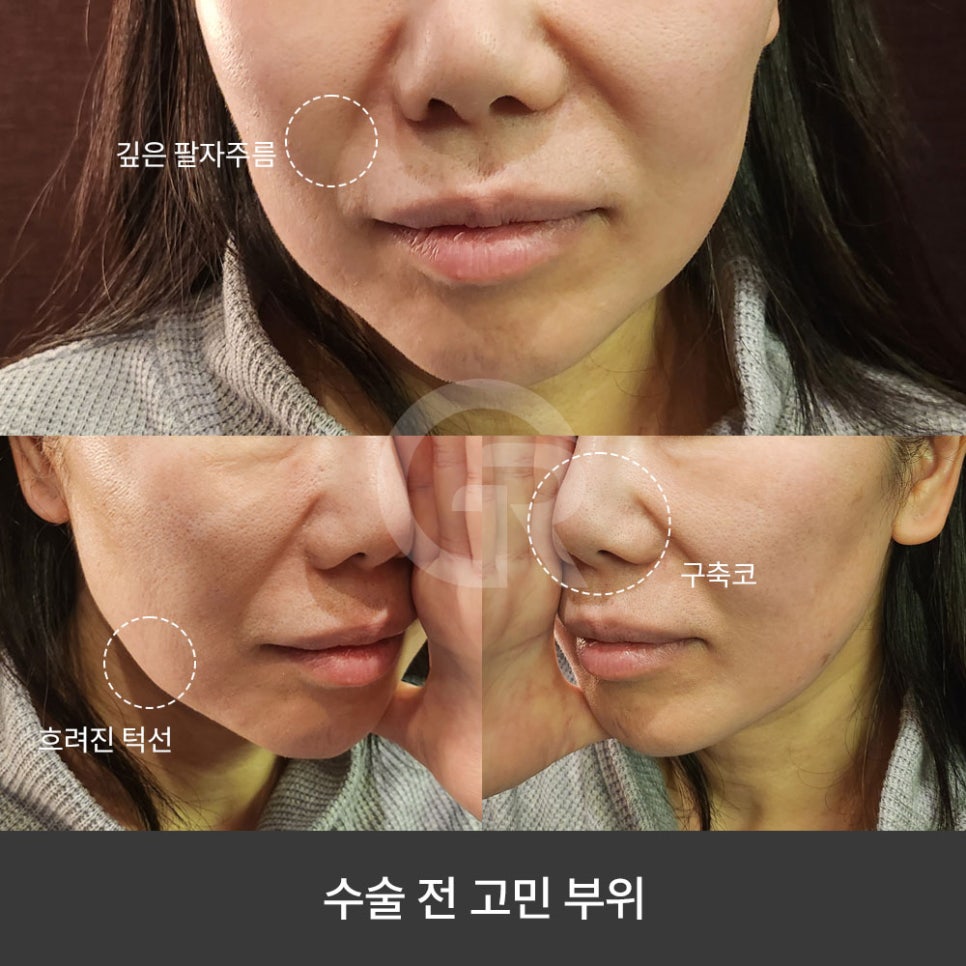
If nasolabial folds and marionette lines are visible together, it is important to evaluate the direction of perioral sagging and the overall facial balance together.
The patient introduced this time was a woman in her 50s who had undergone nose surgery with an L-shaped silicone implant about 30 years ago and had also received nasal filler injections 11 years ago. Over time, she felt that her nose looked shorter, and she said that the length from the glabella to the nasal bridge also seemed shorter. However, she did not want a nose that looked too narrow or obviously operated on from the front, and she considered a completely natural appearance to be the most important factor.
At the same time, she was very concerned that her nasolabial folds and marionette sagging had become severe, making the area around her mouth look heavy and aged. The patient wanted as much improvement as possible through a mini facelift within a feasible range. On diagnosis, the nasolabial folds and marionette lines were not simply skin wrinkles, but a clear downward shift of the perioral and cheek tissue.
Nasolabial folds are wrinkles near the mouth, but they are also connected to the balance of the center of the face. In particular, because she had a history of old implants and filler treatments, such as the long-ago insertion of an L-shaped silicone implant, it was necessary to closely examine the internal condition. When aging is combined with contracture from past nose surgery, the nose becomes shorter and the center of the face looks tighter, making the overall midface appear even more aged.
The surgical plan was to perform a mini facelift to correct the nasolabial folds and marionette lines, while the nose was planned to be refined by reducing the bulbous tip appearance, lengthening the tip, and naturally lowering the columella. During the actual surgery, a large amount of capsule and foreign material had formed around the silicone implant, so these were removed, after which the support structure of the nose was reconstructed. After surgery, the nasolabial folds and marionette lines were assessed as having been corrected by about 90%, and the overall impression could be refined in a way that matched the natural, not-overdone change the patient wanted.
What was the most important specialist judgment in this case?
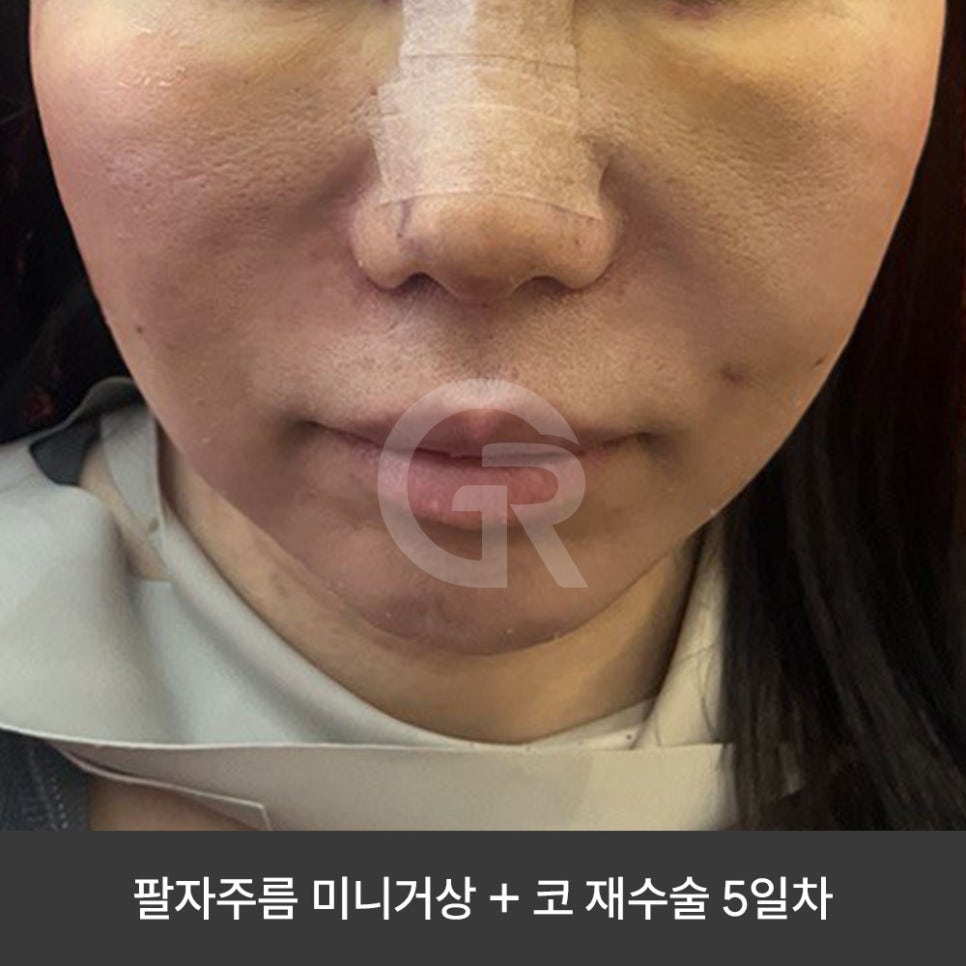
If there is a history of old nose surgery or nasal filler, it is necessary to check the balance of the center of the face as well when consulting about nasolabial folds.
The most important point in this case was that we did not simply look at the nasolabial folds and either fill or pull only that area. Deep nasolabial folds often begin as a concern in the patient’s mind—“I just want this line to disappear”—but in reality, they may be a problem connected to the front cheek, perioral area, jawline, and even the central axis around the nose.
Especially when marionette lines are present, softening only the folds beside the nose does not complete a youthful impression. The tissue sagging below the corners of the mouth, the collapse of the jawline, and the heaviness of the lower cheeks all need to be improved together for the face to look lighter. In this patient’s case as well, correcting the nasolabial folds and marionette lines with a mini facelift while also rebuilding the central balance disrupted by the old nose surgery was necessary.
Is completely eliminating nasolabial folds a good outcome?
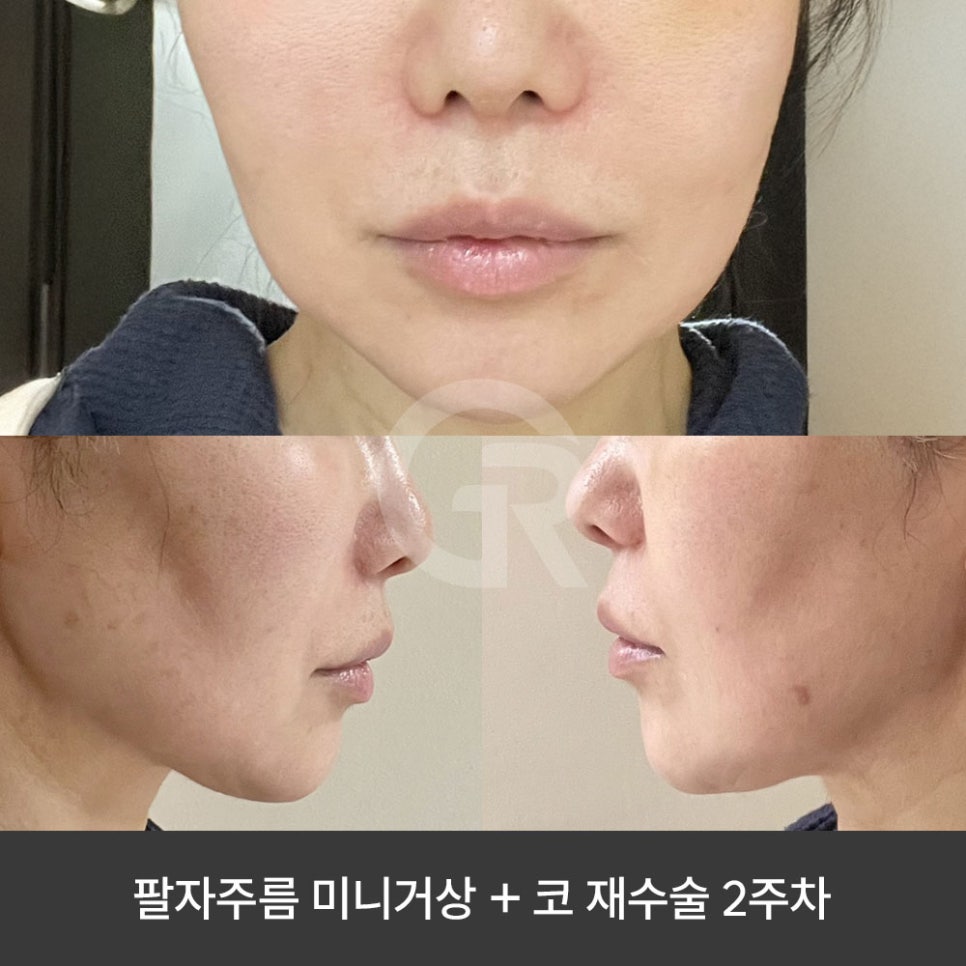
For a natural mini facelift result, it is important not just to pull the skin, but to analyze the direction of the sagging tissue.
From a specialist’s perspective, the approach that must be most carefully avoided is “completely eliminating the nasolabial folds.” Nasolabial folds are a natural boundary that exists to some degree in everyone. If one tries too hard to erase them, the center of the face can look puffy, the expression can look unnatural when smiling, or the area around the mouth can appear awkward and heavy.
A good improvement for nasolabial folds is not about erasing the line completely, but about restoring natural three-dimensionality by reducing the overall sagging and heaviness of the face. In particular, for patients with a history of old implants, nasal filler, or revision surgery, the internal tissue condition may be different from that of a typical first-time surgical patient. If one tries to match only the outward appearance when there is a capsule or foreign body reaction, the result can become unpredictable, so safe removal and a reconstruction plan are both necessary.
What should be considered after surgery?
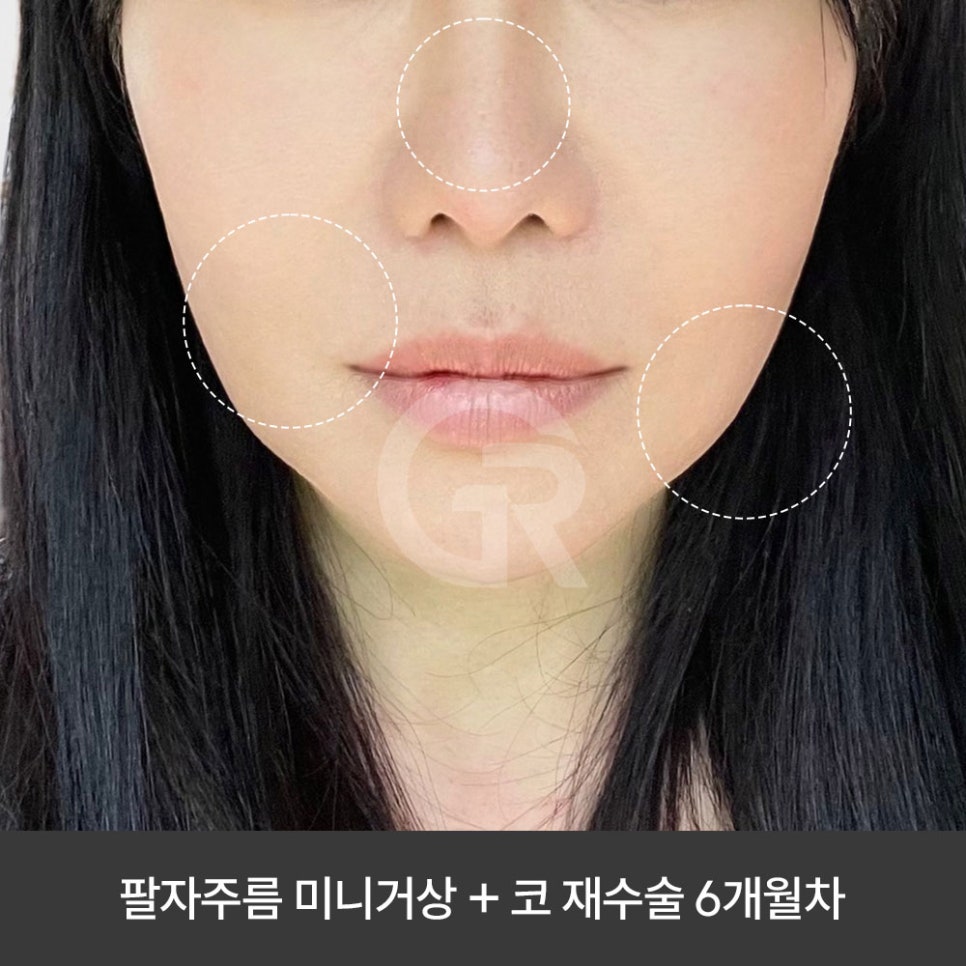
This case involved a mini facelift and nasal reconstruction performed at the same time, with the goal of maintaining a natural-looking face.
In the early period after a mini facelift, the tissue needs time to settle stably into its new position. Therefore, for about 2 days after surgery, it is advisable to avoid making large side-to-side head movements or lifting heavy objects. Excess tension around the face and neck can affect the recovery process.
When nasal reconstruction is performed together, the support structure of the nasal tip and the recovery of the internal tissue are also important. External impact, excessive facial expressions, and pressure around the nose should be avoided, and progress should be monitored regularly to check swelling and tissue stabilization. During early recovery, swelling, pulling sensations, or temporary asymmetry may appear, so rather than judging the result based only on the short-term appearance, it is necessary to follow the recovery process according to the medical team’s guidance.
Are deep nasolabial folds caused only by age?

In mini facelift consultations, the first step is to check what caused the sagging and the direction of tissue movement.
Deep nasolabial folds do not necessarily appear only because someone is old. They can also become noticeable at a relatively young age if there is a congenital lack of midface volume, hollowing beneath the cheekbones, or loss of front cheek volume due to rapid weight loss. Conversely, even if someone is older, the nasolabial folds may appear relatively shallow if the skin thickness and fat distribution are stable.
Therefore, treatment for nasolabial folds should not be determined by age alone. The depth of the wrinkles, the direction of cheek sagging, skin elasticity, the state of the perioral area and jawline, previous procedures and surgery history, and the degree of change the patient wants must all be considered comprehensively.
If deep nasolabial folds are a concern, what kind of consultation is needed?
The key to improving deep nasolabial folds is not “removing the line,” but “how to naturally restore the sagging structure.” In some cases, filler is sufficient; in others, laser treatment or thread lifting is appropriate; and in some cases, a surgical method such as a mini facelift is needed.
Ultimately, a good result is not a face that has changed too much, but a face that the patient sees in the mirror and feels is not awkward. Excessive correction can harm a person’s unique appearance. Also, surgical methods such as minimal-incision procedures and stem cell procedures can help with faster recovery, shortening the return to daily life.
Frequently Asked Questions organized by a mini facelift specialist

Surgical improvement of nasolabial folds can be planned differently depending on the individual’s skin condition, degree of tissue sagging, and past surgery history.
Q. What kind of surgery is a mini facelift?
A: Unlike a traditional facelift, which widely lifts and separates the entire face, a mini facelift is a surgery that repositions tissue within the necessary range, focusing on areas where sagging is especially noticeable. It is often considered for concerns such as △ nasolabial folds △ marionette lines △ sagging around the mouth △ lower cheek sagging △ blurred jawline. Rather than simply pulling the skin, the key is to analyze the direction and depth of the sagging tissue and lift it naturally.
Q. Can deep nasolabial folds improve with a mini facelift?
A: If the cause of the nasolabial folds is simple volume loss, filler or fat grafting may be more appropriate. But if the cheek tissue has descended, making the folds deeper, and if perioral sagging or marionette lines are present together, improvement can be expected with a mini facelift. In such cases, the nasolabial folds are closer to a structural fold created by sagging cheek tissue than a simple “sunken line,” so an approach that repositions the sagging tissue is needed.
Q. Can a mini facelift completely eliminate nasolabial folds?
A: Completely eliminating nasolabial folds is not necessarily a good outcome. Nasolabial folds are a natural facial boundary that exists to some degree in everyone. If one tries too hard to remove them, the center of the face can look swollen, the expression can become awkward when smiling, or the area around the mouth can look heavy. A good result is not forcefully erasing the wrinkle, but making the face look lighter and more natural by organizing the sagging tissue.
Q. Can marionette lines also be improved with a mini facelift?
A: Marionette lines are sagging lines that descend below the corners of the mouth and are closely related to lower-face sagging. When nasolabial folds and marionette lines are both deep, the sagging of the perioral area and lower cheek tissue should be assessed together. A mini facelift can help reduce the heaviness of the sagging perioral tissue and the area around the jawline, and depending on the patient, the improvement in marionette lines may feel even more satisfying than the improvement in the nasolabial folds.
Q. What is the difference between a mini facelift and thread lifting?
A: Thread lifting is a procedure that uses threads to temporarily pull up the skin and tissue without an incision. The recovery burden is relatively small, but if sagging is severe or the relaxation of the skin and SMAS layer is pronounced, there may be limits to how much support and correction it can provide. In contrast, a mini facelift directly organizes and repositions sagging tissue through an incision, so it can offer a more fundamental improvement in cases with structural sagging such as perioral sagging or marionette lines.
Q. What is the difference between a mini facelift and a full facelift?
A: A facelift is a surgery that improves moderate to severe sagging by widely separating the face and neck. A mini facelift, on the other hand, corrects a relatively limited area, focusing on key areas such as the lower cheek, mouth area, and jawline. If sagging is very severe or neck wrinkles and sagging under the chin are obvious, a standard facelift may be more suitable. On the other hand, if the main concerns are nasolabial folds, marionette lines, and sagging around the mouth, and the patient wants a natural improvement rather than a dramatic change, a mini facelift may be appropriate.
Q. At what age can a mini facelift be considered?
A: A mini facelift is not a surgery determined by age alone. It can be considered in the late 30s or 40s if cheek sagging, sagging around the mouth, or marionette lines are pronounced, and even in people over 50, a mini facelift alone may be sufficient depending on skin elasticity and the degree of sagging. The important criteria are not the actual age, but how far the facial tissue has descended, how much elasticity remains in the skin, and how much change the patient wants.
Q. Can a mini facelift look natural?
A: Yes, it can. However, for a natural result, the tissue should not be pulled strongly without discrimination; instead, the direction of facial sagging must be analyzed accurately so that only as much repositioning as needed is done. In particular, the areas around the mouth and nasolabial folds involve a lot of facial movement, so overpulling can make smiling look unnatural. A natural mini facelift should aim for a face that does not look obviously pulled, but rather one in which the tired, sagging impression has been refined.
Q. How long is the recovery period after a mini facelift?
A: There are individual differences, but early swelling and tightness tend to stabilize relatively significantly within 1 to 2 weeks after surgery. The period up to day 3 after surgery is when the swelling is usually most noticeable. Bruising gradually moves downward and fades. For about 2 days after surgery, it is advisable to avoid making large side-to-side head movements or lifting heavy objects.
Q. Is there a lot of pain after a mini facelift?
Pain varies from person to person, but most patients describe it not as severe pain, but as pulling, heaviness, or pressure. Because the surgery involves incisions and tissue repositioning, there may be initial discomfort, but it is generally manageable if prescribed medication is taken and recovery instructions are followed. If the pain suddenly becomes severe or one side swells much more than the other, you must contact the clinic.
Q. Are mini facelift scars very visible?
A: The incision location and suturing method are important in a mini facelift. Typically, the incision is designed in less noticeable areas such as in front of the ear or around the hairline. Redness or firmness may be noticeable at first, but these often fade over time. However, results vary depending on scar tendency, skin thickness, and recovery management, so it is a good idea to confirm the incision location and scar management plan in advance. Kirin Plastic Surgery can help with faster recovery through stem cell treatment and hyperbaric oxygen therapy.
Q. How long do mini facelift results last?
A: Because a mini facelift repositions sagging tissue, the maintenance period is generally longer than that of simple procedures. However, aging continues after surgery. Therefore, the effect is not permanently frozen in time, and the degree of maintenance can vary depending on △ skin elasticity △ lifestyle habits △ weight changes △ UV exposure △ smoking and drinking. The important thing is not only to turn back time with surgery, but also to manage the speed of aging afterward.
Q. Is a mini facelift possible even if I have had filler injections?
A: In many cases, yes. However, it is necessary to check where the previous filler remains and how much of it is still present, as well as whether there is any foreign body reaction or lumping. If too much filler has been injected into the nasolabial area or old filler remains within the tissue, it can affect the surgical plan. If needed, the existing filler can be dissolved, or the correction direction can be adjusted while checking the tissue condition during surgery.
Q. Can I go back to daily life right after a mini facelift?
A: Light indoor activities are possible relatively quickly, but if you need to meet many people or attend an important schedule, it is better to allow time for swelling and bruising to subside to some extent. Right after surgery, the face may feel tight and look swollen, so it is best to avoid strenuous outings or exercise. In particular, at the beginning, you should avoid turning your head sharply or lifting heavy objects.
Q. When can I start exercising after a mini facelift?
A: Light walking may be possible relatively early depending on recovery status (within a maximum of 2 hours only). However, exercise that makes you sweat a lot, strength training, saunas, and vigorous movements should be avoided in the early recovery period. This is because increased blood pressure or pressure on the face can worsen swelling and bruising. The timing for resuming exercise varies depending on the surgical scope and recovery status, so it is safest to decide after follow-up.
Q. Won’t my face look too pulled after a mini facelift?
A: If surgery is performed by pulling too strongly, it can look artificial. But if only the necessary tissue is repositioned while considering the anatomical structure of the face and the direction of facial expressions, a natural improvement is possible. The important thing is not “pulling a lot,” but “pulling in the correct direction.” In particular, the areas around the nasolabial folds and mouth involve a lot of facial movement, so natural motion must also be considered.
Q. Who is a mini facelift suitable for?
A: It can also be considered for people who found that filler or thread lifting did not last long or were not satisfying, or when skin sagging is difficult to solve with simple procedures. On the other hand, if skin texture, fine wrinkles, pigmentation, or enlarged pores are the main concerns rather than sagging, other treatments may take priority.
Kirin Plastic Surgery places the greatest importance on the consultation process and performs mini facelift surgery for various types of sagging, guiding each person only toward the improvement direction that suits them. Check the treatment plan that fits your current condition based on the overall balance of the face. Results and recovery may vary depending on the individual’s condition.