
If your weight has gone down after Wegovy or Mounjaro, but hollow cheeks, nasolabial folds, and facial sagging appear together, this can be seen not as a simple loss of skin elasticity, but as a structural change in the face after weight loss.
After using weight-loss medications such as Wegovy and Mounjaro, there is a concern we often hear in the clinic. The body fat and fatty liver have clearly decreased, and the body feels lighter, but the face looks even more tired than before. Many people say their cheeks look hollow, their nasolabial folds suddenly became deeper, and their cheekbones seem more prominent. In severe cases, some say, “It is especially upsetting when people say I look sick.”
These changes are not simply a change in appearance caused by losing weight. The face is a three-dimensional structure in which the skin, fat, retaining ligaments, fascial layer, muscles, and bone structure are all in balance. A youthful, healthy-looking face is not created by tight skin alone; it is naturally formed when the volume in the upper cheeks, temples, under the cheekbones, and around the mouth is properly maintained and those tissues remain in their correct positions.
However, if a large amount of weight is lost in a short period, facial fat is reduced as well. In particular, when support in the upper cheeks and midface declines quickly, the skin cannot keep up with the speed of the change, leaving a sense of looseness. At this point, the face does not merely look slimmer; the cheeks appear hollow, the nasolabial folds deepen, and the bony contours of the cheekbones and jawline stand out more strongly.
The problem is that these changes can suddenly appear even in people who have already been receiving lifting procedures regularly. A patient who visited with the same concern had been managing skin elasticity consistently with procedures such as Ulthera, Thermage, Shurink, thread lifting, and skin boosters, but decided to undergo a mini facelift because their facial line looked collapsed after weight loss. Unlike a simple decline in skin elasticity, this was a structural change in which volume loss and soft-tissue sagging occurred at the same time.
The hollowing and sagging that appear after Wegovy or Mounjaro are not a problem that suddenly arose only 5 years or 3 years after those drugs were introduced. Overseas, the term “Ozempic face” has already been used for some time.
Why did the term “Ozempic face” come about?

Ozempic face is not a diagnosis for one specific drug, but a phrase used to describe the changes in which facial fat decreases and sagging becomes more noticeable after weight loss from Wegovy, Mounjaro, Ozempic, and similar medications.
In Korea, this may still feel unfamiliar, but in overseas cosmetic and plastic surgery fields, the expression “Ozempic face” is already widely used. Ozempic is originally known as a semaglutide-based medication used for diabetes treatment. Later, as the same class or similar weight-loss medications became more widely known, interest in appearance changes after using GLP-1 class drugs, including Wegovy and Mounjaro, also increased.
What is important here is that Ozempic face does not mean one specific drug directly ruins the face. Medically, it is closer to an expression created to describe the noticeable decrease in facial volume, skin laxity, and tired-looking appearance after rapid weight loss, rather than an official diagnosis. In plastic surgery literature as well, there is discussion that rapid weight loss from GLP-1 class medications may lead to reduced facial volume, skin looseness, and an aged appearance.
When people expect to lose weight, they usually imagine fat decreasing in areas such as the abdomen, thighs, and upper arms. But when weight decreases, fat does not disappear only from the areas you want. The facial fat layer can also decrease, and the larger the loss in a short period, the more noticeable the facial changes may become.
This is why the cheeks look hollow, the area under the eyes looks sunken, the temples seem to cave in, and the nasolabial folds and sagging around the mouth suddenly seem worse. Facial fat is not just “fat”; it serves as a structural support that helps maintain soft contours and a youthful impression. When this support decreases quickly, the skin and soft tissue can no longer stay in place and begin to shift downward, causing an overall older-looking change.
Therefore, when understanding Ozempic face, it should not be taken as a matter of “the drug ruined the face.” More accurately, it should be understood as a condition in which the face’s supporting structure has collapsed due to rapid weight loss. From this perspective, the patient who had used both Wegovy and Mounjaro was judged to need surgical repositioning rather than simple volume restoration.
If facial fat is lost, do you always need a mini facelift?
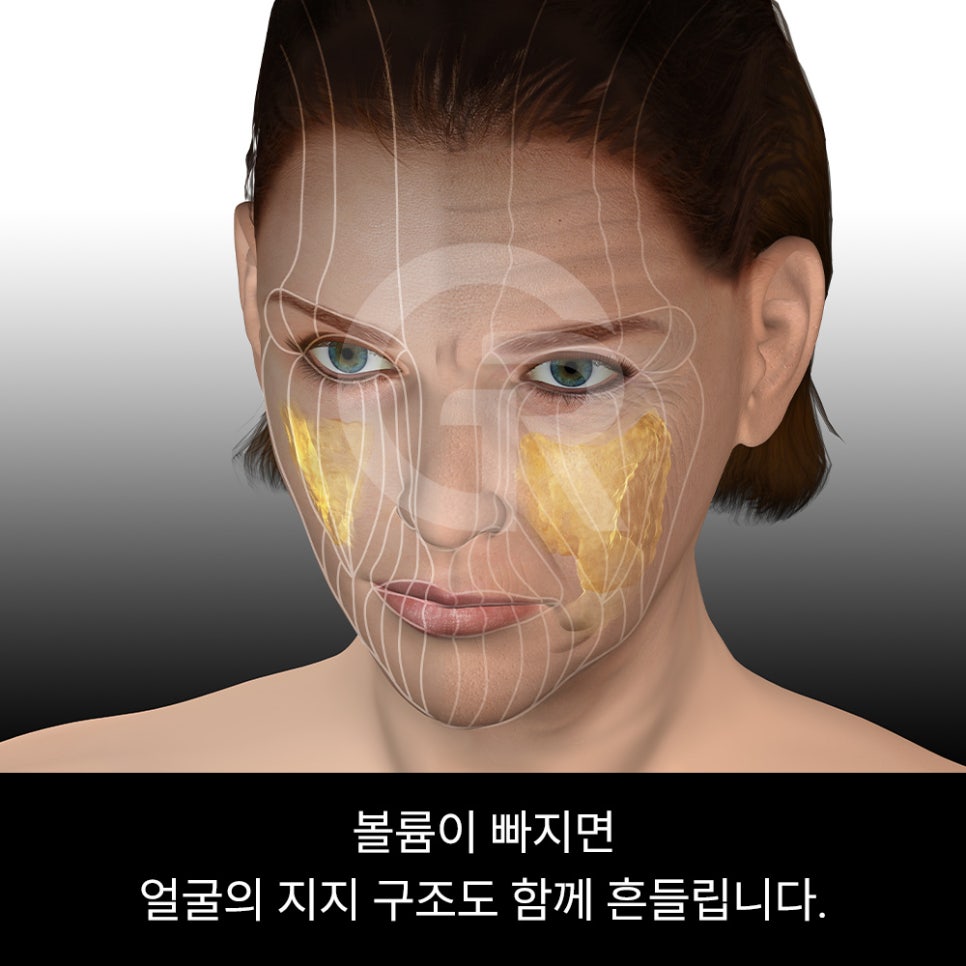
Rapid weight loss can affect not only the abdomen and thighs but also the facial fat layer. When upper cheek and midface volume decreases, the face can look tired and thin.
Not everyone changes in the same way when facial fat decreases. Some people simply look naturally slimmer, while others instead have more prominent cheekbones and hollow cheeks, creating a tired impression. This difference depends on facial fat distribution, skin thickness, bone structure, the degree of sagging, and the person’s preexisting aging state.
The face has both superficial fat and deep fat. Superficial fat creates soft contours just beneath the skin, while deep fat supports the three-dimensional shape of the midface and upper cheeks. A youthful face looks lively because these fat layers maintain volume in the right positions. However, if these fat layers decrease due to rapid weight loss, the support in the center of the face weakens.
In particular, when the volume under the upper cheeks and cheekbones decreases, the nasolabial folds appear deeper. The nasolabial fold is not just a line on the skin surface; it is a structural change that becomes more visible as the midface tissue moves downward and the boundary around the mouth becomes deeper. For that reason, simply filling in the line itself often does not solve the problem.
The same principle applies to the cheekbones appearing more prominent. The patient said it felt as if the cheekbones had become larger, but in reality, when the tissue under the cheekbones and in the upper cheeks is lost, the bony contours stand out more strongly by comparison. Before, soft volume naturally connected the area between the cheekbones and cheeks, but as the fat that played that cushioning role decreased, the cheekbones came to look sharper and more pronounced.
If the skin does not have enough elasticity, the remaining skin and soft tissue move downward. At that point, cheek sagging, mouth corner sagging, and an indistinct jawline appear together. In the end, the concerns patients describe—“my cheeks hollowed out,” “my nasolabial folds deepened,” “my cheekbones became more prominent,” “my face sagged,” and “marionette lines appeared”—are not separate problems, but different manifestations of one structural change.
This point is very important when planning a facial lift surgery. Whether it is better to fill the hollowed areas, lift the sagging tissues first, or consider both together should be judged by looking at the face in three dimensions.
Why does lifting have limits even when you have been doing it consistently?
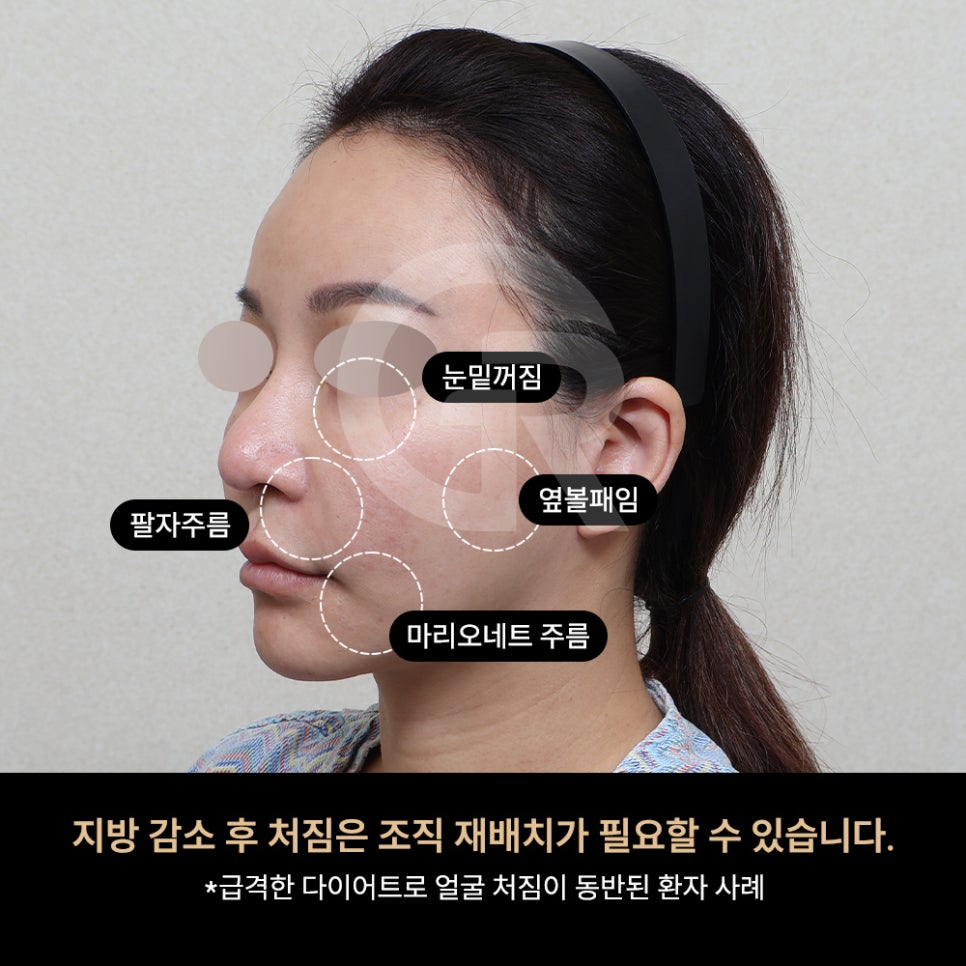
The reason the nasolabial folds can suddenly look deeper after Wegovy or Mounjaro is that it is not simply a wrinkle issue, but a combination of volume loss and midface sagging.
The patient had been consistently managing skin with Ulthera and Thermage lifting even before dieting. For that reason, I think it must have felt especially upsetting when the skin suddenly looked loose and saggy this time. After the rapid weight loss, they said they first had laser lifting earlier than usual to remove wrinkles, thinking, “Would it improve if I got stronger lifting treatments?” Of course, in the early stage of reduced skin elasticity, non-surgical lifting procedures can be helpful. Their purpose is to apply heat stimulation to the skin layer and some soft tissue, induce collagen production, and tighten loosened skin to a certain extent.
However, the facial changes that appear after Wegovy or Mounjaro may differ from ordinary loss of skin elasticity. If facial fat has decreased rapidly and the skin and soft tissue above it have moved downward, improving the surface elasticity alone may not be enough. If excess skin has already formed and the tissue itself has moved lower, simple tightening may not fundamentally resolve the nasolabial folds and cheek sagging.
Thread lifting had also already been performed. The patient had undergone a procedure at another clinic in which threads were used to pull the tissue through an incision at the temple, but the lifting effect of the threads and the scope of improvement may have limits. Even if threads pull the tissue upward, there are restrictions on directly trimming excess skin or stably repositioning a wide area of soft tissue.
Therefore, if you have had lifting procedures but your face continues to look tired and cheek sagging and nasolabial folds keep returning, the issue needs to be reconsidered. In that case, the key is not simply that “the skin is less elastic,” but that the face’s support structure may have decreased and the sagging tissue has moved out of place. At that point, rather than increasing the intensity of the procedure, the more important issue is how to reposition the structure.
How was cheek sagging corrected with a mini facelift?
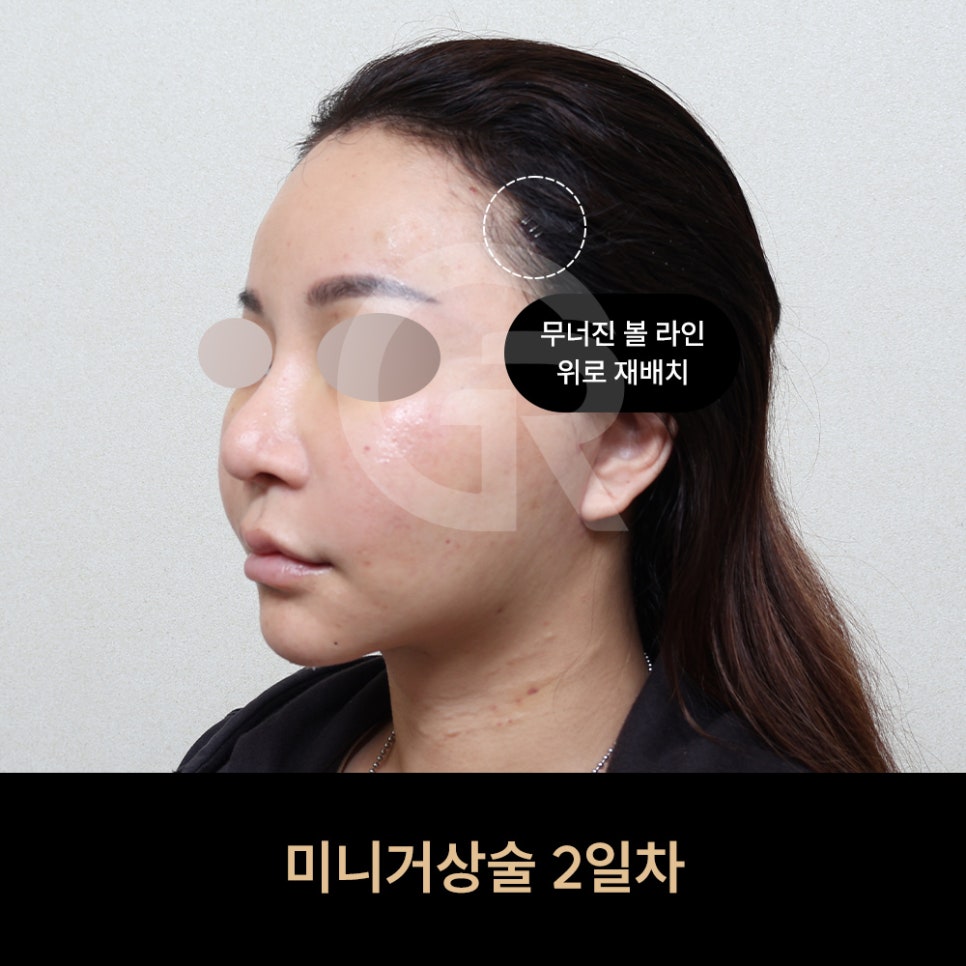
This is a facial lifting surgery performed through re-incision in a mini facelift revision case to reposition the sagging midface and cheek line upward.
In this patient’s case, a mini facelift had already been performed through the temple hairline, so the revision surgery was carried out in the same area to minimize additional incisions. While a full facelift is a surgery that addresses a broad area from the lower face and around the ears, and in some cases the neck as well through incisions that extend to the hairline, a temple-incision mini facelift focuses on improving midface and cheek-line sagging while keeping the incision and dissection range relatively limited.
In people whose facial fat has decreased after Wegovy or Mounjaro, the face often does not sag heavily as a whole; rather, the upper cheeks look hollow, the area under the cheekbones appears empty, and the area around the nasolabial folds and cheek line collapses downward. In such cases, repositioning the sagging midface tissue and cheek tissue upward and outward through the temple incision can help more naturally restore the facial line that collapsed after weight loss.
However, the name “mini facelift” should not make this surgery seem overly simple. A mini facelift is not a procedure that merely pulls the skin slightly tighter. Although the incision range is limited, the results depend on which layer is dissected and how much, in which direction the tissue is moved, and how the skin and fascial layer are fixed. If only the skin is pulled, it may look tight at first, but over time the sagging may return or an unnatural pulling effect may remain.
What matters in facial lifting is not how much you pull, but how accurately you reposition it. The same applies to a temple-incision mini facelift. Because people who have become thin after weight loss already have reduced volume, forcefully pulling only the skin may make the face look sharper and less natural. Therefore, it is necessary to judge together which direction the sagging tissue should be lifted in order to restore the facial curve, and whether the lacking volume should be supplemented separately.
What is the difference between a full facelift and a mini facelift?
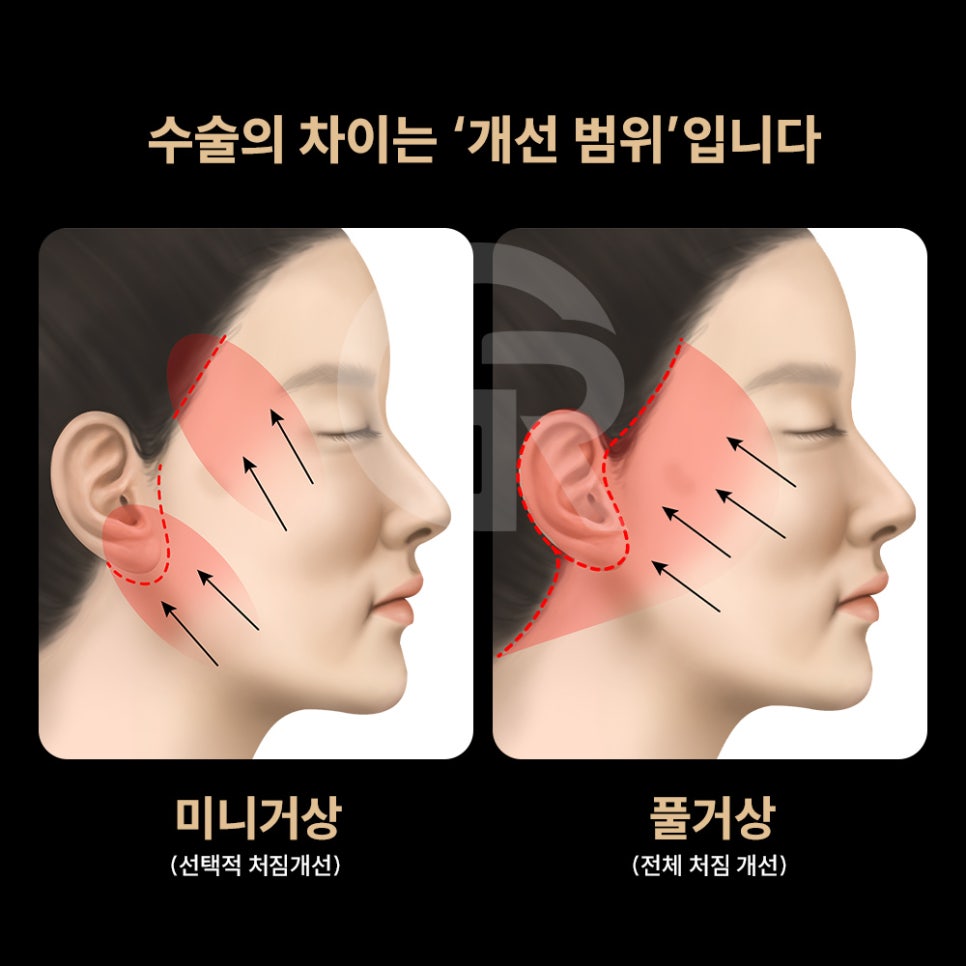
In faces that look hollow and sagging after Wegovy or Mounjaro, a mini facelift that lifts the descended midface and cheek tissue may be needed rather than a treatment that simply adds volume.
The difference between a full facelift and a mini facelift is not simply whether the surgery is large or small. The two surgeries differ in incision location, dissection range, the areas of sagging they aim to improve, recovery burden, and the extent of change that can be expected. For that reason, rather than saying one surgery is better overall, the appropriate method should be selected according to the face and skin condition.
A full facelift, commonly called a full face lift, is a surgery that treats a wide area including the lower face, jawline, and neck. The incision may start in front of the ear, continue behind the ear, and in some cases extend to the hairline. Its purpose is to lift the entire sagging face by adjusting not only the skin but also the SMAS layer and deep soft tissue. If there is a large amount of excess skin, a collapsed jawline, and clear neck wrinkles or neck sagging, a full facelift may be more appropriate.
A mini facelift, on the other hand, has a more limited and clear goal. Rather than broadly approaching the entire face and neck, it focuses on the areas directly related to sagging, such as the midface, cheek sagging, collapse around the nasolabial fold, and the line under the cheekbones. Therefore, if sagging of the lower face and neck is not severe and the changes in the midface and cheek line are more prominent after rapid weight loss, a mini facelift may be the more suitable option.
In the end, mini facelift versus facial lift is not a matter of superiority, but of indication. A full facelift is a surgery that addresses sagging over a wide area, while a mini facelift is a surgery that precisely improves sagging in a limited area. Not every case of looking skeletal after Wegovy or Mounjaro requires the same operation.
Why a mini facelift can help with facial changes after Wegovy and Mounjaro
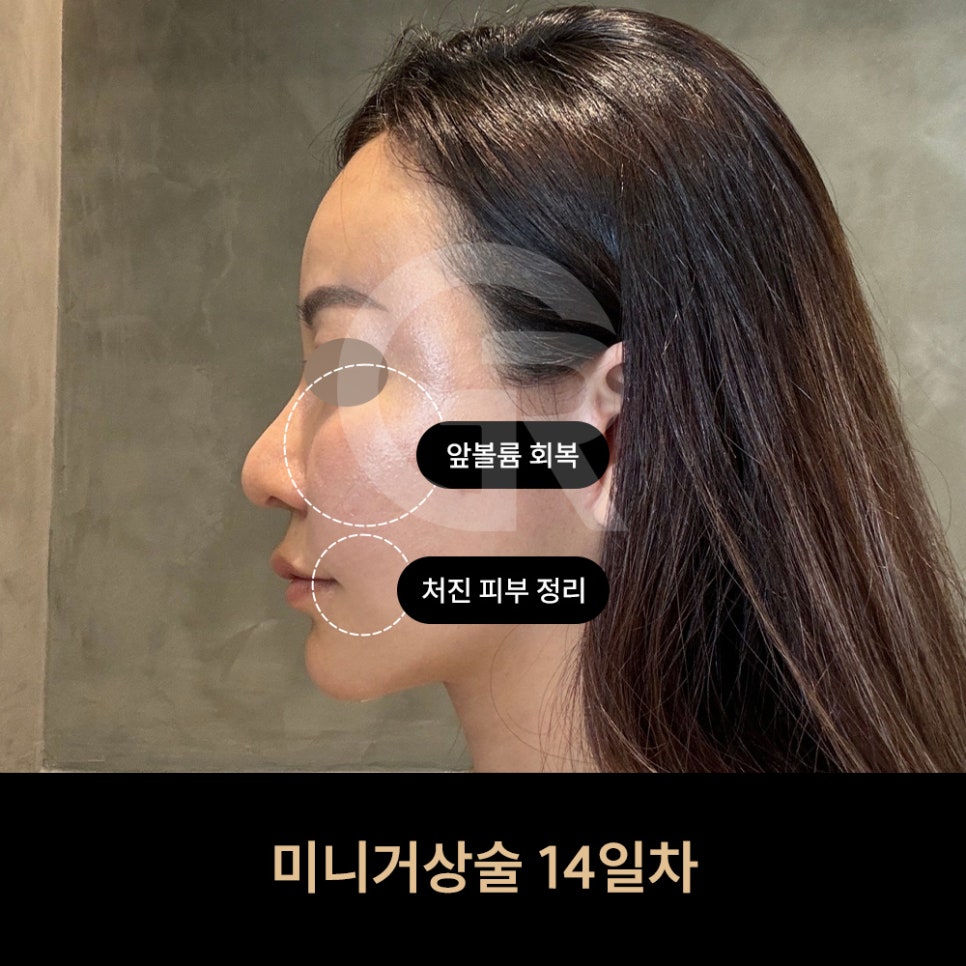
Mini facelift surgery can be considered depending on facial changes after weight loss from Wegovy or Mounjaro, such as midface sagging, cheek sagging, nasolabial folds, and hollowing under the cheekbones.
Of course, if facial volume is lacking, fillers or fat grafting may help. However, if sagging is also present, filling in volume alone may make the face look heavy or unnatural. Even after filling the nasolabial folds, some people still look tired, the hollow under the cheekbones remains obvious, and the area around the mouth can look more crowded.
The reason a mini facelift is meaningful in such cases is that it first corrects the position of the sagging tissue. Through the mini facelift, the patient had the descended midface and cheek line repositioned upward, which eased the compression around the nasolabial area and the cheek sagging. Rather than simply pulling the face tight, it reorganized the collapsed contours of the face.
In particular, for people whose upper cheeks are hollow, cheekbones appear strong, and nasolabial folds and cheek sagging appear together, “repositioning” may be needed before “filling.” After lifting the sagging tissue closer to its proper position, if volume is still lacking, supplementing only as much as needed afterward may be the more natural approach.
In this respect, a mini facelift after Wegovy or Mounjaro should be understood not simply as an anti-aging surgery, but as a surgical option for restoring the facial structure that has collapsed after rapid weight loss.
Advantages of a mini facelift

An incision mini facelift aims to improve the collapsed line by making incisions in a relatively less noticeable area.
The biggest advantage of a mini facelift is that it can focus on the necessary area. For people whose lower face and neck sagging is not severe, the surgery can reduce the scope while targeting the area of concern.
The incision location can also be an advantage. Incisions around the temple or hairline may be relatively hidden by the hair after recovery, which can help reduce concerns about visible scarring. Of course, the incision location and scar healing vary depending on an individual’s skin characteristics, incision design, suturing method, and aftercare, so this cannot be said definitively. Still, for people who feel burdened by long incisions in front of and behind the ear, it may be a relatively accessible option.
So if your body has become slimmer but your face suddenly looks older, if your cheeks have hollowed out and your cheekbones look stronger, if nasolabial folds and cheek sagging have appeared at the same time, or if repeated lifting procedures have not been satisfying, a mini facelift can be considered as one option.
But mini facelift also has limits
A mini facelift is not a surgery that solves every type of facial sagging. This must be clearly understood. Because a mini facelift focuses on restoring lines, such as improving the midface and cheek line, its range of improvement may be limited if neck sagging is severe or there is a large amount of excess skin under the jawline. In such cases, a full facelift or a neck lift may be needed.
If there is almost no sagging and only simple hollowing, volume restoration rather than a mini facelift may be more appropriate. The treatment method differs depending on whether the cause of the facial change is volume loss, tissue sagging, or excess skin. An approach that unconditionally recommends a mini facelift without making this distinction, or conversely unconditionally recommends fillers, is not appropriate.
Therefore, a mini facelift is not “a surgery needed for everyone who has lost facial fat,” but a surgery whose suitability can be considered when rapid weight loss causes both hollowing and sagging, and among those, the main issue is downward movement of the midface and cheek line.
Body weight stability should be checked before surgery

When reducing facial sagging during Mounjaro weight loss, maintaining protein intake, strength training, hydration, and skin elasticity care can help.
If you are currently using medications such as Wegovy, Mounjaro, or Ozempic, or if weight loss has been progressing rapidly recently, the timing of surgery should be decided carefully. If you undergo a mini facelift while your weight is still decreasing, facial fat may continue to decrease after surgery, which can affect the result.
Facial lift surgery is performed based on the current facial condition, calculating excess skin and tissue sagging. However, if weight continues to decrease after surgery, volume may decline again and the face may feel loose. Conversely, if weight increases significantly after surgery, the facial line may look heavy again. Therefore, to keep the surgical result stable, it is better to plan when weight changes have become relatively stable.
During consultation, it is necessary to check the total amount of weight loss, weight changes over the last 2–3 months, whether the target weight has been reached, future plans for continued weight loss, and whether the medication will be maintained. In addition, the history of previous lifting procedures, filler or fat grafting experience, skin thickness, tendency to scar, and available recovery time should also be reviewed.
In particular, if you are using a GLP-1 class medication or a related weight-loss medication, you must inform the medical team in charge of the medication before surgery for anesthesia or recovery purposes. The type of medication, dosage, dosing schedule, and whether to stop it may vary depending on the person’s health condition and surgical plan, so it is important not to decide on your own.
Frequently asked questions about Ozempic, Wegovy, and Mounjaro face concerns

If there is significant excess skin, another approach such as a full facelift or neck lift may be needed.
Q. While taking Mounjaro, how can I manage it so facial sagging does not come easily?
A. It is difficult to completely prevent facial sagging while using weight-loss medications such as Mounjaro, Wegovy, and Ozempic. When weight decreases, facial fat can decrease as well. However, if the rate of weight loss is too fast, the skin and soft tissue may not have enough time to adapt, making cheek hollowing and sagging look more noticeable.
Therefore, it is important to avoid overly rapid weight loss in consultation with the medical team and to combine it with protein intake and strength training. If muscle mass also decreases during weight loss, both the face and the body may look more saggy, so diets that focus only on the number on the scale should be avoided. Hydration, sleep, sun protection, and skin barrier care are also necessary basics.
To manage skin elasticity, high-frequency treatments, ultrasound lifting, skin boosters, and collagen regeneration treatments can be combined. However, if there is already clear volume loss and tissue sagging, these procedures alone may have limits. It is better to provide preventive care during weight loss and to create a treatment plan that matches the structural changes after weight loss.
Q. If facial fat has been lost, should I start with fillers or fat grafting?
A. If there is only hollowing and no severe sagging, fillers or fat grafting may help. In particular, areas lacking volume such as the temples, upper cheeks, under the eyes, and under the cheekbones can look less tired with appropriate volume restoration.
However, if hollow cheeks are accompanied by nasolabial folds, cheek sagging, and a blurred jawline, simply adding volume may make the face look unnatural. If volume is added while sagging tissue remains below, the face may look heavy or dull, and only the area around the nasolabial folds may appear puffy and awkward.
In such cases, it may be more natural to first reposition the sagging tissue and then supplement the lacking volume as needed. In other words, this does not mean fillers or fat grafting are bad choices, but rather that the order and amount must be adjusted according to the facial condition.
Q. Who is a temple-incision mini facelift suitable for?
A. A temple-incision mini facelift may be considered when the midface and cheek line appear to have collapsed downward after rapid weight loss, when sagging around the nasolabial area is prominent, or when the area under the cheekbones is hollow and the tired appearance has become stronger. It may be especially suitable for people whose neck sagging is not severe, but whose changes around the cheeks and nasolabial area are prominent.
However, if the entire lower face is significantly sagging, if the double chin under the jawline has become severe, or if the jawline contour has collapsed, a soft-tissue contouring procedure may be recommended.
In the end, suitability is determined not by the name of the surgery, but by the direction and degree of sagging in the face. Even after the same type of weight-loss-related facial change, some people are suited to a mini facelift, some should prioritize volume restoration, and some may be better suited to a full facelift.
Q. Which is better, a mini facelift or a full facelift?
A. Neither a mini facelift nor a full facelift is always the better surgery. The two procedures have different purposes and scopes. A full facelift may be appropriate when the lower face, jawline, and neck sagging all need broad improvement, while a temple-incision mini facelift may be appropriate when the main concerns are midface sagging, cheek sagging, and collapse around the nasolabial area.
Because the surgical range of a mini facelift is limited, the recovery burden may be relatively lower, but the scope of improvement is also limited. A full facelift can address a wider area, but the surgical and recovery burden may be greater. Therefore, the important thing is not choosing the larger surgery, but choosing the amount of surgery that your face actually needs.
Q. What should I be careful about after a mini facelift?
A. After a mini facelift, early swelling, bruising, tightness, and reduced sensation may occur. During early recovery, it is better to avoid bending the head down for long periods, pressing strongly on the face, strenuous exercise, saunas, and alcohol. While sleeping, be careful not to press on the face, and follow the medication, cold compress, compression, disinfection, and follow-up schedule instructed by the medical team.
The face immediately after surgery is not the final result. Because of swelling and tissue stabilization, it may first look pulled or feel awkward, but it becomes more natural over time. Recovery speed varies depending on skin condition, surgical range, body type, and prior procedure history, so it is important not to judge too quickly.
Also, even after surgery, if body weight changes rapidly, the facial line may change again. To maintain mini facelift results stably, it is better to keep weight consistent and continue skin elasticity care and healthy lifestyle habits.
Q. Can I continue Mounjaro after a mini facelift?
A. Whether to continue using Mounjaro after a mini facelift must be discussed with the medical team in charge. If weight continues to decrease after surgery, facial fat may decrease further and the surgical result may change. Conversely, if weight increases significantly, the facial line may become heavy again.
Therefore, during the preoperative consultation, you should accurately share the medications you are currently taking, the amount of weight loss, your target weight, and your future weight-loss plan. If possible, planning surgery at a time when weight has become relatively stable can help with predicting the result. Whether to stop or restart the medication may vary depending on the individual’s health condition and the purpose of the prescription, so it is safer not to decide on your own.