Have you ever cut your hand on broken glass while washing dishes late at night,
or been injured after falling on your way home after drinking?
A child may fall and split open their forehead, or hit their face against a corner and sustain an injury.
Trauma often occurs without warning.
When you are suddenly injured like this, one thought usually comes to mind first:
“Is there a hospital where I can get sutures right now?”
During the day, it is relatively easy to find a medical facility that is open,
but at night or in the early morning, it can be difficult to find a hospital that provides nighttime care.
Today, we will discuss wound suturing and 24-hour trauma care—information that is useful to know when an injury occurs.
If you are injured at night, it is important to check the condition of the wound first.
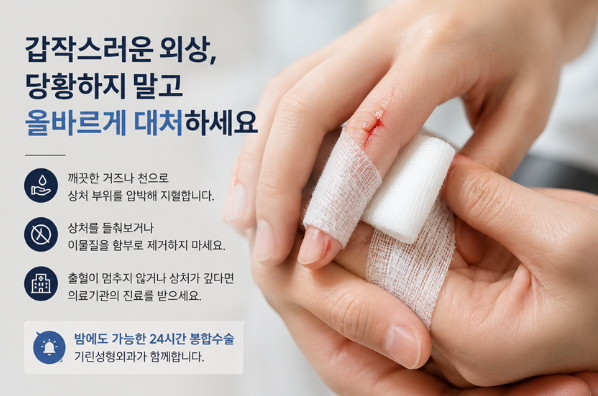
If you have been cut by a knife or glass, your first priority should be to control the bleeding by pressing the wound with clean gauze or cloth.
It is best to avoid repeatedly opening the wound to inspect it or trying to remove foreign objects from inside the wound yourself.
Next, to prevent the wound from drying out, moisten clean gauze with sterile saline, squeeze out the excess liquid thoroughly, and gently cover the affected area.
At this time, do not apply ointment or disinfectant deep into the wound.
The most important thing is to receive treatment as soon as possible.
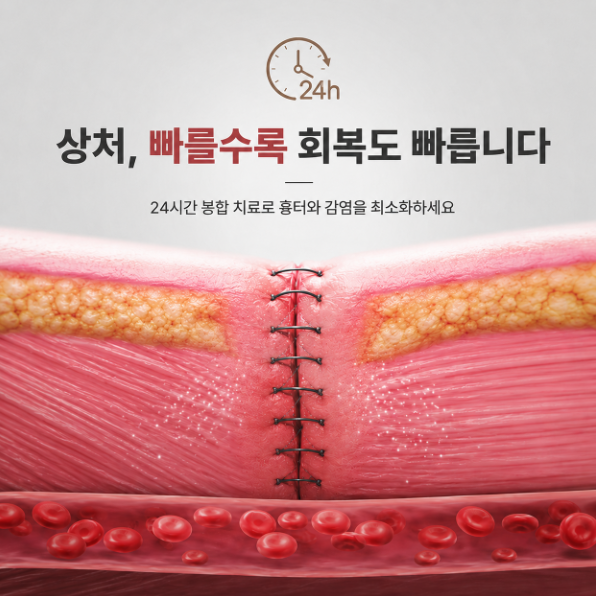
The sooner a wound is closed, the lower the risk of scarring and infection.
If you are injured, it is most important to visit a medical facility as soon as possible.
Wound suturing is not simply a matter of stitching the wound closed.
Many people think of wound suturing as simply sewing the wound shut with thread right away.
However, in actual trauma care, the wound is first thoroughly cleaned, and the extent of contamination, damaged tissue,
the presence of foreign objects, and other factors are also assessed.
When necessary, debridement may be performed to remove damaged or contaminated tissue.
After examining the condition of the wound, suturing may be performed immediately.
For wounds with a high risk of contamination or infection, however, the treatment method or timing of suturing may differ depending on the medical team’s assessment.
In other words, not all wounds are treated in the same way, and it is important to establish a treatment plan suited to the condition of the wound.
The suturing method may also vary depending on the depth of the wound.
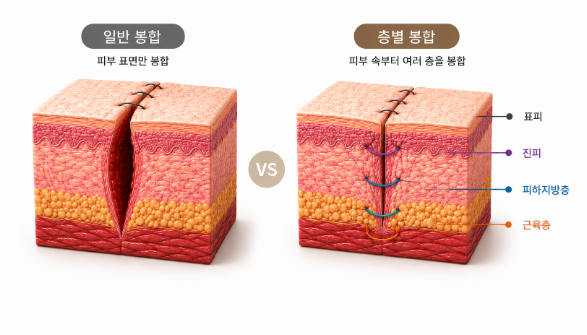
In some cases, only the skin surface is sutured. If the wound is deep, layered suturing may be considered, in which the tissues beneath the skin are sutured sequentially in multiple layers.
Layered suturing helps distribute tension applied to the injured area and align the tissue stably.
Whether it is appropriate is determined by the medical team after considering the wound’s depth, extent of damage, and other factors.
A care system that can coordinate CT and X-ray examinations with hyperbaric oxygen therapy
Even when trauma appears to affect only the skin, internal damage may also be present.
For example, if you have been injured by broken glass, it may be necessary to check whether small pieces of glass remain inside the wound.
After a strong impact, a CT or X-ray examination may also be needed to check for a fracture.
In addition, depending on the condition of the wound and the healing process, hyperbaric oxygen therapy may be considered as part of the treatment plan if the medical team determines that it is necessary.
Not all medical facilities operate CT and X-ray services or hyperbaric oxygen therapy facilities.
Therefore, when receiving trauma care, it is important to check not only whether wound suturing is available, but also whether the medical facility can coordinate detailed examinations before suturing and scar and regenerative care after the procedure.
Girin Plastic Surgery has a system that can coordinate the following within a single care process for trauma patients:
The clinic operates an integrated care system that can continue from wound assessment through the necessary examinations and treatment to subsequent recovery management.
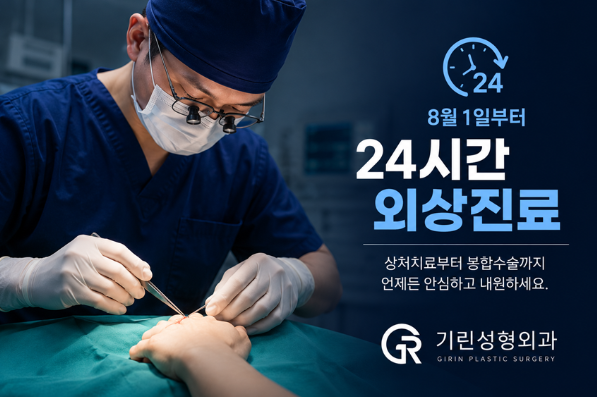
24-hour trauma care will be expanded starting August 1.
Girin Plastic Surgery has already been performing wound suturing for patients with various types of trauma, including lacerations, puncture wounds, and incised wounds.
Starting August 1, 2026, the clinic will expand its existing trauma care services to operate 24 hours a day.
When trauma occurs at night or in the early morning, the wound can be assessed, and, when necessary, wound suturing as well as CT and X-ray examinations and hyperbaric oxygen therapy can be coordinated through an integrated care system.
This system has been prepared to provide more systematic trauma care.
Sudden injuries can occur at any time.
If the wound has opened deeply, the bleeding continues,
or a foreign object or internal damage is suspected, it is important not to make the decision on your own, but to receive medical care and confirm an appropriate treatment plan.
Starting August 1, 2026, Girin Plastic Surgery will expand its care system to provide 24-hour trauma services so that trauma patients can receive the necessary medical care at night as well.