Hello.
This is Giraffe Plastic Surgery.
Some people feel that their face looks wider even though their weight is similar to before, or that their jawline has become less defined as their cheeks have descended.
It is easy to think that the amount of facial fat has increased in such cases, but facial contours are not determined solely by the amount of fat.
The position and volume of the soft tissue beneath the skin also affect the contours of the face and the jawline.
Soft-tissue facial contouring is a method of refining the facial contours by considering the position and volume of the soft tissue beneath the skin rather than the facial bones.
Today, we will look at what soft-tissue facial contouring is and how the non-incisional approach differs.
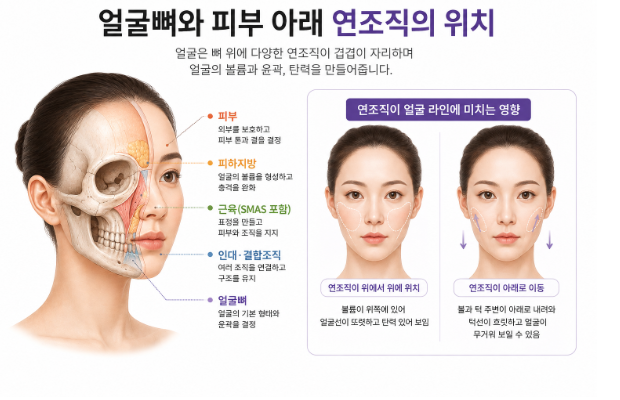
Why Soft Tissue Affects Facial Contours
When we think of facial contours, it is easy to first picture the shape of the bones, such as the cheekbones or jaw.
However, the actual face consists of multiple layers of tissue over the bones, including the skin, subcutaneous fat, and muscles.
In particular, when the soft tissue around the cheeks moves downward, volume can appear concentrated in the lower face, making the boundary of the jawline look less defined.
Areas that originally had more volume may also appear relatively sunken.
Therefore, when assessing facial contours, it is important to examine not only the facial bones but also how the position and volume of the soft tissue are distributed.
How Is Soft-Tissue Facial Contouring Performed?
Soft-tissue facial contouring is not simply a matter of pulling one part of the face upward.
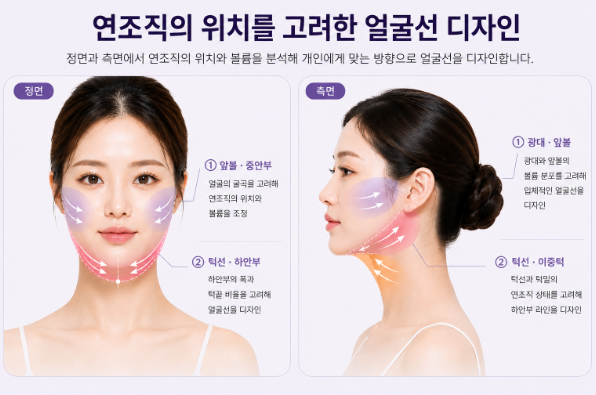
The position of the front and side cheeks, the line extending to the jaw, and the contours of the face are examined from the front, at a 45-degree angle, and from the side.
The facial contours are then designed by considering the direction in which sagging tissue should be adjusted and how areas requiring volume should be supplemented.
The overall design varies depending on which tissues are adjusted and in what direction, as well as how the volume and lines of the face are connected.
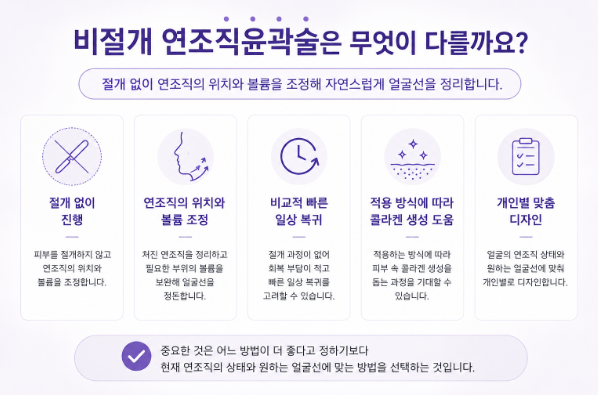
How Does Non-Incisional Soft-Tissue Facial Contouring Differ?
Soft-tissue facial contouring can be approached in various ways depending on the condition of the face and the changes needed.
While some methods address the soft tissue more directly, non-incisional soft-tissue facial contouring refines the facial contours by adjusting the position and volume of the soft tissue without making a skin incision or using surgery.
Since there is no incision, it generally involves less recovery-related burden and may also be considered by those who want to return to their daily activities quickly.
Depending on the method used, the process may also be expected to help support collagen production within the skin.
The important thing is not to decide that one method is universally better, but to choose an approach suited to the current condition of the soft tissue and the desired facial contours.
Consider This If You Have These Facial Concerns
-
Your cheeks feel as though they have descended compared with before
-
The boundary of your jawline feels less defined
-
Your lower face looks heavy
-
Your face looks wider when viewed from the front
-
You are concerned about both facial sagging and hollowing
Even when people have similar concerns about their jawlines, the position and volume of the soft tissue differ from person to person.
Therefore, it is important to determine the treatment approach after assessing the current condition of the face.
Frequently Asked Questions About Soft-Tissue Facial Contouring
Q. Is a less-defined jawline also related to the soft tissue?
When the tissue around the cheeks moves downward, the boundary around the jaw may appear less defined.
In such cases, the position of the soft tissue extending from the cheeks to the jaw is examined along with the jaw itself.
Q. How long is the recovery period for non-incisional soft-tissue facial contouring?
Non-incisional soft-tissue facial contouring does not involve making an incision in the skin, so a relatively quick return to daily activities, in approximately 1–3 days, may be considered.
However, the recovery process may vary depending on the treatment method and extent, as well as the individual’s condition. It is advisable to follow the precautions provided after the procedure.
Q. Does this method change the facial bones?
Soft-tissue facial contouring does not change the shape of the facial bones themselves. It is a method of refining the facial contours primarily by addressing the soft tissue beneath the skin.
Soft-Tissue Facial Contouring Begins by Examining Why Your Facial Contours Have Changed
Facial contours can appear different depending not only on the shape of the bones but also on the position and volume of the soft tissue beneath the skin.
Soft-tissue facial contouring involves assessing the current position and volume of the soft tissue and planning an approach suited to the condition of the face and the desired changes.
If your cheeks seem to have descended compared with before or your jawline feels less defined, it is important to examine not only the amount of facial fat but also the current position of the soft tissue and the overall balance of the face.