Hello!
I am the director of Seoul Bardi Dental Clinic.
▼ Check the Dental Clinic Location ▼
| This post was written directly by Seoul Bardi Dental Clinic for the purpose of providing medical information in compliance with Article 56, Paragraph 1 of the Medical Service Act. We recommend using the information provided for reference only. Please visit a medical institution and receive guidance from a medical professional for an assessment of your symptoms and accurate management methods. All procedures and surgeries performed at dental clinics may involve risks depending on the individual, such as inflammation, bleeding, and swelling. Please make your decision after having a sufficient consultation with a medical professional in advance. The treatment cases shown in this post were photographed with the consent of patients who completed treatment at our clinic, and the before-and-after photos were taken under identical conditions. |
After finishing orthodontic treatment
and having your appliances removed,
you have probably heard
something similar.
Now you need to make sure you wear your retainers properly.
But surprisingly few clinics
clearly explain whether this means
six months, two years, or a lifetime.
Then you come across a post like this
on the internet.
“Retainers—
do I really have to wear them for life?”
You worked hard for two years
to finish treatment, so being told it is for life
can feel a little unfair.
To give you the conclusion first,
it is true that wearing retainers for life
is recommended.
Teeth continue to move throughout life.
Today, I will explain
how to use retainers
and highlight their importance
based on research data.
| Chapter 1. Why Do Teeth Move Back? |
Teeth are not
fixed permanently in one place.
They move slightly.
Immediately after orthodontic treatment,
the teeth are positioned
“temporarily” in their new locations.
The gum fibers and alveolar bone
surrounding them have not yet
adapted to their new positions.
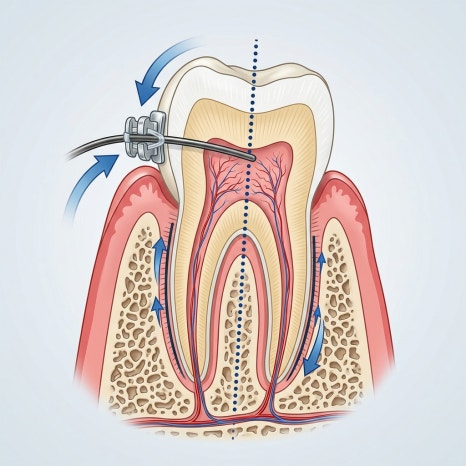
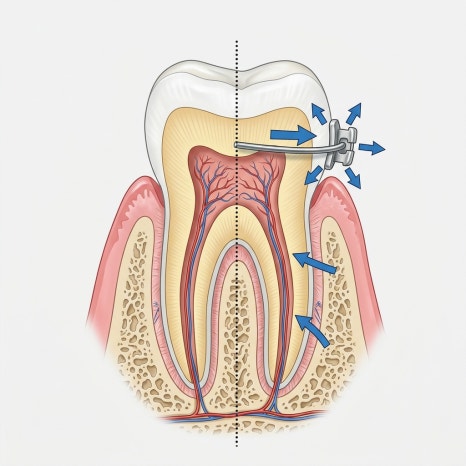
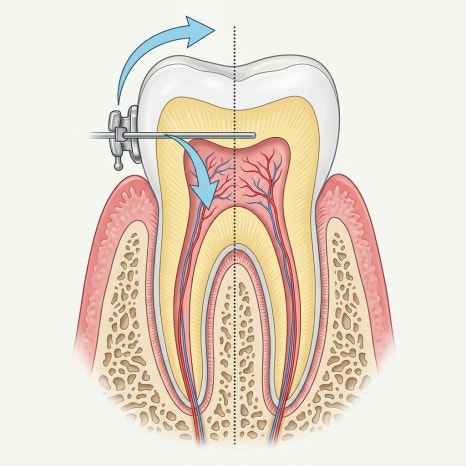
When pressure from the lips and tongue, chewing forces,
and natural changes that occur with age
are added to this,
teeth tend to try to return
to their original positions—a process known as relapse.
The important point is
that this is not a problem
only for people who have had orthodontic treatment.
Even people who have never had orthodontic treatment
may experience crowding
of the lower front teeth
as they age.
In current orthodontics,
“teeth move throughout life”
is considered an established principle.
That is why the concept of retention
focuses on “maintaining the result for as long as possible.”
In other words, retainers
are essential for maintaining the positions
of moved teeth over the long term.
| Chapter 2. When and How Much Does Relapse Occur? |
From this point on,
let’s look at the numbers.
First, half of all relapse
occurs within the first two years.
A long-term study by N University in the Netherlands
found that approximately 50% of all relapse
was concentrated in the first two years
after retention was discontinued.
That is why wearing retainers
for the first one to two years
after orthodontic treatment is most important.
And do not miss your regular checkups either.^^
Second, stability continues to decline over time.
The proportion of patients whose tooth alignment
was maintained at a clinically satisfactory level
dropped to approximately 30% after 10 years.
(Based on extraction orthodontic treatment.)
Third, wearing retainers for only two or three years
is not enough.
Lifetime retention is necessary
to prevent long-term relapse
and age-related changes.
| Chapter 3. Types of Retainers and Practical Care |
There are two main types of retainers.
Each has clear advantages and disadvantages.
Fixed retainers
are made by attaching a thin wire
to the back of the front teeth.
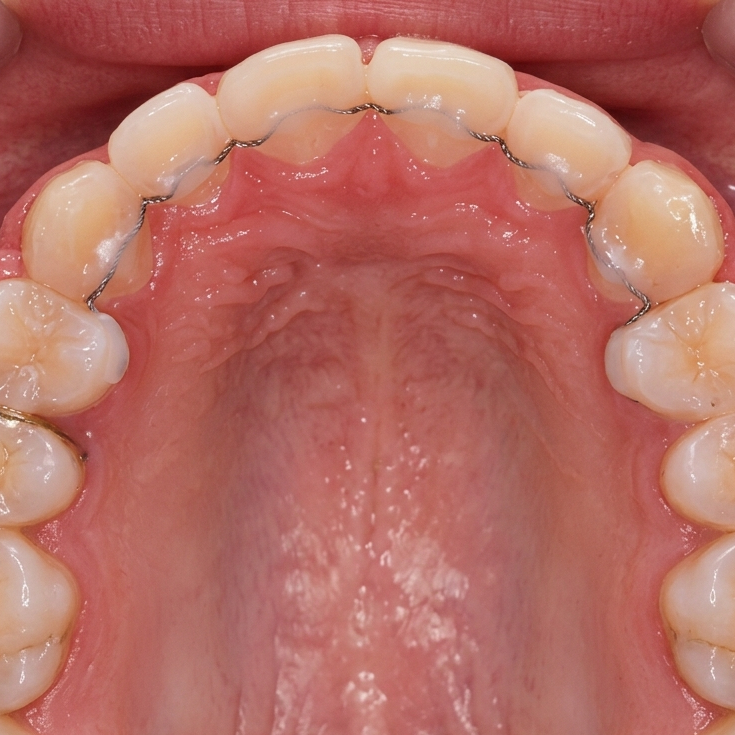
Example photo
Their greatest advantage
is that they provide 24-hour retention
without requiring you to think about them.
However, tartar can accumulate easily
on the inside of the teeth,
so you need to pay more attention
to gum health care.
The wire can also come loose or break.
Research shows that most problems with fixed retainers
are found within the first six months after bonding,
particularly during the first checkup
between three and six months.
That is why early checkups are important.
Removable retainers are easy to clean
and make gum care easier,
but since the results depend on your willingness to wear them,
not wearing them means they cannot do their job.
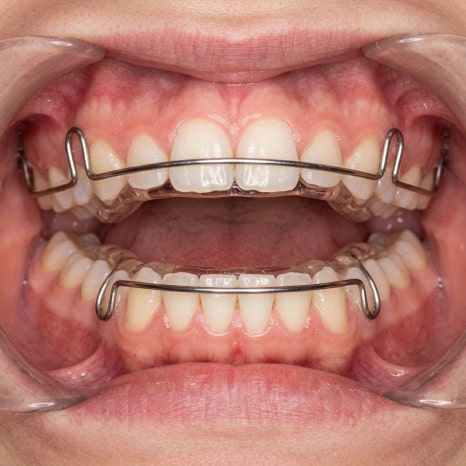
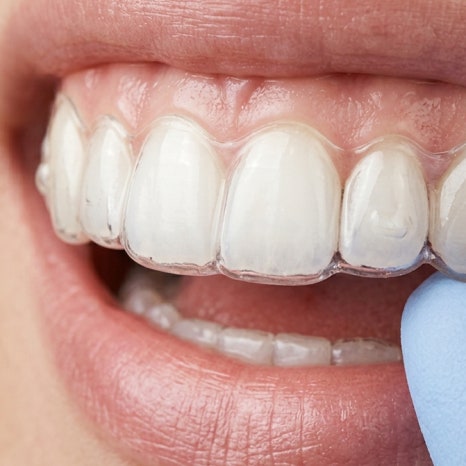
Example photos
You will also need to have them remade
if they are lost or become deformed.
The appropriate type varies depending on
the condition of your teeth, age, relapse risk,
and care habits.
Let’s summarize.
Lifetime retainer use is recommended.
Half of all relapse occurs
within the first two years, and if you do not wear your retainers,
your teeth will begin to move again.
So even if it feels bothersome,
do not skip your retainers;
wear them properly.
In particular, if a fixed wire
comes loose or breaks,
do not leave it as it is.
You should visit your dentist right away.
Retainers are the most affordable insurance
for protecting the results you worked two years to achieve.
Don’t forget.^^