Hello!
I am the director of Seoul Bardi Dental Clinic.
▼ Check the Dental Clinic Location ▼
| This post was written directly by Seoul Bardi Dental Clinic for the purpose of providing medical information, in compliance with Article 56, Paragraph 1 of the Medical Advertising Act. We recommend using the information provided for reference only. Please visit a medical institution and consult with a medical professional for an assessment of your symptoms and accurate guidance on how to manage them. All procedures and surgeries performed at the dental clinic may involve risks depending on the individual, such as inflammation, bleeding, and swelling. Please make your decision after having a sufficient consultation with a medical professional in advance. All images are example images created using AI. |
If you notice a thin vertical line
on a front tooth while looking in the mirror,
there is one thing you should know first.
Almost everyone with adult teeth
has lines like this.
The American Association of Endodontists (AAE)
classifies tooth cracks into five types.
Among them, a craze line
is the most common type, observed in most adults' front teeth.
It is limited to the surface of the enamel
and does not extend inward or reach the nerve.
(American Association of Endodontists)
The problem is that it is difficult to tell from a mirror
whether the line is a craze line
or a true crack that is progressing.
Even when the cracks are diagnosed as the same type,
the treatment decision
can vary completely from person to person.
By the time you finish reading this post,
three things will be clear.
-
Whether the vertical line on my front tooth is a dangerous type or not.
-
Whether treatment is absolutely necessary.
-
Whether the case is suitable for veneers,
or requires a crown.
Where Does a Crack in a Front Tooth Fall Among the Five Types?
The five types of cracks classified by the AAE are as follows.
- Craze line
A vertical line limited to the enamel.
No pain. Present in almost all adults.
- Cracked tooth
A crack extending from the chewing surface toward the gums.
Sharp pain when chewing.
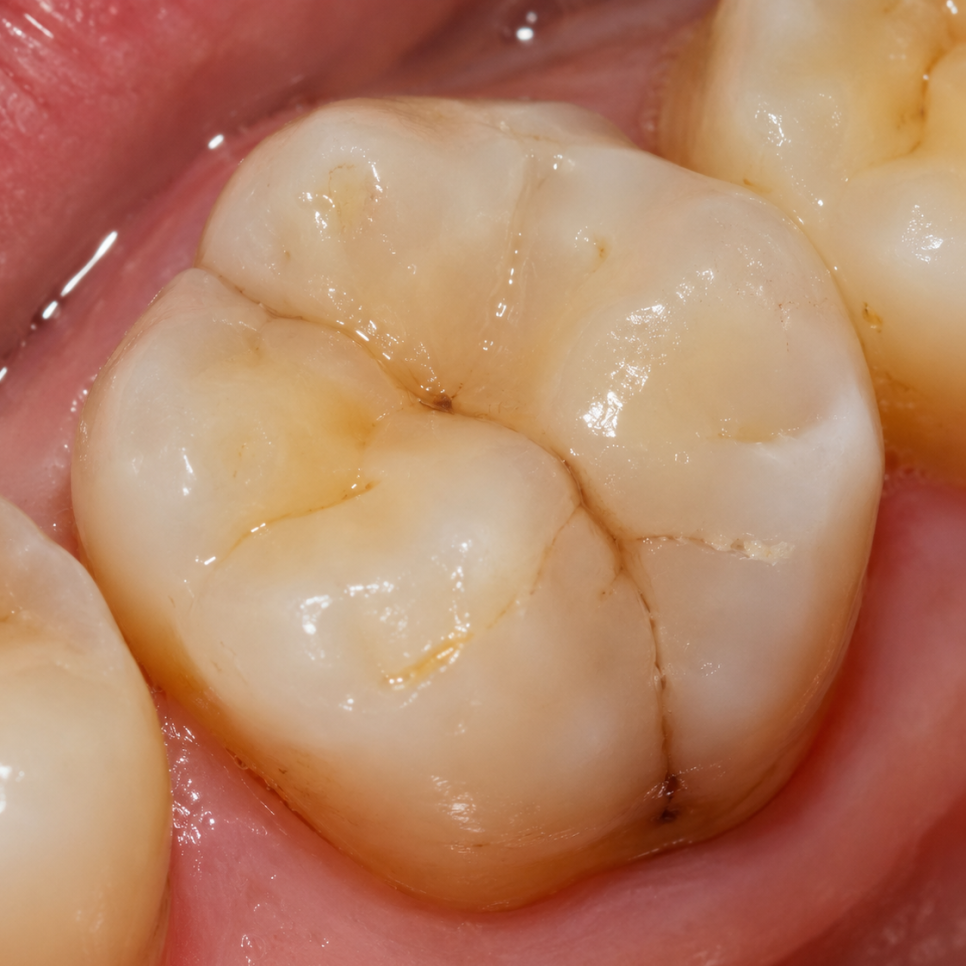
Example image
- Fractured cusp
A cusp that has broken around a restoration. Pain is usually mild.
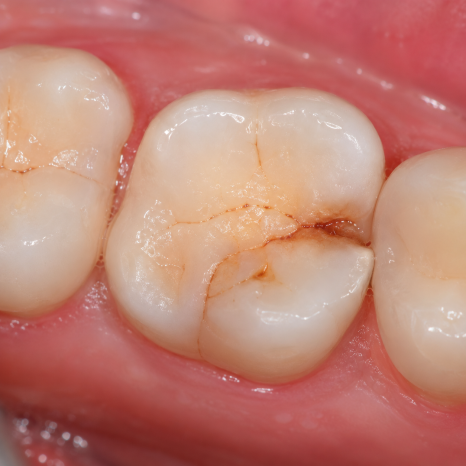
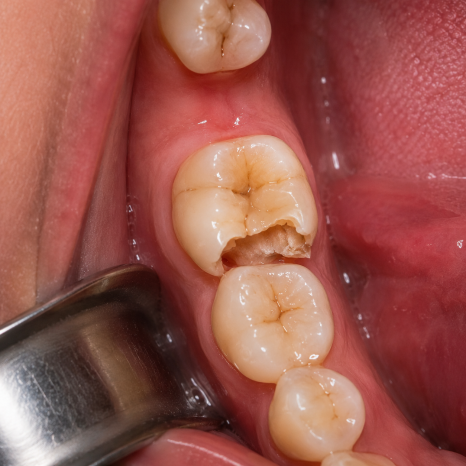
Example images
- Split tooth
A condition in which the crack has progressed and the tooth has split into two pieces.
- Vertical root fracture
A crack that begins in the root beneath the gums.
Extraction is often required.
The thin vertical lines visible in a mirror
are usually type 1, craze lines.
However, if they are accompanied by pain, sensitivity, or discomfort when chewing,
type 2 or a more serious condition should be suspected.
Why Craze Lines Do Not Need Treatment
Because they are limited to the enamel,
they do not affect the strength of the tooth.
They do not increase the risk
of the tooth becoming weak or breaking.
Craze lines also cannot be
physically removed.
Therefore, treatment is performed only for cosmetic purposes.
If the appearance does not bother you,
leaving it as it is is the right choice.
If cosmetic improvement is needed, there are three options:
whitening, composite resin, and veneers.
The Same Line, Different Treatments
The Decision Depends on the Bite
This is the key point in the diagnosis.
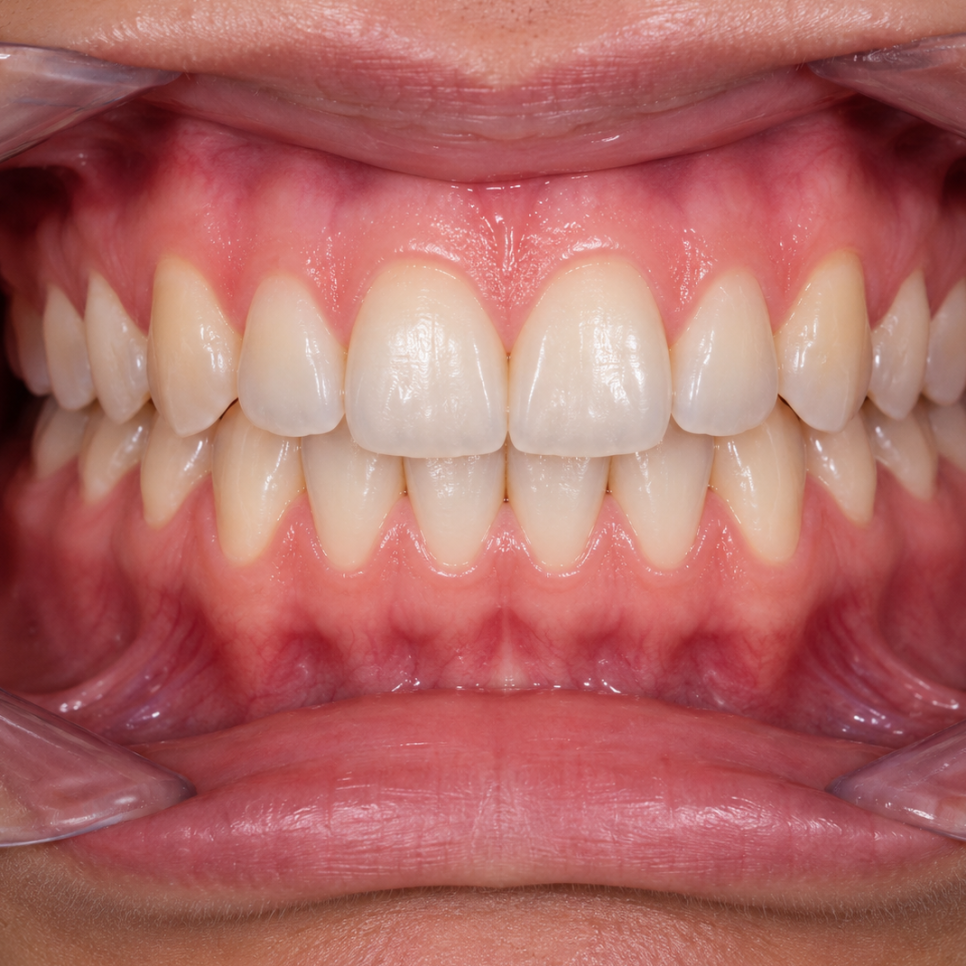
Example image
Even with the same craze line,
whether veneers are possible depends on the patient's bite.
Veneers may be difficult for people with
an edge-to-edge bite (where the tips of the upper and lower front teeth meet directly),
a crossbite, bruxism, or severe wear.
What happens if a patient with an edge-to-edge bite gets veneers?
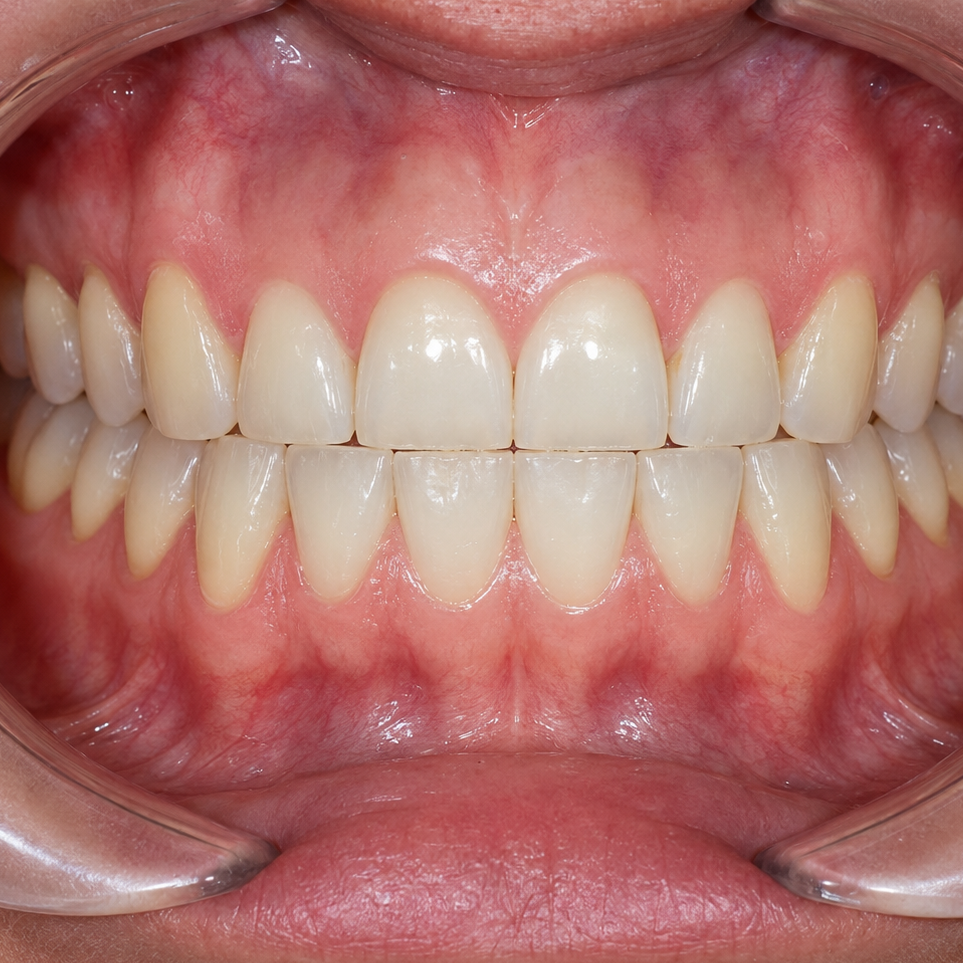
Example image
Every time the person chews, stress is transferred directly
to the thin ceramic,
which greatly increases the risk of fracture.
In this situation, stronger restorations,
such as zirconia or ceramic crowns (PFZ),
may be more suitable than veneers.
[Reference paper]
Skorulska A et al. (2014): Ceramic veneers are contraindicated in edge-to-edge and crossbite situations, with an increased risk of fracture due to excessive stress during function.
https://pmc.ncbi.nlm.nih.gov/articles/PMC3959137/
Conversely, if the bite is normal
(where the upper front teeth slightly overlap the lower front teeth)
and there is little wear,
veneers with minimal tooth reduction may be suitable.
When Discoloration Has Also Developed After Trauma
If a tooth became dark along the crack line
after an impact in the past,
a separate evaluation is needed.
If the discoloration is extrinsic staining limited to the surface of the crack line,
it can be sufficiently concealed with veneers or composite resin.
However, if the discoloration began inside the tooth,
the possibility of nerve damage
must first be checked.
If the nerve has been damaged, root canal treatment takes priority,
and the decision about a restoration comes afterward.
This is why a decision should not be made based only on the outside appearance.
Let me summarize.
The thin vertical lines visible in a mirror are usually craze lines and are generally harmless.
However, the treatment decision depends not on the shape of the line,
but on the bite, wear, and depth of the discoloration.
"Even with the same line,
the right treatment is the one that suits my bite."
[Summary of reference papers]
-
American Association of Endodontists — Five classifications of cracked teeth https://my.clevelandclinic.org/health/diseases/21628-fractured-tooth-cracked-tooth
-
Skorulska A et al. (2014) — Ceramic veneers contraindicated in edge-to-edge and crossbite situations https://pmc.ncbi.nlm.nih.gov/articles/PMC3959137/
-
Layton DM, Walton TR (2017) — Meta-analysis of veneer survival rates at 5–10 years (over 95%) https://pubmed.ncbi.nlm.nih.gov/28267817/
| Directions to the Clinic |