Hello!
I am the director of Seoul Bardi Dental Clinic.
▼ Check the Dental Clinic Location ▼
| This post was written directly by Seoul Bardi Dental Clinic for the purpose of providing medical information in compliance with Article 56, Paragraph 1 of the Medical Service Act. The information provided is for reference only. For an accurate assessment of your symptoms and appropriate care instructions, please visit a medical institution and consult with a medical professional. All procedures and surgeries performed at a dental clinic may involve risks depending on the individual, including inflammation, bleeding, and swelling. Please make your decision after having a thorough consultation with a medical professional in advance. All images were created using AI. |
| Directions |
There are stages of dental treatment when the financial burden can feel particularly significant.
Especially, crowns placed after root canal treatment are not inexpensive, so I often see people stop treatment after receiving only a temporary tooth.
Because the tooth that used to hurt no longer hurts after root canal treatment, you may find yourself thinking, “It hasn’t cracked, so maybe I can just keep using it as it is?”
Today, I will explain why this can be dangerous, together with the clinical evidence.
| Chapter 1. Why do root canal-treated teeth become weaker? — First, let’s address the misconception that they “become dry and brittle” |
It is commonly explained that “a tooth after root canal treatment loses moisture and becomes dry and brittle like an old tree.”
However, recent studies do not support this conventional belief.
The difference in moisture content between vital teeth and root canal-treated teeth is not substantial, and the strength of the tooth itself does not decrease significantly either.
(J Endod and multiple other studies)
The real reasons are twofold.
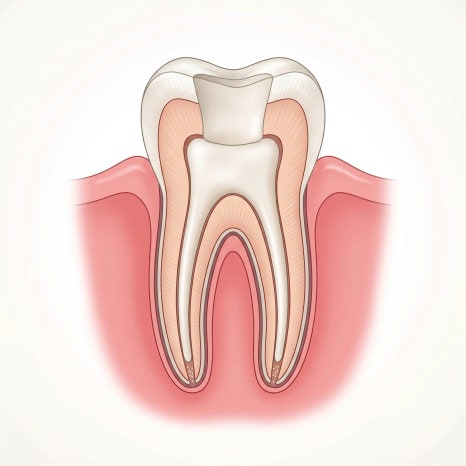
First, tooth structure has been lost.
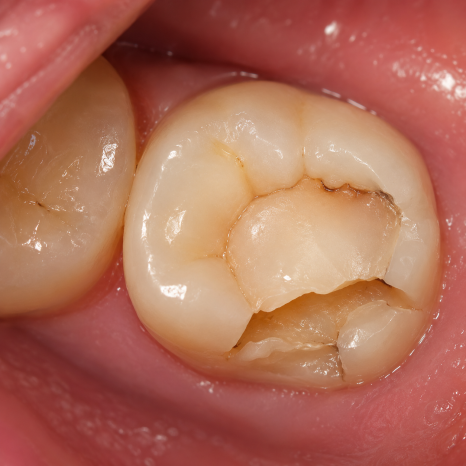
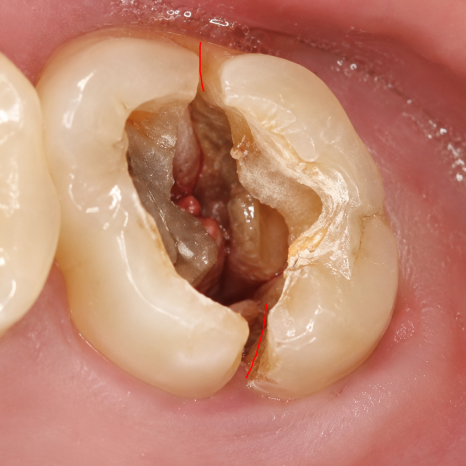
Example image
During the process of removing decay and widening the root canals, a considerable amount of hard tooth structure is removed.
The thinner the remaining walls become, the less able they are to withstand chewing forces, making the tooth more likely to split.
In fact, tissue loss is considered the primary cause of fractures, rather than the root canal treatment itself.
(Dental Update, 2025)
Second, the tooth no longer has a nerve.
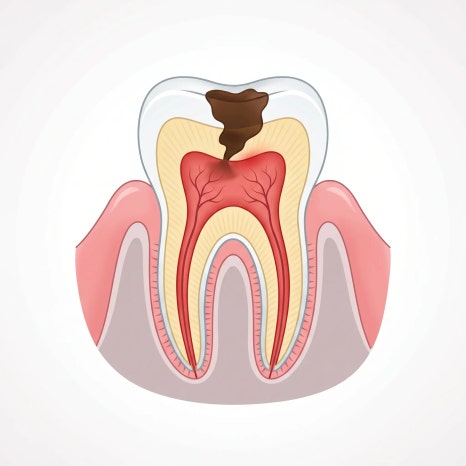
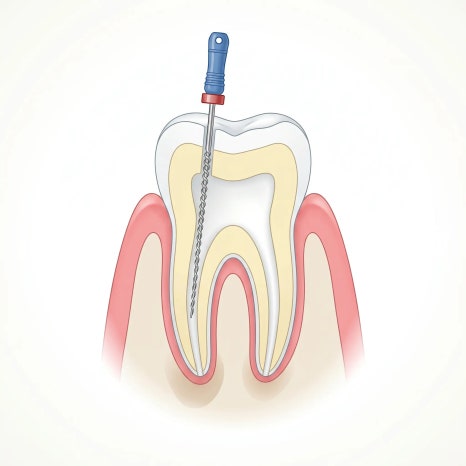
A tooth with a living nerve helps regulate biting force by sending a signal of “pain” when you bite down too hard. After root canal treatment, this sensory function is lost, so you may unknowingly chew with excessive force and experience a sudden crack.
That is why a crown is needed to surround the entire tooth and distribute the force—in other words, a strong helmet for the tooth.
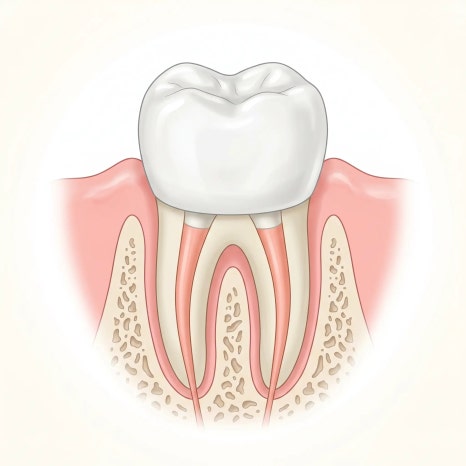
| Chapter 2. How long do teeth actually last after receiving a crown? — Looking at the numbers |
If you are wondering, “Do I really need to get a crown?” the statistics provide a clear answer.
In a large-scale follow-up study conducted in Switzerland, root canal-treated teeth whose cusps were not covered with a crown had a failure rate approximately six times higher over 9–10 years than teeth that received crowns.
In addition, molars with less than 30% of their tooth structure remaining had approximately three times the risk of extraction compared with molars retaining 30% or more.
(Cureus, 2025)
Conversely, one report found that properly crowned root canal-treated molars had a 7-year tooth survival rate of 99%.
(2022, study on partial-coverage crowns)
They are the same teeth, yet the outcome can differ this much depending on whether the final step of treatment is completed.
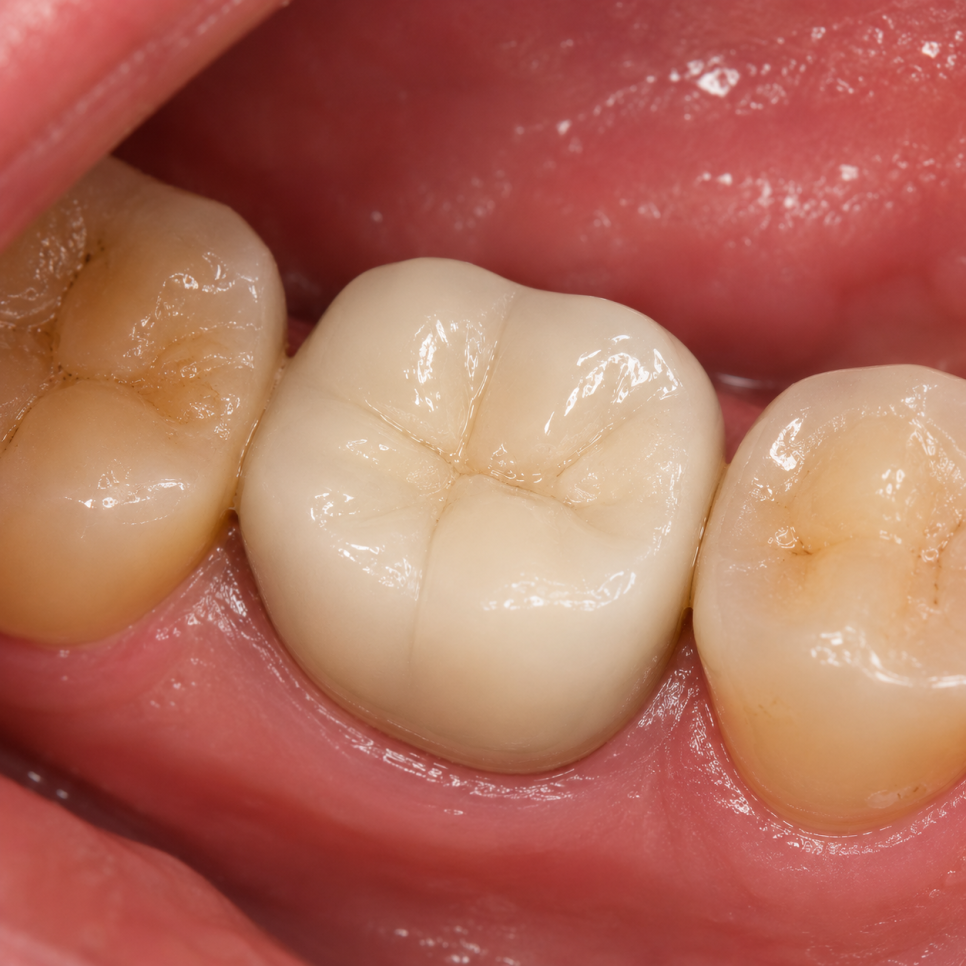
Example image
| Chapter 3. The real role of a temporary tooth |
Many people think of a temporary tooth as something that merely “fills an empty space,” but it actually serves several additional purposes.
- Maintaining daily function
— It allows you to eat and speak without problems during treatment.
- Protective barrier
— It protects sensitive areas exposed by tooth preparation from outside irritation.
- Preventing shifting
— It maintains the spacing so that the surrounding teeth do not tip into the empty space.
- Maintaining the shape of the gums
— It preserves the gum space where the final restoration will be placed.
In other words, a temporary tooth is the “foundation work” needed for the final restoration to fit accurately.
It is not the destination, but a stop along the way.
| Chapter 4. Why you should not keep using it for a long time even if it has not cracked |
When made properly, a temporary tooth may remain intact and last for quite some time.
However, a surface that looks fine does not necessarily mean that everything underneath is safe. Observational reports have found increased fractures and bacterial leakage in teeth that were left untreated.
(Cureus, 2025)
There are three reasons.
First, unlike a final restoration, a temporary tooth has a microscopically rougher surface, creating an environment where bacteria and food can adhere easily.
Second, with prolonged use, it wears down and microscopic gaps can form at the boundary between the tooth and the temporary tooth. If bacteria enter through these gaps, the root canal treatment you worked hard to complete can become compromised again.
Third, the cement inside gradually dissolves and becomes loose. Bacteria can multiply in the space and spread inflammation toward the root.
Ultimately, the situation may progress to the point where the tooth must be extracted.
In conclusion
A temporary tooth is not the final destination, but a stop where you stay temporarily. Do not leave it untreated just because it does not hurt now or has not cracked.
As the statistics show, whether the final step is completed can determine how long the tooth lasts.
If you are postponing treatment while using a temporary tooth, I recommend having it checked before it is too late.
Without unnecessary treatment, I promise to provide an honest answer about what you truly need right now.
Thank you. ^^
< We provide thorough care ↓↓>
[References]
Dental Update (2025) — Current concepts in restoring endodontically treated teeth
(Main cause of fractures in root canal-treated teeth = tissue loss)
Cureus (2025) — Remaining Tooth Structure and Prognosis of Restored Endodontically Treated Teeth
(Approximately six times higher failure rate without a crown; approximately three times higher extraction risk when less than 30% of the tooth structure remains; increased fractures and leakage when left unrestored)
J Endod — Are endodontically treated teeth more brittle