Hello!
I am the director of Seoul Bardi Dental Clinic.
▼ Check the dental clinic location ▼
| This post was written directly by Seoul Bardi Dental Clinic for the purpose of providing medical information, in compliance with Article 56, Paragraph 1 of the Medical Service Act regarding medical advertising. The information provided is for reference only. For an assessment of your symptoms and accurate guidance on appropriate care, please visit a medical institution and consult with a medical professional. All procedures and surgeries performed at a dental clinic may involve risks depending on the individual, such as inflammation, bleeding, and swelling. Please make your decision after sufficient consultation with a medical professional. All images were created using AI. |
When looking into dental implants,
you will likely hear the term “bone grafting” at least once.
Many people therefore assume that bone grafting is naturally performed along with every dental implant procedure,
but that is not actually the case.
Bone grafting is a treatment performed only for people who do not have enough bone.
If there is enough bone, it is not necessary,
but if there is not enough bone and an implant is placed anyway,
the implant may not last very long.
That is why it is truly important to accurately determine the condition of your bone.
Today, I will explain the criteria that determine whether bone grafting is needed,
and, together with the evidence, summarize why this difference can affect the lifespan of a dental implant.
| Chapter 1. Bone Grafting Is Not Necessary for Everyone |
First, there is something that should be made clear.
Not everyone who receives a dental implant also needs bone grafting.
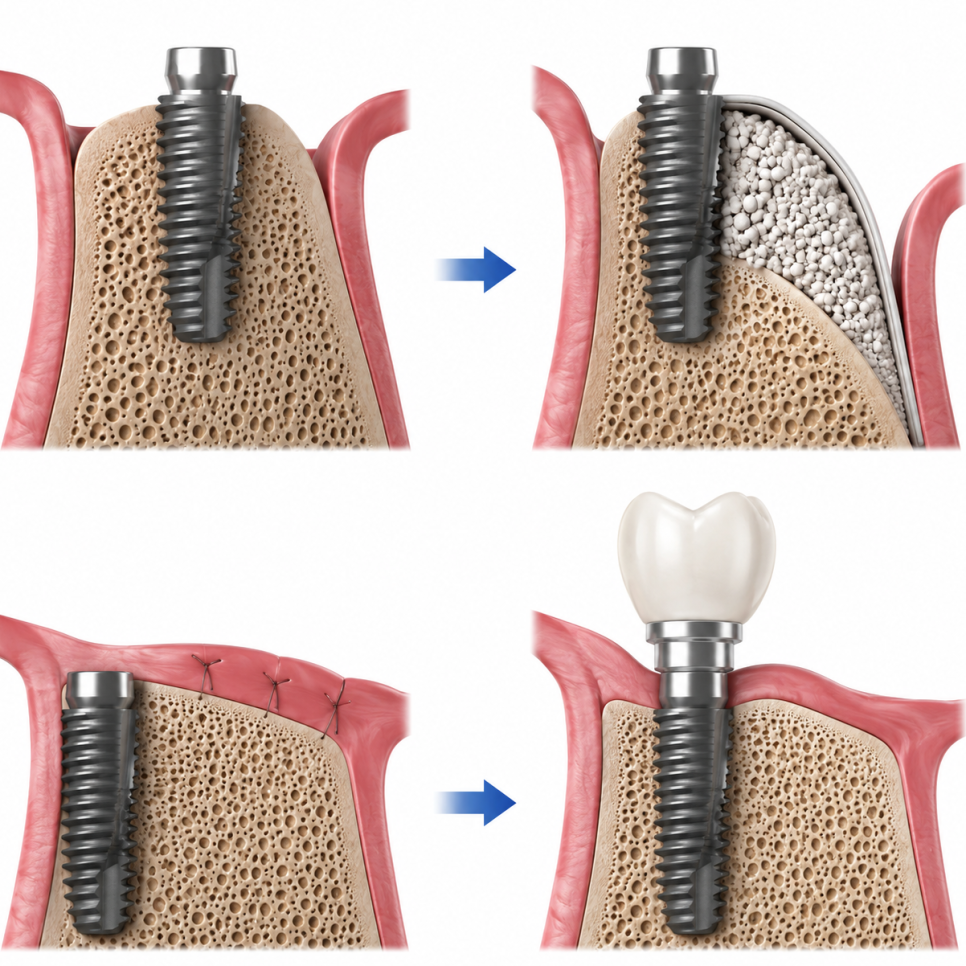
The single purpose of bone grafting
is to secure enough bone to firmly support the implant.
If there is already enough bone, there is no reason to perform it.
Cases Where Bone Grafting Is Not Needed
When there is no severe inflammation at the site where the tooth was extracted,
and sufficient alveolar bone remains to support the implant.
In this situation, the implant can be placed immediately without grafting.
Cases Where Bone Grafting Is Needed
When the alveolar bone has been lost due to chronic inflammation,
or when the bone has become narrow because the extraction site was left untreated for a long time.
In particular, if inflammation at the tip of the root has spread close to the nerve canal,
bone grafting is not an option but a necessity.
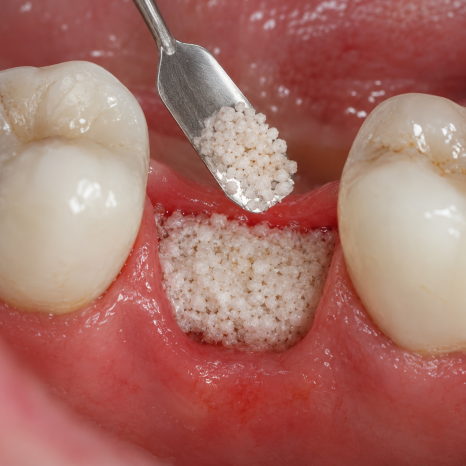
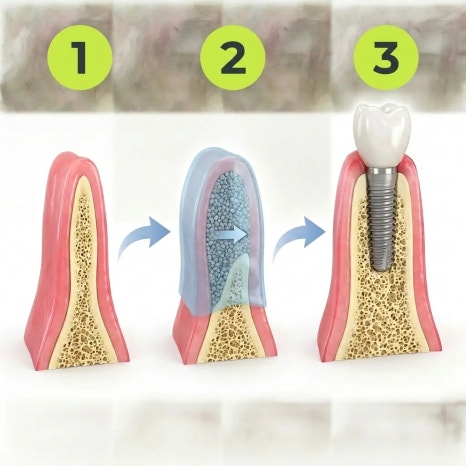
Example photos
Why is it necessary?
Because when the bone volume is insufficient, the bone must be reinforced to secure the implant’s stability and survival rate.
In fact, studies have found that implants placed in bone-grafted areas show a similar survival rate for at least 10 years to implants placed in areas where the original bone was sufficient.
(PMC, 2024 systematic review)
In other words, bone grafting fills in deficient bone and creates a foundation on which the implant can settle securely.
| Chapter 2. Why Is Insufficient Bone Risky? — The Inferior Alveolar Nerve |
The lower molar area is particularly challenging for anatomical reasons.
A large nerve called the inferior alveolar nerve runs beneath the tooth roots.
It is a pathway responsible for sensation in the lower part of the face and the lips,
so damage can leave numbness or a tingling sensation.
Damage to this nerve is considered the most serious complication of implant surgery
and may lead to permanent sensory disturbances, so special care is needed.
(PMC, 2025)
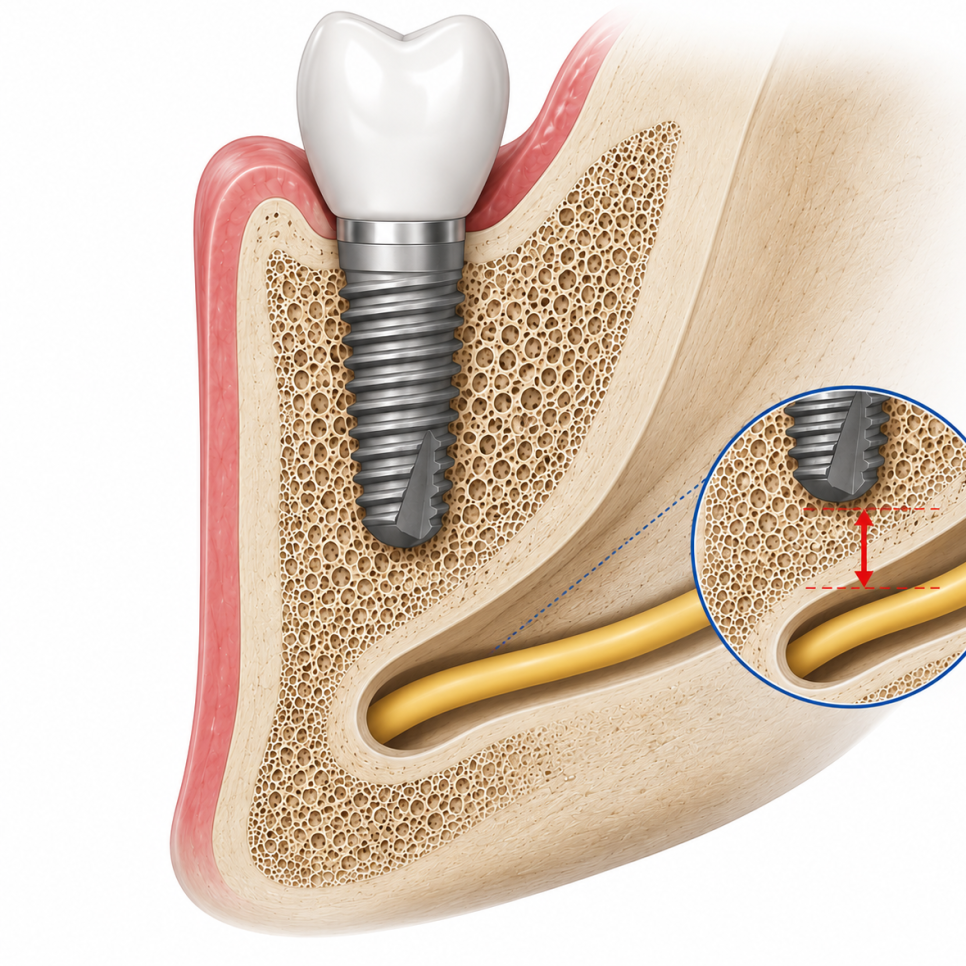
The key point here is “distance.”
According to a study, when the implant was placed at least 2 mm away from the mandibular nerve canal, the incidence of sensory disturbance was 0%.
However, when it was placed very close, at 0–1 mm, the incidence rose to 68%, and it reached as high as 53% when the nerve canal was invaded.
(Med Oral Patol Oral Cir Bucal, 2025)
The problem arises when bone loss reduces the distance from the nerve.
If the implant is placed shallowly to avoid the nerve in this situation,
the implant cannot be properly anchored in the bone and ends up almost floating. Naturally, it cannot be firmly fixed.
That is why bone grafting is needed: to fill the area where bone has been lost and secure a safe distance from the nerve.
It is like preparing the “ground” that will firmly support the implant first.
| Chapter 3. After Bone Grafting, the Waiting Period Is Just as Important |
An implant is not placed immediately after bone grafting.
The grafted bone needs time to integrate with the existing bone and harden firmly.
Implant osseointegration
(the process by which the bone and implant fuse together)
typically requires a healing period of approximately 3 months in the lower jaw
and approximately 3–6 months in the upper jaw.
When bone grafting is performed as well, the general principle is to wait that much longer.
(J Korean Assoc Oral Maxillofac Surg, among others)
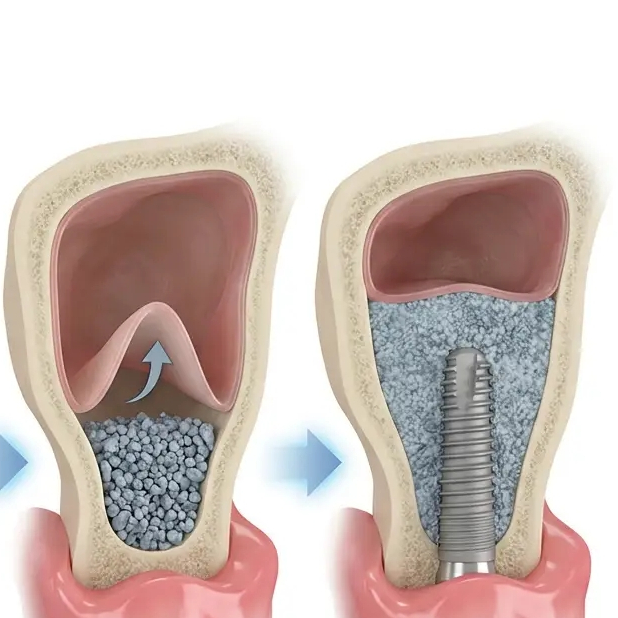
The statistics show why waiting is important.
In one large-scale study,
approximately 70% of implant failures occurred within the first year after placement,
and most were caused by inadequate initial osseointegration.
(PMC, 2025)
Natural teeth are not directly attached to the bone;
a cushioning structure called the periodontal ligament absorbs shocks.
However, implants do not have this cushioning structure and are in direct contact with the bone.
Therefore, if you forcefully chew hard foods before the bone has fully hardened,
the implant, which has not yet stabilized, may be unable to withstand the force and could become loose or fail.
That is why it is safer to confirm the degree of osseointegration using measurements (stability assessment),
rather than relying on the medical professional’s “feel,”
before placing the final prosthesis.
In Closing
To summarize:
Bone grafting is not necessary for everyone.
It is performed to secure safety and the likelihood of success when bone is insufficient or when the distance from the nerve is dangerously short.
Another factor just as important as bone grafting is allowing sufficient time for healing.
This is because most failures are determined during the initial osseointegration stage.
Bone grafting is not simply a procedure that extends the treatment period;
it is the foundational work needed to use the implant securely and reliably.
If you have been told that you may need bone grafting before receiving an implant,
it is advisable to first check the condition of your bone and the distance to the nerve.
Thank you for reading this long post. ^^
[References]
PMC (2024) — Dental Implants Placed in Grafted and Non-Grafted Sites: A Systematic Review
(Similar 10-year survival rates for implants placed in grafted and non-grafted sites)
Med Oral Patol Oral Cir Bucal (2025) — Inferior alveolar nerve damage related to dental implant placement
(Sensory disturbance by distance from the nerve canal: 0% at ≥2 mm, 68% at 0–1 mm)
PMC (2025) — Clinical Success Rates of Dental Implants with Bone Grafting
(Approximately 70% of failures occur within the first year)
J Korean Assoc Oral Maxillofac Surg, among others —
Osseointegration healing period (lower jaw: approximately 3 months / upper jaw: approximately 3–6 months)