Hello!
I am the director of Seoul Vardy Dental Clinic.
▼ Check the Dental Clinic Location ▼
| This post was written directly by Seoul Vardy Dental Clinic for the purpose of providing medical information, in compliance with Article 56, Paragraph 1 of the Medical Service Act regarding medical advertising. We recommend using the information provided for reference only. Please visit a medical institution and receive guidance from a medical professional for an assessment of your symptoms and accurate care methods. All procedures and surgeries performed at the dental clinic may involve individual risks, such as inflammation, bleeding, and swelling. Please make your decision after having a sufficient consultation with a medical professional. The treatment cases in this post were photographed with the consent of patients who completed treatment at our clinic, and the before-and-after photos were taken under the same conditions. |
| Directions |
A tooth that has undergone root canal treatment
may gradually turn black over time.
Many people come in surprised because they think it has decayed.
In most cases, however,
it is not tooth decay,
but discoloration that naturally occurs
after root canal treatment.
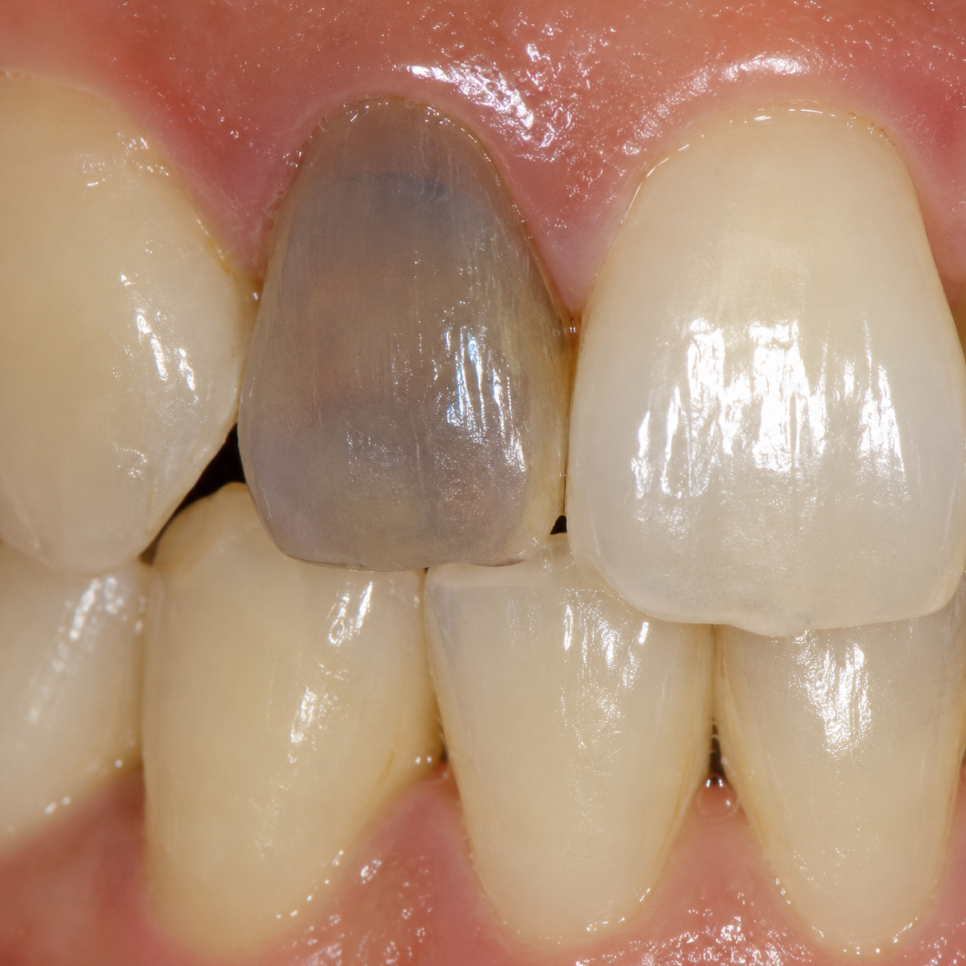
Example photo
However, there is a distinction between cases that can be left alone
and cases that need to be checked.
Today, I will explain why the color changes
and when it should be examined.
| Chapter 1. Why a Root Canal-Treated Tooth Turns Black |
A tooth that has received root canal treatment or
lost its vitality due to trauma
is called a “non-vital tooth.”
Because its blood supply has been interrupted,
its color may darken over time.
It is often explained as being “due to oxidation inside,”
but more precisely,
it is pigmentation caused by blood and tissue
decomposition products
penetrating the dentin.
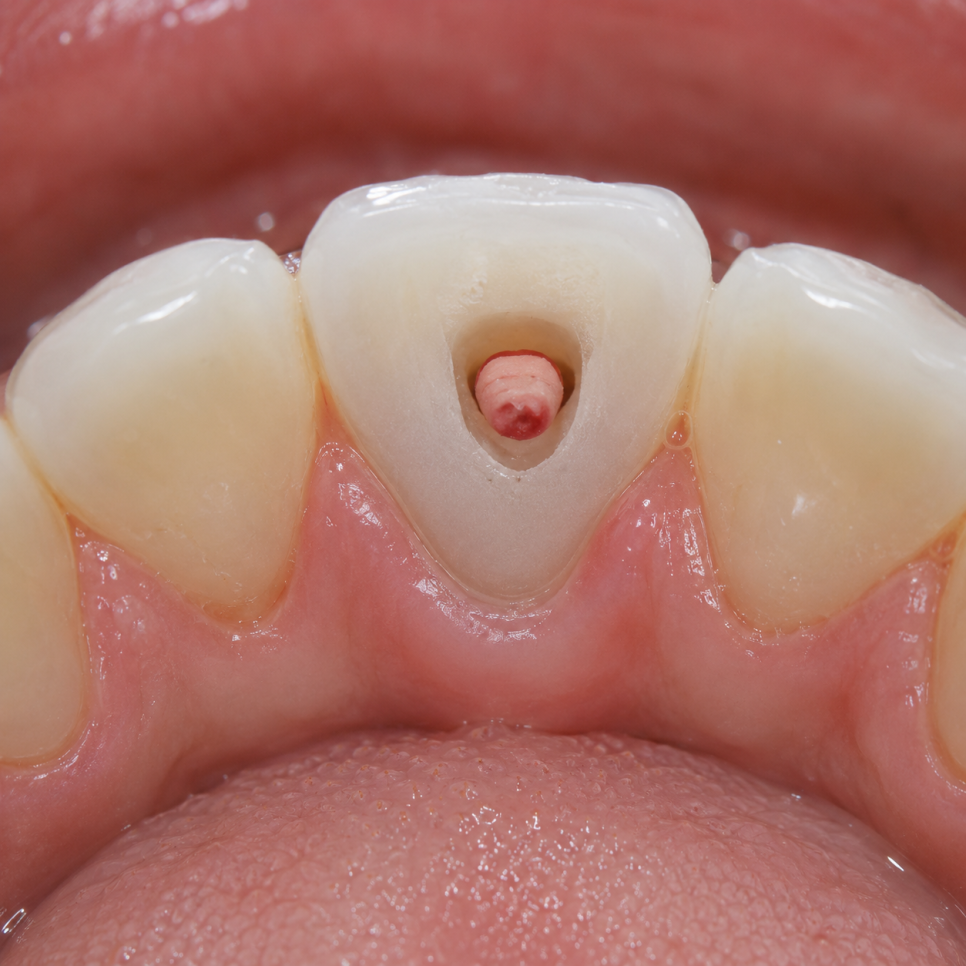
Example photo
Components such as iron released
when red blood cells break down
seep along the dentinal tubules,
causing the tooth to darken.
(Pocket Dentistry / StatPearls, 2024)
There are three main causes.
First, residual blood and nerve tissue components. Blood or tissue components
left in the root canal
may seep into the dentin and cause staining.
Second, old treatment materials. Some root canal treatment materials used in the past
may gradually darken the tooth
over time.
Third, pulp necrosis. In some cases, the internal nerve gradually dies
after trauma or another cause,
leading to discoloration.
The longer the tooth is left in a necrotic state,
the more severe the discoloration may become. (Dental News)
In particular, the enamel—the outer surface—of front teeth
is thinner than that of molars,
so the dark color of the underlying dentin
shows through more easily.
This is why discoloration is especially noticeable.
| Chapter 2. Discoloration May Be a Signal, Not Just a “Cosmetic Problem” |
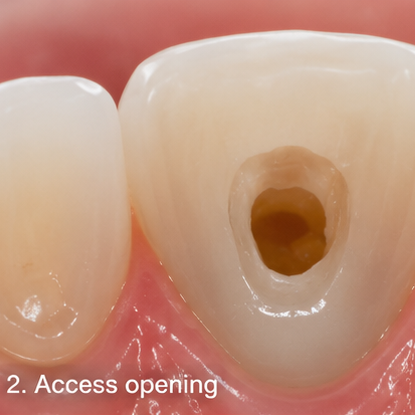
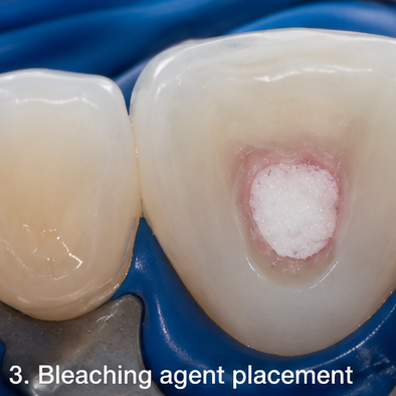
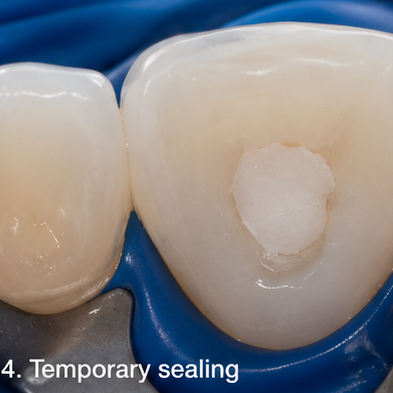
Example photo
If only the color becomes darker,
it could be considered a cosmetic issue,
but a discolored non-vital tooth
is often structurally weakened as well.
The reason a root canal-treated tooth becomes weaker
is not simply that it has “lost moisture,” as is commonly said.
Rather, hard tissue is removed during the process of eliminating decay
and enlarging the root canal,
and because the nerve is no longer present,
the tooth cannot regulate the force of chewing
on its own.
The longer a tooth has been discolored,
the longer it may have remained
in this structurally weakened state,
which also increases the risk of fracture.
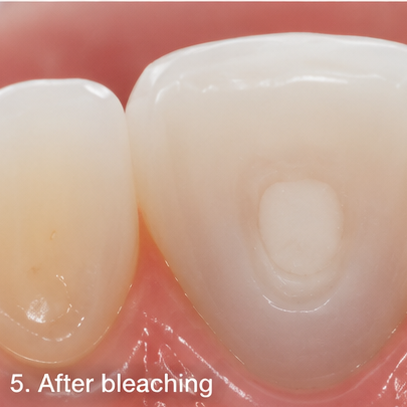
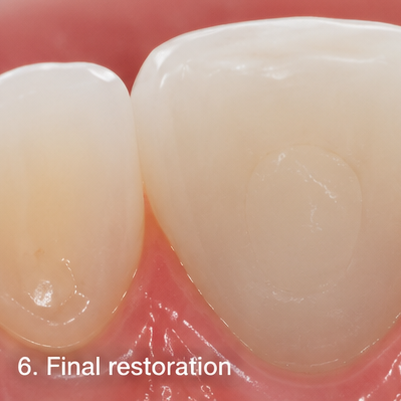
Example photo
Therefore, discoloration should not be viewed simply as a matter of “looking unattractive,”
but as a warning signal sent by the tooth.
| Chapter 3. So How Is It Treated? “Blocking” Comes Before Covering It |
A discolored non-vital tooth
cannot be resolved simply by placing a crown over it.
If the internal color is not addressed before covering the tooth,
the dark color will show through as it is.
Zirconia crowns in particular
have a characteristic degree of translucency,
so if the inside is dark,
that color can show through to the outside.
Therefore, an “opaque treatment”
is applied to the inside of the crown
to create a blocking layer.
The crown should then be placed
so that the dark discoloration does not show through
and the tooth blends naturally with the adjacent teeth.
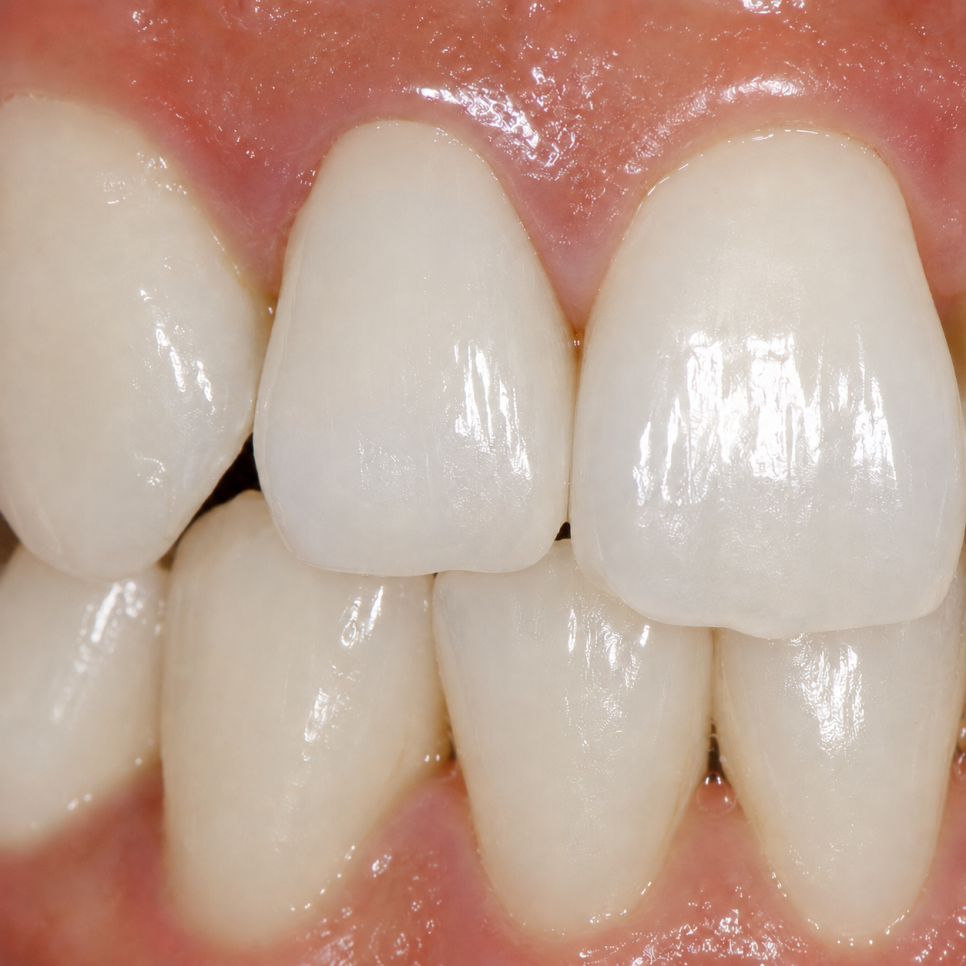
Example photo
Of course, a crown is not the answer for every discolored tooth.
If the remaining tooth structure is strong and the chewing forces are low,
more conservative options, such as internal bleaching,
may also be considered.
The appropriate method depends on the cause of the discoloration
and the condition of the remaining tooth structure.
Closing remarks
In summary:
A root canal-treated tooth
turning black is not necessarily due to decay,
but to discoloration caused by pigments seeping from inside the tooth.
In addition, a discolored tooth is often structurally weakened as well,
so it is difficult to dismiss it as merely a cosmetic issue.
When treating it,
it should not simply be covered.
The internal color should first be blocked,
after which the crown can be placed
for a natural-looking result.
If you notice discoloration
in a tooth,
it may be a signal from the tooth,
so we recommend having it examined at an appropriate time.
Thank you. ^^
[References]
StatPearls (2024), NCBI — Internal Tooth Whitening (causes of discoloration in non-vital teeth: bleeding in the pulp chamber, necrosis, residual pulp tissue, and remaining materials)
Pocket Dentistry / Greenwall — Discoloration of Teeth (penetration of blood decomposition products into the dentinal tubules)
Dental News (2018) — Bleaching of Non-vital Discolored Teeth (discoloration becomes more severe the longer necrosis continues)
J Endod and others — Causes of weakening in root canal-treated teeth (loss of tooth structure)