Hello!
I am the director of Seoul Bardi Dental Clinic.
▼ Check the dental clinic location ▼
| This post was written directly by Seoul Bardi Dental Clinic for the purpose of providing medical information, in compliance with Article 56, Paragraph 1 of the Medical Service Act regarding medical advertising. The information provided is intended for reference only, and we recommend visiting a medical institution to receive guidance from a medical professional regarding symptom assessment and accurate management methods. All procedures and surgeries performed at a dental clinic may involve risks depending on the individual, such as inflammation, bleeding, and swelling. Please make your decision after sufficient consultation with a medical professional. All images were created using AI. |
These days, many people of all ages consider clear aligners first.
Since visible wires and brackets can feel burdensome, this is a natural trend.
However, the question, “Can clear aligners treat everything?” needs to be answered accurately.
The conclusion is that clear aligners are well suited to some cases, while their limitations are clear in others.
Today, I will organize the criteria for you.
| Chapter 1. It is true that the range of cases treatable with clear aligners has expanded |
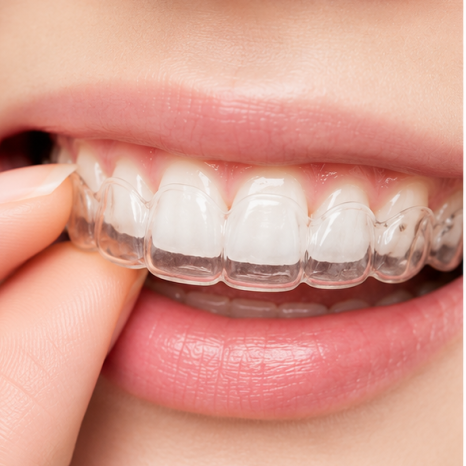
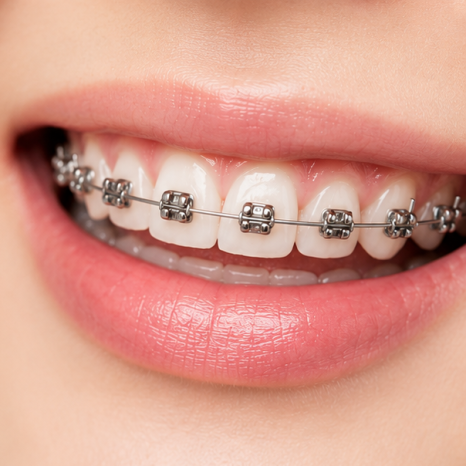
Example photos
In the past, clear aligners were mainly used to realign slightly crooked teeth after initial orthodontic treatment.
However, things are different now.
As digital technology has advanced, the range of applications has expanded to include crowded teeth, spaced teeth, and some cases of protruding teeth.
There is an assessment that advances in digital orthodontics have elevated clear aligners to an alternative for cases ranging from mild to some severe malocclusions.
(Cureus, 2023 / 2026 systematic review)
However, “expanded” does not mean “anything is possible.”
This is where things become important.
| Chapter 2. The honest limitations — Fixed appliances may be more advantageous for complex cases |
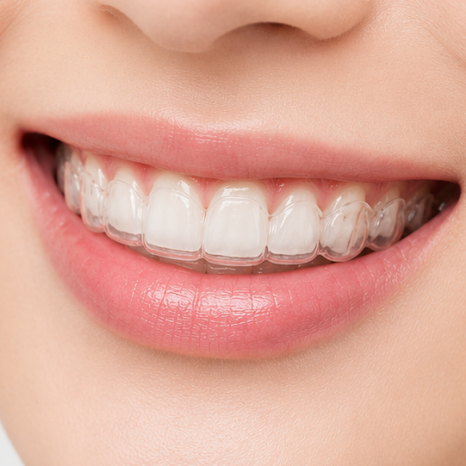
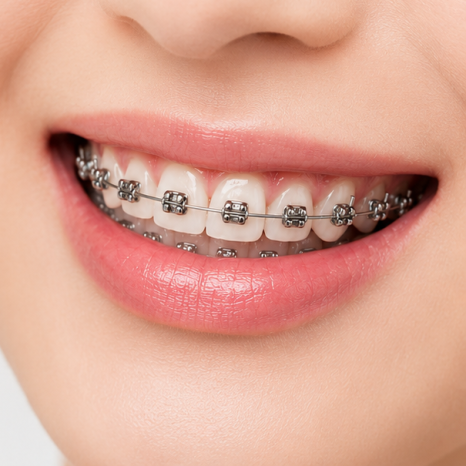
Example photos
Although clear aligners are often promoted as if they can do everything, they should be approached carefully.
According to a synthesis of several systematic reviews, clear aligners are effective for mild to moderate malocclusions, but outcomes have been reported to be less favorable in severe cases or for certain tooth movements.
(Clin Oral Investig, 2022)
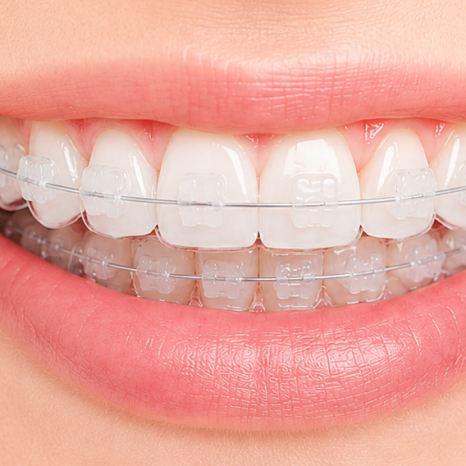
When precisely adjusting the bite or performing complex movements such as rotating or uprighting tooth roots, fixed appliances (wires) may actually be more accurate.
(Cureus, 2023)
Predictability also varies depending on the type of movement.
In one analysis, the predictability of tipping movements was high at 82.5%, while movements involving uprighting or rotating an entire tooth were relatively more difficult.
The more difficult the case, the more accurate it is to say that a diagnosis should first determine whether clear aligner treatment is feasible.
| Chapter 3. The real strengths of clear aligners — Precise planning and everyday convenience |
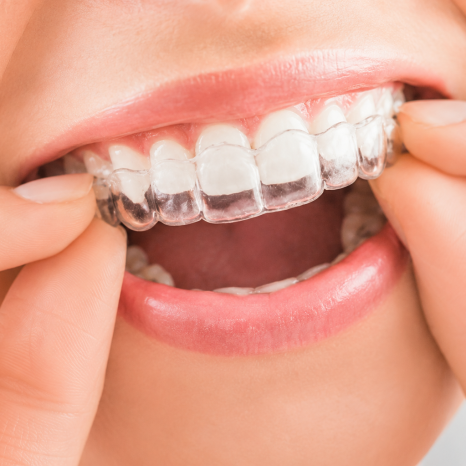
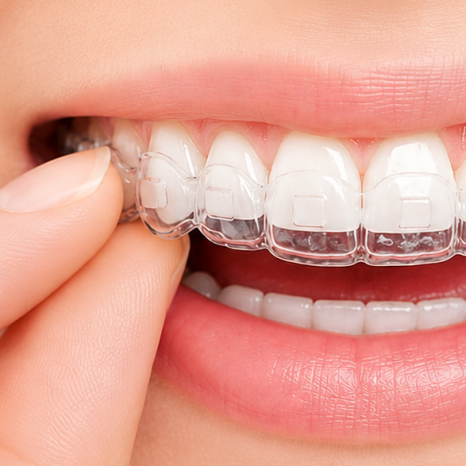
Where do the advantages of clear aligners come from?
Example photos
First, digital planning.
Instead of taking dental impressions as in the past, a 3D image is created with an intraoral scanner, allowing the treatment process to be simulated in advance.
Since patients can begin treatment with some understanding of the expected outcome, this can provide reassurance.
Second, everyday convenience and hygiene.
In practice, clear aligners have shown more favorable plaque and gum indices than fixed appliances, as well as better results in terms of pain and quality of life during treatment.
(J Evid Based Dent Pract, 2025)
There are also reports that the average treatment period is shorter in simple to moderate cases.
Fewer dental visits can also be advantageous for people staying abroad or those who have difficulty finding time for appointments.
(This can be helpful when wires cause discomfort by poking or when an appliance comes loose.)
| Chapter 4. The most important condition — Daily wear time |
The effectiveness of clear aligners depends not only on the performance of the appliance but also on how long it is worn.
The recommended wear time is 20–22 hours per day.
This means wearing them almost all day, except when eating and brushing your teeth.
Research has consistently shown that treatment outcomes are greatly influenced by adherence to the prescribed wear time.
(Decisions in Dentistry, 2025)
With fixed orthodontic treatment, once the appliance is attached, the orthodontist continuously controls the force. With clear aligners, however, removing and reinserting them is up to the patient.
Therefore, the advantage of being “comfortable” can turn into the disadvantage of “not being effective” if the aligners are not worn.
In closing
Here is a summary.
The range of cases treatable with clear aligners has expanded, and they have clear advantages in digital predictability, everyday convenience, and hygiene.
They are a good option for simple to moderate malocclusions.
However, they are not a universal solution for every case.
For complex or severe cases, fixed appliances may be more advantageous, so the first step is to determine through a diagnosis which option is appropriate for your case.
If you are considering clear aligners, rather than choosing a brand first, I recommend receiving a diagnosis to determine whether the condition of your teeth falls within the range that can be adequately treated with clear aligners.
This will help you make a choice that saves time and money.
Thank you.
[References]
Clin Oral Investig (2022, PubMed 34993617) — Overview of 18 systematic reviews on the clinical effectiveness of clear aligners (effective for mild to moderate cases; inferior for severe cases and certain movements; moderate level of evidence)
Cureus (2023) — Clear aligners vs. fixed appliances in complex cases involving extractions (fixed appliances may be superior in occlusion, torque, and precision)
J Evid Based Dent Pract (2025) — Meta-analysis of clear aligners vs. fixed appliances (clear aligners were superior in periodontal indices, quality of life, and pain; low-quality evidence)
Decisions in Dentistry (2025) — Recommended wear time of 22 hours per day; adherence influences outcomes