Hello!
I am the director of Seoul Bardi Dental Clinic.
▼ Check the dental clinic location ▼
| This post was written directly by Seoul Bardi Dental Clinic for the purpose of providing medical information, in compliance with Article 56, Paragraph 1 of the Medical Service Act concerning medical advertising. We recommend using the information provided for reference only. Please visit a medical institution and receive guidance from a medical professional to identify your symptoms and determine the appropriate management method. All procedures and surgeries performed at a dental clinic may involve risks depending on the individual, such as inflammation, bleeding, and swelling. Please make your decision after having a thorough consultation with a medical professional in advance. All images were used with AI. |
Clear aligners are known to be difficult when extensive tooth movement is required or when bite problems are severe.
Many people therefore give up in advance, thinking, “It probably won’t work for me.”
To get straight to the point, problems such as deep overbite and overjet can also be improved with clear aligners.
However, “possible” and “easy” are two different things.
Today, I will explain what these two conditions are, how far clear aligners can go, and what their limitations are.
| Chapter 1. What Are Deep Overbite and Overjet? |
Both are problems involving the “occlusion” of the front teeth, but they occur in different directions.
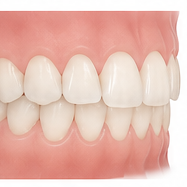
A deep overbite refers to excessive vertical overlap.
When the molars are brought together, the upper teeth excessively cover and conceal the lower teeth.
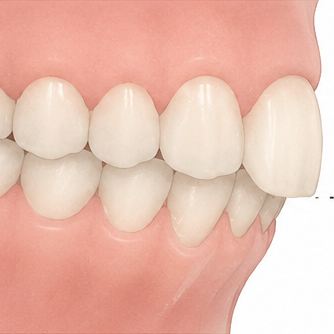
Example image
Overjet refers to excessive horizontal projection.
The upper front teeth extend significantly farther forward than the lower front teeth, creating a large horizontal gap between them.
These are not merely cosmetic issues.
If a deep overbite is left untreated, tooth wear may become more severe due to teeth grinding and clenching, and the condition may become more pronounced over time.
There have also been reports that a large overjet increases the risk of trauma, as the front teeth may collide and fracture.
Therefore, orthodontic treatment may be indicated not only for appearance, but also for function and protection.
| Chapter 2. Can Clear Aligners Treat Them? Yes, but These Are Among the Most Challenging Movements |
This is the key point.
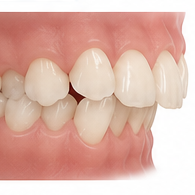
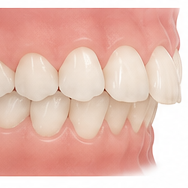
Example images
Clear aligners can indeed improve a deep overbite.
The approach involves slightly moving the front teeth inward (intrusion) and adjusting the molars to open up the deep bite.
(PMC, 2025)
However, this “vertical movement of the front teeth” is one of the movements that clear aligners handle with the greatest difficulty.
The difference is clear in research findings.
In patients with a deep overbite, when the first set of aligners was completed, only approximately 33% of the planned orthodontic movement was actually achieved.
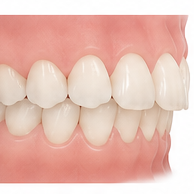
Example images
The plan called for 3.35 mm, but the actual reduction was only 1.15 mm.
Another study found that the average predictability of Invisalign for deep overbite was in the 39% range, and more than 95% of patients required additional orthodontic treatment (refinement) to achieve the planned result.
In other words, it is true that “a deep overbite can be treated with clear aligners,” but in most cases, additional treatment is required afterward, and it is uncommon for treatment to be completed in one round exactly as initially planned.
| Chapter 3. That Is Why Diagnosis Determines the Outcome |
Even with the same deep overbite, the level of difficulty varies greatly depending on its depth.
The deeper the overbite, the lower the predictability. In such cases, clear aligners alone may not be sufficient, so auxiliary devices such as elastics or orthodontic miniscrews (TADs) may need to be used to improve predictability.
In addition, if an adult whose jaw growth is complete has a severe skeletal problem, surgery may be necessary beyond the scope of clear aligner treatment.
Therefore, before starting treatment, X-rays and 3D scans are needed to accurately determine whether the cause of the bite is dental or skeletal and how deep the overbite is.
This diagnosis determines whether clear aligners alone will be sufficient, whether auxiliary devices will be needed, or whether surgery should be considered.
| Chapter 4. Why You Still Do Not Need to Give Up in Advance |
Looking at everything so far, you may think, “I guess it really is difficult,” but that is not necessarily the case.
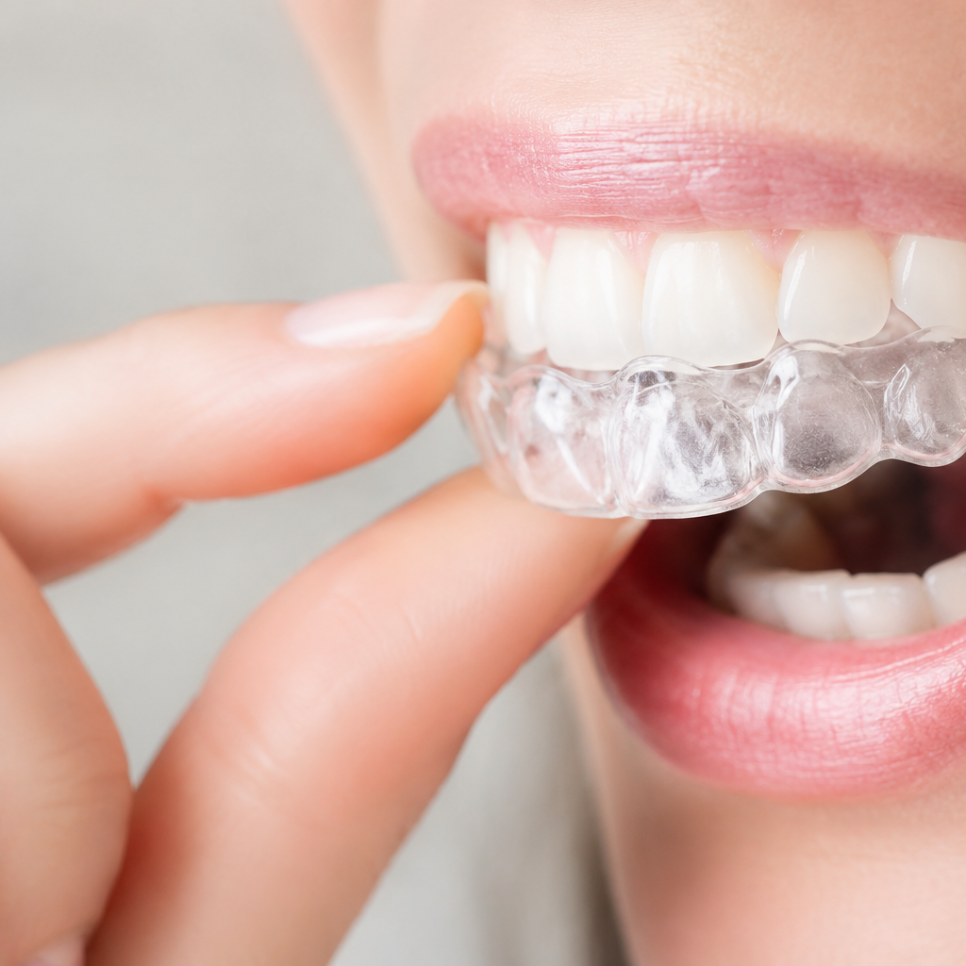
Example image
The key point is that “low predictability” does not mean “impossible.”
If treatment is planned with additional aligners and auxiliary devices in mind, mild to moderate deep overbite and overjet can often be sufficiently improved with clear aligners.
There have been reports of appropriately planned cases in which a deep bite was corrected, improving both the side profile and function.
However, the premise is not that treatment will be completed easily in a single round exactly as initially planned, but that it will be completed through gradual adjustments.
If you understand this difference before starting, you can continue through the entire process without becoming disappointed along the way.
In Closing
To summarize:
Deep overbite and overjet are bite problems associated not only with appearance but also with the risk of tooth wear and trauma, and they can be improved with clear aligners.
However, because a deep overbite involves one of the movements that clear aligners handle with the greatest difficulty, additional treatment is almost essential. In severe cases, auxiliary devices or surgery may be necessary.
Therefore, whether treatment is possible must be accurately determined through diagnosis.
Do not give up in advance by thinking, “It probably won’t work for me,” but also let go of the expectation that it will be easy to complete in one round. We recommend first receiving a diagnosis to determine what type of condition your teeth are in.
[References]
AJODO (2023) — Predictability of deep overbite correction using clear aligners (approximately 33% accuracy of deep overbite correction after the first set; planned 3.35 mm vs. actual 1.15 mm)
Clinical study (2021) — Average predictability of Invisalign for deep overbite was 39.2%; 95.3% required additional orthodontic treatment
PMC (2025) — Predictability of overbite reduction and Curve of Spee levelling in CAT (mechanism of anterior intrusion and molar adjustment; careful consideration is needed for virtual treatment planning)
AAO — Deep bite causes and corrections (definition, tooth wear when left untreated, consideration of surgery in severe adult cases)