Hello!
I am the director of Seoul Bardi Dental Clinic.
▼ Check the dental clinic location ▼
| This post was written directly by Seoul Bardi Dental Clinic for the purpose of providing medical information in compliance with Article 56, Paragraph 1 of the Medical Advertising Act. The information provided is for reference only, and we recommend visiting a medical institution to receive guidance from medical professionals regarding symptom assessment and accurate care methods. All procedures / surgeries performed at a dental clinic may involve individual risks, such as inflammation, bleeding, and swelling. Please make your decision after having a sufficient consultation with a medical professional. To aid understanding, all images were created using AI. |
When you sit in a dental chair,
you may have had thoughts like these:
"Was this instrument just sterilized?
Am I the first person it has been used on?"
It is natural to feel concerned since these instruments enter your mouth.

However, this is not simply a matter of feeling uneasy.
Even if the treatment is performed well, an infection at the surgical site
can cause the treatment itself to fail.
Infection control
is one of the conditions for treatment success.
Today, I will explain
why infection control in dentistry
is important,
what principles and evidence it is actually based on,
and what patients should check.
| Chapter 1. Why Is Infection Control 'Part of Treatment'? |

It is easy to think of infection control as simply creating an image of cleanliness,
but in reality, it is directly connected to treatment outcomes.
In particular, for procedures such as implants or extractions
that involve opening the gums and accessing the bone,
if bacteria enter the surgical site,
this can lead to inflammation, delayed healing, or failure.
Therefore, high-risk instruments that come into contact with tissue or bone
are thoroughly cleaned and then required to be sterilized
or treated with a chemical sterilant.
(ADA infection control guidelines)
In other words, sterilization is not optional;
it is a basic principle that must be followed.
| Chapter 2. Sterilization and Disinfection Are Different: Why the Method Varies by Instrument |
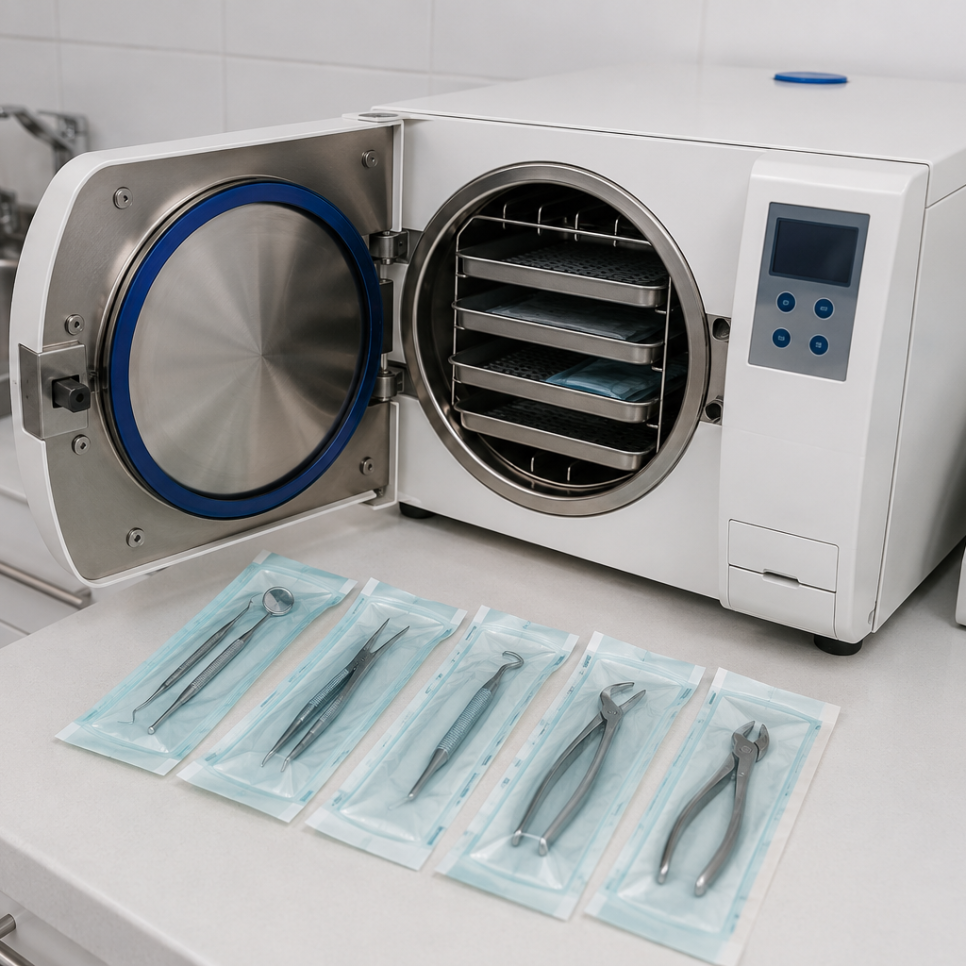
Not all instruments are processed in the same way.
The method varies depending on the material.
Heat-resistant metal instruments
are processed using pressurized steam sterilization (an autoclave).
This is the standard method of killing microorganisms
with high-temperature, high-pressure steam.
In contrast, instruments that are vulnerable to heat and may melt,
such as plastic instruments, cannot be placed in a sterilizer,
so they are immersed in chemical disinfectants
to remove bacteria and viruses.
(ADA · CDC)
The one-instrument-per-patient principle is also applied.
An instrument used for one patient
must not be used again
without cleaning and sterilization,
and disposable items should be discarded immediately after use.
| Chapter 3. The Meaning of 'Color-Changing Paper' and Common Misunderstandings |
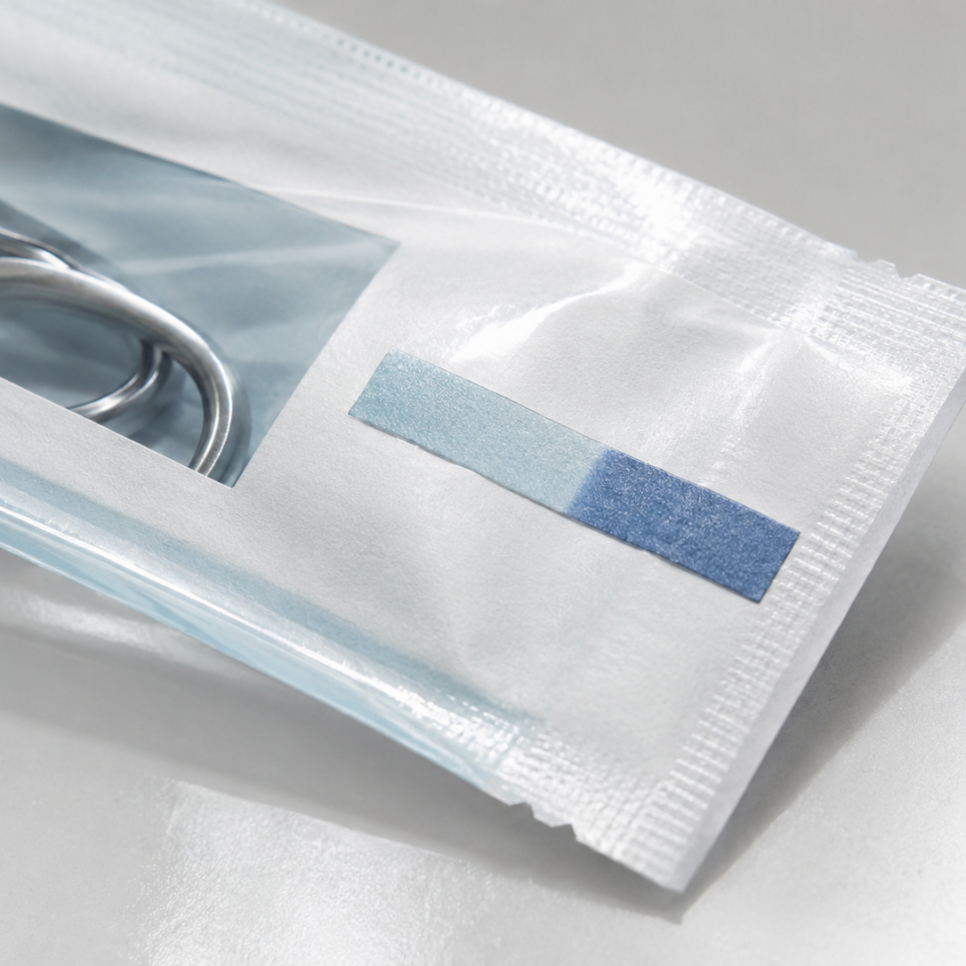
You may have seen the indicator on a sterilization package
change from blue to black
(or brown).
This is called a chemical indicator.
It is a device used to check whether sterilization steam
has properly penetrated inside the package.
If the color has not changed,
the instrument should not be used
and must be sterilized again.
(CDC sterilization guidelines)
However, one point needs to be clarified.
This color change indicates that the item
was exposed to the appropriate conditions (temperature and steam);
it does not, by itself,
prove complete sterility 100%.
Sterilization requires the appropriate temperature, time, and pressure,
which is why, in addition to the color indicator (chemical monitoring),
regular biological testing should also be performed.
(RDH / CDC)
Therefore, rather than saying "0% viruses,"
it is more accurate to say that microorganisms are removed
to a safe level through validated procedures.
The color-changing paper is what makes that verification visible.
| Chapter 4. It Is Not Just About the Instruments |
Infection control does not end with the instruments.
Dental care uses water for most procedures,
from scaling onward.
That is why water-quality management and surface disinfection must also be carried out,
and it is recommended that surfaces touched by patients
be wiped regularly with a high-level disinfectant.
One more point:
there is also evidence supporting pre-treatment mouth rinsing.
Studies have found that an antimicrobial mouth rinse before treatment
can help reduce bacterial contamination in dental aerosols
(the tiny droplets dispersed during a procedure),
so rinsing before an extraction or surgery may be helpful.
(ADA / Cochrane, 2022)
However, the certainty of evidence for this effect is low to moderate,
so it should be understood not as a "cure-all,"
but as an additional measure that may improve safety.

Today, I explained
why infection control in dentistry
is part of treatment.
Infection control is not about maintaining an image of cleanliness;
it is a condition for treatment success.
High-risk instruments are sterilized,
while heat-sensitive instruments
are processed with chemical disinfection,
and proper sterilization is verified
with color-changing indicators and regular testing.
Water and surface management,
along with pre-treatment mouth rinsing,
can further reduce infection risk.
However, rather than guaranteeing "0%,"
the key is to follow validated procedures.
When choosing a clinic, asking how its instruments
are managed
is not being overly particular at all.
It is, in fact, a natural right.
We will manage even the unseen areas
with honesty and care.
Thank you for reading this lengthy post.
[References]
CDC, Dental Infection Prevention and Control — sterilization and disinfection guidelines; do not use items when the chemical indicator has not changed color
American Dental Association — Infection Control and Sterilization (heat sterilization / chemical sterilization of high-risk instruments; resterilization when the color-change indicator fails)
RDH / Dimensions of Dental Hygiene — color change indicates exposure to temperature during processing; concurrent biological testing is recommended
Cochrane Systematic Review (2022) / ADA — reduction of bacteria in aerosols through pre-treatment mouth rinsing (low to moderate certainty of evidence)
| Directions |