Hello!
I am the director of Seoul Bardi Dental Clinic.
▼ Check the Dental Clinic Location ▼
| This post was written directly by Seoul Bardi Dental Clinic for the purpose of providing medical information, in compliance with Article 56, Paragraph 1 of the Medical Service Act regarding medical advertising. We recommend using the information provided for reference only. Please visit a medical institution and consult with a medical professional for an accurate assessment of your symptoms and appropriate care. All procedures and surgeries performed at a dental clinic may involve individual risks, such as inflammation, bleeding, and swelling. Please make your decision after having a thorough consultation with a medical professional. All images were created using AI to aid understanding. |
For people who have used dentures for a long time,
there are certain things they commonly say.

“I'm sick and tired of dentures now,”
and, “Before I die, I want to try implants too.”
This is especially true for people who have come to us
after eating nothing but soft foods such as porridge
because their dentures did not fit properly.
However, when they consider full-arch implants
for the entire upper and lower jaws,
many give up before they begin,
worrying about their age and the nearly
year-long treatment period.
Today, I will explain why using dentures
for a long time can become problematic,
whether it is actually possible to restore
the entire upper and lower arches with implants,
and how the process proceeds,
along with the supporting evidence.
| Chapter 1. Long-Term Denture Use Causes the Jawbone to Resorb |
There is one fact you should know first.
Dentures do not protect the jawbone.
When teeth are lost, the stimulation
that was applied to the bone disappears,
and the jawbone in that area gradually resorbs.
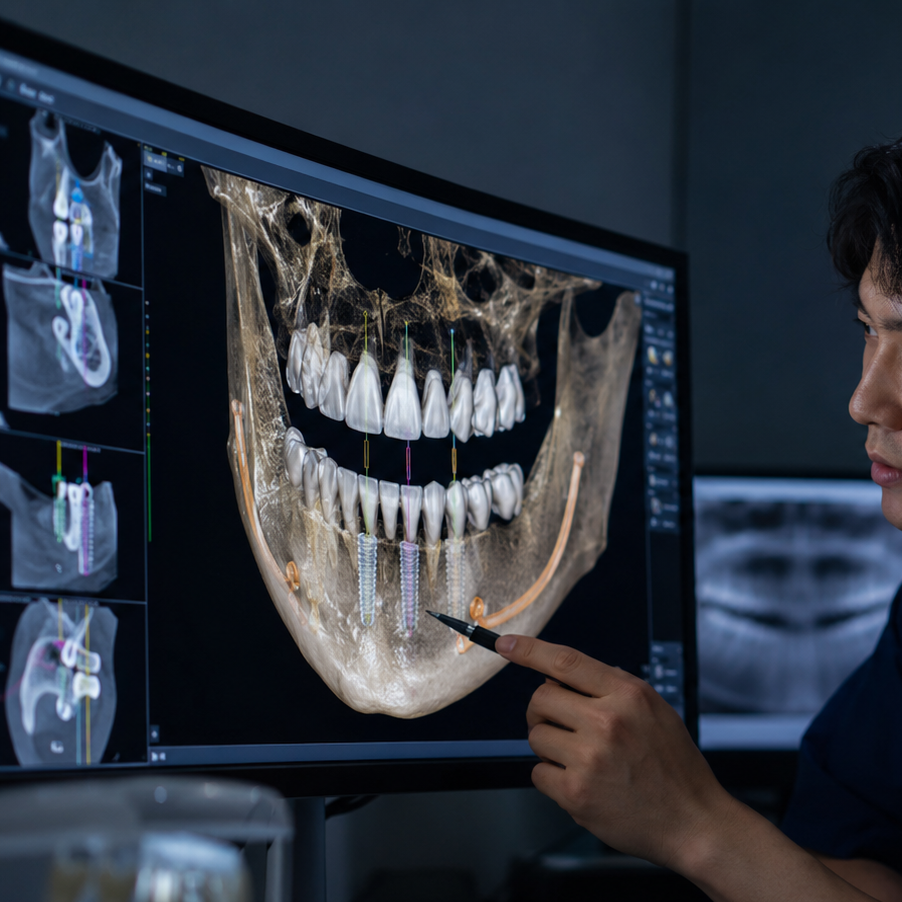
Bone loss after extraction reaches
40–60% during the first three years,
and continues gradually each year thereafter.
(Review of the literature, including Helmi 2019)
In addition, if poorly fitting dentures
apply inappropriate pressure to the gums,
that pressure can actually accelerate bone resorption.
(IntechOpen, 2021)
In other words, it is not simply a matter of saying,
“I can just manage with dentures.”
The bone continues to resorb
while you are managing with them.
As you delay treatment, there may be less bone available
for implant placement later, reducing your options.
| Chapter 2. Can the Entire Upper and Lower Arches Be Restored with Implants? If the Conditions Are Right, It Is Possible |
To give you the conclusion first,
full-arch implants are possible.
However, several conditions must be considered together.
Your overall health and medications,
the amount of bone that remains,
whether you can manage the treatment period,
and your budget all need to be taken into account.
A treatment plan is developed
by considering these factors together.
In particular, when the bone has significantly resorbed
after long-term denture use,
CT scans are used to analyze the remaining bone precisely
and plan in advance where and at what angles
the implants will be placed.
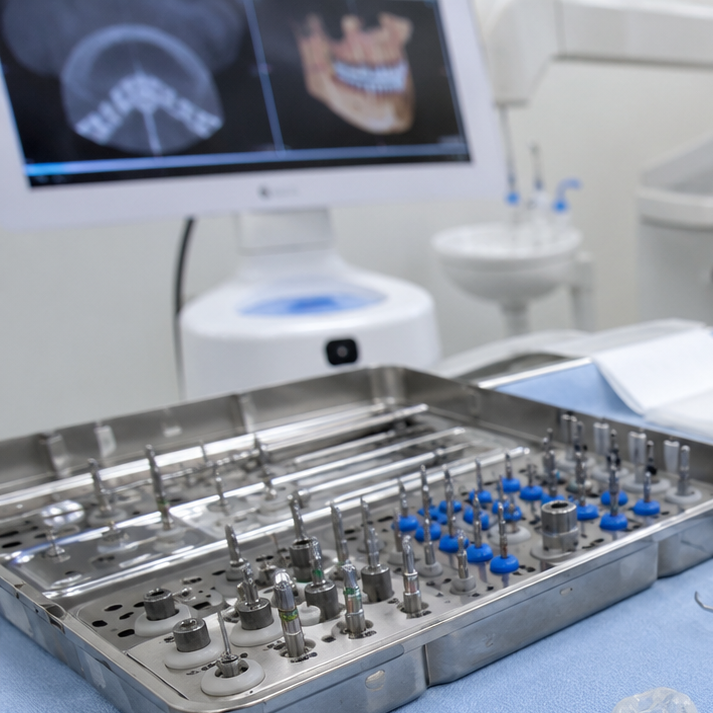
Restoring the entire arch
with an immediately fixed prosthesis
is considered a reliable alternative
to the traditional approach performed in multiple stages.
It can reduce the treatment burden
by avoiding unnecessary bone grafting
and reducing the number of implants.
(J Oral Maxillofac, 6-year follow-up study)
| Chapter 3. “Why Treat Both the Upper and Lower Arches in One Day?” To Shorten the Treatment Period |
Many people are concerned
before full-arch surgery.
They ask, “If the upper and lower arches are treated at once,
won’t there be a lot of bleeding and increased risk?”
Of course, treatment can also be divided into separate procedures.
However, if surgery is split into multiple sessions
when you cannot chew on either side,
the total treatment period becomes longer by that amount.
Therefore, when the conditions are suitable,
we may choose to place implants in the upper and lower arches
on the same day to shorten the overall treatment period.
The key here is the minimally invasive, flapless approach.
Rather than opening the gums extensively,
this method accesses only the areas that are essential.
Based on the available evidence, it can reduce bleeding,
swelling, operating time, and postoperative inflammation.
(PMC 2024 / Wiley 2022)
When a 3D plan is prepared in advance using CT
and navigation is used to determine
the placement angle and size,
the actual operating time does not increase substantially,
even for a full-arch procedure.
However, to be honest,
this is a technique-sensitive procedure
that depends greatly on the clinician’s expertise.
Therefore, precise preoperative planning and experience are essential.
(PMC, technique-sensitive)
| Chapter 4. Implant Placement Is Not the End |
The final teeth are not attached immediately
after the implants are placed.
This is because osseointegration,
the process by which the bone firmly bonds with the implants,
usually takes several months.
During this period, function and appearance
are maintained with temporary dentures
or temporary teeth.
(PMC, full-arch cases)
This is not simply a matter of filling empty spaces.
When someone who has been without teeth for a long time
suddenly has teeth again,
the jaw may feel unfamiliar and speech may feel awkward.
By adapting to temporary teeth for about two weeks,
you can become accustomed to the sensation of chewing,
while the height, color, and shape
of the final prosthesis can be adjusted together with you.

People who had been eating nothing but porridge
for a long time often say during the temporary-teeth stage,
“I don’t remember how long it has been
since my teeth last came together with a firm click.”
The final prosthesis can settle comfortably
only after going through this adaptation process.
The entire process generally takes
about six months to one year,
and multiple visits are required.
Therefore, above all, consistently attending
on the scheduled dates affects the outcome.
Today, I discussed the process of restoring
the entire upper and lower arches
with full-arch implants after long-term denture use.
Dentures do not protect the jawbone,
so the longer they are used, the more the bone resorbs,
and the fewer the conditions available later
for placing implants.
When the conditions are suitable, the entire upper and lower arches can be restored.
Minimally invasive treatment and digital planning
can reduce the burden,
but the treatment also includes waiting for osseointegration
after implant placement and adapting with temporary teeth.
Rather than postponing treatment by saying,
“I’m already older—why do it now?”
remember that the bone is continuing to decrease even now.
When you feel that it is already too late
may actually be when you still have the most bone remaining.
If your dentures are uncomfortable
or you are curious about full-arch implants,
we recommend first checking the current condition
of your bone with a CT scan.
If you have any questions,
please feel free to contact us at any time.
Thank you for taking the time to read this long post.
[References]
IntechOpen (2021) — Full Arch Rehabilitation with Dental Implants (overloading from ill-fitting dentures and alveolar bone atrophy caused by tooth loss)
Helmi MF et al. (2019) and other literature reviews — 40–60% bone loss during the first three years after extraction, followed by 0.25–0.5% annually
J Oral Maxillofac Implant Dent (2020, 6-year follow-up) — Immediate fixed full-arch restoration as a reliable alternative to the staged approach; cost reduction through fewer bone grafts and implants
Wiley Clin Implant Dent Relat Res (2022) / PMC (2024) — Reduced bleeding, swelling, operating time, and inflammation with flapless guided surgery; technique sensitivity
MSDI (2025) — High accuracy of navigated immediate loading for full-arch treatment (approximately 2.19° angular deviation)