Hello!
I am the director of Seoul Bardi Dental Clinic.
▼ Check the clinic location ▼
| This post was written directly by Seoul Bardi Dental Clinic for the purpose of providing medical information, in compliance with Article 56, Paragraph 1 of the Medical Advertising Act. We recommend using the information provided for reference only. For an assessment of your symptoms and accurate treatment guidance, please visit a medical institution and consult with a medical professional. All procedures and surgeries performed at a dental clinic may involve individual risks, such as inflammation, bleeding, and swelling. Please make your decision after having a sufficient consultation with a medical professional in advance. All images were created using AI to aid understanding. |
| Directions |
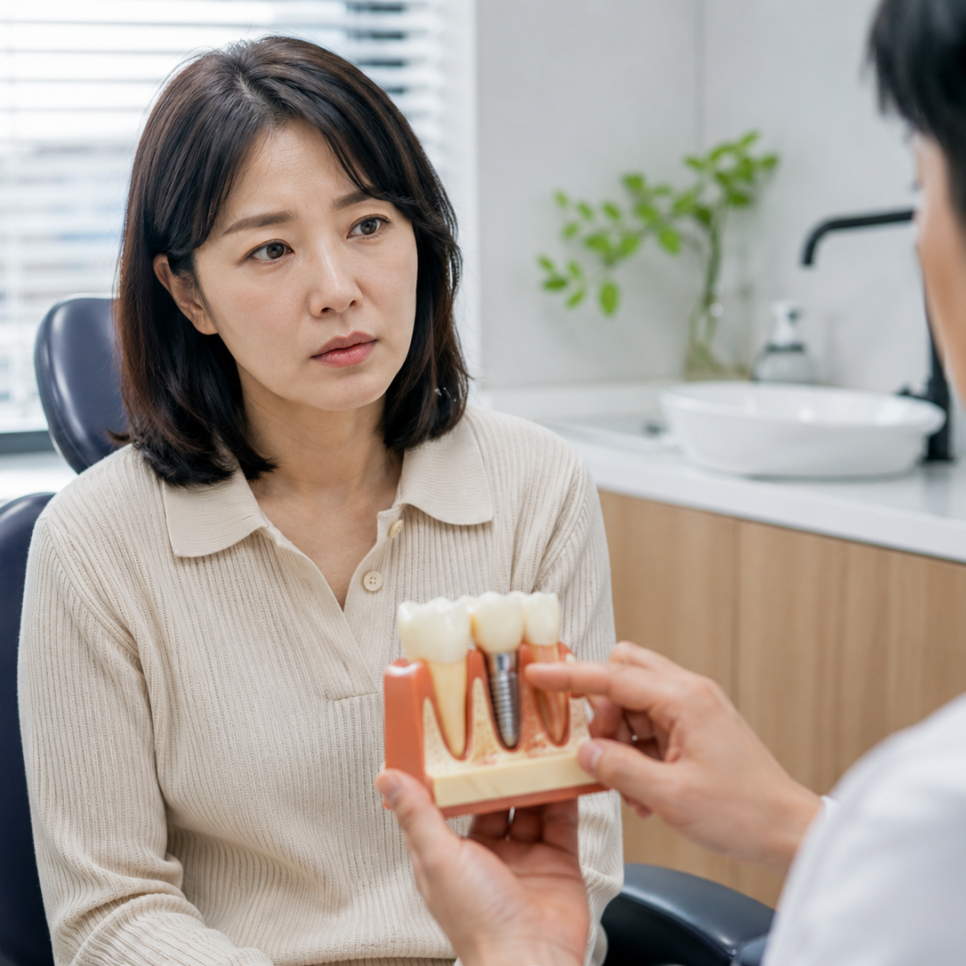
Many people think of surgery involving cutting and suturing the gums when they hear the word “implant” and become unnecessarily frightened.
However, these days, “flapless” or “non-incisional” implant placement—placing an implant without cutting the gums—is possible.
“You don’t even have to cut the gums? Then surely that must always be better.”
You may think so, but there are conditions you should know about.
This approach is not suitable for everyone.
Today, I will explain exactly what flapless implant placement is, what its advantages are and why it is possible, and who is and is not a candidate, together with the supporting evidence.
| Chapter 1. Why Were the Gums Opened in the Past? |
Let’s first look at the conventional approach.
An implant corresponds to the root of a tooth, so it must be placed in the jawbone beneath the gums.
For this reason, dentists used to cut open the gums, directly inspect the bone, and then place the implant.
The problem was that it was difficult to accurately determine the condition of the bone using only two-dimensional X-rays.
Sometimes, the actual findings after opening the area differed from the diagnosis, leading to an unplanned bone graft. In other cases, a bone graft that had seemed necessary turned out not to be needed.
There was an uncertainty of having to “open the area to find out.”
| Chapter 2. What Is Flapless Implant Placement? |
Flapless implant placement, as the name suggests, is a method of placing an implant without cutting the gums.
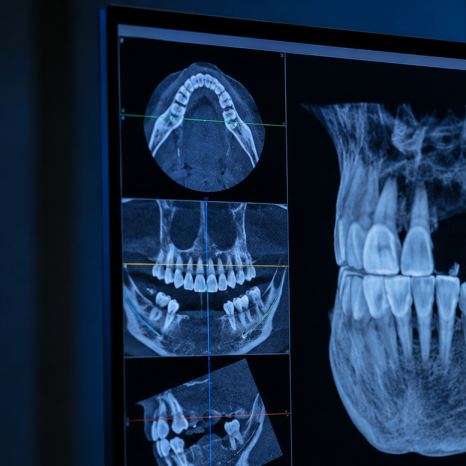
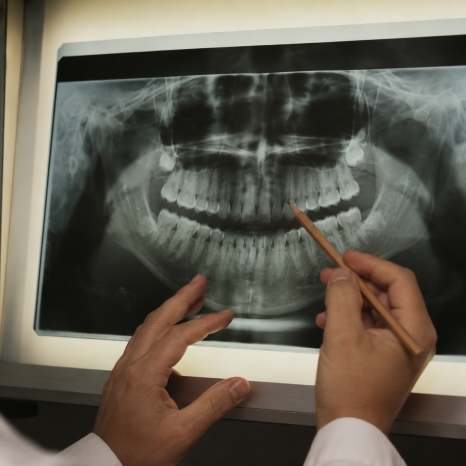
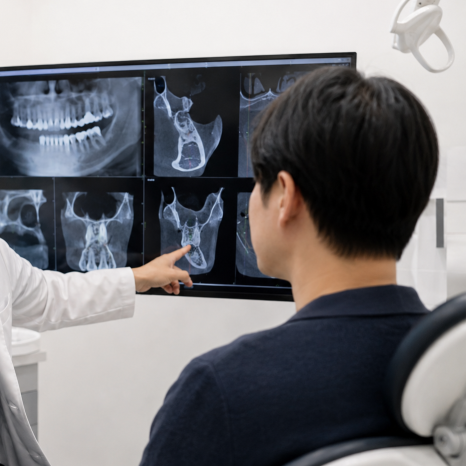
A small opening is made in the gums to place the implant, or the procedure is performed at the same time as extraction to avoid an incision.
This has become possible thanks to 3D CT and navigation (guided surgery) technology.
The shape of the bone, anatomical structures such as nerves, and even the shape of the gums can be assessed three-dimensionally in advance, so there is no need to open the area simply to inspect it.
In other words, the approach has changed from “opening the area to find out” to “viewing it in advance and planning the procedure.”
| Chapter 3. Three Reasons Why Flapless Implant Placement Is Beneficial |
There are clear reasons why people prefer flapless placement.
And these are not merely promotional claims; there is supporting evidence.

First, recovery is faster, with less swelling and bleeding.
Because the gums are not opened extensively, suturing is not necessary either.
In fact, flapless guided surgery has been reported to reduce bleeding as well as postoperative swelling and hematoma.
(Wiley Clin Implant Dent, 2022 / PMC, 2024)
Second, there is less pain.
Because there is less tissue damage, postoperative discomfort is reduced.
(PMC / 4M Dental)
Third, the procedure takes less time.
Since the incision and suturing steps are omitted, the procedure time is shortened.
(PMC literature)
| Chapter 4. Most Important: Flapless Placement Is Not Suitable for Everyone |
This is the point I most want to emphasize.
Just because flapless placement is beneficial does not mean it can be used in every case.
When there is insufficient bone and bone grafting or a sinus lift is required, opening the gums and performing the treatment accurately may actually be the appropriate option.
This is why, even though more than 90% of cases may be performed using a flapless approach, an incision is chosen when it is truly necessary.

Another point I would like to state frankly is that flapless placement is a technique-sensitive procedure whose outcome depends greatly on the operator’s skill.
Because the gums are not opened, the surgical site cannot be directly seen. Therefore, precise preoperative planning is essential; without it, the procedure may actually be risky.
(PMC, technique-sensitive)
That is why, rather than saying, “Please perform my implant without an incision,” the first step is to determine whether you are actually in a condition that allows flapless placement.
That assessment begins with a detailed CT analysis.
Today, I discussed flapless implant placement.
In summary, flapless implant placement is a method of placing an implant without cutting the gums. It has evidence-based advantages, including faster recovery and reduced swelling, pain, and procedure time.
However, 3D CT and navigation-based planning are prerequisites. When there is insufficient bone, an incision may be safer, and this approach is not suitable for everyone.
If you have been putting off an implant because you are afraid of having your gums cut, I recommend first having a CT scan to determine whether flapless placement is possible for you.
If it is possible, you may be guided toward a more comfortable option; if not, you can be advised on a safer approach.
I will honestly explain which options are possible for you at this time.
Thank you.
[References]
Wiley Clin Implant Dent Relat Res (2022) — Reduction in bleeding, swelling, hematoma, and procedure time with flapless guided surgery; preservation of periosteal blood flow
PMC (2024) — High precision and reduced trauma with computer-guided flapless surgery; technique sensitivity
4M Dental (2026) — Reduction in soft-tissue trauma, pain, and bleeding with flapless surgery
MSDI (2025) — High accuracy of navigation-guided surgery, particularly effective in complex cases