Hello!
I am the director of Seoul Bardi Dental Clinic.
▼ Check the Dental Clinic Location ▼
| This post was written directly by Seoul Bardi Dental Clinic for the purpose of providing medical information, in compliance with Article 56, Paragraph 1 of the Medical Service Act regarding medical advertisements. We recommend using the information provided for reference only. For an assessment of your symptoms and accurate guidance on treatment, please visit a medical institution and consult with a medical professional. All procedures and surgeries performed at dental clinics may involve risks depending on the individual, such as inflammation, bleeding, and swelling. Please make your decision after having a thorough consultation with a medical professional in advance. To help with understanding, all images were created using AI. |
When looking into dental implants,
you may come across the term
“navigation implants.”
Just from the name, it sounds as though,
like a car navigation system, they will
guide the way precisely.
In practice, they help make surgery faster and more accurate,
while avoiding the need to open the gums extensively.
However, there is a fact that is not widely known.
This accuracy is determined almost entirely
not on the day of surgery,
but during the “preparation process” beforehand.
Today, I will explain what navigation implants are,
why the preparation process determines the outcome,
and why they are not a universal solution,
along with the supporting evidence.
| Chapter 1. What Are Navigation Implants? A Method of Planning in Advance and Placing the Implant Accordingly |
Navigation implants are a method in which
surgery is simulated in advance using
CT and intraoral scan data,
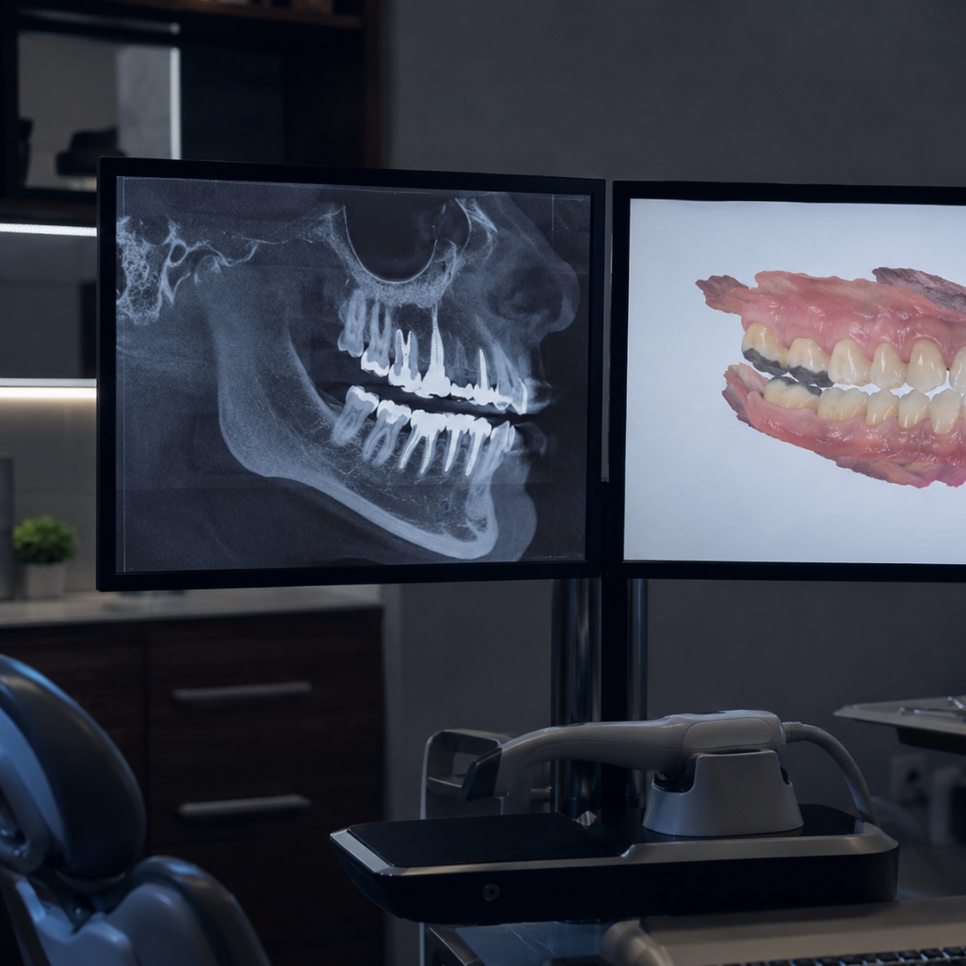
and a “surgical guide”
is created and used to guide implant placement
according to that plan.
The benefits are clear.
Computer-guided surgery is reported to provide
more accurate implant placement by reducing
deviations in placement position and angle
compared with a freehand approach that relies solely on tactile sensation.
(PMC, research on guided-surgery accuracy)
The nerves and bone positions are identified in advance,
so surgery can also be performed more quickly
without extensively opening the gums.
| Chapter 2. The Real Key to Accuracy |
This is the key point.
The accuracy of navigation implants comes
from the “preparation” more than from the equipment itself.
Two types of data are needed for navigation-guided surgery:
three-dimensional CT images showing the inside of the bone,
and a precise intraoral scan of the gum and tooth surfaces.
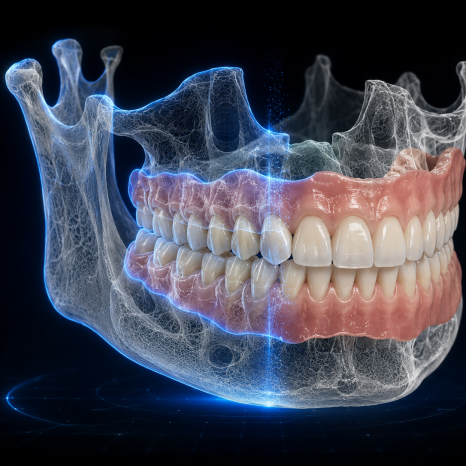
These two different datasets must be accurately aligned
using common reference points.
This process is called “merging.”
And this merging process
essentially determines the accuracy of the surgery.
According to research,
if the merging is inaccurate,
errors between the CT data and the scan
are transferred directly to the surgical site,
creating a difference between the planned position
and the actual implant position.
(PMC, research on merging accuracy)
In other words, even if the starting point is slightly misaligned,
that error remains throughout the process.
More importantly,
merging accuracy is not automatic.
Research reports that the results can vary considerably
depending on how the data is preprocessed
and who performs the process.
(PMC, 5599947)
That is why expertise in merging
can be considered the core expertise
behind navigation implants.
| Chapter 3. The “Preparation” Takes More Time and Hands-On Work Than You Might Expect |
This is why, contrary to the impression
that navigation implants involve “simple surgery,”
the preparation process is actually longer and more meticulous.
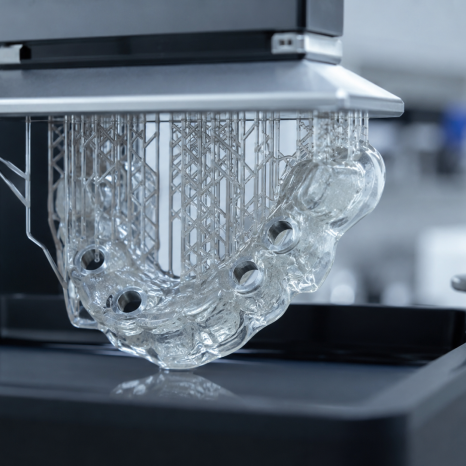
The two datasets must be merged,
the implant position, angle, and depth must be planned,
a surgical guide must be designed according to that plan,
then printed with a 3D printer,
followed by curing and post-processing.
Even with skilled hands, this work takes several hours.
The surgery itself is merely the stage
where the finished product of this preparation is “executed.”
That is why it is fair to say that accurate navigation implant treatment
is largely completed outside the treatment room,
at the design stage.
| Chapter 4. Even So, It Is Not a “Universal Solution”: Errors and Limitations |
I will also explain the limitations honestly.
Even when a guide is used,
errors do not become zero.
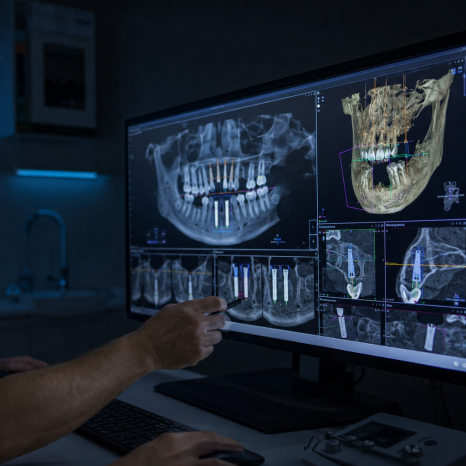
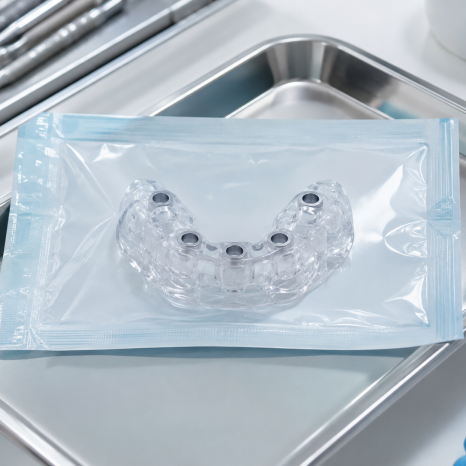
Digital guided surgery has also been reported to show,
on average, a deviation of around 1 mm
at the implant apex,
and approximately 3–5 degrees in angle.
(PMC, research on guided-surgery accuracy)
This means it is a tool that greatly improves accuracy,
not a magic solution that guarantees perfection.
Ultimately, the question is not “It must be accurate because it uses navigation.”
The outcome depends on how precisely the merging is performed
and what your individual oral conditions are.
Today, I explained where the accuracy
of navigation implants comes from.
To summarize,
navigation implants are more accurate than a freehand approach
and are advantageous for flapless procedures,
but their accuracy is determined not by the equipment itself,
but by the preparation involved in precisely merging
the CT and intraoral scan data.
If the preparation is inadequate,
those errors are transferred directly to the implant surgery,
and using a guide does not eliminate errors completely.
Therefore, when considering implants,
you should look not only at whether a clinic has navigation equipment,
but also at how precisely the treatment planning and design are carried out.
If you are curious, I recommend first checking
what conditions apply to your individual case.
If you have any questions, please feel free to contact us at any time.
I will explain the preparation process honestly as well.

[References]
PMC (12703900) — Static computer-guided surgery (sCAIS) provides greater placement accuracy than freehand surgery; integration of CBCT, intraoral scans, and prosthetically driven planning
PMC (8466254) — Merging CBCT and intraoral scans is fundamental to guided treatment planning