Hello!
I am the director of Seoul Vardi Dental Clinic.
▼ Check the dental clinic location ▼
| This post was written directly by Seoul Vardi Dental Clinic for the purpose of providing medical information in compliance with Article 56, Paragraph 1 of the Medical Service Act concerning medical advertising. We recommend using the information provided for reference only. Please visit a medical institution and receive guidance from a medical professional for an assessment of your symptoms and accurate care methods. All procedures and surgeries performed at dental clinics may involve individual risks, such as inflammation, bleeding, and swelling. Please make your decision after thorough consultation with a medical professional. All images were created using AI to aid understanding. |
When people hear the word “implant,” most think of only two parts:
the “screw placed in the bone”
and the “tooth placed on top.”
However, there is one more component that connects the two.
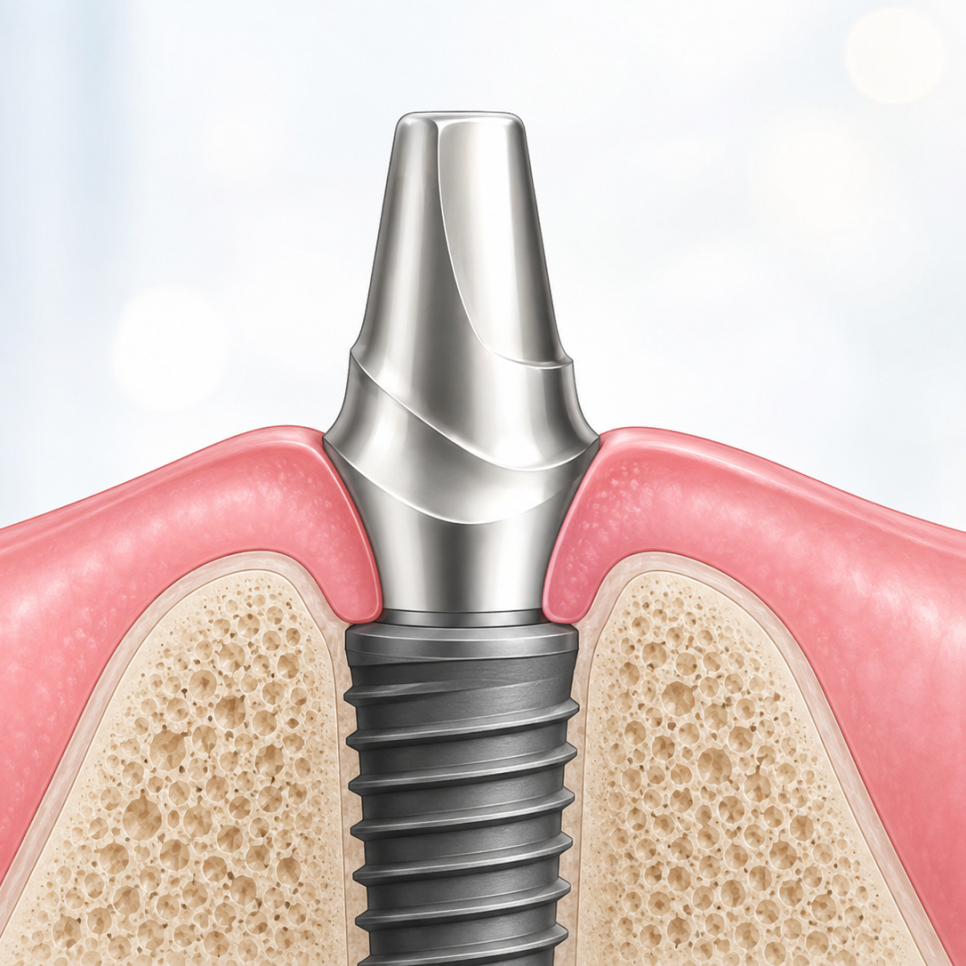
It is the “post (abutment).”
Because it is an intermediate component that is not easily visible, it is easy to overlook.
In fact, this post greatly affects the health of the gums around the implant.
Today, I will explain what this post is, how prefabricated and customized types differ, and why customization can make a difference in gum inflammation, along with the supporting evidence.
| Chapter 1. Implants Are Actually Divided into “Three Components” |
Let’s start with the structure of an implant.
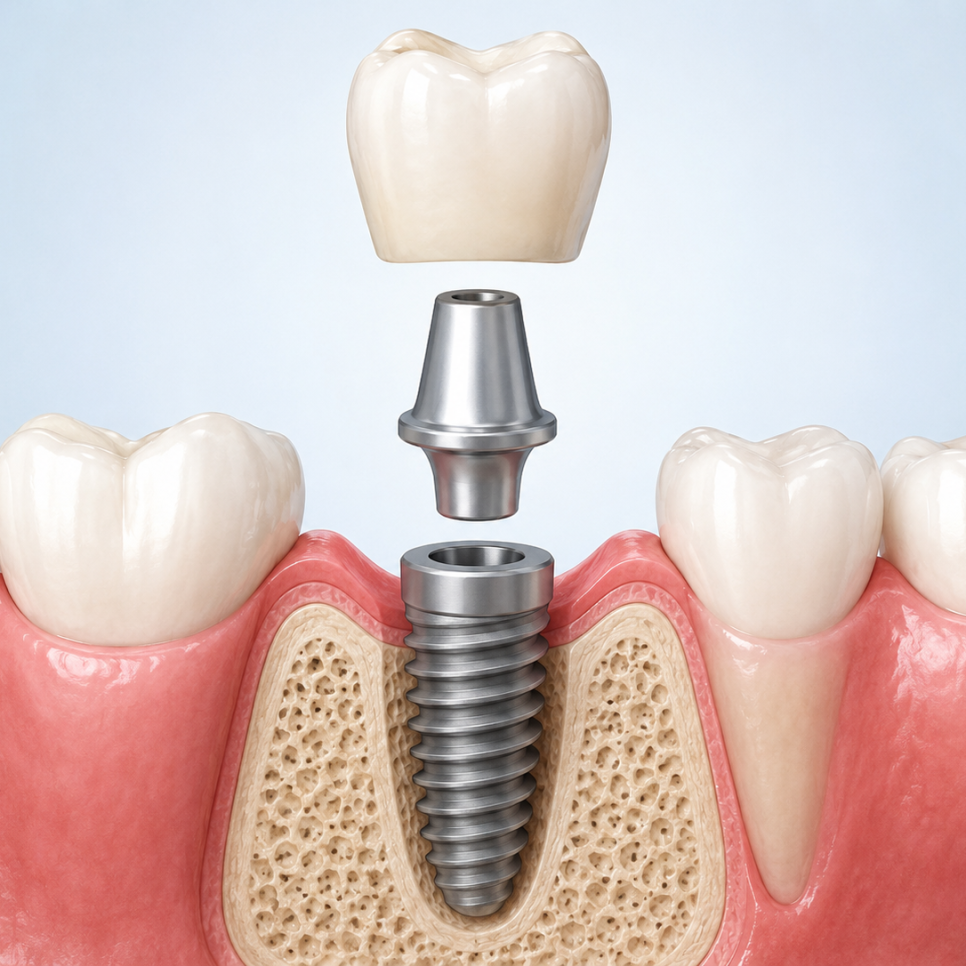
Adding one component to the two parts commonly known, an implant consists of three parts.
The first is the screw placed in the bone (fixture), and the third is the prosthetic tooth placed on top for chewing (crown).
The component that connects these two is the second component, the post (abutment).
When the crown is removed, the post that comes up through the gum underneath is revealed.
This post is not simply a connecting component.
Because it passes through the gum, how well it fits with the gum becomes the starting point for the health of the tissues around the implant.
| Chapter 2. Prefabricated vs. Customized: Like Ready-to-Wear and Tailored Clothing |
This post is divided into two types according to how it is made.
One is a prefabricated product manufactured in advance according to standard specifications.
The other is a customized product designed and manufactured to fit the patient’s oral cavity.
It is easy to understand when compared to clothing.
Standard-size ready-to-wear clothing may fit reasonably well, but everyone has different shoulder widths and arm lengths.
Implants are the same.
The thickness of the gums, the distance from the surrounding teeth, and the angle at which the implant is placed vary from person to person, making it difficult for prefabricated products to fully accommodate these individual differences.
Research also supports this.
Customized abutments allow precise control of the shape where the abutment emerges through the gum (emergence profile), the crown position, and soft-tissue support. They have been reported to provide better gum adaptation and aesthetic outcomes than prefabricated products.
| Chapter 3. Do Customized Abutments Reduce “Gum Inflammation”? |
This is the key point.
The greatest value of customization lies not in aesthetics, but in gum health.
When the post fits the shape of the gum precisely, there is less space between the post and the gum, so less food becomes trapped.
When less food and fewer bacteria become trapped, the risk of inflammation developing in the gums around the implant is also reduced.
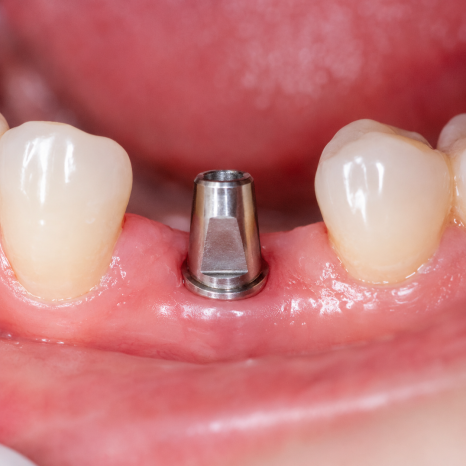
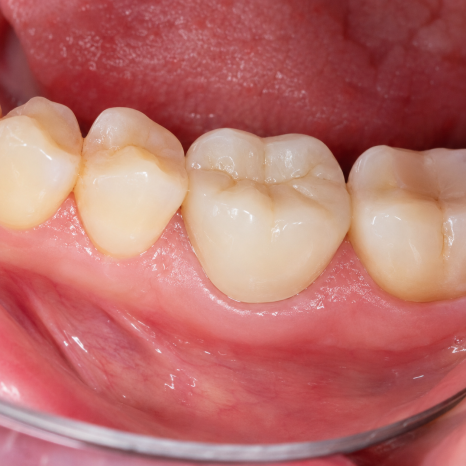
The evidence for this is clear.
In one randomized controlled trial, cases using customized abutments had shallower probing depths around the implant after 12 months, which is an indicator of less inflammation, and less bone loss around the gums.
Several studies have also confirmed that a well-fitting customized post closely seals the post–implant connection, reducing bacterial leakage and improving gum health.
In other words, this single invisible component can affect the lifespan of an implant several years later.
| Chapter 4. So, Is It Always Better? |
For balance, there is one point I want to state clearly.
Although customized abutments are sometimes said to distribute chewing forces more effectively, recent reviews conclude that from a biomechanical perspective (force distribution), there is no major difference from prefabricated products when the material and connection structure are appropriate.
(IJRMCS review, 2026)
The true strengths of customization lie in gum adaptation, reduced inflammation, and aesthetics, as discussed above, rather than in force distribution.
That is why I explain customized abutments as “a choice that protects the gums.”
This is why I insist on using them even though the material cost is higher.
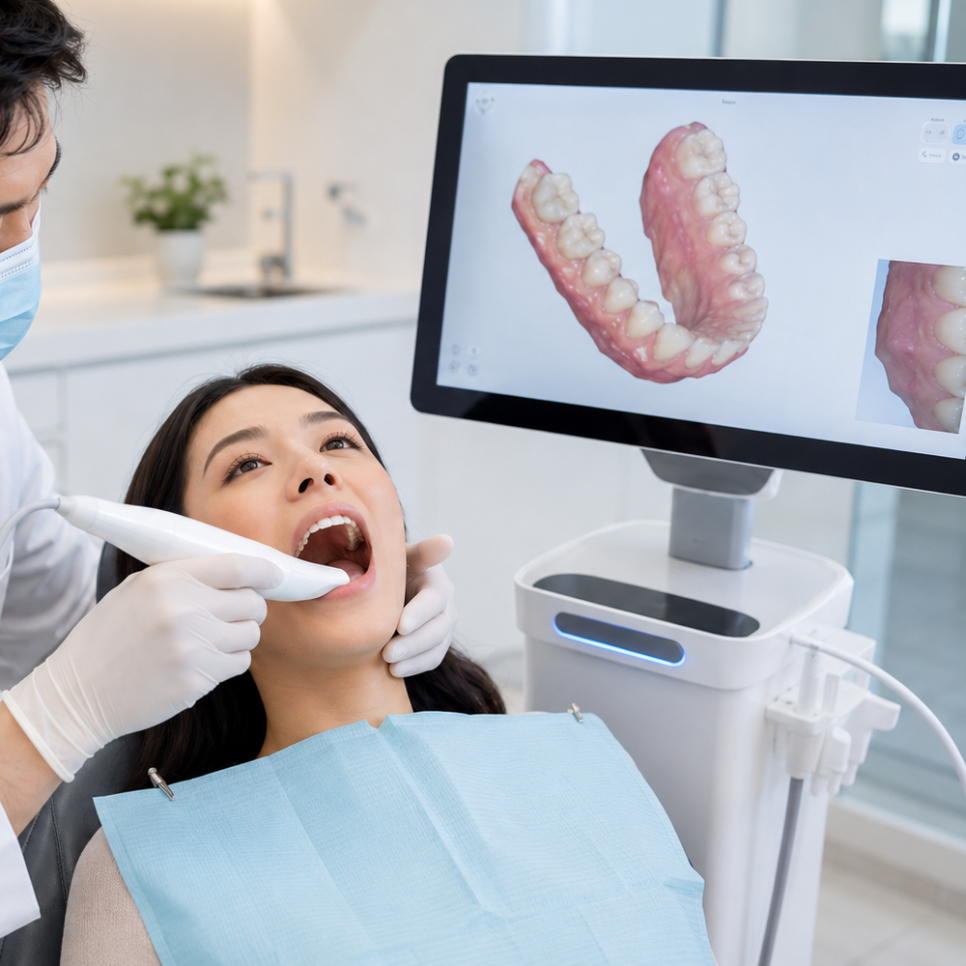
For reference, these days, the mouth can be scanned with a 3D scanner as if taking photographs, allowing customized fabrication to proceed comfortably without the difficult impression-taking process used in the past.
< Impression-free dentistry at Vardi Dental Clinic ↓↓ >
Today, I have discussed the hidden component of an implant: the post (abutment).
To summarize,
an implant consists of three components: the screw, the post, and the prosthesis.
Because the post passes through the gum, it greatly affects gum health.
Evidence has confirmed that customized posts fit the gums precisely and reduce food impaction, inflammation, and bone loss.
However, there is no major difference from prefabricated products in terms of chewing-force distribution, so the main strength of customization is “protecting the gums.”
If you are planning an implant, I recommend checking not only how the visible tooth is shaped, but also how the invisible components are fabricated.
Implants that last a long time are determined by details like these.
If you have any questions, please feel free to contact us at any time.
We will explain even the invisible parts in detail.
Thank you for reading this lengthy post.

[References]
PMC (12385633, RCT) — Customized CAD/CAM titanium abutments had shallower probing depths at 12 months than prefabricated abutments (−0.54 mm), higher aesthetic scores, less marginal bone loss, and reduced bacterial leakage.
ScienceDirect (2026) — Appropriate abutment shapes, including an emergence angle of 30 degrees or less, are ideal for the health of the tissues around implants.
IJRMCS review (2026) — Customized abutments are superior in emergence profile, soft-tissue support, and aesthetics, while the two types are generally similar biomechanically (force distribution).
PMC (11635071, systematic review) — Customized healing abutments tend to provide better soft- and hard-tissue stability and aesthetics, with no biological disadvantages reported.