Hello!
I am the director of Seoul Bardi Dental Clinic.
▼ Check the Dental Clinic Location ▼
| This post was written directly by Seoul Bardi Dental Clinic for the purpose of providing medical information, in compliance with Article 56(1) of the Medical Advertising Act. We recommend using the information provided for reference only, and that you visit a medical institution and receive guidance from a medical professional for symptom assessment and accurate care methods. All procedures and surgeries performed at a dental clinic may involve individual risks, such as inflammation, bleeding, and swelling. Please make your decision after having a sufficient consultation with a medical professional in advance. All images were created using AI to aid understanding. |
Many of the people who visit us
have delayed treatment for a long time.
Some come only after their pain becomes severe,
after their teeth became loose due to periodontal disease and fell out while eating,
or after they fell out at home when touched by hand and were then left untreated.
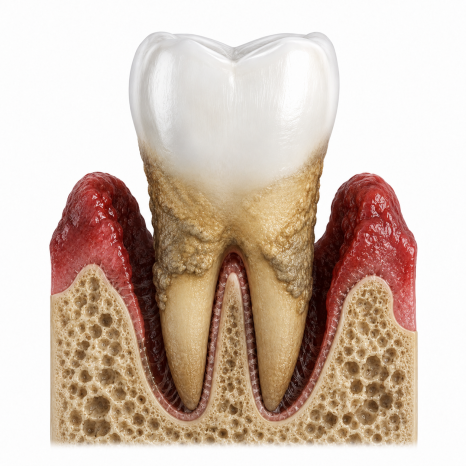
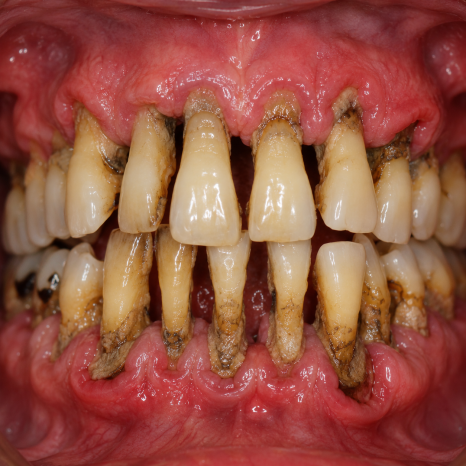
However, these people
have something in common that they often say.
"It did not really hurt during that time.
" This phrase, "it did not hurt," was actually the most dangerous warning sign.
Today, I will explain why gum disease
progresses without causing pain,
what happens when it is left untreated,
and how severely damaged teeth may be restored.
| Chapter 1. Periodontal Disease Normally Progresses 'Without Pain' |
Let us first clear up the most important misconception.
The absence of pain does not mean everything is fine.
The most frightening aspect of gum disease, or periodontitis,
is that it progresses quietly without pain.
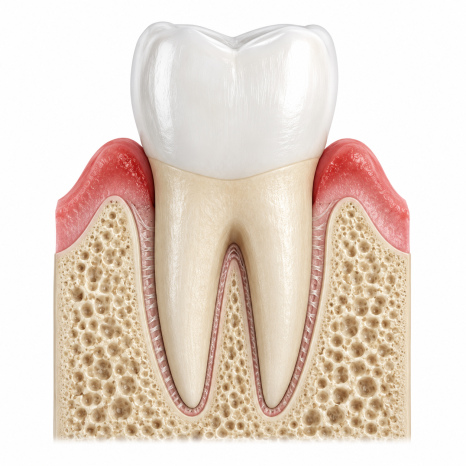
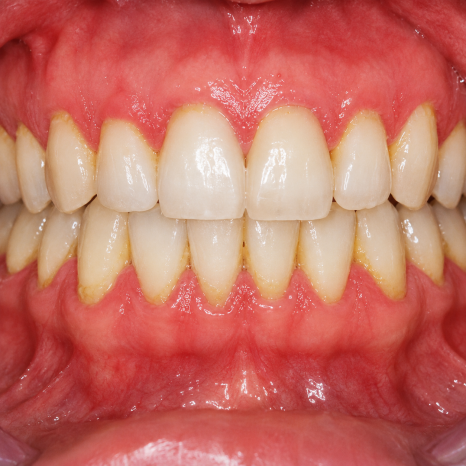
In fact, most patients with substantial bone destruction
feel no pain at all,
and by the time symptoms such as loose teeth or an abscess appear,
significant bone loss has already occurred.
(Smile Perfections, 2026)
Therefore, rather than thinking, "It does not hurt, so it must be fine,"
you should understand that "it may still be progressing even if it does not hurt."
Pain does not serve as
a reliable early warning signal for this disease.
| Chapter 2. Why Does It Spread to the 'Entire' Mouth When Left Untreated? |
If only one tooth is affected,
why does the entire mouth deteriorate?
There are two reasons.
First, irreversible bone loss.
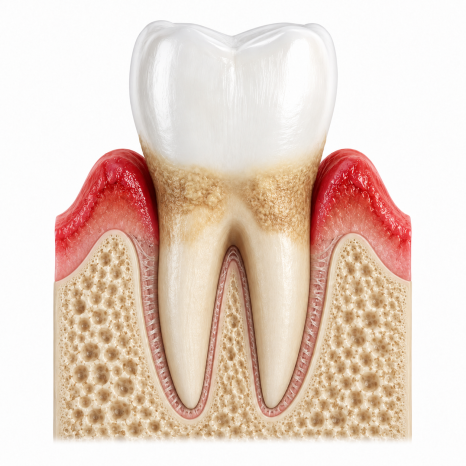
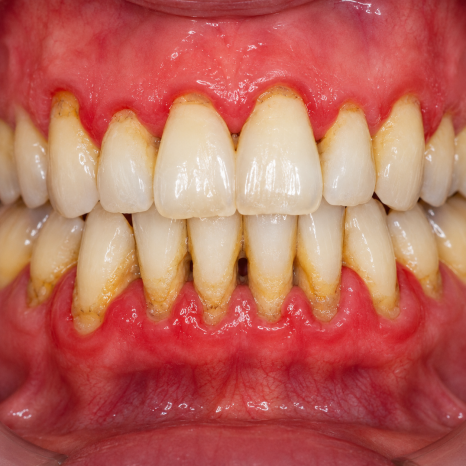
The key risk of advanced periodontitis
is irreversible bone loss.
When the bone breaks down, the tooth loses support,
becomes loose, and eventually falls out.
And this bone loss continues to spread
from one tooth to neighboring teeth.
<What happens if you only take gum medication ↓↓>
Second, a chain reaction occurs
when an empty space is left untreated after a tooth is lost.
If the space left by a missing tooth is left as it is,
the bone in that area begins to be resorbed,
with approximately 25% of the bone disappearing during the first year after tooth loss alone.
In addition, the neighboring teeth tilt
into the empty space,
while the opposing teeth rise upward,
making cleaning more difficult and allowing cavities and gum disease to spread further.
In other words, it is not simply "just one tooth."
While it is left untreated,
the mouth can collapse like a row of dominoes.
| Chapter 3. We Preserve the Remaining Teeth as Much as Possible—Extraction Is Not Always Necessary |
When you visit with advanced gum disease,
many people first worry, "Do I have to have them all pulled?"
That is not necessarily the case.
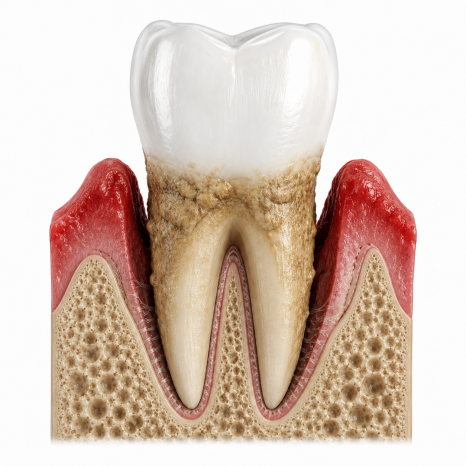
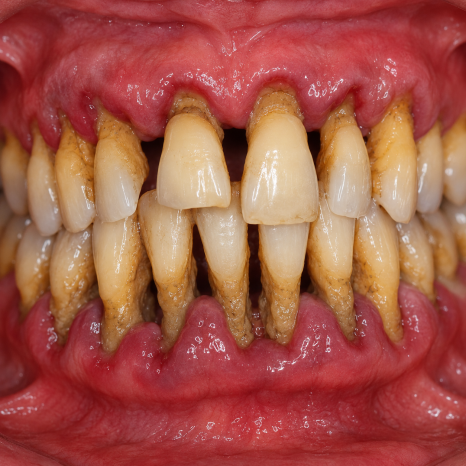
The decision to extract is made separately for each tooth.
Extraction may be unavoidable for a tooth with almost no bone remaining to support its root,
but if some bone remains
and the tooth is not severely mobile, we first consider preserving it through periodontal treatment and ongoing care.
Evidence also indicates that,
even teeth so severely damaged that their prognosis is uncertain
may in some cases avoid extraction and regain function
with an appropriate treatment plan.
Preserving even one more of your natural teeth
is always a priority.
However, whether a tooth can be preserved or should be extracted
depends on how much jawbone remains,
which must be assessed precisely.
It cannot be determined based only on mobility visible to the eye.
| Chapter 4. If Missing Molars Make Eating Difficult: A Design for Minimum Implant Placement and Maximum Restoration |
If you have lost many teeth and have
few or no molars left,
chewing itself becomes difficult.
In this situation, implants can restore chewing function,
but the plan does not necessarily involve placing one implant for every missing tooth;
a design strategy is involved.
The key is to analyze the jawbone three-dimensionally using CT,
then plan a method of connecting the implants
so that the number placed is minimized while the number of functional molars is sufficiently restored.
Reducing the number of implants
reduces both the scope of surgery and the financial burden,
while the connected structure distributes chewing forces across multiple posts,
reducing the load placed on each individual implant.
If molars are missing in both the upper and lower jaws,
and the conditions are suitable, implants may be placed in both jaws on the same day
to shorten the period without teeth.
However, simultaneous placement with a minimal number of implants
is not possible for everyone.
It can only be considered when the amount and density of the remaining bone
and the initial stability immediately after placement are adequate,
so precise CT analysis is essential beforehand.
In summary, the goal is not simply to place fewer implants,
but to analyze the situation accurately and place only as many as are needed.
That is why even treatments described as the same "full-mouth implant" treatment
can differ in the number of implants, cost, and treatment duration depending on the design.
Today, using a case involving teeth that had been left untreated for a long time,
I explained the risks of "not having pain."
In summary, because periodontal disease
progresses quietly without pain, the fact that "it does not hurt"
can actually be a warning sign.
If left untreated, the problem can spread throughout the mouth
through irreversible bone loss and movement of neighboring teeth.
However, even when the damage is already extensive,
we can preserve the remaining teeth as much as possible,
and restore chewing function with the minimum necessary number of implants based on CT planning.
If you currently have a loose tooth,
or have left a missing-tooth space untreated for a long time,
we recommend having it examined before the problem spreads further.
Even if it does not hurt, you should still have it checked.
The time when you feel it is too late is still the earliest time to act.
If you have any questions,
please feel free to contact us at any time.
We will provide honest guidance focused on preserving even one more tooth.
Thank you for reading this long post. ^^

[References]
Smile Perfections (2026) — Periodontal bone loss is mostly painless; by the time symptoms appear, the condition has already progressed
Penn Dental (2026) / Cleveland Clinic (2025) — Irreversible bone loss in advanced periodontitis can lead to tooth mobility and tooth loss
Dr Handler / PMC (12091735) — Approximately 25% bone resorption during the first year when a tooth socket is left untreated after extraction; movement of neighboring teeth and secondary disease
PMC (4582840) — Even severely damaged periodontal teeth may be preserved with an appropriate plan