Hello.
For those who feel their shoulders stiffen
just hearing the words “root canal treatment,”
this is Magok Station Seoul Dia Dental Clinic,
where we整理 practical criteria only.
In Part 1,
we explained in an easy way
why pain can occur after root canal treatment,
focusing on the causes.
If you haven’t seen Part 1 yet,
you may want to read it first through the link below.
It feels like a background guide to what we’re talking about now,
so it will make understanding much easier.
Now, in Part 2 today, we’ll sort out the question
many people find most confusing.
“Is this level of pain normal?”
“Can I just watch it a little longer?”
“Or should I get it checked again?”
So today, we’ll divide post-root-canal pain into
normal range vs. signs that need a recheck,
to make the 기준 clear.
Whether it’s pain you can wait out,
or pain that should be checked now,
by the end of this post, things will feel much clearer.
Post-root-canal pain considered within the normal range
- Mild pain only when chewing
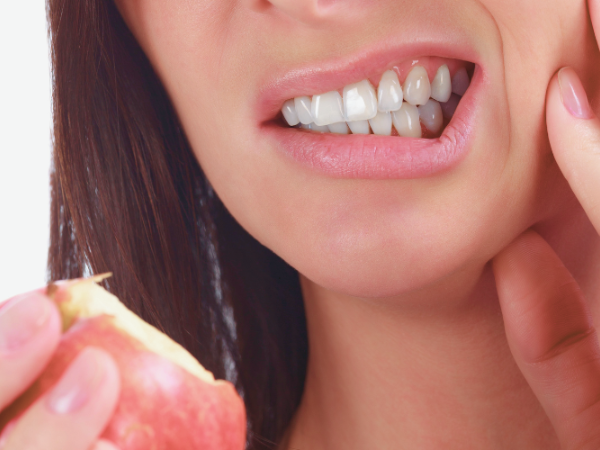
Pain when chewing food
It feels fine when left alone,
but there’s a slight pain only when chewing.
This is fairly common.
After root canal treatment,
the tissues around the tooth root are still sensitive,
so they can temporarily react to chewing pressure.
If it gradually becomes weaker over time,
it is likely part of the normal healing process.
- A heavy, dull type of pain

Dull feeling
Not a stabbing pain,
but a dull, bruised feeling.
This is also a reaction that can appear
when the irritation from treatment is still settling down.
Especially in the 2 to 7 days right after treatment,
it may feel more noticeable when your condition is low.
If the frequency and intensity gradually decrease,
you can monitor it over time.
- Discomfort only when biting at a specific angle
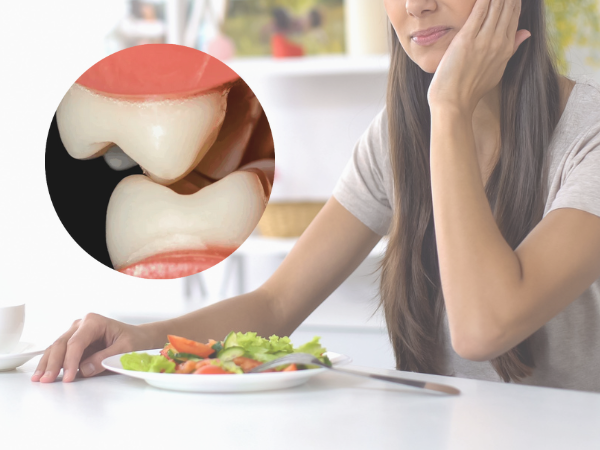
Discomfort only when chewing at a specific angle
“It hurts when I chew at this angle,
but the other side is fine.”
This also happens often.
In most cases, it’s because the bite
changed slightly while the temporary filling or temporary crown was in place.
Since it often improves after adjusting the height,
it usually is not considered a major problem.
Pain after root canal treatment that needs a recheck
From here on,
instead of “Should I just bear it a little?”
it becomes a signal that says,
“Should be checked again at least once.”
- Pain that gets worse over time
Severe toothache
Pain in the normal healing range
gradually decreases over time.
But if day 7 hurts more than day 3,
and today hurts more than yesterday,
then rather than healing,
you should consider the possibility that the problem is progressing.
- Throbbing pain even when sitting still

Toothache that gets worse at night
Even without chewing, even without doing anything,
it throbs while you’re just sitting still.
Especially if it gets worse at night,
the inflammation around the root may not yet have settled enough.
This is not a signal to brush off with,
“Maybe if I just wait a little, it’ll be fine.”
- Pain + swelling + severe tenderness when pressed

Pain accompanied by increased swelling
If it’s not just pain,
but the gums are swollen,
or it clearly hurts when pressed,
or there is a feeling of heat,
then it is more appropriate to see this as a sign of additional inflammation
rather than simple recovery pain.
- Pain that does not ease at all even after taking painkillers

Taking painkillers
Pain within the normal range usually
responds to painkillers to some extent.
But if it stays the same even after taking them,
it may not be a matter of “Why does this hurt when there’s no nerve?”
but rather a time to look again at the tissues around the root.
Why does it hurt if the nerve has been removed?
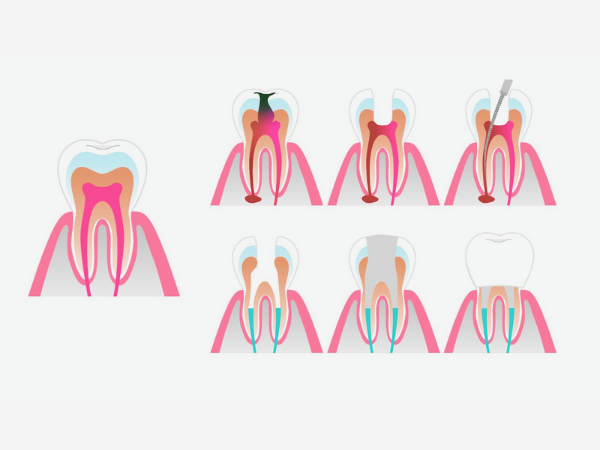
Root canal treatment process
Through root canal treatment, the nerve inside the tooth
is completely removed,
but the tissue outside the root remains.
So pain after root canal treatment is much more often
not “nerve pain,”
but a reaction from the surrounding tissues.
The issue is whether this reaction is still settling down
or whether there is a remaining problem.
So the 기준 is this
-
Pain gradually decreases → normal
-
Discomfort only when chewing → monitor the course
-
Pain even when sitting still → recheck
-
Gets worse over time → recheck
When pain returns after root canal treatment,
it is not always “It’s fine,”
and it is not always “It has to be done again.”
Just sorting out four things—
the current pattern of pain, when it started,
how it is changing, and the bite condition—
often makes the direction clear.
If I sum up today’s story in one line,
pain after root canal treatment is
less about whether it exists or not,
and more about what kind of pain it is.
There’s no need to make it worse by enduring it for no reason,
and there’s no need to get scared and imagine the worst.
If you even slightly think,
“This doesn’t seem right,”
that’s the time to get it checked once.
Pain after root canal treatment is
less a signal to endure,
and more a signal asking to be understood.
In Part 3, we’ll continue with cases where
pain after root canal treatment lasts a long time,
and explain when it is still okay and when action is needed.
[ This post has been written in accordance with the Medical Service Act for the purpose of providing accurate information about dental surgery and procedures. Infection and side effects may occur after surgery, so you should decide on surgery (procedure) after consulting thoroughly with a skilled medical professional. ]
[ Magok Station Seoul Dia Dental Clinic Root Canal Treatment Pain Series]
-
Causes of pain after root canal treatment
-
Root canal pain, normal vs. recheck criteria
-
Cases where pain lasts a long time after root canal treatment