Hello.
We reduce unnecessary worries,
and provide only the dental information you truly need
to help take care of your lifelong oral health together.
This is Seoul Dia Dental Clinic at Magok Station.
In the previous post,
[When should old amalgam be replaced?]
we organized the 5 signs that should definitely be checked
based on practical criteria.
If you haven’t seen it yet,
you may want to check the link below first.
If you read that first, it will be much easier to understand why replacement was needed.^^
Now, let’s begin the third story in the amalgam series!
One day, while looking in the mirror,
your molar catches your eye.
“Wait… wasn’t this supposed to be silver?”
“Why did it turn so black…?”
The amalgam that once shone silver
has somehow become dark.
It seems like decay,
or like something has gone wrong for no reason,
and that’s the moment you start searching online.
So today,
we’ll look at why amalgam turns black,
whether it is a natural change,
or a sign that needs to be checked,
and explain [amalgam discoloration]
in an easy, not difficult way
in the style of Seoul Dia Dental Clinic at Magok Station.^^
Why amalgam turns black
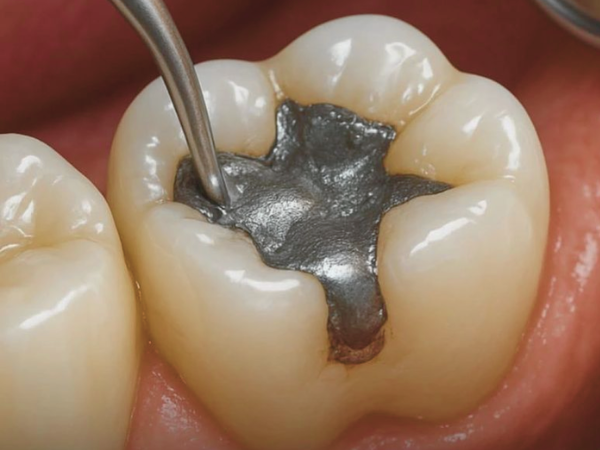
Discolored amalgam at Magok Station Dental Clinic
To put it simply,
the most common reason is a natural change.
Amalgam is a metal material.
As metal time passes,
it comes into contact with air, moisture, and food,
and the surface color gradually darkens.
In simple terms,
a new silver spoon shines,
but after long use its color becomes dull.
Amalgam works the same way.
The mouth is an environment where metal color can change easily.
It is constantly exposed to saliva, you eat food,
hot and cold things go back and forth,
and the inside of the mouth can become acidic.
As these changes repeat,
the color may gradually appear darker.
On top of that, if you often drink or eat
dark-colored foods like coffee, tea, or curry,
the color can become deeper more quickly.
Just like white sneakers
feel different when they are brand new
and after being worn for a few months,
fillings also show natural signs of use over time.
(Fillings, too… they’re showing the signs of working hard.)
In other words,
you can understand it as color changes caused by the passage of time,
the oral environment, and eating habits all together.
Is amalgam discoloration a problem?
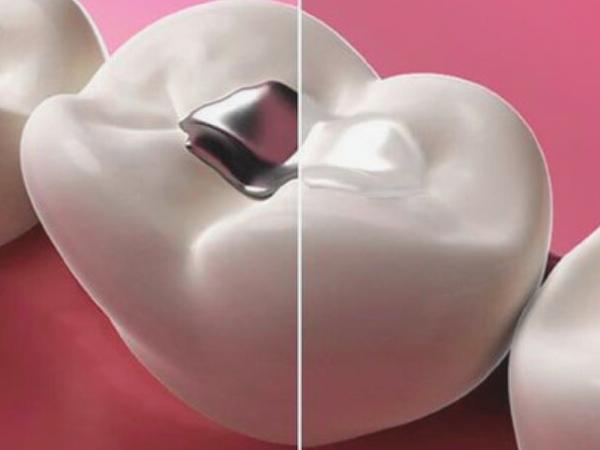
Amalgam vs. resin at Magok Station Dental Clinic
The amalgam color changed?
“Is it decay?”
“Should I replace it right away?”
That’s usually the first thought.
But just because the color has darkened
does not mean you can immediately conclude that it is decay
or that it must be replaced right away.
In most cases, it is simply a color change that happened over time,
and it is often not directly related to chewing function or tooth health.
Put simply,
a brand-new pot shines,
but with long use the color fades and becomes dull.
Still, rice cooks just fine, right?^^
Amalgam is similar.
It just has signs of hard work left on it.
That is why a color change alone is not considered a problem.
However, even if there is no problem with function,
if the color shows when you smile and bothers you,
or if you want it to look more natural,
it may be replaced with tooth-colored resin.
It is not because it must be replaced,
but because it is a choice for a more natural smile.
When these changes appear together, it should be checked
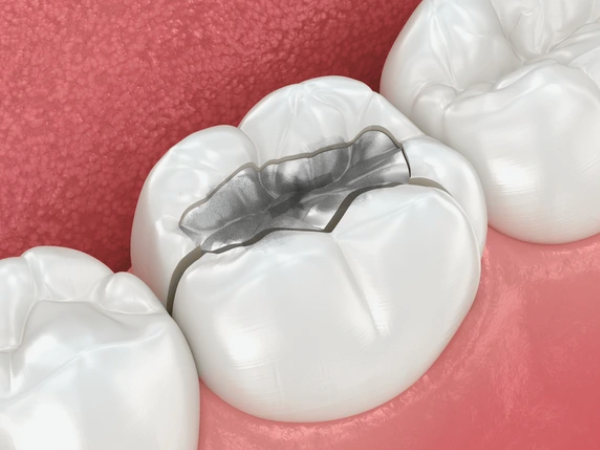
Gap at the edge of amalgam and tooth fracture at Magok Station Dental Clinic
At first glance, everything looks fine.
So it is easy to just pass over it.
But in the mouth,
small incidents can happen quietly.
If the edge of the filling
looks brown or blackened?
Just like water seeping through a gap in wallpaper,
bacteria may be getting in through that gap.
If it feels rough when touched with the tongue?
Like a frying pan with the coating worn off.
The surface protective layer may be a little worn out.
If chewing feels like something is catching?
Like walking in shoes with only one sole worn down.
It may be a sign that the balance of force has changed.
If you feel a sharp twinge with cold water?
That is the tooth sending a message.
“I'm a little sensitive right now.”
Let’s sum it up.
Don’t be reassured just because the outside looks fine!
Even small signs should be checked!!
It may not be severely painful,
but if you notice these signs,
it is a good idea to have it checked once.
Just checking can make you feel much more at ease.
Key points from today’s post
(You only need to remember this part)
-
Amalgam discoloration is a natural change
-
It can darken due to metal reactions + oral environment + staining
-
Discoloration alone does not mean replacement is necessary
-
If there is a gap, breakage, or pain, it should be checked
Seoul Dia Dental Clinic at Magok Station
If the molars in the mirror have started to bother you,
once you start noticing what you couldn’t see before,
you keep seeing it from that day on. TT
If you are curious about small changes inside your mouth,
you may want to get them checked once at a dental clinic near Magok.
Just checking can make you feel much more at ease.
In the next post,
we will realistically summarize
what treatment is performed when old amalgam is replaced.
We hope both your teeth and your 마음 have a peaceful day.
This has been Seoul Dia Dental Clinic.
[ This post was written in accordance with medical law for the purpose of providing accurate information about dental surgery and procedures. Infections and side effects may occur after surgery, so you should decide on surgery (procedure) after sufficient consultation with a skilled medical professional. ]
[Magok Station Seoul Dia Dental Clinic Amalgam Series]
-
Amalgam safety
-
When amalgam replacement is necessary
-
Causes of amalgam discoloration
-
Treatment when replacing amalgam