Hello.
We are Seoul Dia Dental Clinic, providing appropriate treatment guidance based on accurate diagnoses at Magok Station.
In Part 3, we discussed how teeth grinding and clenching are major causes of temporomandibular joint disorder.
Today, we will cover the aspect that many people tend to take most lightly.
"It only makes a sound and doesn’t hurt right now, so it should be okay to wait a little longer, right?"
But here’s the thing.
Temporomandibular joint disorder quietly and steadily progresses in a worse direction over time.
Today, Seoul Dia Dental Clinic will explain step by step what can happen if it is left untreated.
How Temporomandibular Joint Disorder Progresses
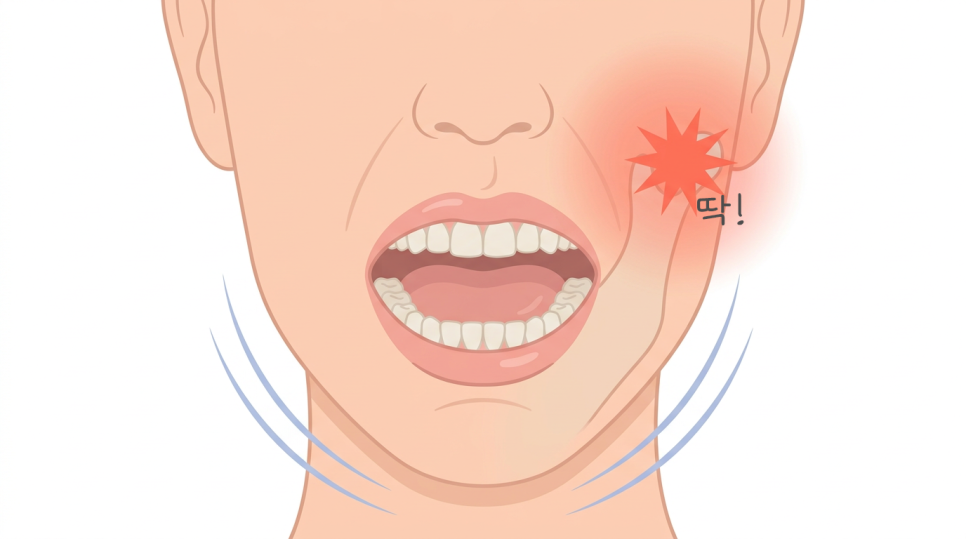
Magok Station Dental Clinic_Symptoms of Temporomandibular Joint Disorder
Temporomandibular joint disorder does not suddenly become severe.
Because it progresses slowly and in stages, it is easy to dismiss it as insignificant at first. In many cases, it eventually reaches a point that is difficult to reverse.
Stage 1 — The stage when there is only a sound
A clicking sound begins when opening or closing the mouth.
There is no pain, so many people simply overlook this stage.
However, this sound may be a sign that the disc has begun to gradually move out of its proper position.
If you begin managing the condition at this stage, progression can often be prevented through relatively simple methods.
Stage 2 — The stage when pain begins
Along with the sound, stiffness or pain begins to be felt around the jaw.
Discomfort while chewing or difficulty opening the mouth wide may appear at this stage.
Headaches and neck and shoulder stiffness may also become more severe.
From this stage onward, treatment is necessary.
Stage 3 — The stage when restricted mouth opening develops
As the disc becomes significantly displaced, the mouth becomes difficult to open.
Normally, when the mouth is opened wide, three fingers should fit vertically between the upper and lower teeth.
If the opening is narrower than this, the condition has already reached Stage 3.
Eating becomes uncomfortable, and pain may occur when yawning or laughing widely.
Stage 4 — The stage when the joint structure becomes deformed
If the condition is left untreated for a long time, the bones of the temporomandibular joint itself may begin to change shape.
As the cartilage wears down and changes develop in the bone, chronic pain may continue.
At this stage, treatment becomes more complex, and complete recovery may be difficult.
Problems That Can Occur If It Is Left Untreated


Magok Station Dental Clinic_Problems of Leaving Temporomandibular Joint Disorder Untreated
1. The teeth wear down quickly
If teeth grinding is left untreated, the surfaces of the teeth gradually wear away.
Once a tooth has worn down, it does not grow back.
Severely worn teeth may become sensitive and may eventually require prosthetic treatment.
2. Chronic headaches become more severe
As mentioned in Part 2, chronic tension in the temporalis muscle can lead to headaches.
The longer the condition is left untreated, the more likely the intensity and frequency of the headaches are to increase.
This can lead to a vicious cycle of repeatedly relying on headache medication.
3. Facial asymmetry may develop
If the load is concentrated on only one temporomandibular joint or only one masseter muscle becomes more developed, the balance between the left and right sides of the face may begin to change.
The longer this continues, the more difficult it becomes to correct.
4. Sleep quality decreases
Teeth grinding and jaw pain reduce sleep quality.
By interfering with deep sleep, they can lead to chronic fatigue and affect concentration and daily life.
5. Psychological stress accumulates
When chronic pain continues, you may become more sensitive and experience increasing stress...
That stress can then trigger more clenching, creating a repeated vicious cycle.
If the Sound Suddenly Disappears, It May Be More Serious
Here is one important point.
"My jaw used to make a clicking sound, but one day it suddenly stopped.
Does that mean it has improved?"
No.
This may actually be a situation that requires greater caution.
The disappearance of the sound may mean that the disc has become completely displaced and the condition has progressed to the next stage, in which the mouth becomes difficult to open.
If the sound has disappeared but your mouth feels less able to open than before, it is best to visit a dental clinic promptly.
Check How Serious It May Be
Check the items below.
-
A clicking sound occurs when opening the mouth
-
Three fingers cannot fit vertically in the mouth
-
There is pain or a catching sensation when moving the jaw
-
The jaw feels stiff or you have a headache when you wake up in the morning
-
You chew only on one side
-
Unexplained headaches or repeated neck and shoulder stiffness occur
-
The teeth are visibly wearing down
If two or more of these apply to you, it is best to have your condition checked right away.
Now Is the Best Time to Act
The earlier temporomandibular joint disorder is detected, the simpler treatment tends to be.
When detected at Stage 1, it can often be managed sufficiently with a splint or lifestyle adjustments.
However, once it progresses to Stages 3–4, the treatment period becomes longer, and complete recovery may be more difficult.
The thought, "It doesn’t hurt much yet, so I’m probably fine," is the most dangerous one.
At Seoul Dia Dental Clinic, we carefully examine the condition of the temporomandibular joint and provide accurate guidance on which stage you are currently in and what treatment is needed.
We offer convenient consultations through Naver TalkTalk and reservations.
Feel free to have it checked without any pressure.
Seoul Dia Dental Clinic at Magok Station
Now, shall we briefly summarize today’s discussion?
-
Temporomandibular joint disorder progresses in the order of sound → pain → restricted mouth opening → joint deformity
-
If the sound suddenly disappears, it may be a sign that the condition has progressed further
-
If left untreated, it can lead to tooth wear, chronic headaches, facial asymmetry, and sleep problems
-
The earlier it is detected, the simpler treatment tends to be and the faster recovery may be
Temporomandibular joint disorder—
Don’t assume that you are fine just because your jaw only makes a sound right now.
That sound may be an early warning signal.
In the next part, we will discuss "what the masseter muscle is." 😊
Stay healthy today,
and have a day filled with bright smiles. ^^
[ This post was written pursuant to the Medical Service Act for the purpose of providing accurate information about dental surgeries and procedures. Infection and side effects may occur after surgery, so you should decide whether to undergo surgery or a procedure after sufficient consultation with a qualified medical professional. ]
[ Magok Station Dental Clinic_Temporomandibular Joint Disorder Series ]
"Why is my jaw like this? From causes to treatment"
-
"My jaw makes a clicking sound." What is temporomandibular joint disorder?
-
These symptoms can also indicate a jaw joint problem — the relationship with headaches and shoulder pain
-
Why does temporomandibular joint disorder occur? The main culprits are teeth grinding and clenching
-
What happens if temporomandibular joint disorder is left untreated?
-
What is the masseter muscle? How the chewing muscle affects the jaw
-
What is the temporalis muscle? The hidden connection between headaches and jaw pain
-
Masseter + temporalis muscle Botox: Who may benefit from it