Mini facelift surgery to improve skin elasticity
Hello.
This is Mutoel Plastic Surgery.
After middle age, due to decreased skin elasticity,
noticeable sagging of the cheeks and jawline
begins to stand out more clearly.
Most people who visit Mutoel also come in for consultations
with similar concerns.
These issues are caused not only by aging of the skin,
but also by relaxation of the fascial layer (SMAS)
and the soft tissue beneath the skin,
so simple lasers or lifting devices have limitations
when it comes to solving them.
At times like this, the surgical option to consider
is mini facelift surgery.
Today, we’ll go over one by one the parts that many people
have heard about but do not know in detail.

What is a mini facelift?
As the name suggests, it is a surgery that can create
a lifting effect while minimizing the incision area itself.
Compared with a traditional facelift, which involves
an incision from the hairline to behind the ear and
extensive dissection,
this procedure is performed by making a small incision
only in front of or on the side of the ear and pulling
and securing the loosened fascial layer.
Because of this, the biggest advantages of this method
are faster recovery and less concern about scarring.
Who is it effective for?
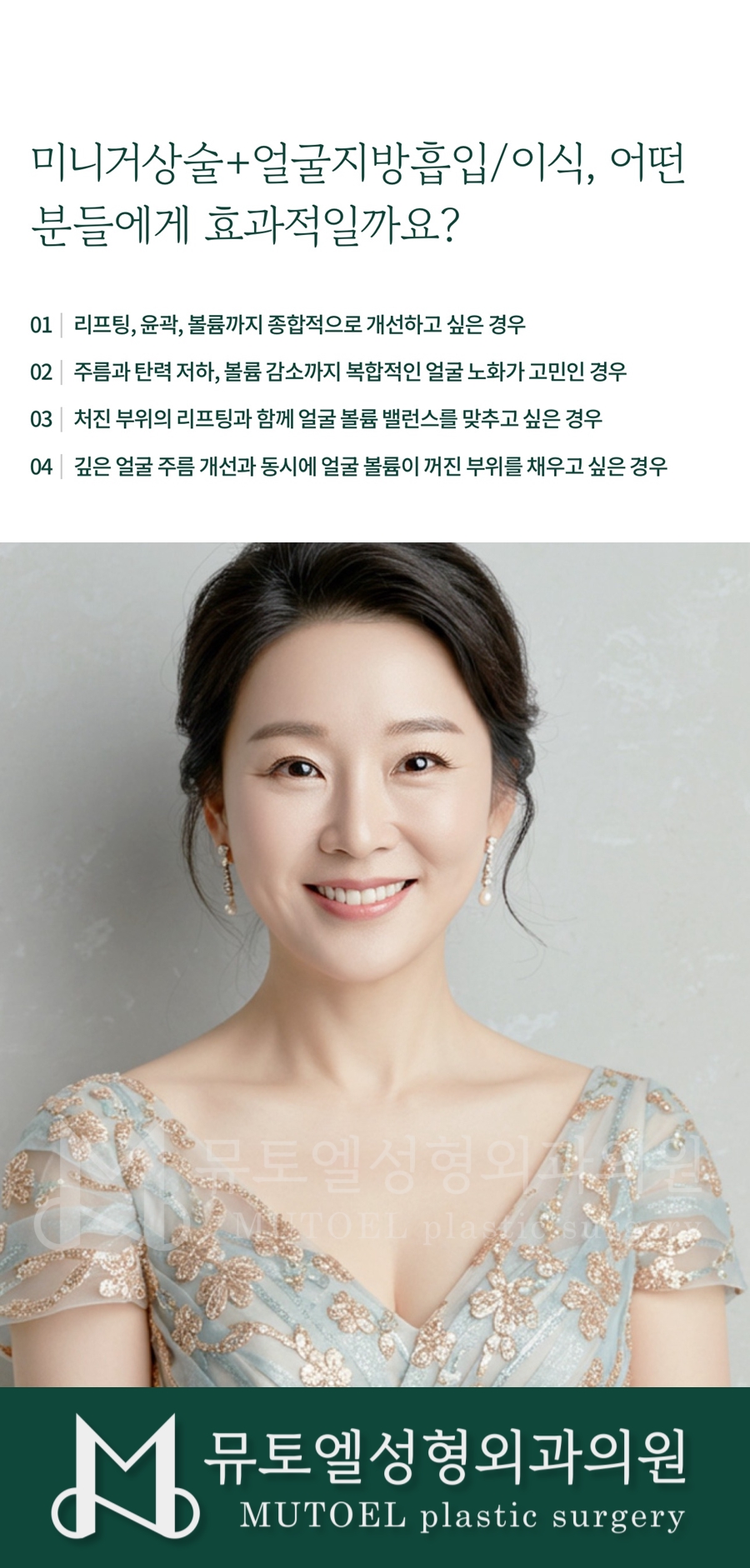
Rather than for older patients with severe skin sagging,
it is effective for people in their 40s to early 60s who,
compared with older age groups, still retain relatively good elasticity,
but have begun to show noticeable nasolabial folds,
jawline lines (marionette lines), and cheek sagging.
In particular, for people who have repeated Ulthera,
thread lifting, or similar procedures several times but
have not felt much effect,
this can be a good way to compensate for the limitations
of these non-surgical procedures.
When combined with facial liposuction
A mini facelift is a surgery that firmly lifts the skin,
but if there is a large amount of residual fat in the face,
the lifting effect may be diminished.
In particular, if there is a lot of subcutaneous fat in the cheeks,
buccal area, and under the chin, the lifting effect may be obscured,
or it may feel like sagging returns quickly.
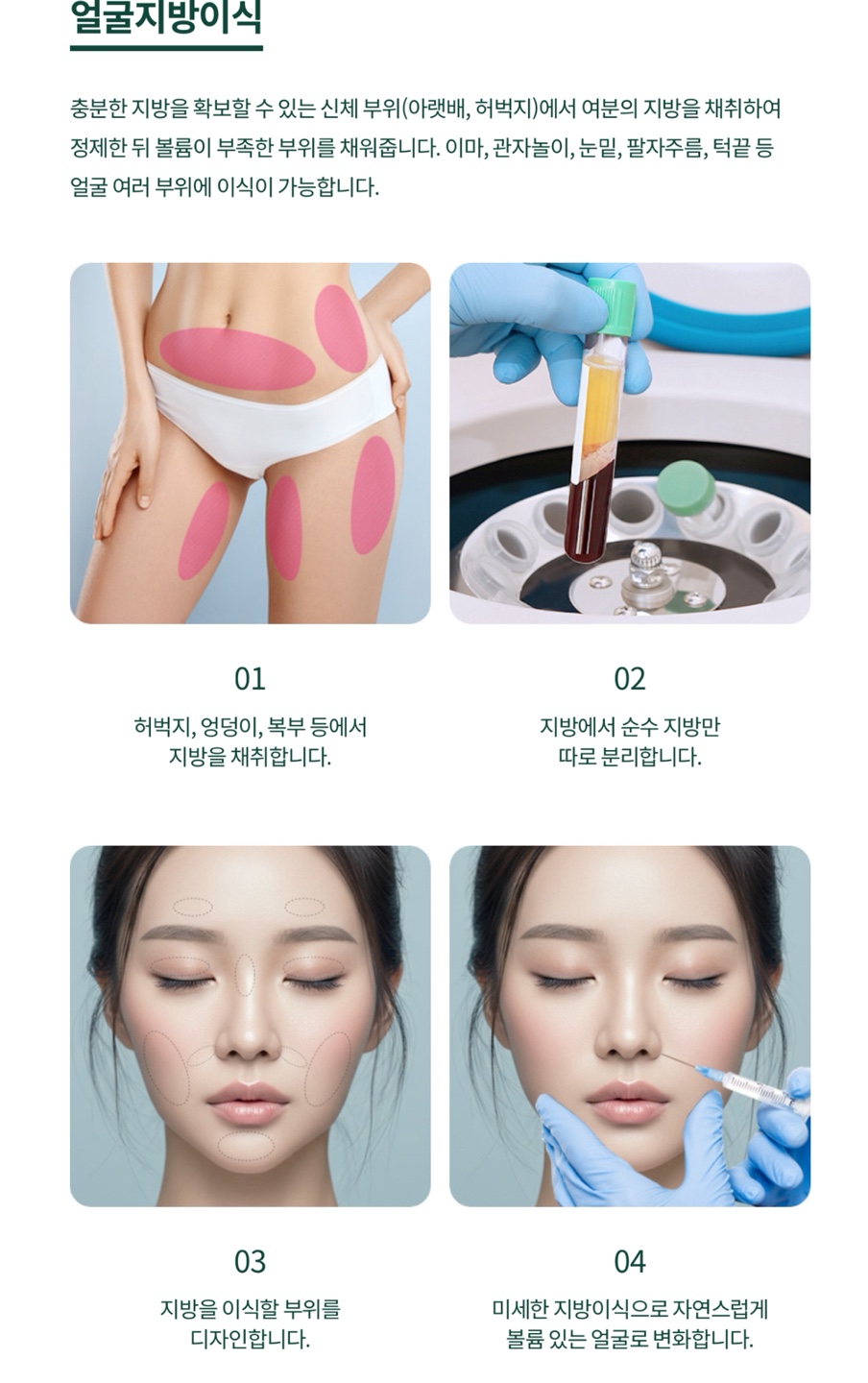
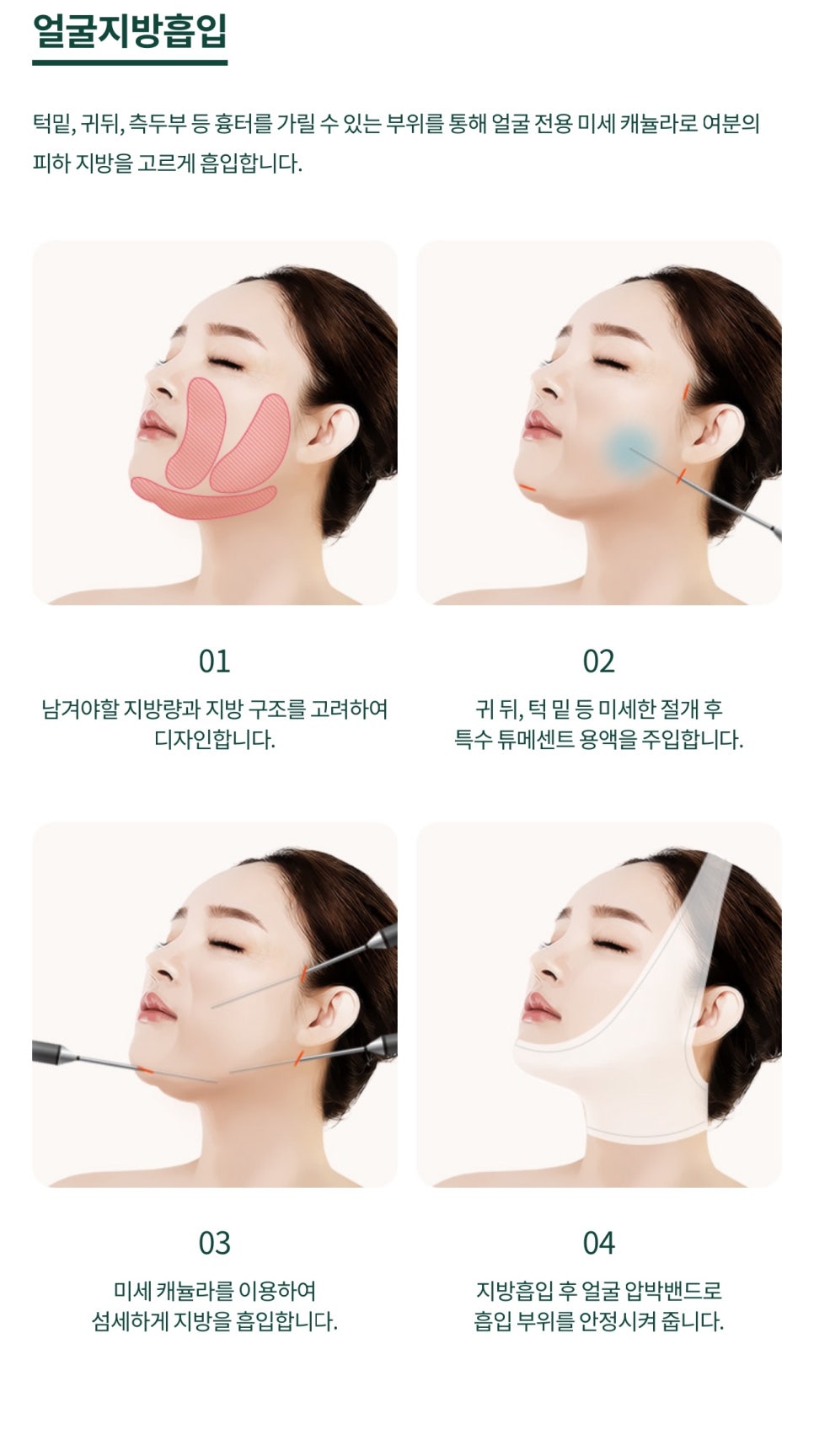
In such cases, if facial fat is removed at the same time
through only a small skin opening,
a much clearer and longer-lasting effect can be expected.
In addition, if skin elasticity remains after liposuction,
fat grafting to lightly fill the remaining volume
can make the improvement more noticeable.
For example, hollowness beside the nasolabial folds,
the front cheeks, and the temple area are factors that
make the face look more saggy, but if a small amount of
fat is grafted into these areas, the overall balance is improved,
and the youthful effect becomes greater.
In short, after lifting the overall structure,
liposuction/fat grafting plays a supportive role in completing
a three-dimensional and neat facial line.

Surgical method and recovery process
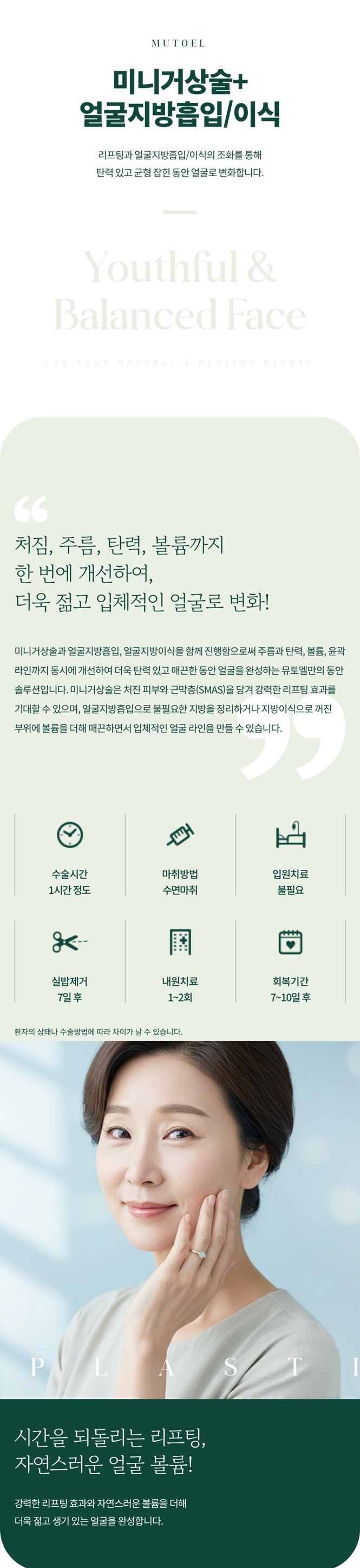
A mini facelift is performed under local anesthesia or
sedation, and the surgery takes about one hour.
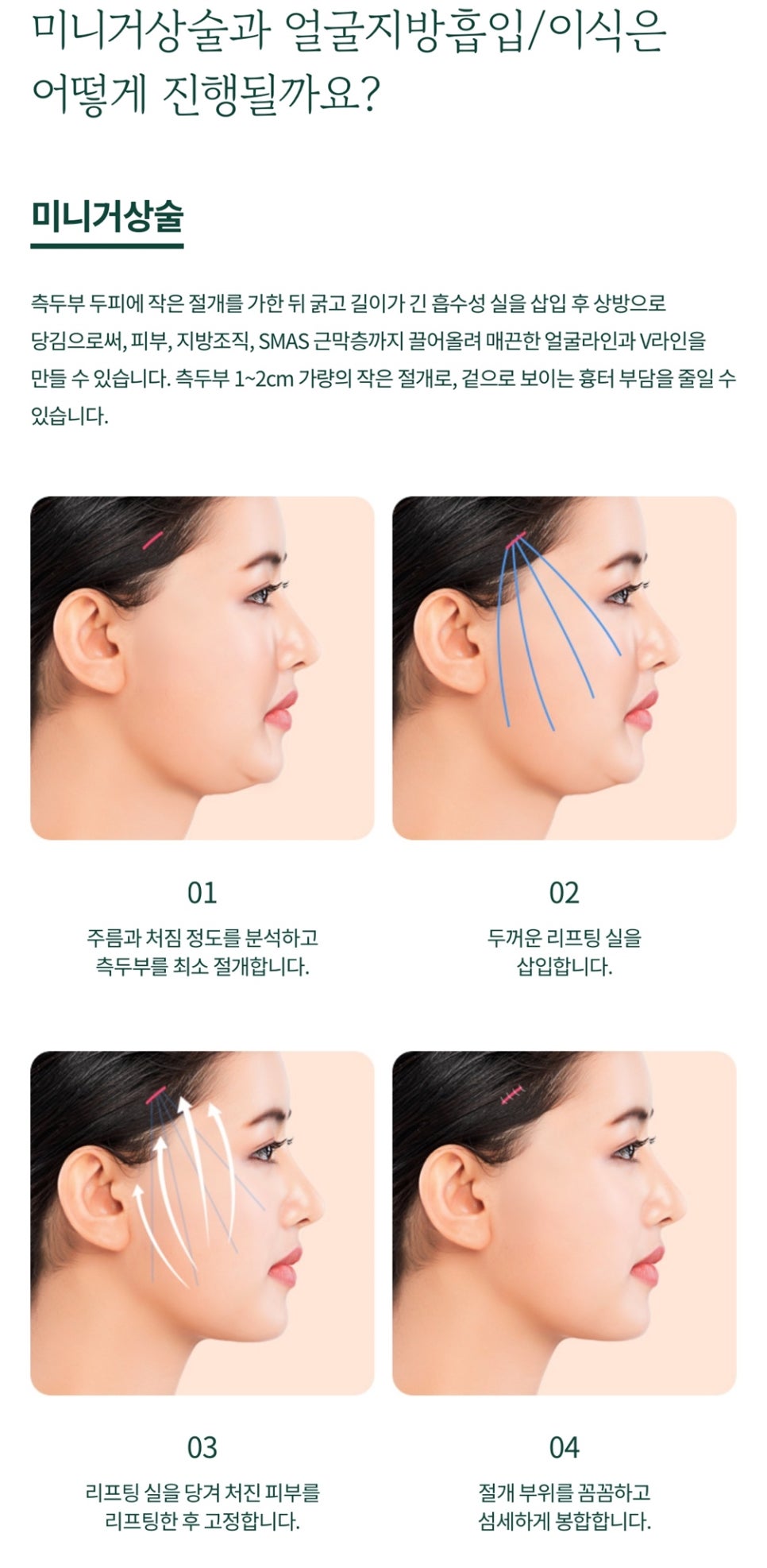
Through a 1–2 cm incision in the temporal scalp,
the skin is dissected and the loosened fascial layer is fixed.
After that, thick lifting threads are inserted and the incision is closed,
which completes the surgery.
The recovery period is relatively short.
Swelling and bruising may occur immediately after the procedure,
but in most cases they improve within 3 days,
and returning to daily life may be possible within 7 days.
Stitches are usually removed after 7 days,
and the scar gradually becomes less noticeable over time.
If combined procedures are performed, swelling may last a little longer,
but the overall recovery speed can vary depending on each person's skin
and the extent of surgery.
Changes you can expect
The biggest effect is tightening sagging cheeks and jawline,
which makes the facial contour more defined.
If marionette lines or buccal sagging improve,
the face as a whole feels lighter,
and the impression of looking older changes significantly.
Also, when combined with liposuction/fat grafting,
it can be redesigned into a youthful face with balanced,
three-dimensional contours.
Even if the procedure is performed while skin elasticity still remains,
you can also gain a preventive effect that helps slow the aging process,
which is why we recommend it to many people.
How is it different from a facelift?
Many people may think of it as just a slightly simpler surgery.
Although both methods may have similar improvement goals,
they differ greatly in the incision range, dissection range,
surgical time, and recovery period.
A traditional facelift involves an incision from the hairline
to behind the ear, extensive skin dissection,
and lifting and fixing both the sagging SMAS layer and the skin.
As a result, the surgery time is longer and recovery can also take longer.
By contrast, this surgery uses only a small temporal incision
to dissect and lift only the necessary area, by only as much as needed,
so it is very effective for moderate cheek sagging and jawline refinement.
In short, a mini facelift is effective in the early stages of
midlife facial sagging, while a facelift is suitable when the entire face
needs to be fundamentally lifted because aging has progressed more severely.

Closing remarks...
A mini facelift is a less burdensome option than traditional methods
that pull the entire face too aggressively,
and it is an effective way to improve both the skin and the SMAS layer at the same time.
In particular, as mentioned earlier, when performed together with other surgeries,
you can expect more refined contours and a more three-dimensional effect,
so I think it can be a good choice for those considering lifting after middle age.
Please keep in mind that there is such an option
if repeated procedures do not lead to improvement,
or if sagging feels like it is progressing too quickly.
The most important thing is to determine the direction at an appropriate time
before the skin sagging becomes too severe.
At this time, the most important thing is to consult with a board-certified plastic surgeon
with expertise and experience in a variety of youthful facial surgery cases.
If you have any additional questions or personal concerns,
please visit Mutoel Plastic Surgery Clinic and let us know,
and we will kindly answer them.
That’s it for today’s post,
and we’ll be back next time with better information.
This has been Mutoel Plastic Surgery.
Thank you.