Hello.
This is Mutoel Plastic Surgery.
As we age, everyone begins to lose facial elasticity.
In particular, many middle-aged people notice that
as the cheeks sag, nasolabial folds deepen,
and the jawline becomes less defined.
You may want to restore the same facial contour you used to have,
but surgery can feel burdensome,
and many people are hesitant about treatments that place a lot of stress on the skin.
For those people, the procedure introduced today
may be a good option.
It is called “thread lifting.”
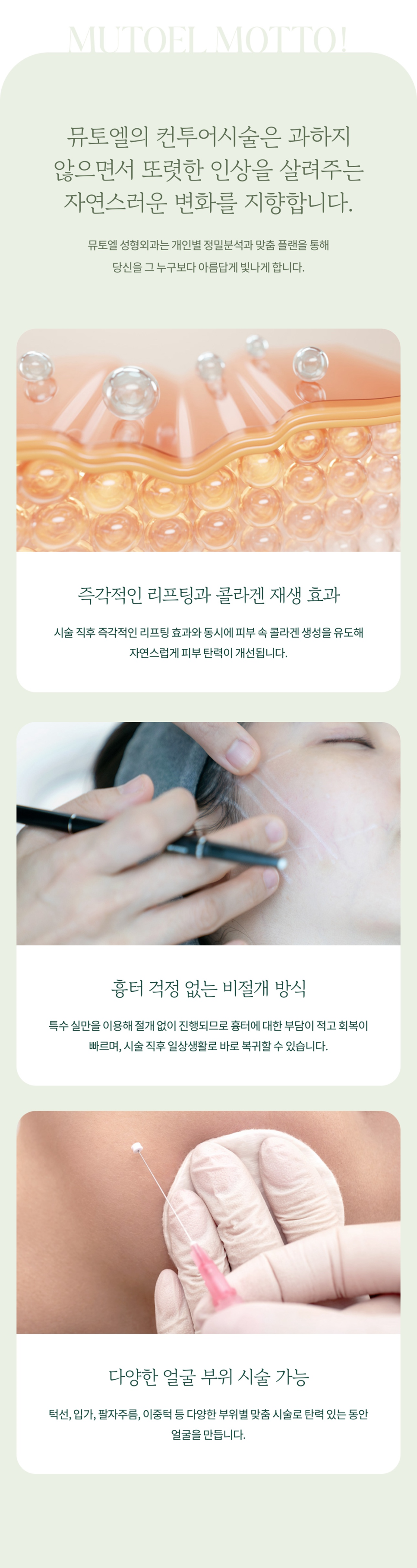
This procedure involves inserting special medical threads into the skin
to directly lift sagging tissue,
sharpen the facial line,
and improve elasticity at the same time.
Compared with surgery, it is much less burdensome,
and because immediate changes can also be expected,
it is a Dongjak-gu dermatology procedure
that we at Mutoel often recommend to middle-aged patients in their 50s and older.

What kind of procedure is it?
It is a procedure that inserts naturally dissolving threads into the skin
to physically lift sagging tissue.
The threads used are mostly made of biocompatible, absorbable materials
such as PDO, PCL, and PLLA,
so after a certain period of time, they naturally break down and are absorbed by the body.
The threads do not stop at simply creating a physical lifting effect.
Along the path where they are inserted, they also stimulate collagen production,
which helps natural elasticity gradually recover from within over time.
In other words, it is a practical procedure
that can offer both an immediate lifting effect
and a long-term skin-regenerating effect.
Why is thread lifting a good fit for middle-aged people?
As people reach middle age, the skin’s ability to produce collagen
begins to decline sharply.
Due to gravity, the fat layer sags downward,
and especially below the cheekbones, around the nasolabial area,
the jawline, and even the neck line,
the overall impression gradually changes to one of skin flowing downward.
To improve this in the short term,
physical lifting is needed.
Thread lifting creates an internal support structure
that can help hold up the surface,
so it can be said to be structurally well suited for middle-aged people
whose overall elasticity has decreased.
In addition, because it also promotes collagen regeneration,
many people who visit the Dongjak-gu clinic experience
that their skin feels firmer over time in the long run.
What kinds of threads are used?
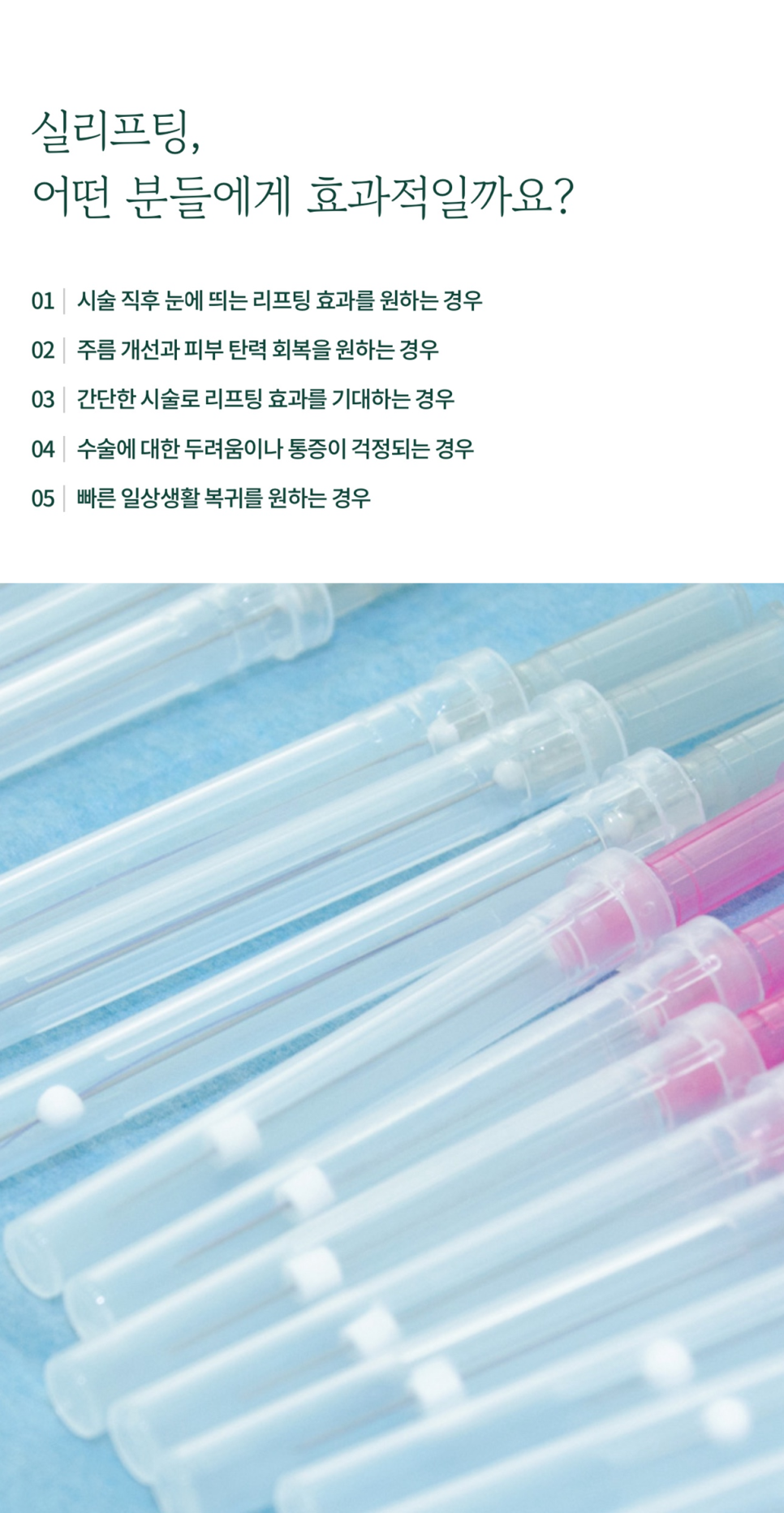
The types of threads used for thread lifting
vary widely depending on the purpose and use.
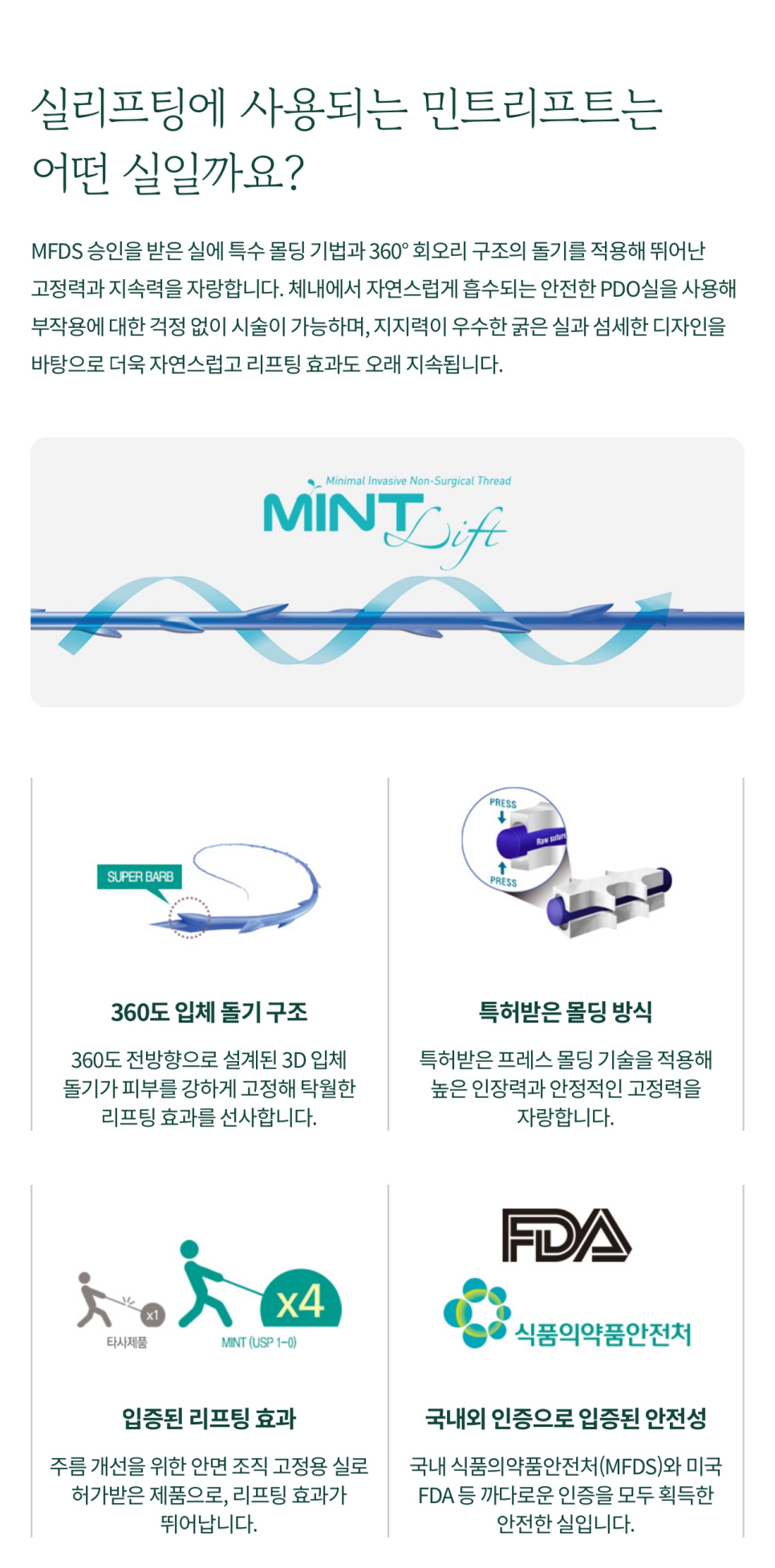
A representative type is PDO (polydioxanone) threads,
which remain in the skin for about 6 months
and are a basic type that provides both a lifting effect
and a collagen-inducing effect.
PCL (polycaprolactone) threads dissolve relatively slowly,
remain for more than a year,
and are used for longer-lasting support.
PLLA (polylactic acid) is a main ingredient of fillers such as Sculptra,
and has the advantage of inducing collagen from within for a long time.
Each thread also has a different shape,
so barbed, spiral, and smooth threads
are selected according to the skin layer and purpose.
Therefore, among the many options,
to make the most effective choice,
it is most important to have a thorough consultation with a plastic surgery specialist
and choose according to your own goals and situation.
Which areas can be treated, and how far does the effect go?
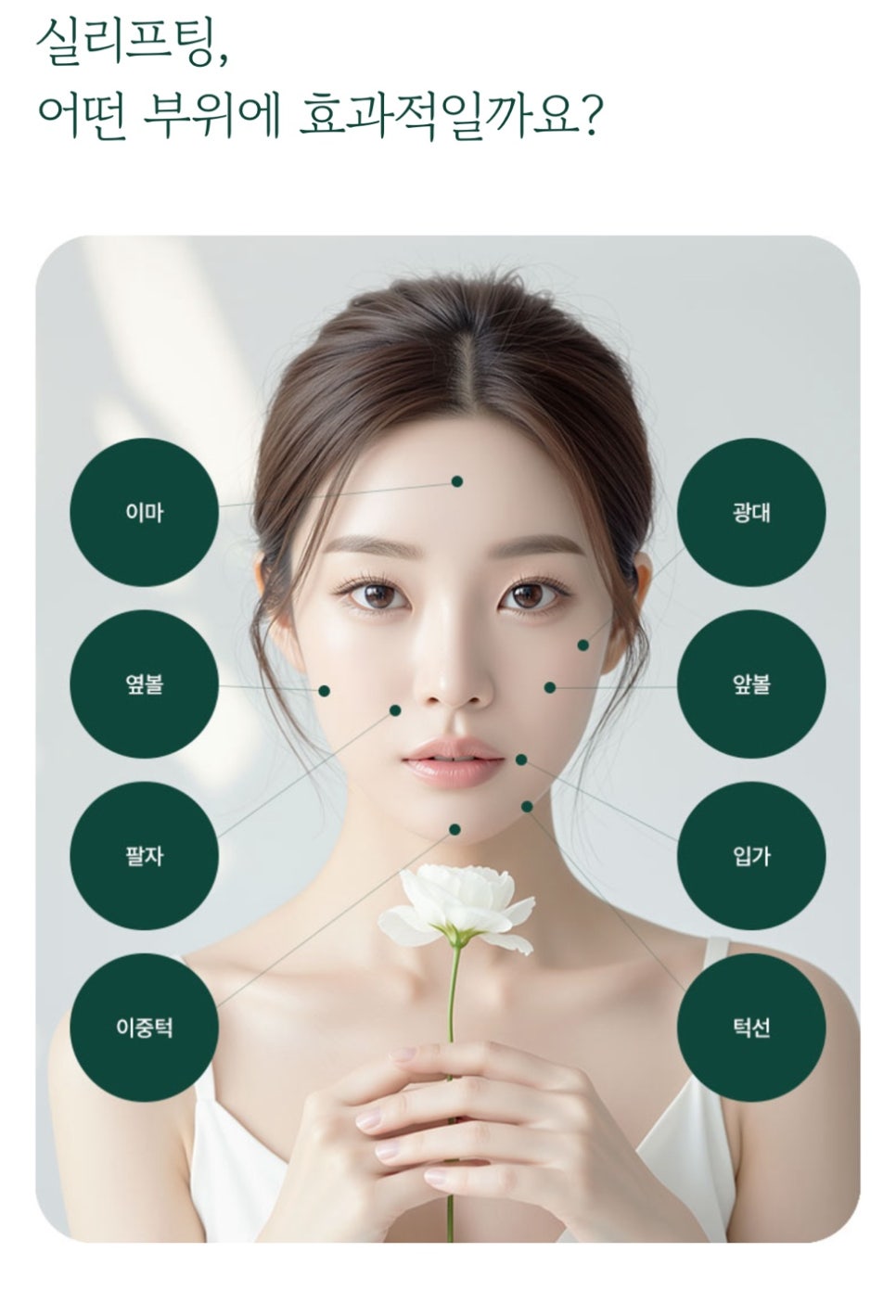
It can be applied to almost all areas of the face.
Commonly selected areas include nasolabial folds,
a sagging jawline, sagging cheeks,
and wrinkles around the mouth.
In particular, a double chin or a face that looks long
can also be improved through this procedure.
When the procedure is performed at the Dongjak-gu clinic,
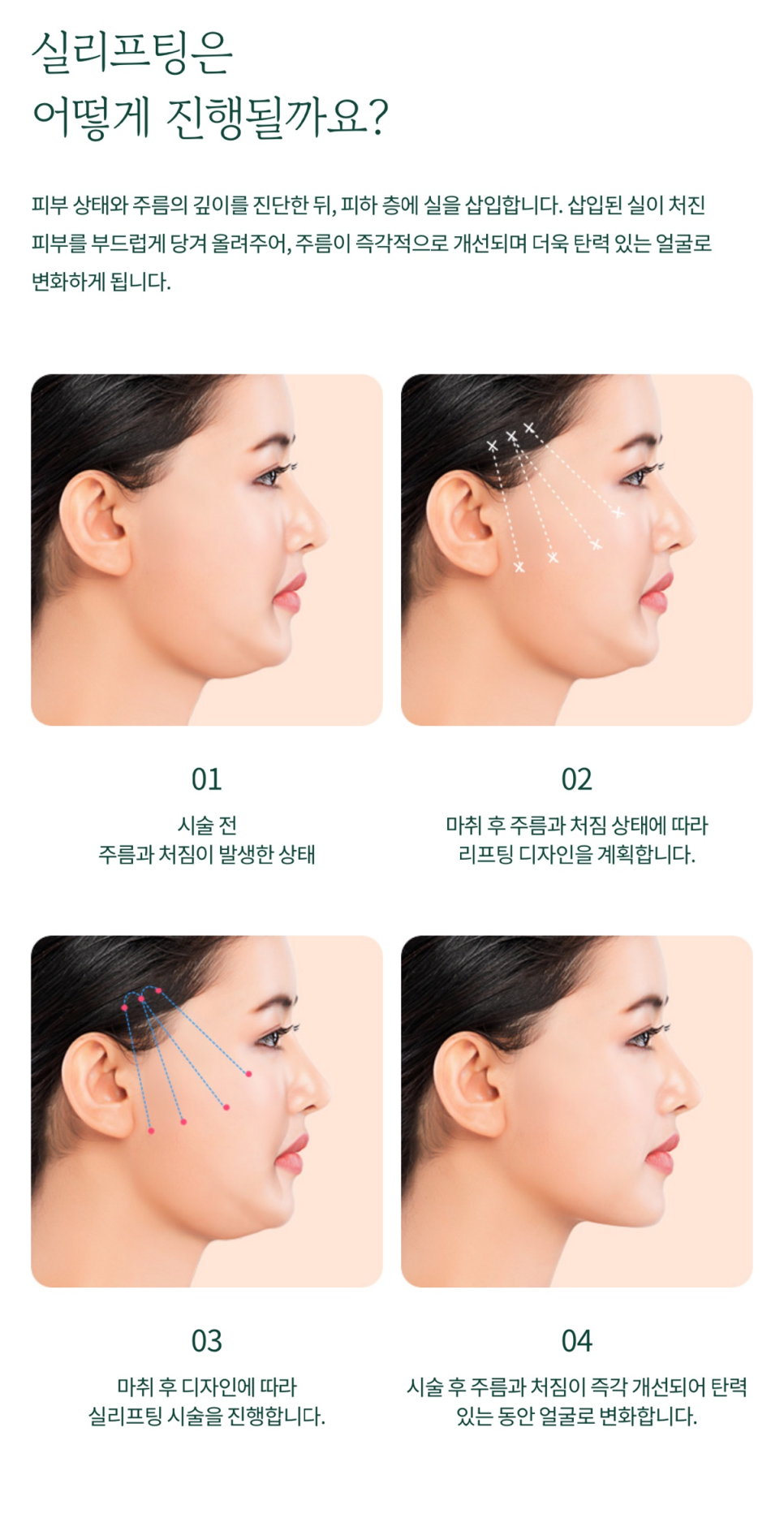
a plastic surgery specialist considers the facial muscles,
the position of the cheekbones, and the degree of sagging,
designs the direction of improvement,
and then carefully plans the direction and angle of the threads.
This can create a V-line effect
that smoothly lifts the overall facial contour.
Beyond simply reducing wrinkles,
this is a process that restores the face’s overall harmony and dimensionality,
so I would like to emphasize that it is most important to go through it
with a skilled specialist.
How long does the procedure and recovery take?
Thread lifting performed at the Dongjak-gu clinic
can be carried out relatively quickly.
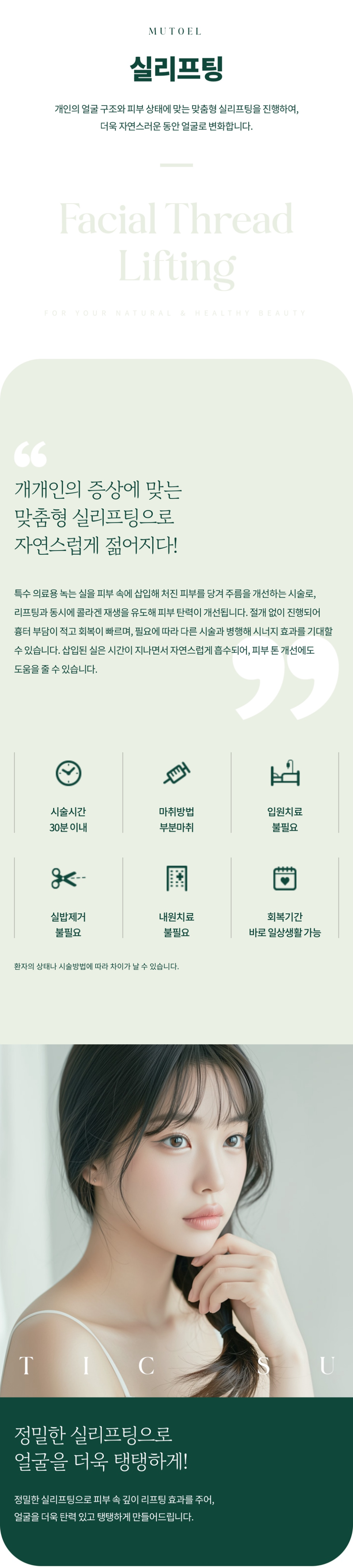
It is performed under local anesthesia,
and although the procedure time varies depending on the area,
it is usually completed within 30 minutes.
Mild swelling or bruising may occur immediately afterward,
but most people recover in about 3 days,
and face washing or makeup can usually be done after 1–2 days
without difficulty.
Since you can return to daily life right away,
the recovery process is not particularly burdensome.
However, it is best to avoid excessive mouth opening or forceful laughing for a few days.
Please be careful not to apply undue pressure to the treated area immediately after insertion.
Although it is a relatively safe procedure,
the results can vary greatly depending on the medical staff’s skill,
so if the insertion direction is off or the threads are pulled too tightly,
side effects such as asymmetry, unevenness, or threads protruding may occur.
In addition, infection or inflammation may rarely occur,
so aftercare is very important.
You must check whether officially approved materials are being used
and whether the procedure is being carried out in a hygienic environment
before deciding to proceed.
How long does it last?
Although it varies depending on the type of thread used
and the individual’s condition,
in general the effect can last from 6 months to up to 1 year and 6 months.
The lifting effect continues until the inserted threads
are completely absorbed by the body,
and because the collagen-inducing effect created as they dissolve remains afterward,
elasticity itself tends to last even longer.
If you combine additional maintenance at regular intervals
or undergo the procedure together with other lifting treatments,
you can extend the duration of the effect.
In closing...
As people reach middle age, no matter how consistently they care for their skin,
it gradually sags downward,
and the face tends to look tired.
At times like this, instead of only caring for the surface,
there are times when you need to choose a method
that can physically improve the internal structure.
Thread lifting directly pulls from within the skin
and stimulates collagen production,
helping maintain a firm facial line even as time passes.
When surgery feels burdensome or you are concerned about recovery time,
I think it can be a good alternative.
Lastly, it is most important to receive an accurate consultation
based on your skin condition and desired results,
and to have the procedure performed by experienced medical staff.
Why not try to regain a youthful, lively, younger-looking face?
That is all for today,
and I will greet you again with a better post next time.
This was Mutoel Plastic Surgery.
Thank you.