Hello.
This is MUTOEL Plastic Surgery.
After surgery, swelling sometimes lasts longer than expected,
or the treated area may not heal well.
I’m sure many of you have experienced this at least once.
When recovery slows down
and returning to daily life is delayed beyond schedule,
it can become very difficult for office workers with tight schedules
or for those planning important events such as weddings.
In situations like that, hyperbaric oxygen therapy (HBOT)
can be a good option that, with something as simple as breathing,
promotes the recovery of damaged tissue
and may help improve a variety of concerns at once,
including fatigue recovery, anti-aging, and better blood circulation.
So today, let’s look at how this treatment works
and what makes it beneficial when you want to improve the recovery speed
after surgery for the skin or the body as a whole.
Why is hyperbaric oxygen therapy effective?
The basic idea and the principle itself are simple,
but at the same time, it is one of the most powerful methods.
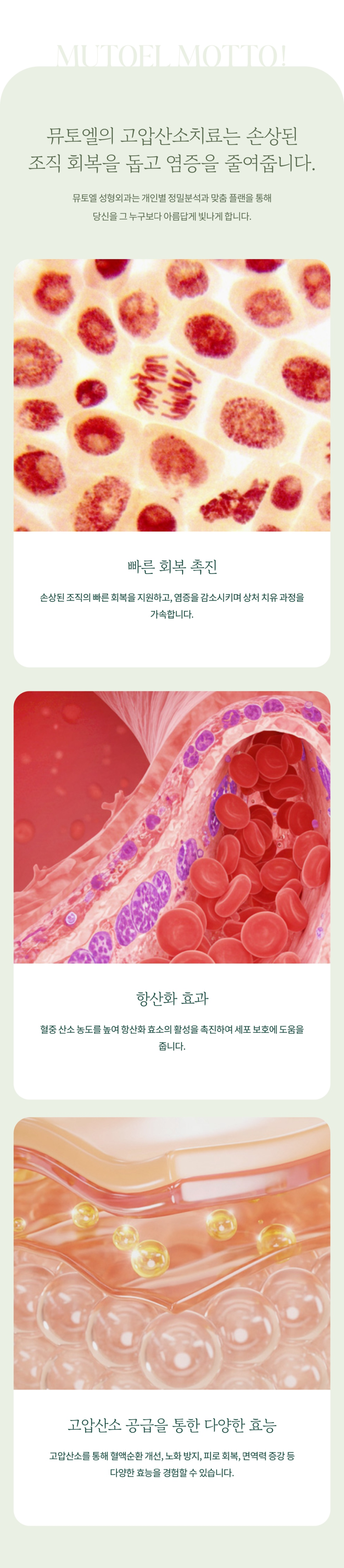
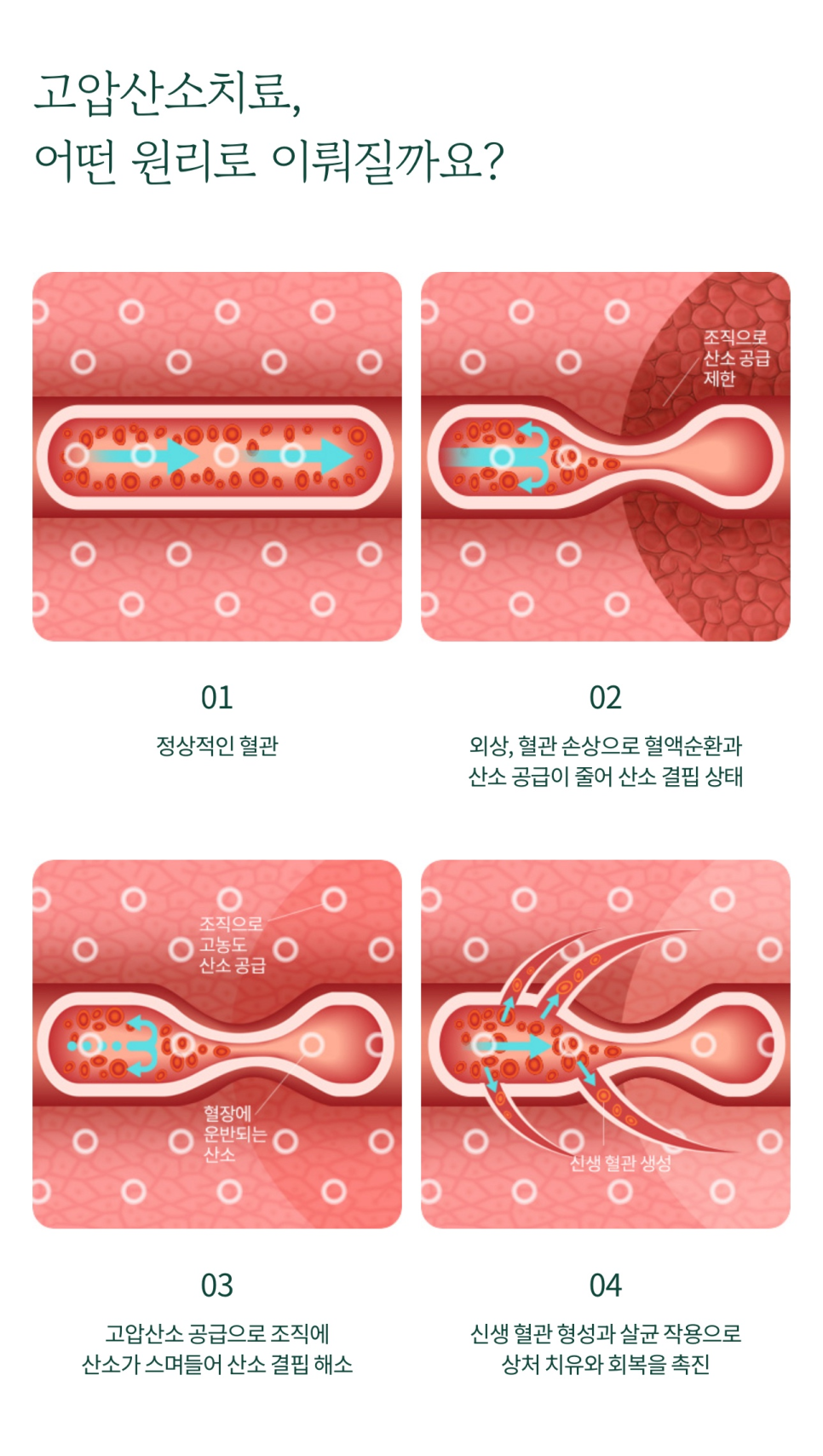
When you inhale 100% oxygen inside a chamber with increased pressure,
the concentration of dissolved oxygen in the plasma rises significantly.
Through this process, oxygen is effectively delivered even into the smallest capillaries,
and the tissue quickly resolves oxygen deficiency.
As a result, wound healing in damaged skin or incision sites speeds up,
inflammation decreases,
and blood circulation improves, making wound recovery much easier.
It can also improve various other areas
through antioxidant enzyme activity,
new blood vessel formation,
fatigue recovery,
immune support,
anti-aging effects,
and more.
Is it better to use it together after cosmetic procedures?
In fact, even before receiving a minor cosmetic procedure,
it is understandable to worry a lot and feel 부담 because scars, swelling, and inflammation can last a long time.
But for these unavoidable concerns,
hyperbaric oxygen therapy is already drawing attention
as an adjunct treatment that can quickly ease those worries.
In an Oxford University journal,
a systematic review on anti-aging and recovery after cosmetic procedures
reported that HBOT may play a positive role
in shortening recovery time,
reducing swelling,
and improving tissue survival rates.
Moreover, in a study of patients who underwent a facelift,
the group that received HBOT together showed a wound healing period
of an average of 13 days, which was significantly shorter than the 37 days
of the control group.
There are also cases showing that it has been used as an effective adjunct treatment
for acute complications such as skin necrosis and inflammation
that may occur after fillers or thread lifting.
In fact, there are several cases where HBOT improved the condition
by restoring oxygen supply to the tissue
when vascular blockage or infection occurred.
In addition, through various actions such as regulating immune cells,
reducing inflammatory substances, and inducing new blood vessel formation,
there are studies showing that it can improve symptoms not only in recovery after procedures
but also in chronic inflammatory skin diseases such as psoriasis and atopic dermatitis.
How is it carried out?
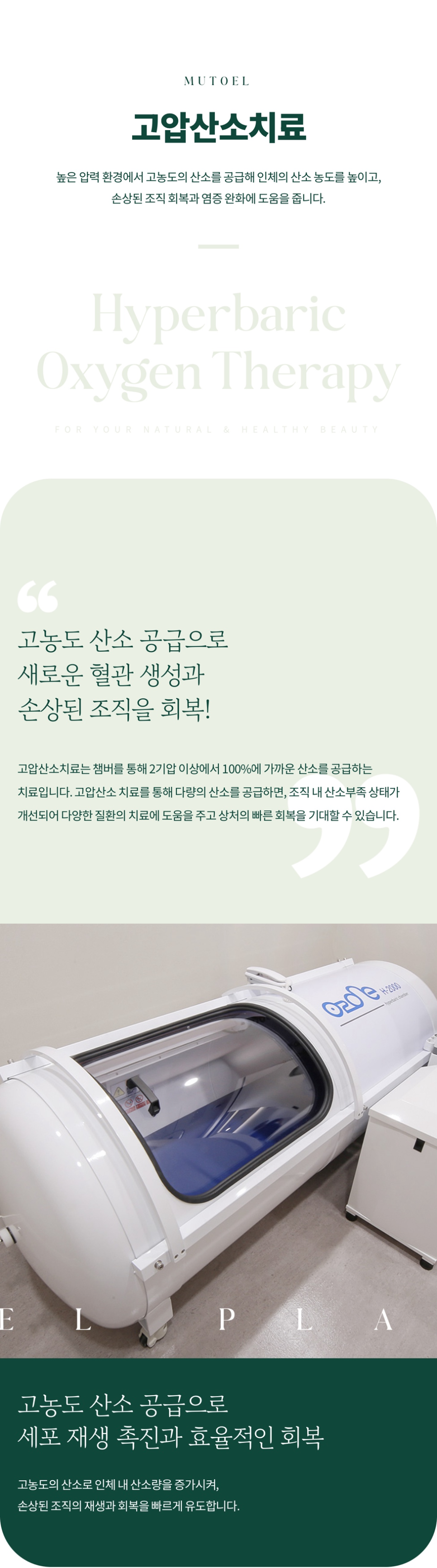
Hyperbaric oxygen therapy is performed with the patient
inside a special chamber, and the process is simpler than you might think.
First, the patient lies down in a bed-type chamber.
Then the pressure inside the chamber gradually increases
to twice atmospheric pressure,
and at that point, the patient inhales a high concentration of oxygen close to 100%.
A session usually lasts about 30 to 60 minutes,
and depending on the symptoms or purpose, it is often received consistently
more than 10 times.
For example, for patients with chronic wounds,
treatment may be recommended more than 20 times,
and if the goal is skin recovery,
a small number of sessions may be enough to expect sufficient results.
During treatment, patients can spend their time in a relatively comfortable state,
such as reading a book or listening to music,
so patient satisfaction tends to be high.
What should you be careful about?
At first glance, it may seem like it can be used safely in all situations,
but there are points that must definitely be considered.
The FDA and medical associations do not recommend using a 'soft home chamber'
without supervision from medical staff,
and advise that it should only be performed safely under strict management
using specialized equipment inside a hospital.
Entering a capsule-type device directly
for treatment is a situation in which accurate and rapid response is the most important factor.
You may feel discomfort such as ear fullness or dizziness,
and if it is carried out without knowing the correct usage,
it can rarely lead to lung or ear problems as well,
so strict management and supervision are essential.
Therefore, if you are planning this kind of combined treatment,
consultation and evaluation with a doctor before the procedure are absolutely necessary.
In closing...
Hyperbaric oxygen therapy is not simply about inhaling oxygen,
but an important adjunct treatment that creates an environment
in which the body can recover on its own.
In particular, after middle age, tissue regeneration ability declines,
so even simple wounds or swelling often last a long time,
and when recovery after various procedures or surgeries is slow,
it can be a very attractive option.
The treatment process is also relatively comfortable,
and it is considered a treatment with a fairly high level of safety,
so it has the advantage of being something you can consider without much burden.
It is a treatment that is even better when used together with other procedures,
but it can still provide meaningful improvement on its own,
which is why I recommend it to many people.
That’s all for today’s post,
and I’ll be back next time with another good article.
This was MUTOEL Plastic Surgery.
Thank you.