Yongsan Plastic Surgery: Non-Implant Rhinoplasty
Natural Results Together
Hello.
This is Mutoel Plastic Surgery.
When meeting clients who are considering nasal surgery,
we are often asked very frequently,
"Is surgery possible without artificial implants?"
For those who have this need,
the procedure we are introducing today is
"non-implant rhinoplasty."
This method corrects both the shape and function of the nose
by using the patient’s own cartilage, bone, dermis, fascia, and other tissues
without inserting silicone or any other artificial material.
Because it offers a natural feel and long-term stability,
it continues to attract interest from people who want results that feel
"like their own."
Today, at Yongsan Plastic Surgery, we will explain this procedure in detail,
from its principles to indications, surgical techniques, advantages and disadvantages,
and recovery and care.

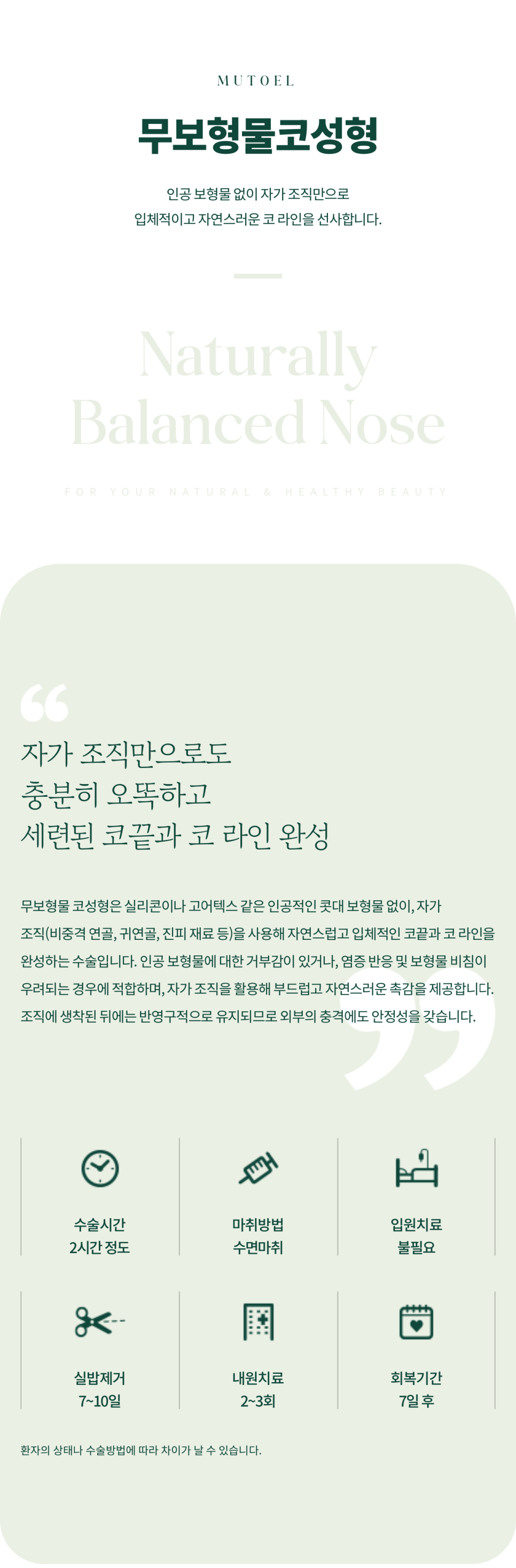
What kind of procedure is it?
It is more than simply "a surgery without implants."
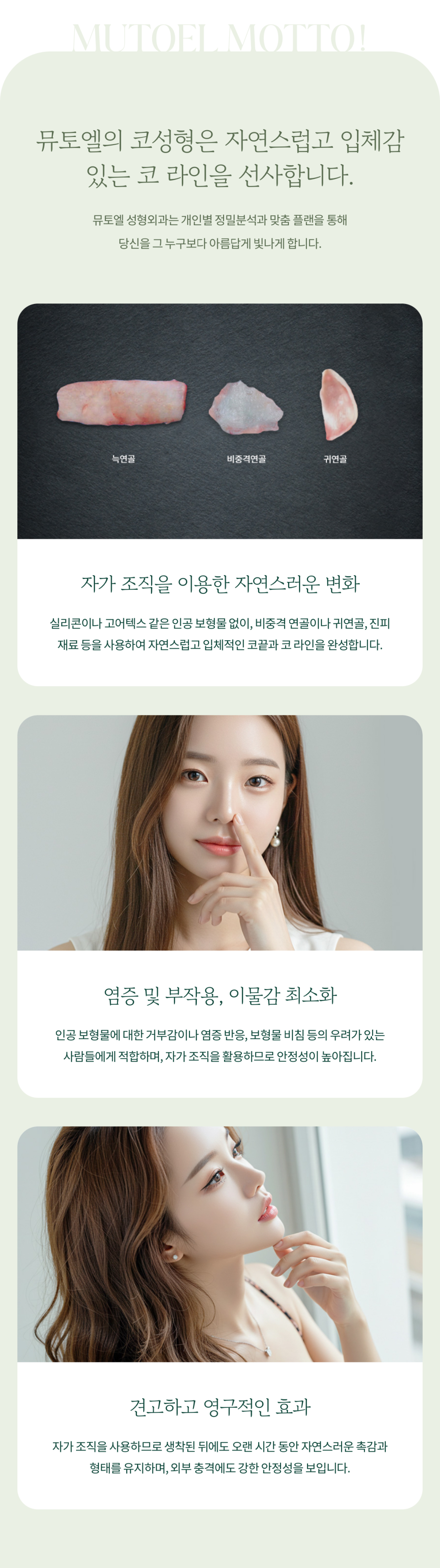
Basically, it uses autologous tissue (septal cartilage,
ear cartilage, costal cartilage, autologous dermal fat, fascia, etc.)
to reconstruct the support structure of the nasal tip,
and if needed, it can naturally raise a low nasal bridge while
simultaneously addressing structural issues such as the nostrils,
nasal bridge, septum, and turbinates.
In other words, it is an approach that does not rely on artificial elements
and instead rearranges the anatomical resources the patient already has
to create shape and function.
Who is it suitable for?
At Mutoel, we recommend this procedure most often for patients whose nasal tip is drooping
or who have moderate nasal tip deformity and want improvement,
or for those who dislike artificial implants
or place the highest priority on long-term stability.
It is also a good option for people who have previously experienced implant-related problems
in earlier surgery and want to reduce the risk of side effects as much as possible during revision surgery.
On the other hand, in highly complex cases where the size of the ear cartilage is too small to create sufficient support with ear cartilage alone,
or when lengthening is needed to correct a short nose, a combined plan including costal cartilage may be necessary,
and in some patients whose nasal bridge is extremely low and cannot be built sufficiently with autologous materials alone,
an implant may be the more reasonable choice.
Therefore, we recommend planning surgery under the diagnosis of an experienced plastic surgery specialist.
How is the surgery performed?
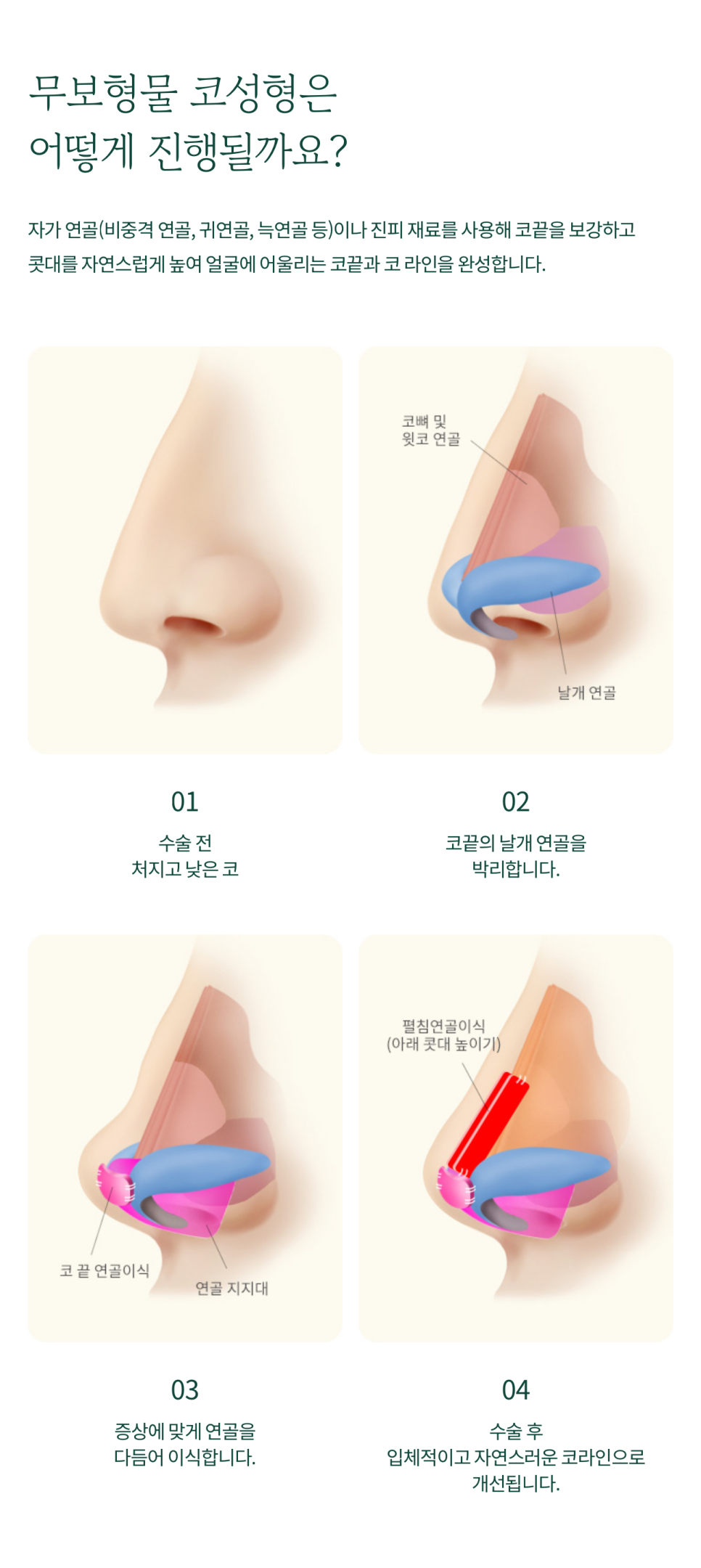
In non-implant rhinoplasty, creating "structural support"
is the most important point.
Once sterile surgical preparation is completed under sedation anesthesia,
a columellar incision or an intranasal incision is made.
In general, when the scope of nasal tip surgery is broad
or when precise reconstruction of the nasal tip cartilage is needed,
a transcolumellar incision is used to approach from the outside with an open technique. However,
when the degree of correction is small and the internal structure can be preserved,
a closed technique using only an intranasal incision is used.
After the incision, the skin and subcutaneous tissue are carefully dissected to create a soft tissue pocket,
and based on the exposed nasal tip cartilage, septal cartilage, and bony structure,
a new three-dimensional nasal tip is created.
With the open technique, septal autologous cartilage is first harvested
and used as material for septal extension,
and if that is not enough, ear cartilage and other tissue are additionally harvested,
shaped, and then grafted onto areas that need structural reinforcement.
The grafted cartilage pieces are positioned and fixed according to the desired nasal tip angle and height,
then the soft tissue is restored to its original position,
and the layers are sutured precisely.
Finally, an external splint is applied,
and internal splints or packing are used for support,
keeping the nose fixed during the first week while swelling and stabilization are monitored,
and various factors are continuously checked.
Most procedures are performed under sedation anesthesia,
and surgery usually takes about two hours.
Because this kind of complex planning and technique is required,
we can say that it is most important to proceed at Yongsan Plastic Surgery with an experienced plastic surgery specialist who can perform precise cartilage use,
suturing techniques, and delicate design.
What are the advantages and disadvantages?
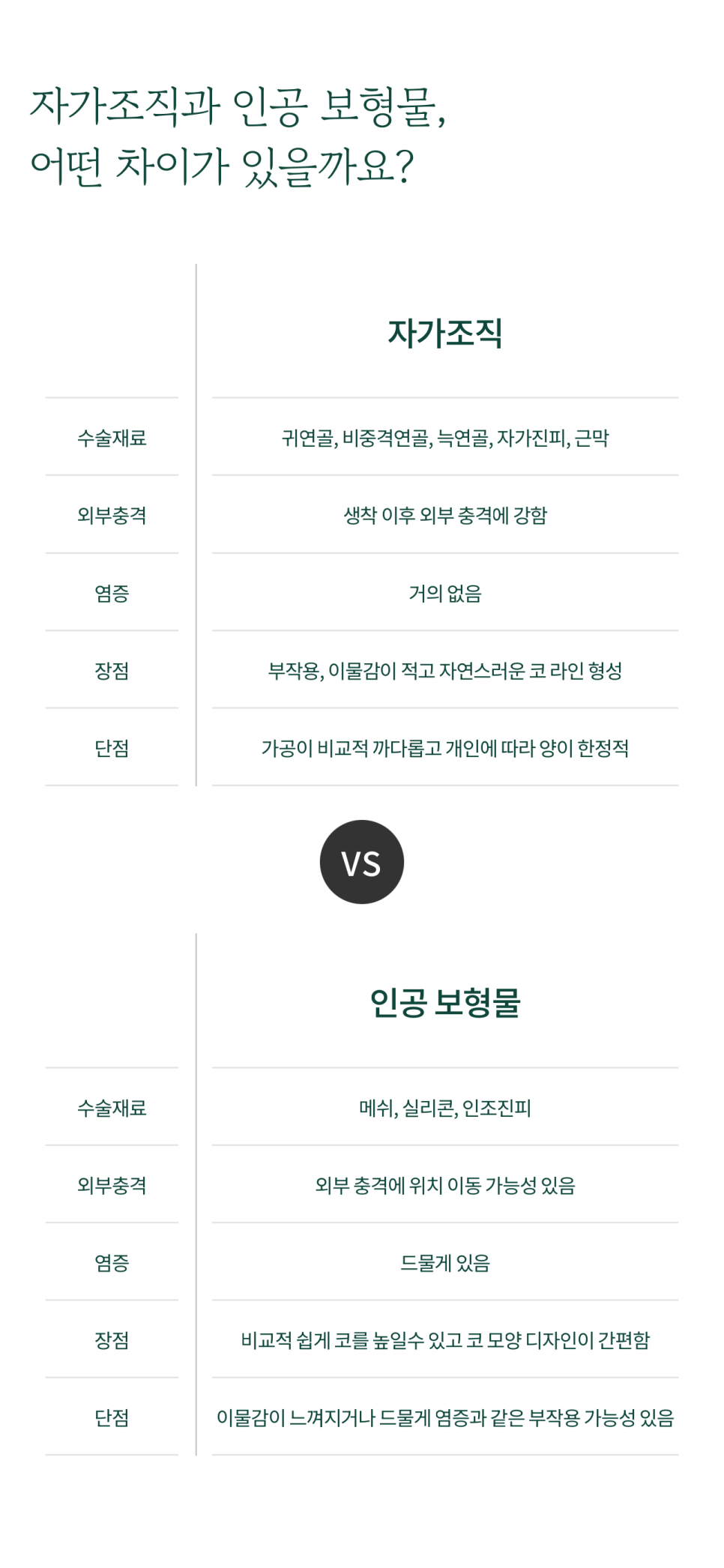
The biggest advantage of non-implant rhinoplasty is the natural appearance and feel.
Because it uses autologous tissue, foreign body reactions are significantly reduced,
and even if an infection occurs, urgent situations such as implant removal are less likely.
In addition, since the tissue tends to integrate well over time and remain stable,
patients seem to appreciate most the fact that "it looks less awkward even decades later."
However, autologous tissue is not a cure-all.
In the case of costal cartilage, warping, resorption,
donor-site pain, and scarring can occur,
and ear cartilage is limited in quantity, so it may not be enough for substantial lengthening.
Also, gradual changes in shape may occur due to cartilage resorption or structural failure,
and the surgery may take longer and recovery may be delayed.
Considering these points, it is most effective to choose the best surgical method that suits you
through a detailed consultation with a medical team before surgery.

How does the preoperative consultation and planning proceed?
During a consultation at Yongsan Plastic Surgery,
we first set individual surgical goals based on the facial bone structure, skin thickness, and cartilage condition.
After that, we review the expected surgical outcome together through photos and 3D simulation,
and explain in sufficient detail the advantages and disadvantages of autologous tissue,
the harvest site, and the possibility of scarring.
The most important part before surgery is to transparently plan which tissue will be used,
and, if necessary, even the primary and secondary plans, including reinforcement materials.

How does the recovery process proceed?
During the first week, swelling and bruising are at their worst,
and returning to daily life is possible within 1 to 2 weeks,
but the final shape appears over 6 months to 1 year.
After surgery, a splint is worn to protect the nose,
and guidance is provided on precautions and care to manage wounds and pain at the tissue harvest site.
During recovery, complications such as inflammation and infection, cartilage resorption, warping,
asymmetry, and breathing difficulties can occur,
so continuous observation is necessary, and if problems arise,
a second surgery such as antibiotic treatment or incision and drainage with irrigation may be required depending on the cause.
Therefore, from before surgery, it is important to establish a plan that allows for long-term management rather than only short-term planning,
so that safe recovery can be expected.
In closing...
Non-implant rhinoplasty at Yongsan Plastic Surgery is an attractive option
for those who want "my own tissue, naturally for a long time."
However, it is not a method that applies unconditionally to every case,
and for successful results, accurate diagnosis, delicate planning,
skilled technique, and honest adjustment of expectations between doctor and patient
must all come together in harmony.
After understanding the advantages and disadvantages of implant insertion and non-implant rhinoplasty,
we recommend clarifying your own priorities and establishing the best customized treatment plan
with a plastic surgery specialist.
That’s all for today’s post,
and we will come back next time with even better information.
This has been Mutoel Plastic Surgery.
Thank you.