Hello.
This is Mutoel Plastic Surgery.
As the trend of “youth enhancement” in plastic surgery has continued to attract attention,
“thread lifting,” which has established itself as a simple yet steady procedure,
has also become a widely chosen option. However, because there are so many types,
deciding can actually be difficult.
Today, just as we explain it to patients in the consultation room, we would like to go
through the principle of thread lifting, its characteristics, the order and method of the
procedure, the details, and tips for achieving successful results, one by one.

How does it lift, and why does it last so long?
The basic principle of thread lifting is really simple.
It can be described as a combination of “physical fixation,” which directly lifts the skin,
and “structural improvement,” in which collagen forms around the inserted threads.
As soon as the thread is inserted, it provides physical support and creates a visible lifting effect.
At the same time, as the thread material dissolves in the body, fibrosis and collagen regeneration
occur around it, resulting in a natural improvement in skin elasticity.
The advantage is that you can experience both immediate change and gradual improvement at the same time,
which helps create long-lasting results.

Are there differences in the materials?
The absorbable materials most commonly used for medical threads at Yongsan Plastic Surgery include
PDO, PLLA, and PCL.
PDO is absorbed relatively quickly, so it offers excellent immediate lifting effects,
but its duration is comparatively shorter. PLLA and PCL are absorbed more slowly,
so they can support collagen induction for a longer period.
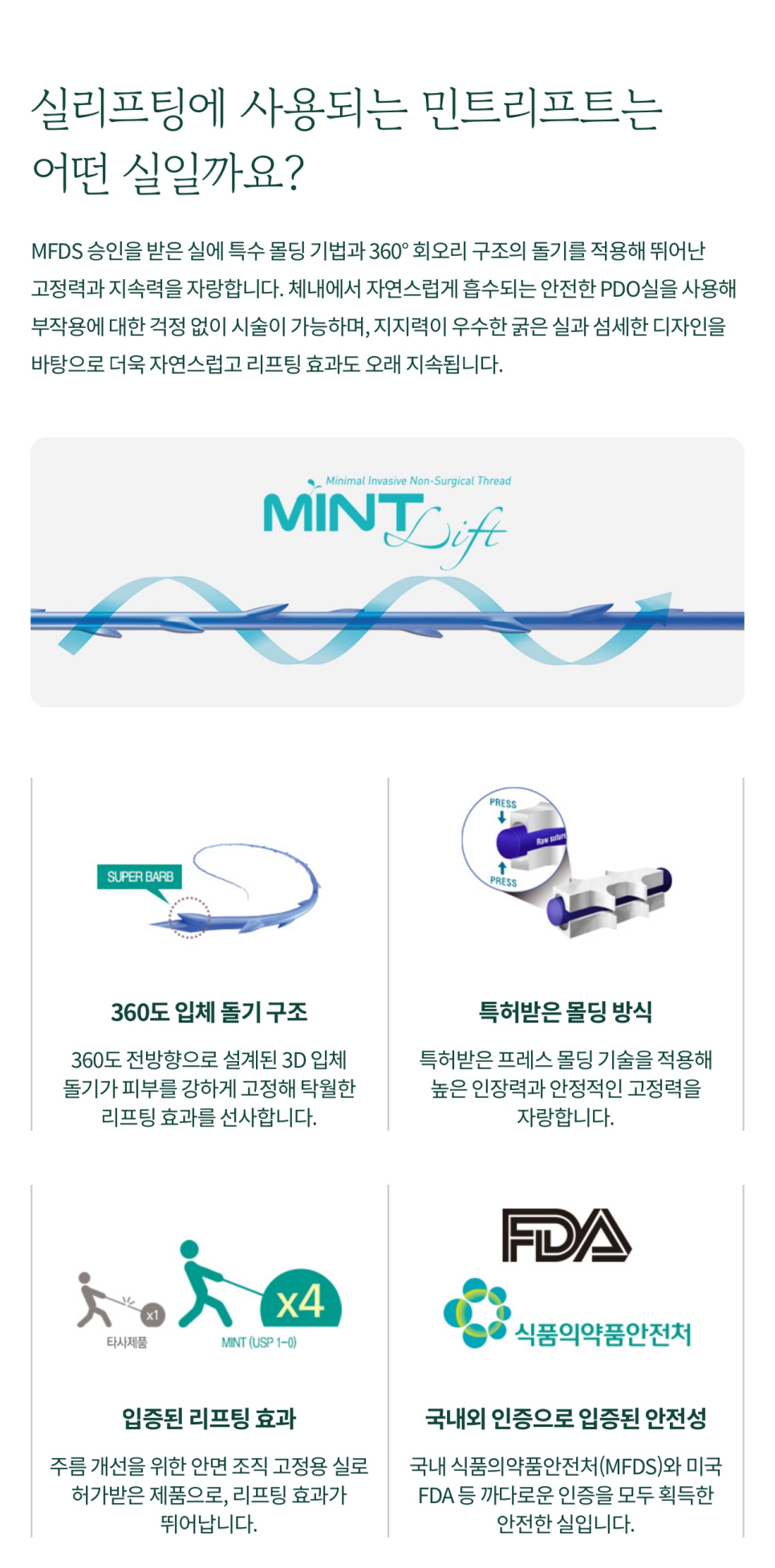
The shape of the thread surface is also important. Broadly, it is divided into straight, barbed, and cone types.
Barbed types have a stronger grip on tissue, so the lifting effect itself is quite strong,
but if pulled too much, there is a risk of uneven skin texture or nodules.
Straight types have strengths in subtle lifting and collagen induction.
Each type has different characteristics, and the recommended insertion layer
(subcutaneous layer, fat layer, SMAS) also differs, so the practitioner’s anatomical knowledge
and range of experience are important.
Why is the design process important?
Thread lifting at Yongsan Plastic Surgery is 90% design.
The face must be analyzed three-dimensionally to determine where sagging is most severe,
while carefully considering skin thickness and elasticity, fat distribution, and the amount
of volume present.
If you simply pull the skin in a face with little volume,
it may actually make the face look thinner.
In such cases, a more natural look is created through a combined surgical plan that supplements
insufficient volume with fillers or fat grafting while also lifting with threads.
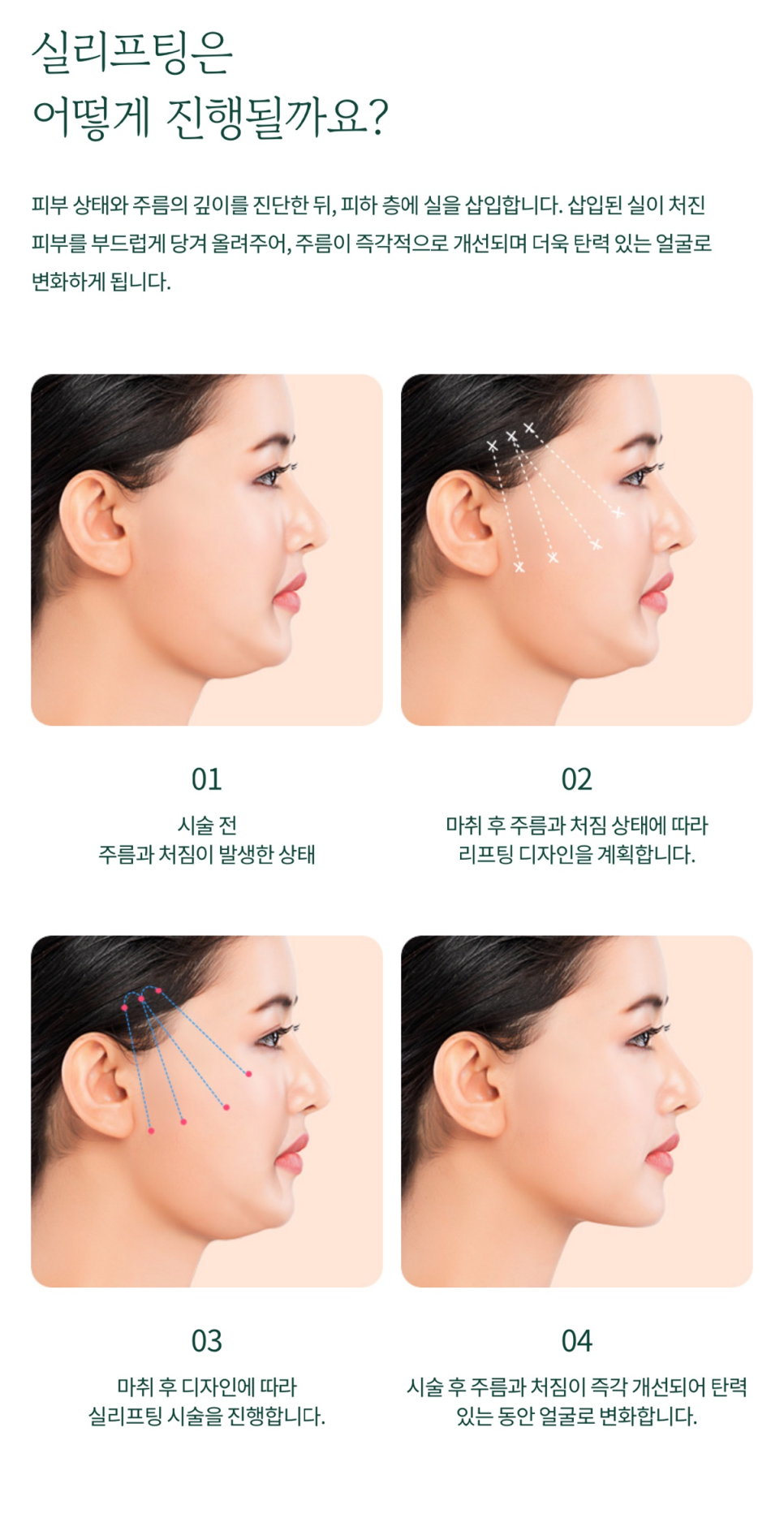
It is important to set the entry point, fixation point, insertion angle,
and the number and length of threads in advance, and then adjust them according to the patient’s needs.
For such a refined result, we recommend proceeding only after consultation with an experienced board-certified plastic surgeon.

How is the procedure performed?
Usually, the procedure is performed under local anesthesia.
The insertion path of the threads is designed with a marking pen,
and after injection anesthesia, a small opening is made at the entry point.
In a sterile setting, the thread attached to a cannula or needle is inserted and pulled upward to secure it.
Additional threads are then inserted to achieve left-right symmetry.
It is important to create a natural surface so that the thread is firmly anchored at the target point
without contacting the skin surface, and the procedure usually takes less than 30 minutes,
so it is not a long procedure.
Immediately after the procedure, some swelling and bruising may occur,
and you may feel localized discomfort.
In most cases, these improve within 3 to 7 days. Some parts of the thread may also be felt on the skin surface
or the oral mucosa, but this too usually settles within a few weeks or disappears as the thread dissolves.
It takes at least 6 months to 1 year for the thread material to be fully absorbed
and for newly formed collagen to stabilize.
During the first 2 weeks, to prevent side effects, you should avoid excessive facial expressions,
saunas, strenuous exercise, and massages that apply pressure.
Points to keep in mind when choosing a medical team and clinic
Because thread lifting at Yongsan Plastic Surgery is a procedure in which the results are determined
by the person’s skill, it is important to choose a clinic that is well equipped with the practitioner’s
expertise and experience, the quality and authenticity of the threads used, sterilization and hygiene management,
and a process for responding if problems arise after the procedure.
During the consultation, you should always carefully review the portfolio to see whether the results are natural
and whether there are any areas of overcorrection.

In closing...
If carefully planned and cautiously performed, thread lifting is a procedure that can provide
satisfaction comparable to surgery.
However, if chosen too easily without careful consideration, it may lead to unsatisfactory results
or a higher chance of complications, so caution is needed.
Based on a delicate understanding of facial structure, we hope you achieve satisfying results
by working with a board-certified plastic surgeon who aims for natural improvement.
That concludes this post from Yongsan Plastic Surgery.
If you have any further questions, please feel free to visit Mutoel for a consultation at any time.
After directly examining the three-dimensional structure of your face in the consultation room,
we will strive to provide care that is helpful from the patient’s perspective so that you can make the best choice.
This has been Mutoel Plastic Surgery.
Thank you.