Hello.
This is Mutoel Plastic Surgery.
As we get older, when we look in the mirror,
there are times when our eyebrows droop,
making it hard to open our eyes, or when the
wrinkles on the forehead seem especially deep.
Wrinkles and loss of elasticity caused by aging
are unavoidable, but when they appear directly
on me, they can still feel discouraging.
If you get Botox in the forehead, the forehead
wrinkles may smooth out, but the heavy feeling
around the eyes still remains.
Thread lifting on the forehead also has only a
minimal effect.
At this time, in order to address heaviness in the
upper face and create a brighter impression,
an 'endoscopic forehead lift' can be a good choice.
The key phrase for Mutoel anti-aging facial
plastic surgery is
"Changing the big picture while keeping it harmonious and natural," so today, from the perspective of a board-certified plastic surgeon, I will explain in detail what this surgery is, how it is performed, and what its effects and precautions are.
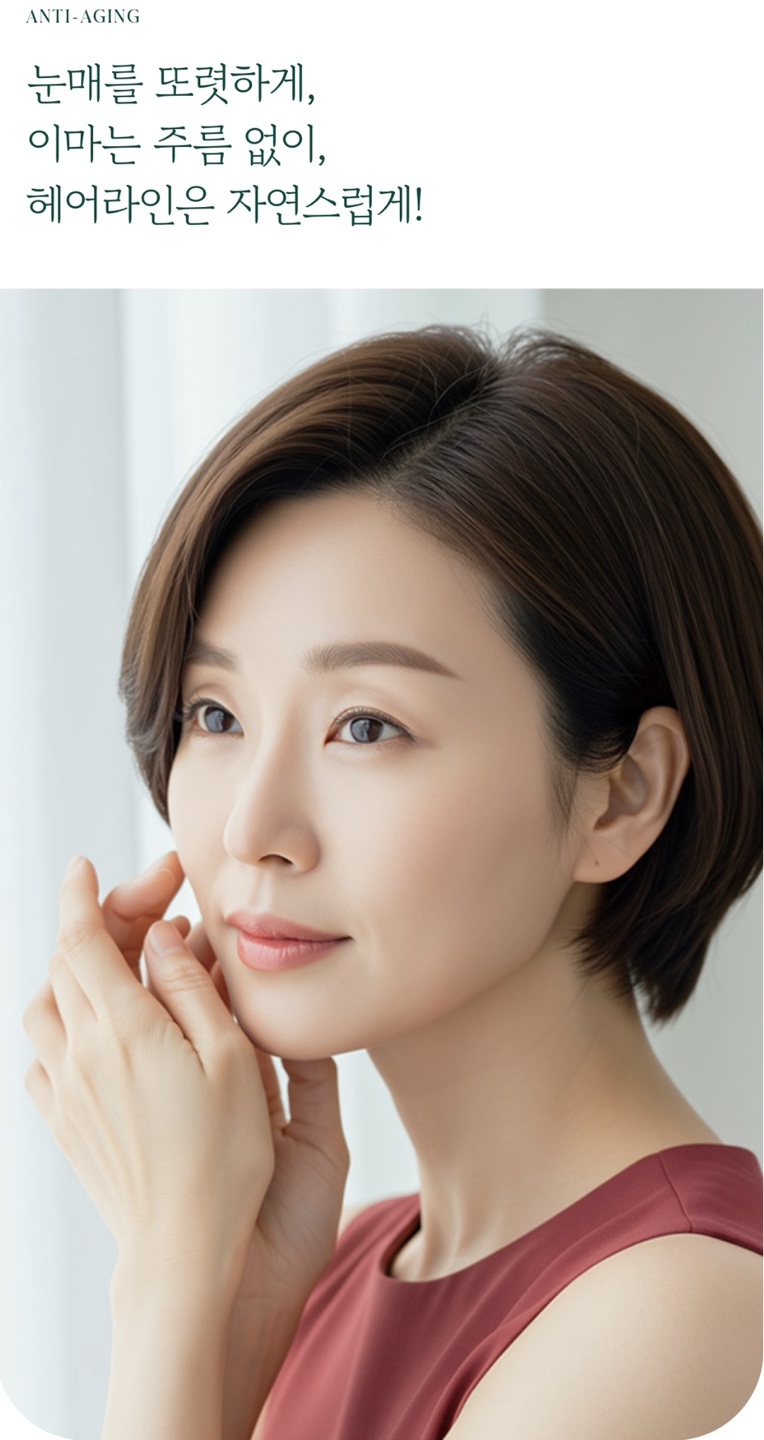
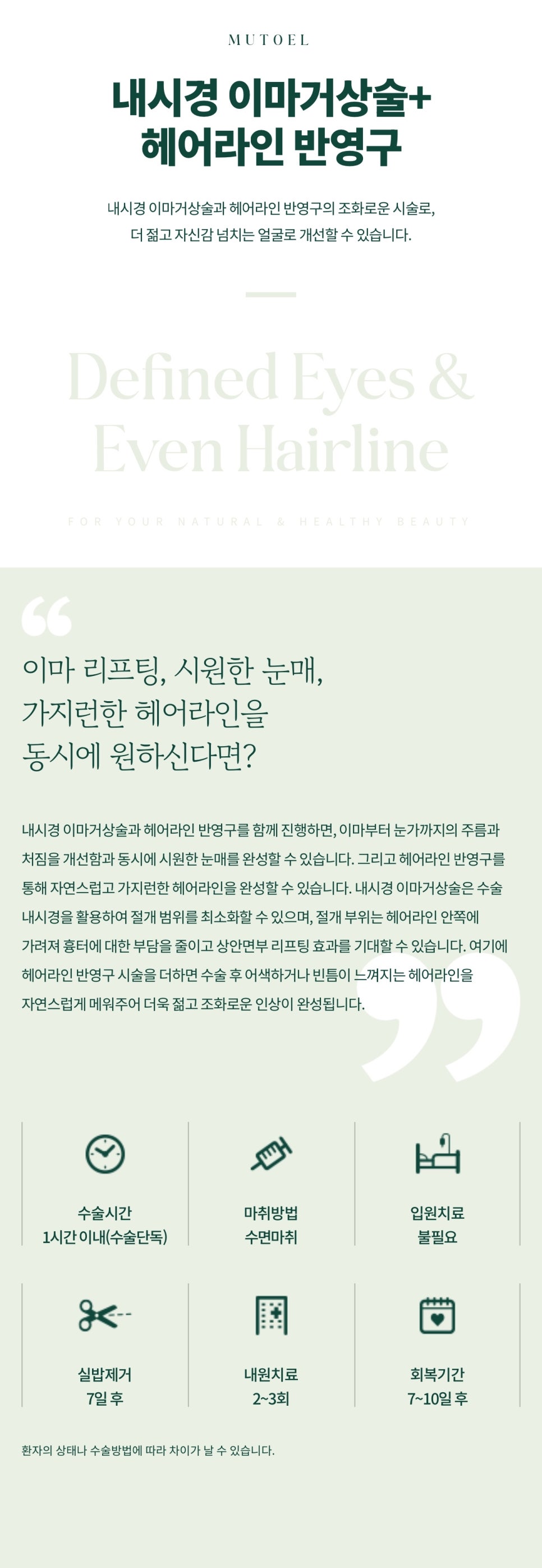
What kind of surgery is it?
The procedure minimizes scarring by making incisions only in the scalp, then inserts an endoscope to dissect the muscles and lift the entire forehead tissue upward before fixing it to the skull bone.
In the past, traditional lifting surgery involved making a horizontal incision across the entire scalp, widely dissecting the upper face, and directly pulling it upward. As a result, scars remained and recovery took a long time.
Like laparoscopic surgery, endoscopic lifting allows precise manipulation while directly viewing the structures of muscles, nerves, and blood vessels with a high-resolution camera, which lowers the risk of nerve injury and reduces the size of the incision.
It is an anti-aging facial plastic surgery that is receiving increasing attention because it offers similar effects and longevity with less scarring and faster recovery.
Who is it suitable for?
It is mainly recommended for middle-aged patients in their 40s and 50s or older when sagging is moderate to severe.
It is effective in cases where the forehead and eyebrows have descended overall, causing horizontal wrinkles on the bridge of the nose and around the eyes, or when opening the eyes feels uncomfortable and the upper face looks heavy.
However, if soft tissue sagging is severe and skin elasticity is also reduced, or if the forehead is wide, traditional lifting that directly removes tissue may be more effective. That is why it is important to choose the most suitable lifting procedure for yourself.
In the consultation room, we comprehensively check the shape of the eyebrows (between the brows to the tails), the depth of forehead wrinkles, the position of the hairline, skin thickness and elasticity, and the overall facial proportions. After comparing the difference in expression when the forehead is relaxed versus when it is lifted, we design the optimal lift points.
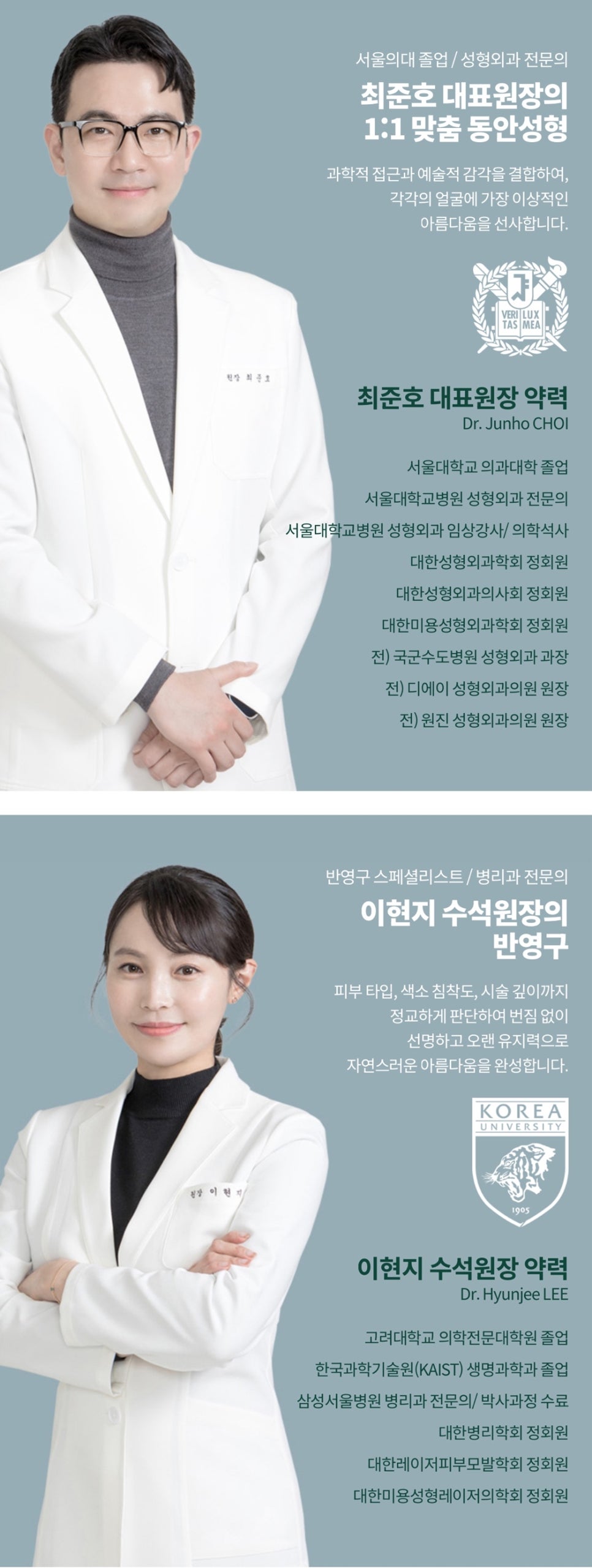
A safe surgery is only possible after carefully checking past surgical history in the scalp area (such as hair transplantation), whether you are prone to scarring, and any history of taking medications such as anticoagulants or omega-3. Therefore, I recommend working with a board-certified plastic surgeon who has extensive experience performing anti-aging facial plastic surgery.
How is it performed?
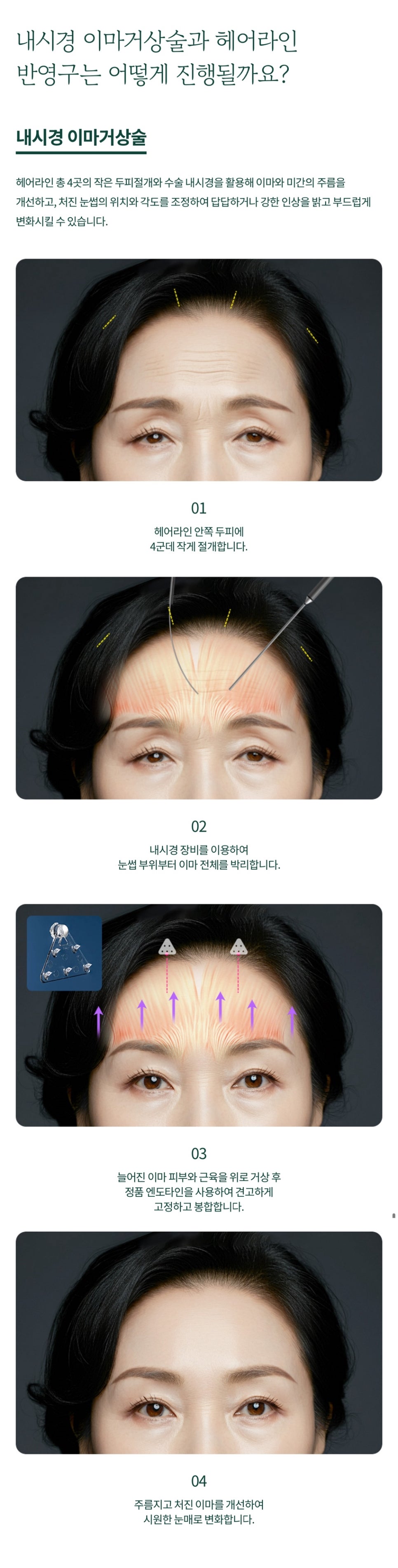
Forehead lifting is mostly performed under sedation anesthesia, so it is comfortable and can be completed within an hour.
Usually, a total of four incisions are made in the scalp around the hairline and temples. An endoscope is inserted, and while viewing the enlarged screen directly, important structures such as the muscles, nerves, and blood vessels around the eyebrows are dissected, and adhesions in the temporal area are also released.
To minimize recurrence, the forehead tissue is pulled sufficiently upward, and the scalp is fixed using a special anchoring device called 'Endotine.'
Because all of these steps are carried out under a detailed endoscopic view, tissue damage is minimal and the procedure is safe. The small incision also leads to faster recovery.
During the first 2 to 3 days, swelling and bruising occur, and the scalp may feel numb, but these improve significantly after more than a week.
Sutures are removed on day 7 after surgery, and returning to daily life is also possible after 7 days.
However, actions that irritate the scalp, such as washing your hair roughly, or vigorous exercise, should be especially avoided until 2 weeks after surgery.
Immediately after surgery, the forehead is pulled upward to the point that the eyes may not close well, but it becomes natural after just one month, and the final tissue stabilization and surgical result appear after 3 months.
When it may be better to combine it with other procedures
When you undergo an endoscopic forehead lift, the eyebrows and forehead line rise, making the overall impression noticeably fresher. However, some people may feel that the forehead looks wider than before surgery.
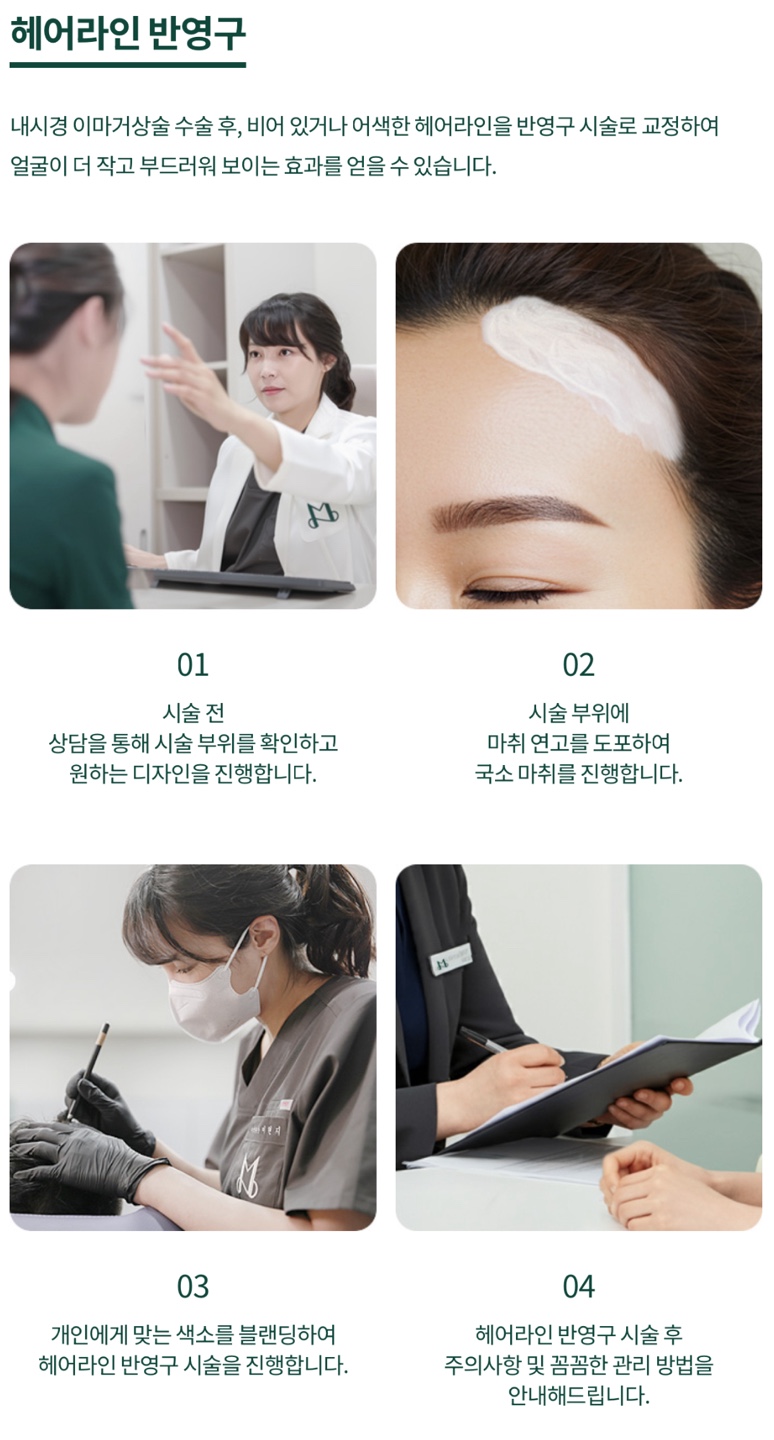
In such cases, a simple semi-permanent hairline procedure can be considered.
Because it creates a new hairline that naturally matches the direction of hair growth, it can correct the appearance of a wider forehead and improve the overall proportions of the face.
In particular, many women want to reveal the forehead clearly but feel burdened because their face looks longer. By combining it with a semi-permanent hairline procedure, these drawbacks can be addressed and satisfaction can be improved.
In closing...
It is very rare for a single surgery to completely transform a person's impression. Some people may experience a large change simply by improving the position of the forehead and eyebrows, but for those who want a "completely youthful" transformation, additional procedures or surgery may be necessary.
Therefore, it is important to set realistic goals and a plan that suit your own condition.
An endoscopic forehead lift is a good surgery that can create a natural forehead line and change the eyebrow height with relatively small incisions.
However, if the surgeon lacks experience or if a customized plan is not established in advance, the effect of the surgery can be greatly reduced.
Recovery is also an important part, so please avoid drinking and smoking from several days before surgery and stop taking risky medications.
After surgery, be careful with taking prescribed medications and wound care, avoid saunas and strenuous exercise, and take care not to apply excessive physical刺激 to the surgical area.
That concludes today’s article from Yongsan Plastic Surgery.
If you have any additional questions, please visit Mutoel. Through careful consultation, we will explain one by one which procedure or surgery is suitable for you and how it should be performed.
This has been Mutoel Plastic Surgery.
Thank you.