Hello.
This is Mutoel Plastic Surgery.
As the hot summer passes and autumn arrives,
the temperature difference between day and night is also gradually increasing.
Before the seasonal flu begins in earnest,
more and more people seem to be contacting Mutoel
to get vaccinated.
Every flu vaccination season, the question I hear most often is,
“Which vaccine is the best?”
Since COVID-19 spread worldwide,
more people have also been looking into
the products and characteristics of each vaccine.
In Korea, the quadrivalent
vaccine has been widely used as the standard following the trivalent one,
and among them, Sanofi’s Vaxigrip Tetra is
used a lot in many medical institutions.
Today, I’ll explain in detail what this vaccine is exactly,
its mechanism of action, recommended recipients and vaccination method,
expected effects and side effects, and the important points
I’ve noticed while administering it in practice, one by one.
What exactly is Vaxigrip Tetra?
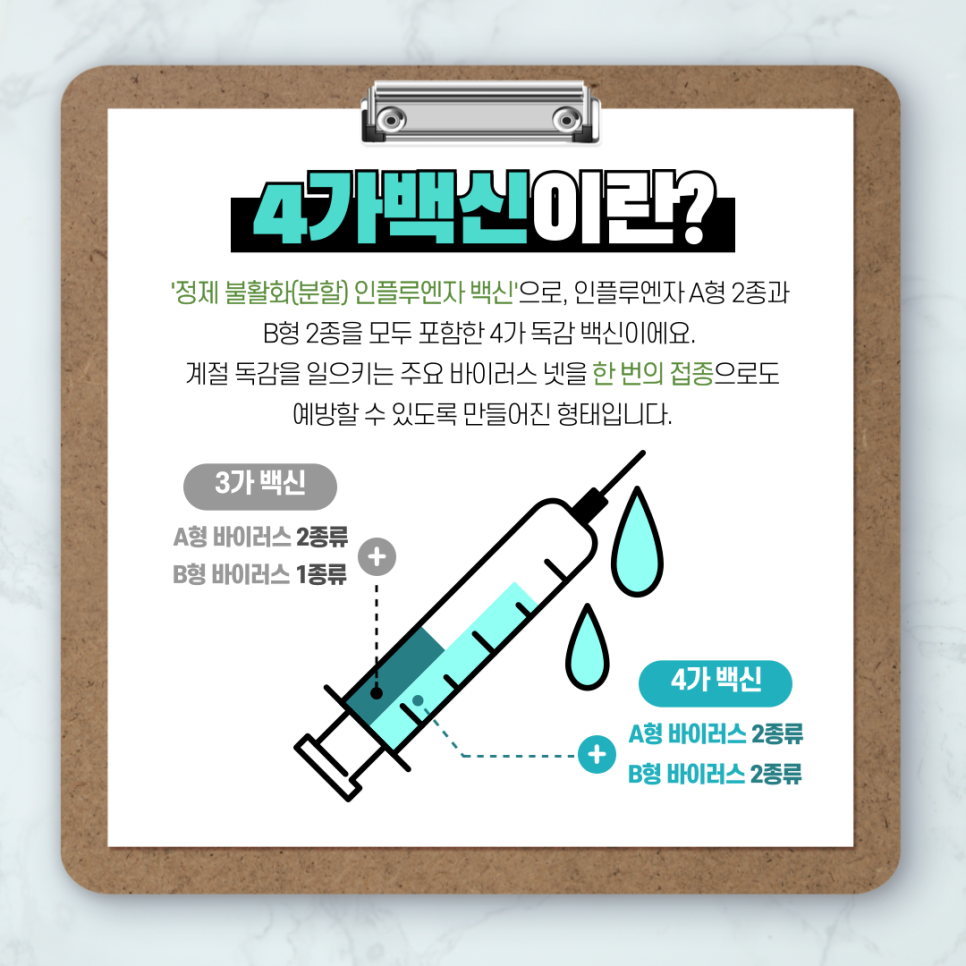
Vaxigrip Tetra is a
'purified split influenza vaccine,'
and it is a quadrivalent flu vaccine that covers
all four types of influenza: two type A strains (H1N1, H3N2)
and two type B strains (B-Victoria, B-Yamagata).
Simply put, it is a vaccine designed to prevent,
all at once, the four influenza viruses that cause seasonal flu.
It is supplied in a prefilled syringe
(ready-to-use injection) form, and vaccination is recommended without age restrictions
from 6 months of age and older.
What is different from other vaccines?
In the past, the trivalent vaccine also included
two type A strains, but for type B,
unlike the quadrivalent vaccine, it included only one strain.
However, type B has two major lineages
coexisting, so it was difficult to predict which lineage
would be dominant in a given year.
Because the quadrivalent vaccine includes both type B lineages,
it significantly reduces the risk of prevention failure
due to a type B mismatch compared with before,
allowing for broader protective effects.
This is also why the WHO and many public health authorities
recommend the use of quadrivalent vaccines.
Who should get it, and when?
Vaxigrip Tetra can be safely used in all age groups
from 6 months of age and older.
It is especially strongly recommended for high-risk groups
at risk of severe complications, such as infants and young children
(6 months to 5 years), pregnant women,
the elderly (65 years and older), and people with chronic diseases.
The vaccination period is usually recommended from September to November,
before that year’s flu season begins,
but it is implemented flexibly depending on regional outbreak timing
and individual schedules.
How is it administered?
Both adults and children receive it as an intramuscular (IM) injection.
However, among children aged 6 months to 8 years,
if this is their first time receiving an injectable vaccine,
an initial dose is given first, and then a second dose
after 4 weeks, so a total of two doses may be required.
For pediatric recipients, please check their previous history
and make a plan accordingly.
It is safest to follow the exact dosage and injection interval
stated in the product instructions and the opinion of the attending medical professional.
Can we trust the side effects and safety?
Vaxigrip Tetra is a reliable quadrivalent flu vaccine
that has been confirmed through global clinical trials
for its immunogenicity and safety profile.
As a quadrivalent formulation, it can reduce the risk of failure
due to type B lineage mismatch, and some studies have reported
that it effectively reduced flu-related hospitalization rates and complications
in both infant and adult groups.
However, because the characteristics of circulating viruses vary every year
and individual immune responses differ, no vaccine guarantees
'100% prevention.' Rather, it plays an important role
in reducing severe illness and complications even if you do
become infected with the flu.
As with all injectable vaccines,
pain, redness, and swelling at the injection site,
as well as systemic fever, muscle aches, and fatigue,
are common post-injection reactions.
In rare cases, severe side effects such as allergic reactions
(anaphylaxis) may occur, so please get vaccinated at a clinic
that can provide emergency treatment.
In post-marketing surveillance in Korea, the incidence of serious adverse reactions
has so far been reported to be low, and the safety profile
has been evaluated as favorable across all age groups.
In addition, safety data have been accumulated in studies involving pregnant women,
which serves as evidence for recommending vaccination during pregnancy.
So unless you are in the very early stages of pregnancy,
it should be fine to get vaccinated without too much concern.

In closing...
In Korea, Vaxigrip (the quadrivalent flu vaccine)
has already been included in the National Immunization Program (NIP)
and has been supplied as a vaccine available at public health centers
and designated medical institutions. Considering that this is a policy-based
support made on the basis of reviews of large-scale safety data
by the manufacturer and public health authorities,
the safety of current quadrivalent vaccine use
can be considered sufficiently verified,
and it is proving very helpful in community-based
and high-risk-group-centered prevention strategies.
Vaccines are like a strong shield
that protects both individuals and communities.
The Vaxigrip Tetra quadrivalent flu vaccine can prevent
a broader range of influenza viruses while still being a safe vaccine.
However, before vaccination, we recommend fully discussing
your underlying conditions, allergy history, and whether you are pregnant
with the attending medical professional before setting your vaccination schedule.
If you have any questions before getting vaccinated,
or if you would like to decide on the timing of your vaccination,
please visit Mutoel and inquire.
After carefully checking each person’s health status,
we will recommend the most appropriate vaccination schedule.
This has been Mutoel Plastic Surgery.
Thank you.