Hello.
This is Mutoel Plastic Surgery.
For facial rejuvenation surgery, when customers who visit Mutoel say, “A facelift surgery feels burdensome, but I want my facial contours refined,” we often recommend a simpler option called “thread lifting.”
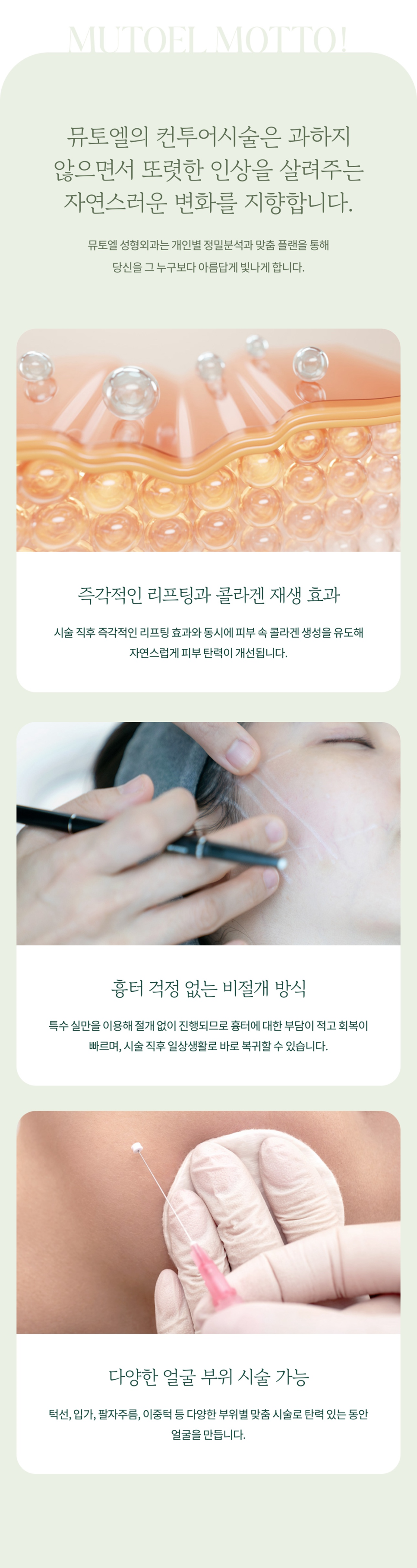
It is a method that minimizes skin incisions and uses dissolvable threads to hook and pull the facial tissues. It leaves almost no scar and has a quick recovery.
However, it is not something to think of lightly as a “simple procedure,” because the practitioner’s detailed planning and skill, as well as the choice of materials, can determine the outcome of thread lifting, so it is necessary to consider it carefully before deciding.
So today, we will explain in detail, step by step, everything from the principles of thread lifting, a trending facial rejuvenation treatment, to materials, procedure process, effects, precautions, and the types of procedures that can be combined with it.

What kind of procedure is thread lifting?
The key to thread lifting is two things.
The first is “mechanical lifting,” which physically pulls sagging tissue by placing threads in it.
The second is the “biological response,” in which fibrosis (collagen induction) develops around the inserted threads, gradually making the tissue beneath the skin firmer.
The thread materials mainly used are absorbable suture materials such as PDO, PLLA, and PCL.
Each product differs in how quickly it is absorbed and in the characteristics of the collagen it generates, so the duration and feel also differ.
For example, threads with barbs or cones on the surface play the role of firmly catching facial tissue.
Their durability also varies depending on which layer they are placed in.

Who is it recommended for?
It is mainly recommended as the most effective option for those with mild to moderate skin sagging.
It can also be a good option for people whose cheeks and the area around the mouth are beginning to sag and whose jawline is becoming less defined, when they want the effects of facial rejuvenation through a non-surgical method.
However, if sagging is accompanied by excess skin, or if the sagging tissue is extensive and tissue repositioning is needed, surgical lifting is more appropriate.
How is it performed?
Before the procedure, the facial contours and the amount of tissue are analyzed three-dimensionally to set the lifting path.
After local anesthesia with anesthetic cream and injections, threads are inserted into the tissue along the preplanned path using a sterile cannula or needle, and then secured.
An appropriate number of threads are inserted on both sides of the face to create symmetry, and areas lacking volume are filled with fillers or collagen injections.
Although there are slight differences depending on the number of threads, the procedure takes less than 30 minutes, and because swelling and bruising are not severe, recovery to daily life is quick.
What about the effects, duration, and side effects?
You can observe a clearly visible lifting effect immediately after the procedure, but after about a week of recovery, it becomes somewhat more natural.
Afterward, as the threads are absorbed, collagen forms, and the tissue gradually becomes firmer and more stabilized.
Although there are individual differences depending on facial shape and tissue characteristics, it is often maintained for about a year on average.
Depending on the type of thread and other procedures performed in combination, it may be maintained for even longer.
However, if you undergo repeated procedures too frequently in pursuit of a bigger effect, tissue adhesion can become worse and the lifting effect may decrease, so it is better to approach it with a plan.
Common side effects after the procedure include swelling, bruising, and localized pain, but these improve within a few days.
Rarely, the thread may be felt or become exposed externally, and localized infection may also occur.
In particular, nodules caused by the thread or thread exposure can cause discomfort and require prompt treatment, so the depth, angle, and fixation of the procedure must be handled carefully.
To reduce complications, avoid alcohol and smoking before and after the procedure, avoid medications that increase bleeding tendency, and refrain from strenuous exercise, saunas, and facial massages for up to one week after the procedure.

What are the benefits of combining it with skin boosters?
After first creating structural support through thread lifting, combining it with a skin booster can create a synergistic effect.
Using HA-based or PDRN · PDLLA-type skin boosters to strengthen the skin over the tissue pulled by the threads adds immediate moisture and radiance, while also promoting the synthesis of collagen and elastin in the dermis, maximizing the lifting effect.
This strategy of physically pulling with threads and improving skin quality with a skin booster improves both “shape and texture,” which can greatly increase satisfaction with the procedure.

In closing...
Thread lifting is relatively simple in principle, but satisfactory results can only be expected when it is backed by the skill of a board-certified plastic surgeon who can understand the structure of the face in three dimensions and perform the procedure delicately so that side effects do not occur.
In other words, thread lifting is a delicate procedure in which not so much the material or the number of threads as the question of “which part of the face should be pulled, and how, to make it look most naturally youthful” is what determines the result.
Combining it with skin boosters can lead to greater change, but not all problems can be solved depending on each person’s tissue condition, so please set realistic goals.
Through a careful consultation with a specialist, I hope you achieve the optimal procedure outcome by combining a “customized design” that suits your face, “appropriate material selection,” and auxiliary treatments such as skin boosters.
If you have any further questions, please visit Mutoel for a consultation.
We will establish the optimal treatment plan by considering your individual facial shape and characteristics.
This was Mutoel Plastic Surgery.
Thank you.