Complete Guide to Military Civilian Hospital Referred Treatment & Medical Expense Reimbursement
(feat. a Specialist Former Military Doctor from Armed Forces Capital Hospital)
Image - Produced by Mutoel Plastic Surgery
Hello.
I am Choi Jun-ho, CEO and head surgeon at
Mutoel Plastic Surgery.
In the past, I served as a military doctor
at Armed Forces Capital Hospital,
where I not only treated many service members,
but also directly handled the work of requesting
referrals to civilian hospitals for three years.
Now, as a board-certified plastic surgeon in civilian life,
I treat many patients and have become the person
who receives referral treatment requests from the military.
Having experienced both sides, I often saw that many soldiers
unexpectedly did not know
'how to go to a civilian hospital'
or 'whether medical expenses can really be reimbursed,'
which caused them to miss the right time for treatment
or experience inconvenience.
So in this post, I will thoroughly explain
'Everything about military civilian hospital referred treatment'
from the perspective of a former military doctor
and current director at Armed Forces Capital Hospital.
I hope this article will be helpful
for service members who work hard to protect the Republic of Korea,
and for their concerned parents.
How does military referred treatment proceed?
When you get sick during military service,
you first visit the infirmary inside your unit
or a military hospital.
However, when it is judged that proper treatment
or detailed examination is difficult within the scope
of military medical facilities,
'referred treatment at a civilian hospital' begins.
Step 1: Military hospital consultation and military doctor assessment
First, you must receive treatment at a military hospital
(or district hospital).
At this point, if there is no dedicated doctor
for the relevant department,
if there is a lack of advanced diagnostic equipment such as MRI,
or if urgent surgery is deemed necessary,
'a referral request' is initiated.
Step 2: Approval from the Armed Forces Medical Command
If the referral request documents prepared by the military doctor
for the reasons above are approved
by the Medical Command Referral Treatment Review Committee,
only then is a 'referral treatment request form' issued.
This document is the most important proof
that state support is provided for civilian hospital treatment.
Step 3: Visit a civilian hospital
Bring the issued referral treatment request form
and your ID, then visit the civilian hospital you want.
The system differs by hospital, but in general
you will go through the process of
[Registration → Consultation → Tests → Diagnosis → Treatment/Surgery].
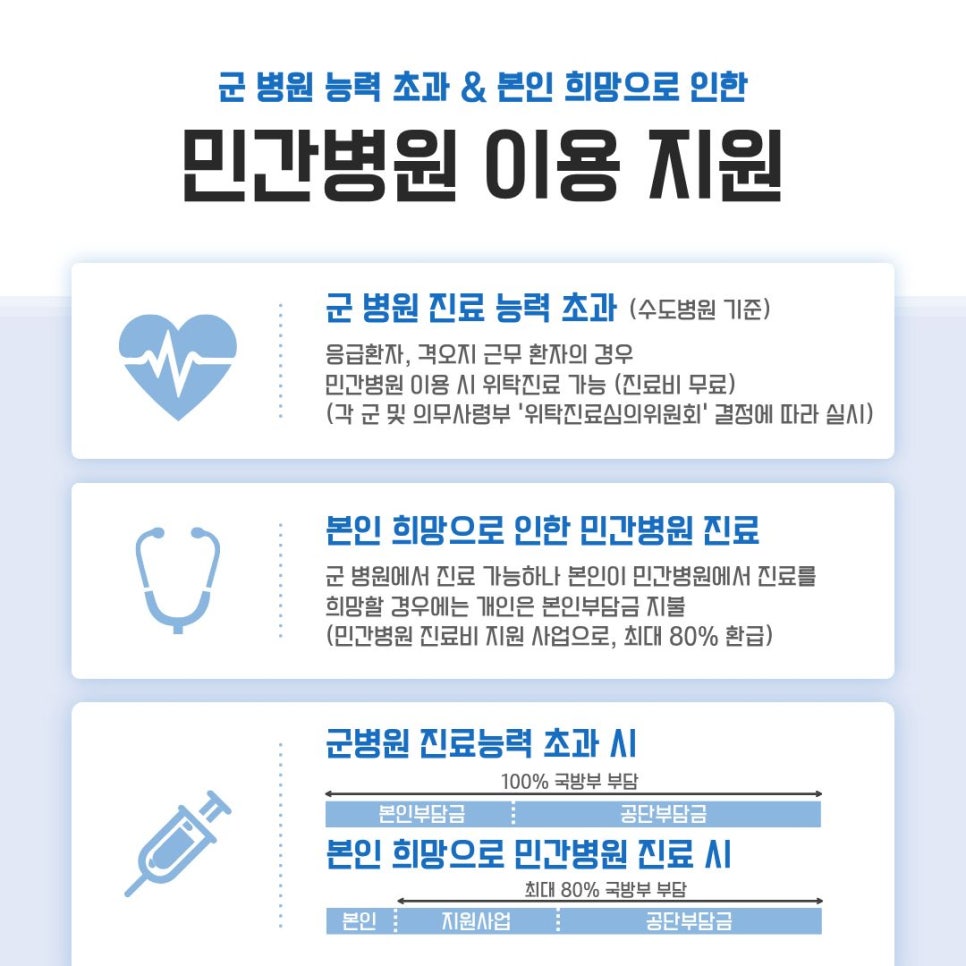
Image - Produced by Mutoel Plastic Surgery
Which is better: a tertiary general hospital or a private clinic?
Many soldiers and guardians think,
"Isn't a big hospital always better?"
However, depending on the symptoms and situation,
you need to make a wise choice.
<Tertiary general hospital>
Advantages
High-difficulty surgeries are possible,
and it is advantageous for treating complex conditions
such as cancer or rare diseases.
Disadvantages
It can take weeks just to get the first appointment,
and months to undergo surgery.
For soldiers whose leave or outing schedules are limited,
time will be the biggest obstacle.
<Private clinic> (plastic surgery/dermatology, etc.)
Advantages
The waiting time is overwhelmingly shorter.
In many cases, tests and surgery can be done on the same day,
which is very efficient for service members
who need to return quickly.
Disadvantages
The equipment available and the expertise of the specialist
can vary greatly from clinic to clinic.

At Mutoel Clinic, to save the precious time
of service members, we operate a three-specialist
collaborative care system, including dermatology and plastic surgery.
In the case of relatively simple skin tumor removal procedures,
it can be a process that takes a long time at a university hospital,
but at Mutoel, one of the biggest advantages is that
surgery can be received within a few days after visiting.
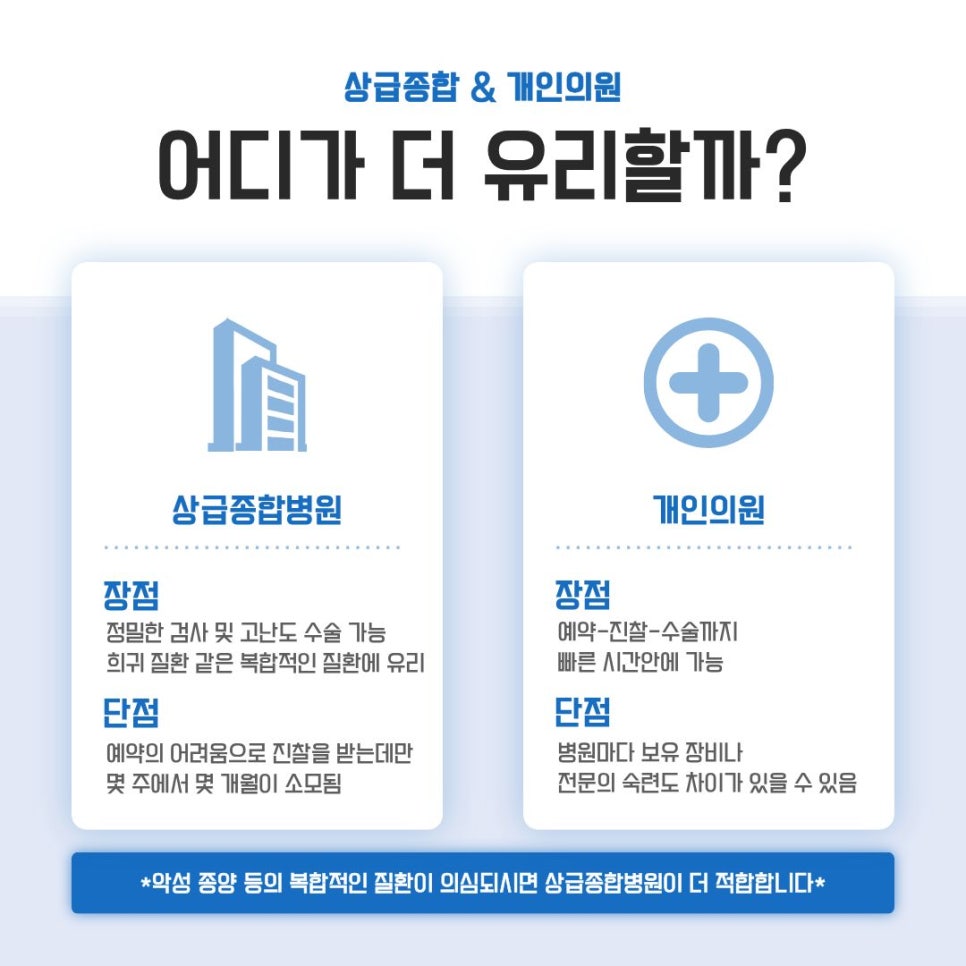
Image - Produced by Mutoel Plastic Surgery
The most frequently asked question: 'medical expense reimbursement'
How much can you receive, and how?
Civilian hospital medical expenses are by no means small,
so you may be worried. Depending on the type of referral,
the reimbursable percentage differs.
Non-covered items such as cosmetic plastic surgery
or orthodontic treatment may be excluded from support.
It is a good idea to check in advance whether your condition
falls under a 'covered' item.
The reimbursement process is as follows.
On-site payment
Pay the medical expenses incurred at the civilian hospital
first with your own card or cash.
Prepare documents
After treatment is complete, before going home,
be sure to obtain and keep the medical bill/receipt
and the detailed statement of medical expenses.
Apply through Narasarang Portal
Access the 'Narasarang Portal' app on your smartphone,
upload photos of the supporting documents,
and submit your claim.
Check deposit
After document review, the reimbursement amount
will be deposited into your salary account within
about 1 to 2 months.
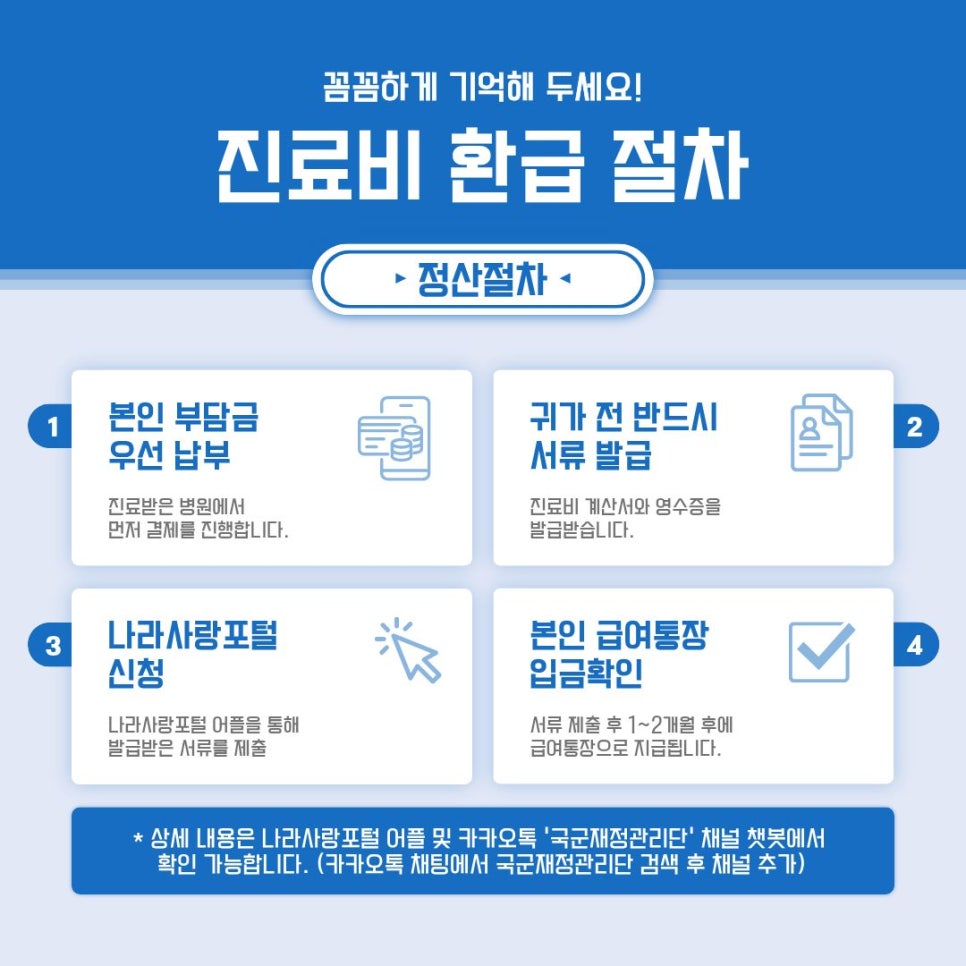
Image - Produced by Mutoel Plastic Surgery
Final note from a former military doctor and current director
During military life, due to dust, sweat, stress,
and the nature of group living during training,
it is easy for skin masses or diseases that did not exist before
to develop.
In particular, if sebaceous cysts or epidermoid cysts
are left untreated, inflammation can spread,
pain can become severe,
and the scope of surgery can also increase.
The idea that "it will get better if I just endure it"
is a dangerous one.
By actively using the state-supported referred treatment system,
receiving treatment as quickly and accurately as possible
is the way to protect your health.
To help you return safely to civilian life after your honorable time
in military service,
Director Choi Jun-ho and Mutoel Clinic
will be a reliable support for you.
If you have any further questions about referred treatment,
feel free to contact us anytime.
We support the healthy military life of all service members
of the Republic of Korea!
This was Mutoel Plastic Surgery.
Thank you.