Hello.
This is Mutoel Plastic Surgery.
The expressions on the faces of patients who open the consultation room door
always contain both excitement and fear.
In particular, compared with other cosmetic surgeries, rhinoplasty is one that many people describe as especially “scary.”
This is because examples of side effects that people encounter online—such as inflammation, infection, implant visibility,
and contracture, where the tip of the nose becomes hard and lifted—feel even more visually frightening than those from other surgeries.
But as a plastic surgery specialist,
what I want to make clear is that
rhinoplasty is not a surgery that is automatically dangerous.
What matters is not being overwhelmed by vague fear and giving up on surgery itself,
but accurately understanding the key points of how to minimize risks
and achieve safe results.
Today, I’d like to take a closer look at the essence of safe rhinoplasty,
which I emphasized in my YouTube video.
Rhinoplasty is divided into bridge surgery and tip surgery.
For most Koreans, the majority of rhinoplasty procedures are surgeries that raise the nose,
called “augmentation rhinoplasty.”
To properly understand this surgery,
we must first divide the nose into two areas:
the bridge and the tip.
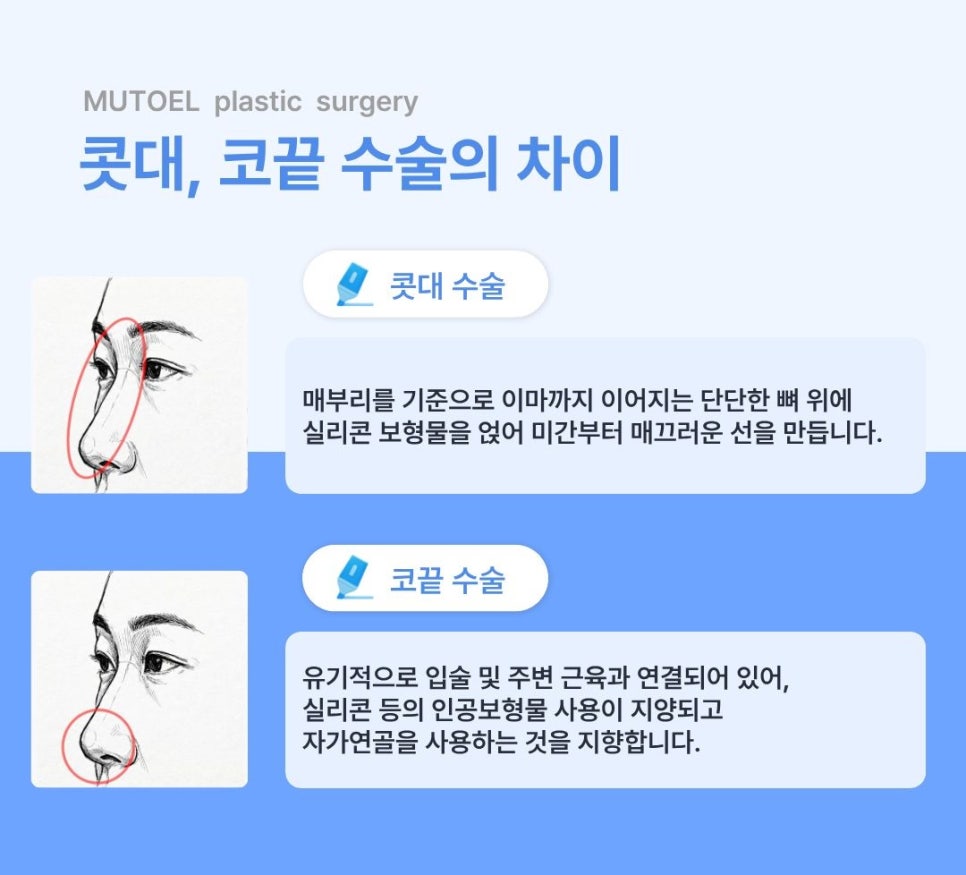
Based on the hump on the bridge of the nose,
the upper part leading toward the forehead
is mainly made of hard bone,
while the lower part is composed of flexible cartilage.
Bridge surgery is usually the process of placing a silicone implant on top of this hard bone
to create a smooth line from between the eyebrows.
By contrast, the tip of the nose has a much more complex structure.
The nasal tip is organically connected to the muscles around the lips and mouth,
so it is constantly subjected to movement whenever we speak,
eat, or smile broadly.
Therefore, unlike bridge surgery, the use of artificial implants is generally avoided for the nasal tip.
Problems in bridge surgery usually occur when the patient’s expectations or the surgeon’s ambition
exceed the limits of the skin.
The amount of extra skin on the nose varies greatly from person to person.
However, if these individual limits are ignored
and the implant is inserted too high,
it may look dramatic on the outside,
but on the inside, the tissue is crying out.
Even if the surgical wound appears to heal well after surgery,
over time there may be tightness in the bridge area or unexplained headaches,
and the reason the skin over the bridge becomes thinner and turns red
is also related to this.
Therefore, in bridge surgery, the beauty of restraint is absolutely required:
finding the most harmonious height within one’s own anatomical limits.
 Why silicone extended all the way to the nasal tip is dangerous
Another point emphasized in the video was
the risk of a surgical method in which silicone implants are inserted all the way to the nasal tip.
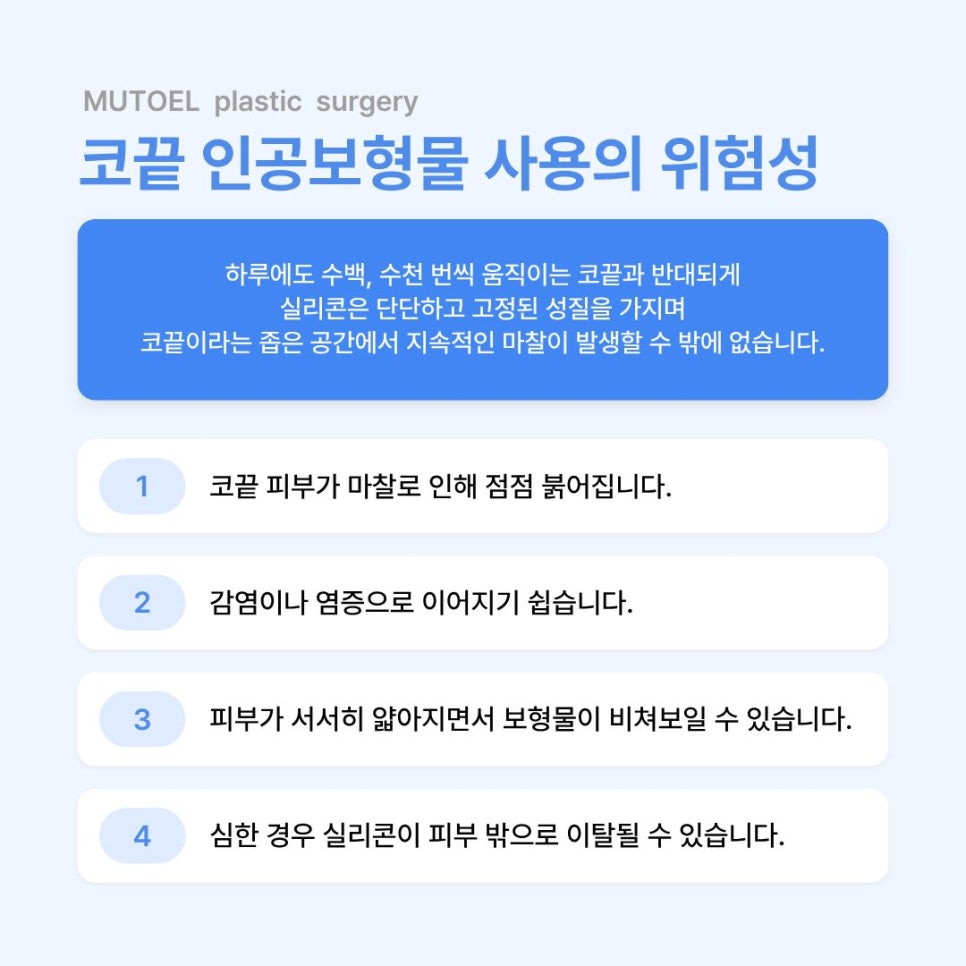
The skin at the nasal tip moves hundreds of times a day.
Silicone, on the other hand, is a material that is firm and fixed.
When two things with such different properties meet in the narrow space of the nasal tip,
continuous friction is inevitable.
As this friction repeats, the skin gradually becomes thinner,
and this can ultimately lead to inflammation or infection.
It can go beyond simply making the implant visible,
to severe cases where the silicone breaks through the skin and is displaced outward.
If long-term stability is taken into account,
I firmly believe, as a plastic surgery specialist,
that artificial implants should be avoided for the nasal tip,
and that materials capable of flexibly accommodating movement should be chosen.
 The permanent stability provided by your body’s own cartilage
So then, what material can safely support the nasal tip instead of silicone?
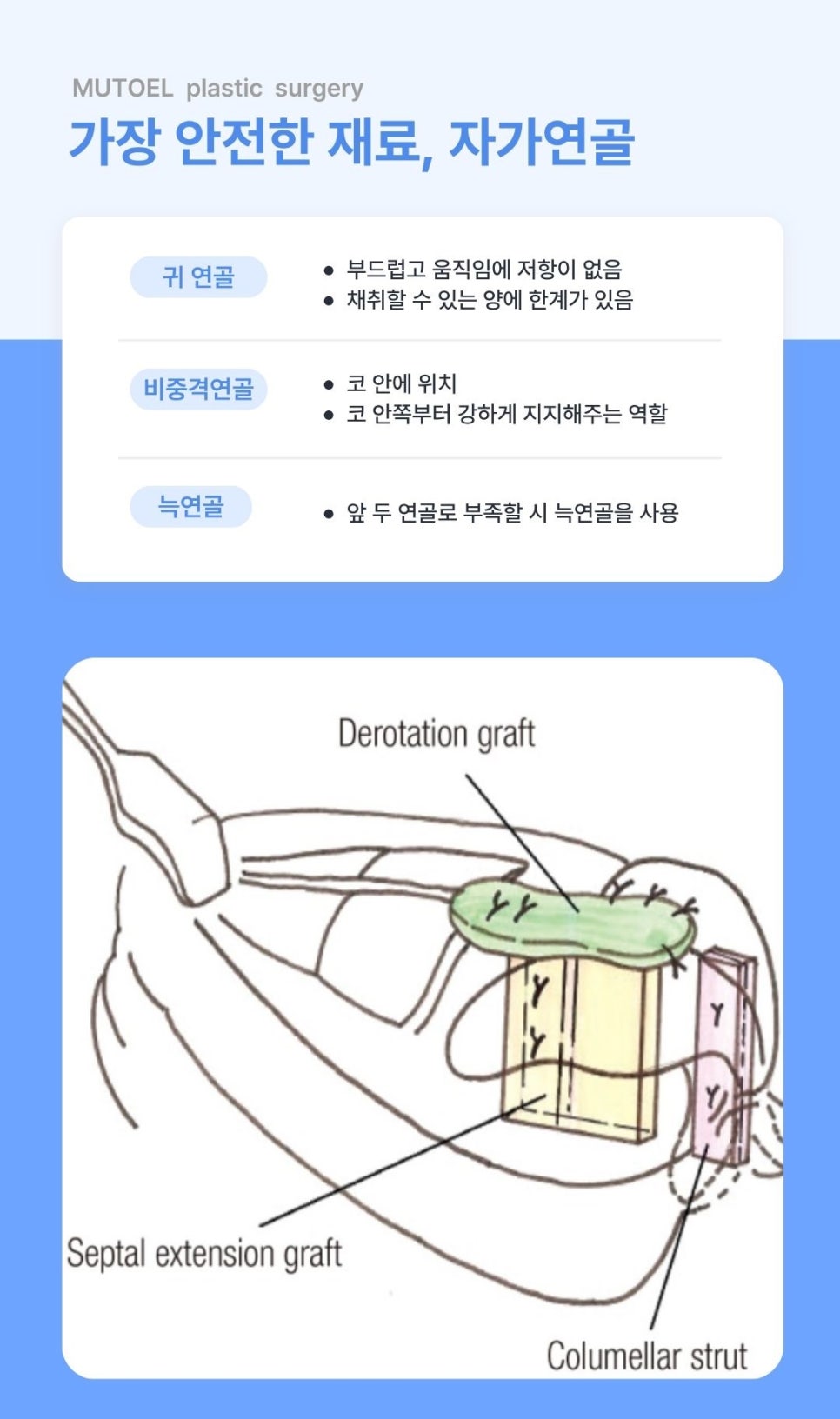
The answer is the patient’s own “autologous cartilage,”
taken from their own body.
The most representative sources are
the septal cartilage inside the nose,
the ear cartilage that forms the shape of the ear,
and the costal cartilage from the chest area.
The nasal tip itself needs structural support,
should not be too rigid,
and must be able to withstand movement.
Septal cartilage strongly supports the nose from the inside,
while ear cartilage is soft and rounded,
so it offers less resistance to movement.
However, the amount of ear cartilage that can be harvested is limited,
and if too much is removed, it can cause ear deformity or pain,
so skilled technique is required.
If there is insufficient cartilage in a first surgery,
or if significant lengthening is needed,
a method called “septal extension” is used,
in which septal cartilage is harvested and extended outward.
Also, even in a first surgery,
if the nose is short,
or in revision rhinoplasty where the amount that the skin and cartilage can stretch is limited,
autologous costal cartilage is used as a stronger supporting material.
If these three types of autologous cartilage are appropriately combined according to the patient’s condition,
a nasal tip can be completed that remains sturdy over time
while moving smoothly like your own nose.
 In closing..
I’m sure there are many people who are losing sleep
and worrying before rhinoplasty.
But rather than increasing your fear by looking up side-effect cases on your own,
meeting directly with a specialist at a clinic
and checking the condition of your own nose
is likely the fastest solution.
Mutoel Plastic Surgery goes beyond simply raising the nose;
we promise safe results that you can trust and feel at ease with for a lifetime.
If you have any questions, please feel free to visit Mutoel anytime.
We will do our utmost to help ensure that your precious nose becomes the brightest source of pride
at the center of your face.
This has been Mutoel Plastic Surgery.
Thank you.