Everything About Lifting the “Retaining Ligaments,” the Key to Facial Sagging
Hello.
Mutoel Plastic Surgery
I am Dr. Choi Jun-ho, director.
The hot season has arrived,
and as people gradually switch to lighter clothing,
many are taking an interest in caring for their appearance.
When looking at yourself in the mirror,
the facial contours that appear especially prominent
and the loss of elasticity can leave many people
feeling distressed.
In the hope of returning to the
smooth, firm facial contours they once had,
many people actively look into lifting procedures
or surgery and visit our clinic.
However, even after receiving expensive and well-known
procedures, many people become concerned when
the effects are temporary or their face quickly
begins to sag again.
They may find themselves wondering,
“Why does my face quickly return to how it was
even after undergoing lifting treatments diligently?”
Today, we will discuss the
“most fundamental and anatomical cause”
of facial sagging, as covered directly on Mutoel TV.
I will explain in detail the role of the retaining ligaments
deep within the face and the treatments used to correct them.
Are the “retaining ligaments” really the key to lifting?
To give you the conclusion first,
the long-term success or failure of facial lifting
depends entirely on how these firm support structures
are adjusted.
In our faces, there are very firm fibrous tissues
that begin at the periosteum of the bones,
pass densely through the fascial (SMAS) layer,
and extend to beneath the skin.
These are the “retaining ligaments.”
They function much like iron stakes and strong ropes
that firmly anchor a tent deep into the ground
so that it does not get blown away or collapse
in strong winds.
When these strong anchoring structures firmly support
the center of the face in various locations,
they allow us to maintain elastic, balanced,
and smooth facial contours.
In other words, they are the most basic and central axis
that determines the three-dimensional appearance of the face.
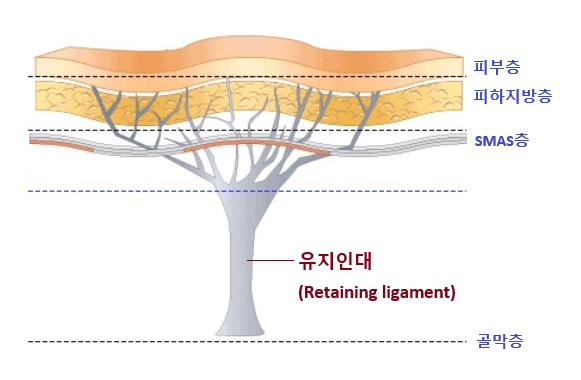
Schematic diagram of the “retaining ligaments”
However, as aging progresses,
collagen and elastin decrease significantly,
and the once-firm anchoring ligament structures
themselves gradually become loose and elongated.
Ligament structures that have stretched and lost elasticity
can no longer hold the tissues above them in place.
Just as the ropes anchoring a tent become loosely undone,
their supporting strength is lost and the poles
begin to shake uncontrollably.
Eventually, as the firm anchoring force that had supported
the tissues gives way, the fat and skin tissues hanging above it
collapse downward under the force of gravity.
As a result, the area beneath the eyes becomes puffy and droops,
nasolabial folds deepen, and thick bulges develop
around the corners of the mouth.
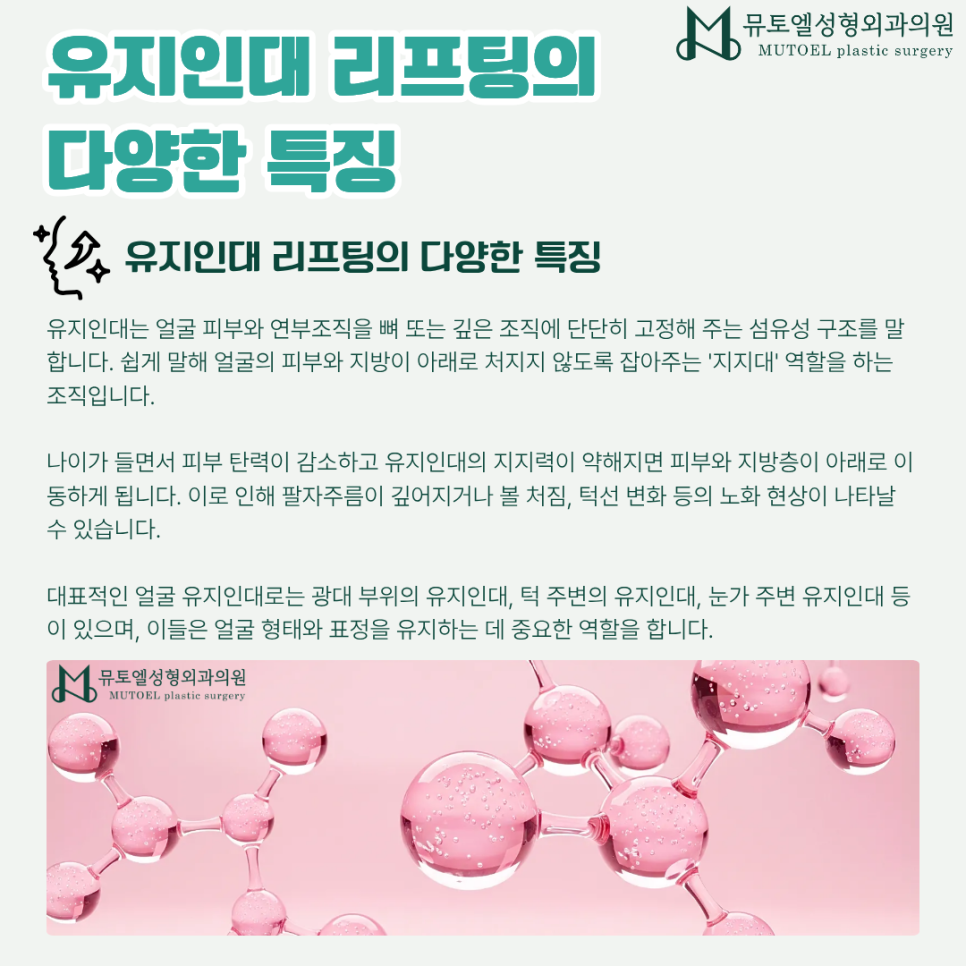
Why does the face sag again if it is simply pulled upward?
It is not difficult to encounter people who feel distressed
because their face sagged again not long after receiving
expensive thread lifting or facelift surgery.
Although they invested considerable money and time,
the reason the results last only a short time
can be attributed to the unique anatomical characteristics
of the anchoring structures inside the face.
If the “retaining ligament tissue” that firmly supports
the structures beneath the skin remains intact,
no matter how strongly the skin is pulled with threads,
it becomes caught and blocked by the tough “ropes”
of the ligaments and cannot move any farther upward.
In other words, if you attempt to forcefully pull only
the skin or fascia upward without releasing these firm
anchoring structures, the treated area quickly becomes loose
because of its tendency to return to its original position.
Unnatural facial expressions or side effects such as
depressions in the skin may also occur.
Release and refixation for reliable lifting
Therefore, to achieve “true lifting effects”
that last for a long time,
treatment must fundamentally address the cause
of the loosened anchoring ligaments.
Only after carefully and gently releasing the retaining ligaments
whose supporting strength has greatly weakened,
and firmly refixing them in a position one layer higher,
can a genuine lifting effect be achieved.
In plastic surgery, this is professionally referred to as
the process of “retaining ligament release and refixation.”
It is like the simple truth that any building
will soon collapse if its weak foundation is not repaired.
In particular, even during lower eyelid surgery,
which is performed beneath the eyes,
the orbital retaining ligament tissue surrounding the orbit
must be properly addressed to reliably prevent the recurrence
of under-eye fat protrusion caused by fat pushing out again.

A specialist’s expertise for safe results
The method of making minute structural corrections
is an extremely careful and precise procedure
closely related to patient safety.
Inside the face, countless microscopic blood vessel networks,
sensory nerves, and complex facial nerves that enable
free facial expressions are densely intertwined.
If excessive release is performed in an inexperienced
or improperly planned manner, the risk of seriously injuring
the facial nerves—and consequently causing temporary paralysis
or asymmetry in facial expressions—increases significantly.
For this reason, all examinations, procedures, and surgeries
should be entrusted safely to a board-certified plastic surgeon
who is thoroughly familiar with the internal and external anatomy
of your face.
By delicately releasing the retaining ligaments inside the face,
we help protect your face more safely and precisely.
In closing..
Mutoel Plastic Surgery, located in Yongsan,
pursues natural beauty that harmonizes with each patient’s
own complexion and features, rather than an unnatural face
that appears overly pulled.
By actively operating a sterilization and aseptic system
in the operating rooms, we make safety our top priority
by thoroughly eliminating even minor potential sources
of external infection in advance.
We provide more accurate treatment through a collaborative system
involving three specialists from the fields of plastic surgery,
dermatology, and pathology.
This is why we never provide unnecessary overtreatment
and instead focus on maximizing harmony.
If you would like to rediscover your unique confidence
and original contours that have become disrupted over time,
please feel free to knock on our door and begin a consultation
with Mutoel.
At Mutoel, where we always offer honesty,
we will provide you with natural changes.
This was Dr. Choi Jun-ho.
Thank you.