Hello.
I am Kim Tae-young, Director of Barunyeong Dental Clinic at Yaksu Station.^^
In my previous post, I explained the dental implant placement process, including the timing of placement after extraction, bone grafting, and sinus lift procedures.
This time, I would like to discuss post-operative implant care and the precautions you should know during the recovery process—topics that many people have questions about.
There are several questions that patients ask most frequently after surgery.
"When can I eat after surgery?"
"How should I brush my teeth after implant surgery?"
"When can I exercise or drink alcohol again?"
Implant treatment is not complete simply because the implant has been placed.
For good results, the osseointegration process must proceed properly so that the placed implant can bond securely with the jawbone.
Today, I will organize the post-operative care methods and essential precautions during recovery by time period.
Why Initial Hemostasis Is Important After Implant Surgery
The day of implant surgery is the most important time for bleeding control and initial stabilization.
The recovery process can proceed smoothly only when the surgical site is properly protected and stabilized during this period.
Keep the gauze in place for the instructed amount of time
Immediately after surgery, you will be asked to bite down on gauze to reduce bleeding.
In general, pressure is applied for about 1–2 hours, and removing the gauze too often to check the area is not recommended.
Avoid frequently spitting out saliva or blood
Forceful spitting or rinsing can dislodge the blood clot.
It is best to swallow your saliva naturally.
Do not touch the area with your tongue or hands
Repeatedly touching the surgical site may interfere with recovery.
Avoid hot foods and using straws
On the day of surgery, it is best to eat lukewarm or cool foods and refrain from using straws.
When Is Swelling Usually at Its Worst After Implant Surgery?
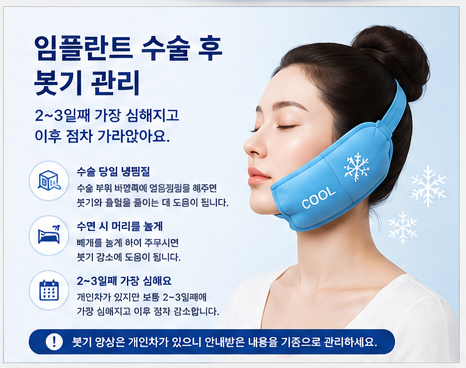
Swelling after implant surgery is a normal part of the recovery process.
It is generally at its worst on the second or third day after surgery and gradually decreases afterward in many cases.
On the day of surgery, applying an ice pack to the outer cheek over the surgical area may help.
Keeping your head slightly elevated while sleeping may also help reduce swelling.
How Should You Eat After Implant Surgery?
Many people also have questions about eating after implant surgery.
Immediately after surgery, it is best to focus on soft foods such as thin rice porridge, porridge, yogurt, and soft tofu.
After about one week, once the gums have recovered to some extent, you may be able to return to a regular diet depending on your recovery status.
However, osseointegration of the implant usually continues for about 3–6 months, so caution is needed with very hard foods such as nuts, ice, and dried squid.
When Can You Brush Your Teeth After Implant Surgery?
Oral hygiene remains very important after implant surgery.
In fact, failing to brush your teeth may increase the risk of inflammation.
Immediately after surgery, bleeding may not yet have stopped and swelling around the surgical site may make brushing difficult, so brushing is generally resumed from the day after surgery.
However, the surgical site should be cleaned gently, and care should be taken to prevent the bristles from making strong, direct contact with it.
Activities to Avoid After Implant Surgery
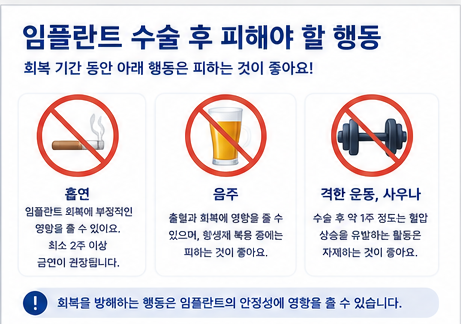
Smoking
Smoking is one of the key factors that can affect the osseointegration process of an implant.
Not smoking for at least two weeks after surgery is recommended.
Alcohol
Alcohol may affect bleeding and the recovery process, and it is best avoided while taking antibiotics.
Strenuous exercise
It is recommended to avoid activities such as working out at the gym, running, and using a sauna for about one week after surgery.
The Key to Implant Treatment Is Osseointegration
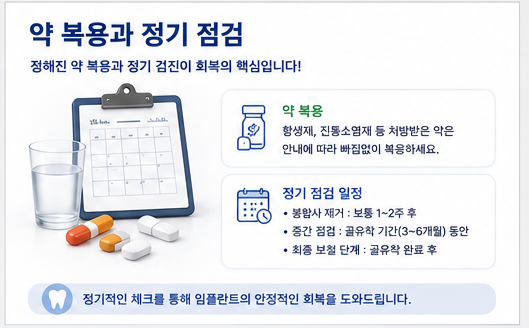
The most important process in implant recovery is osseointegration.
Osseointegration refers to the process by which the implant surface bonds securely with the jawbone.
It usually takes approximately 3–6 months, and it is important to manage the area during this period so that excessive force is not applied.
This osseointegration process is precisely why post-operative implant care is important.
Contact Your Dentist If You Experience These Symptoms
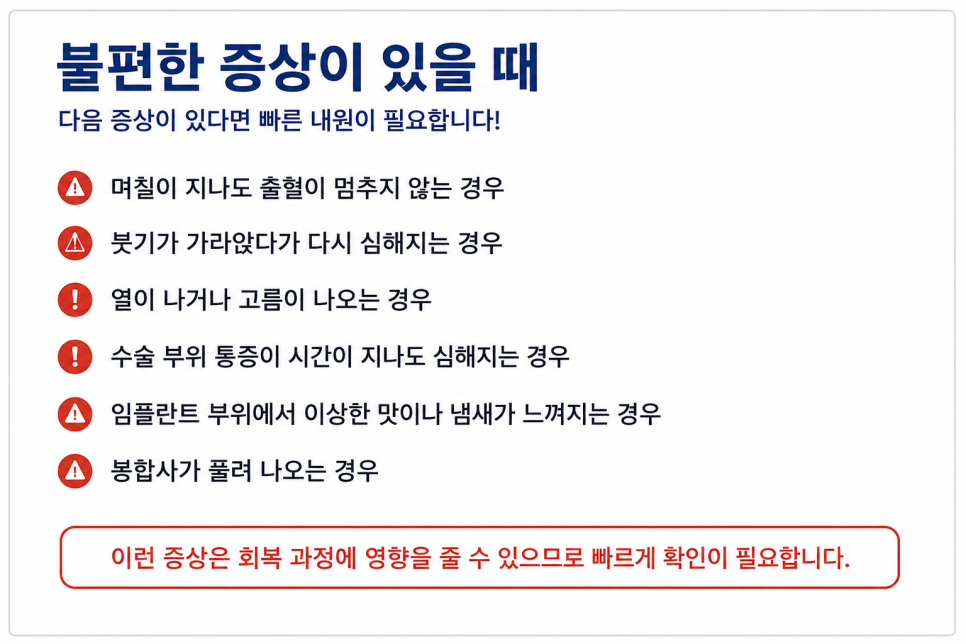
If you experience any of the following symptoms, it is advisable to seek dental care.
-
Bleeding that continues
-
Swelling that becomes severe or increases again
-
Fever
-
Visible pus
-
Pain that gradually worsens
-
A persistent unusual odor or taste
Key Points
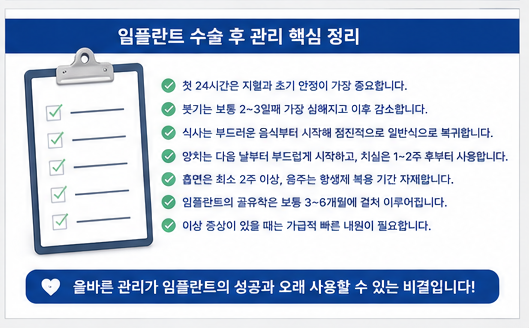
The first 24 hours after implant surgery are important for bleeding control and stabilization.
Swelling may be at its worst around the second or third day.
It is best to begin with soft foods.
You can brush your teeth from the following day, but the surgical site must be cared for gently.
It is recommended to refrain from smoking and drinking alcohol during the recovery period.
Osseointegration of the implant usually proceeds over a period of 3–6 months.
If you experience any unusual symptoms, it is best to contact your dentist for evaluation.
In Closing
As I provide implant treatment at a dental clinic near Yaksu Station, I believe that the outcome of an implant is not determined on the day of surgery alone.
Care during the recovery period after surgery is also an important part of the treatment process.
Of course, recovery patterns may vary from patient to patient, and the instructions provided may also differ. Therefore, I recommend that you prioritize the individualized instructions you receive after the procedure.
This has been Kim Tae-young from Barunyeong Dental Clinic at Yaksu Station.^^
I believe that proper care leads to proper results.
We provide care with the goal of helping everyone who visits us return home feeling more at ease.
Barunyeong Dental Clinic
This post was written for the purpose of providing medical information in compliance with Article 56, Paragraph 1 of the Medical Service Act.