I often hear people say that their eyes look tired because they appear sunken.
That is one of the most common things people say when they come in for a consultation about sunken eyes.
When the upper eyelid lacks volume, the face can look tired,
and it may also create an impression that you look older than your actual age.
And if sunken eyes are left untreated, wrinkles can become more fixed,
and some people even complain of discomfort because the skin folds inward when they open their eyes.
At MOOi Plastic Surgery, where we help you discover a unique beauty that exists only once,
we will organize the key points you need to know about correcting sunken eyes all in one place. ✨
| Summary from the start | · If there is insufficient orbital fat → fat grafting to the upper eyelid may be a better fit. · If fat is present but the issue is its position/adhesions → orbital fat repositioning is the key. · If you have sunken eyes but do upper blepharoplasty or a brow lift first, the hollowing may stand out even more. Sequence matters! |
Why do sunken eyes happen?
The causes of sunken eyes differ from person to person, but in consultations, the following three patterns are the most common.
Cause 1: Aging (orbital fat atrophy + thinning of the skin/muscle layers)
As we age, orbital fat atrophies and the skin and muscle layers also become thinner, which can make the upper eyelid look hollow.
For people who naturally have little fat, the hollowing can become noticeable even at a relatively young age.
Cause 2: When fat was excessively removed in a previous surgery
Quite a few people had fat removed because their upper eyelids were puffy, but over time the “hollowing” became worse.
In these cases, it is not just about simple volume replenishment; the current structure (adhesions/scar tissue/the location of the remaining fat) also needs to be examined.
Cause 3: When the eyes only look “more sunken” due to weight changes or poor condition
Sunkenness can also appear more pronounced because of rapid weight changes, lack of sleep, accumulated fatigue, and similar factors.
However, whether there is structural hollowing (whether there is truly a lack of fat itself) requires an in-person diagnosis.


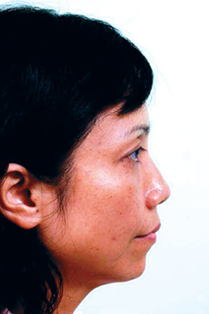
Example photos of sunken eyes showing reduced upper eyelid volume / Sunken eyes can create a tired-looking impression because the volume of the upper eyelid decreases
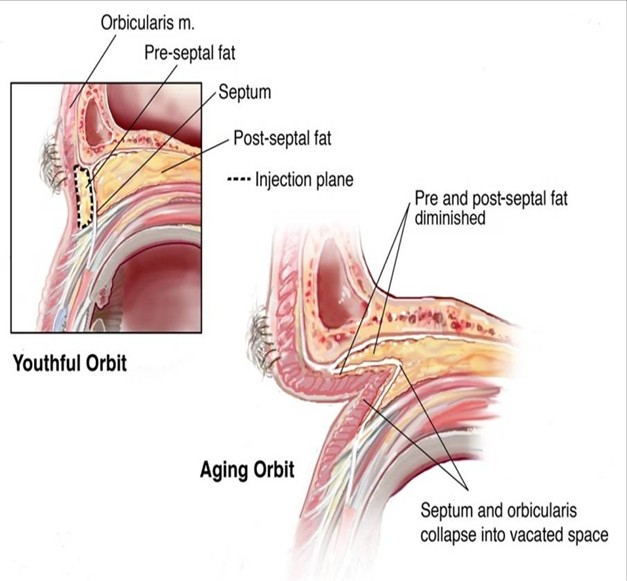
Sunken eyes caused by aging-related orbital fat atrophy + thinning of the skin/muscle layers
Why can it look awkward if you do double eyelid surgery or a lift first when you have sunken eyes?
If you proceed with double eyelid surgery or a brow lift
without considering the sunken-eye condition, the hollowing may appear even more emphasized.
There are also cases where people become dissatisfied because it looks like “triple eyelids” have formed or the double eyelid crease seems to have loosened,
so it is important to consider correcting the sunken eyes first.
What is the difference between fat grafting and orbital fat repositioning?
The key to correcting sunken eyes is
distinguishing whether there is a lack of fat volume or whether the fat is present but its position is the issue.
| Classification | Fat grafting | Orbital fat repositioning |
|---|
| Suitable for | Absolute shortage of orbital fat | Orbital fat is present, but there is upper adhesion/position issue |
| Method | Harvest from the abdomen, thighs, etc., refine, then inject | Release the adhesion of the existing orbital fat and reposition it downward |
| Advantages | The volume replenishment effect is relatively clear | Uses your own fat / less burden from additional harvesting |
| Caution | Accurate anatomical layer (injection location) + avoiding overcorrection | Precision of adhesion release + left-right balance are key |
For these people, fat grafting may be a better fit
-
When the upper eyelid lacks overall volume and looks “bony”
-
Cases where fat was actually reduced a lot after a previous removal
-
When you want a relatively clear volume change with a single procedure
For these people, orbital fat repositioning may be a better fit
-
When fat is present but is “clumped in the upper area” and the lower area looks hollow
-
When the line is unnatural because of upper eyelid adhesions (scar tissue)
-
When you want to reduce the burden of additional fat harvesting
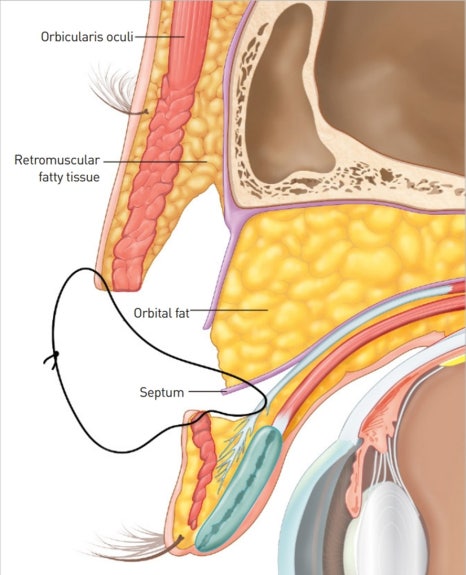
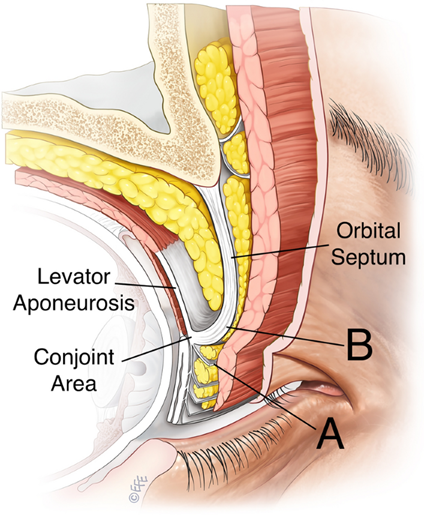
A diagram showing the layers where fat grafting can be injected in sunken-eye correction (inside/outside the septum)
Concerns people often raise during consultations
Q1. “Won’t fat grafting make it bumpy?”
The eyelid skin is extremely thin,
so it is important to inject refined fat evenly into the correct layer.
Bumpy results are usually largely influenced by the material (refining process) and the injection layer/technique,
so we recommend receiving treatment from a medical team with extensive experience.
Q2. “If something goes wrong, won’t I be unable to open my eyes?”
Although rare, discomfort can occur if the injection location is inaccurate or if too much is injected.
That is why, in sunken-eye correction, the key is not “putting in a lot”
but rather accurately matching the anatomical location.
Recovery period and longevity (varies by individual)
-
Fat grafting: Major swelling and bruising usually last 1–2 weeks, and it may take 1–3 months to look natural.
-
Orbital fat repositioning: Recovery is relatively quick, but there are individual differences depending on the adhesion condition.
-
With fat grafting, some absorption may occur, so if there is insufficient volume, a second supplementation procedure may be considered.
What to prepare before your consultation
-
When the eyes started looking sunken
-
History of previous eye surgeries (fat removal, upper blepharoplasty, double eyelid surgery, etc.) and when they were done
-
Whether the concern is cosmetic or functional (opening the eyes/fatigue)
-
The look you want (natural/defined) and reference photos
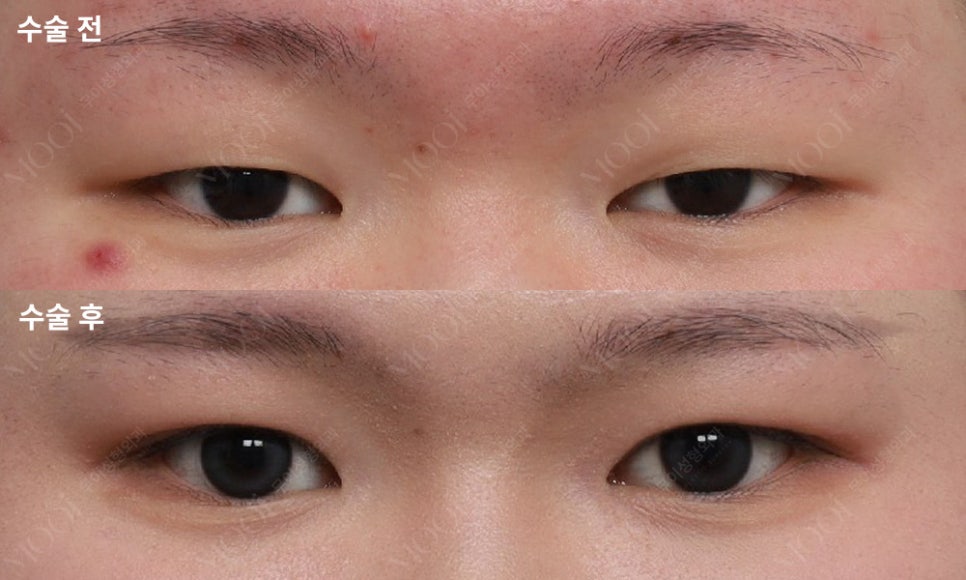
Before-and-after comparison photos of sunken-eye correction
Frequently Asked Questions (FAQ)
Q. Does fat grafting for sunken eyes last well?
A. The graft survival rate varies by person, and some absorption can occur.
If there is insufficient volume, a second supplementation procedure may be planned.
Q. Can double eyelid surgery be done together if I have sunken eyes?
A. Yes, it can.
However, in many cases, it looks more natural if the sunken area is corrected first (or at the same time) while designing the double eyelid crease.
Q. How long does recovery take after sunken-eye correction?
A. It depends on the scope of the procedure/surgery, but after the major swelling subsides in 1–2 weeks, it gradually looks more natural.
In summary
-
If orbital fat is absolutely insufficient → fat grafting
-
If fat is present but there is a position/adhesion issue → orbital fat repositioning
-
If you are planning double eyelid surgery or a lift → consider correcting the sunken eyes first or at the same time
Sunken eyes tend to worsen if left untreated.
We recommend getting an accurate diagnosis of the condition of your upper eyelids and choosing the correction method that best fits your situation.
MOOi
MOOi Plastic Surgery
Beauty like No Other
As MOOi (無二) means “one and only, not two,”
MOOi Plastic Surgery designs a face that is uniquely and exclusively yours in this world.
🩷 Directions 🩷
💖 Introduction to the head doctors 💖

💛 Go to the KakaoTalk channel 💛

🧡 Go to the website 🧡


#SunkenEyes #SunkenEyeCorrection #HollowUpperEyelids #UpperEyelidFatGrafting #EyelidFatGrafting #FatGrafting #OrbitalFatRepositioning #UpperEyelidRepositioning #UpperBlepharoplasty #DoubleEyelidRevision #TiredLookingEyes #GangnamEyeSurgery #MOOiPlasticSurgery
This content was written directly by MOOi Plastic Surgery Clinic for the purpose of providing information in an easy-to-understand way regarding procedures and surgeries, in compliance with Article 56, Paragraph 1 of the Medical Service Act. Since every procedure/surgery may vary by individual and side effects may occur, we recommend that you consult with the attending medical staff before proceeding.