“When can I start wearing glasses?”
“Won’t sneezing put strain on my nose?”
“My nose feels stuffy inside—how long do I need to be careful?”
Hello✨
We are MOOi Plastic Surgery, where beauty is one of a kind.
After nose surgery, it’s easy to think that once the major swelling goes down, everything is over.
In reality, daily habits during the recovery period have quite an important effect on stabilizing the nose line.
That’s why the most common questions we receive after consultations are always similar.
When glasses are allowed,
how to handle sneezing or yawning,
how to care for the inside of the nose,
and even how to use compresses and for how long.
Today, we’ll organize the aftercare questions that many people have during the recovery period after nose surgery into four easy-to-follow points.
However, the recovery period after nose surgery can vary depending on the surgical method, whether osteotomy was performed, the materials used,
and each person’s recovery speed,
so please prioritize the guidance of your attending medical team in the end.
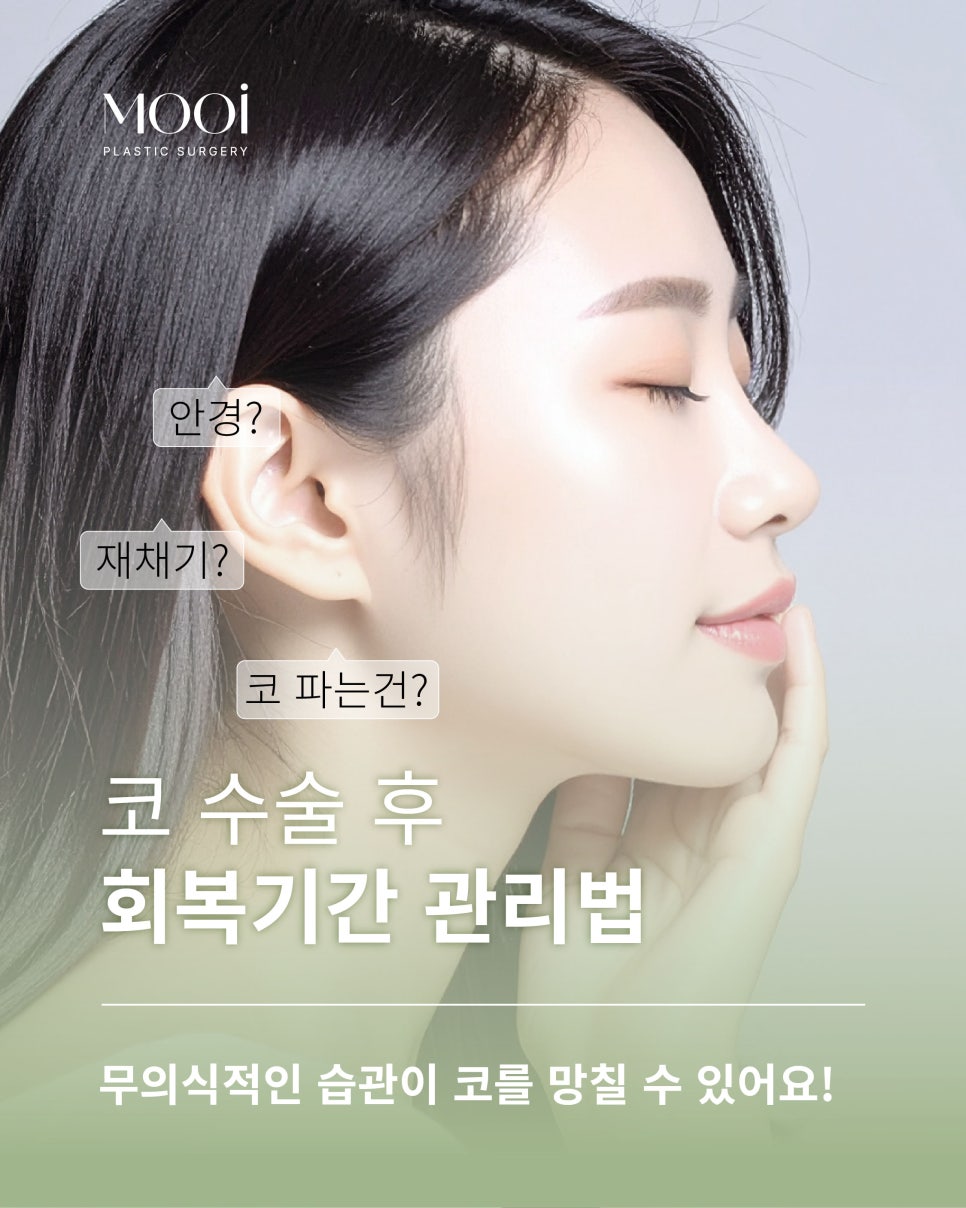
A summary of the most frequently asked daily care points during the recovery period after nose surgery at MOOi Plastic Surgery in Gangnam
Recovery period after nose surgery, easier to understand like this
To understand the recovery period more easily,
it helps to separate it into the period when bruising fades and the period when you need to be careful with daily habits.
During the first 1–2 weeks, swelling and hygiene management are important,
and after that, what matters most is how well you avoid habits that put pressure on the nose.
Even if it looks fine on the outside, the tissue inside may still be recovering for longer.
① Clothing and accessories
Actions that directly put pressure on the bridge of the nose need special care, especially in the early recovery period.
Glasses and sunglasses can press on the nose bridge,
so at MOOi Plastic Surgery, we usually advise that they can be worn after 4 weeks.
You also need to be careful when changing clothes.
In particular, tight knits or tops with narrow neck openings
can rub against or catch the nose when taking them off or putting them on, so please be careful.
For masks as well, rather than very stiff materials or ones that create strong pressure,
please choose a soft material that does not press hard on the nose.
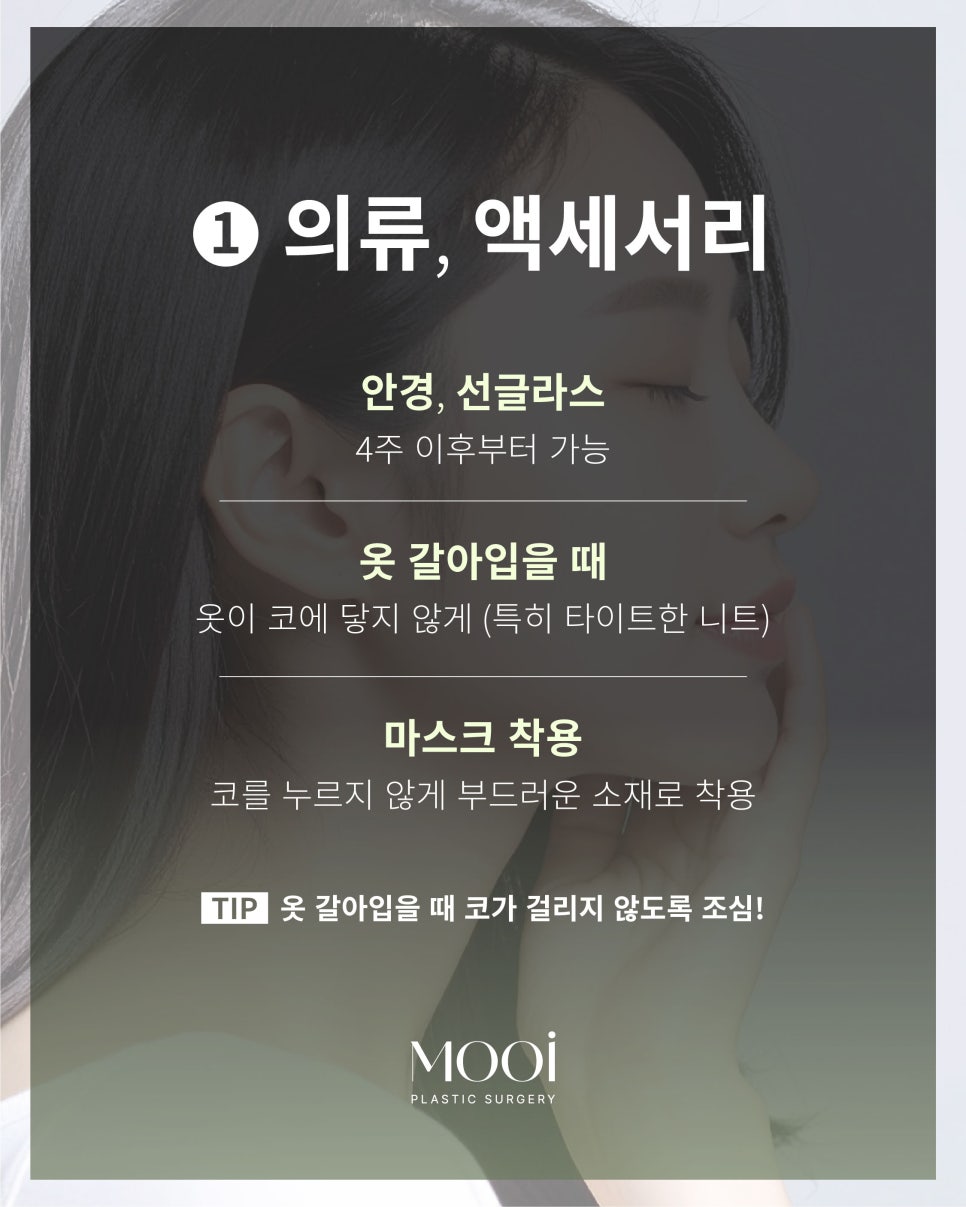
Clothing and accessory care: habits that put pressure on the nose bridge should be especially avoided in the early recovery period
② Hygiene care
Blowing your nose or picking inside the nose can interfere with recovery more than you might think.
At MOOi Plastic Surgery, we usually advise no nose blowing for 2 weeks,
and if you see mucus or blood, do not blow your nose forcefully; gently wipe around the nostrils instead.
If the inside of your nose feels stuffy or dry and you keep wanting to touch it,
rather than picking with your fingers, it is safer to spray saline spray 1–2 times
to keep the nasal cavity moist.
Facial washing is often allowed after stitches are removed,
and before then, it’s best to carefully clean only the surrounding area so that water does not directly touch the nose.
If dryness is severe, maintaining moisture with ointment can also help.
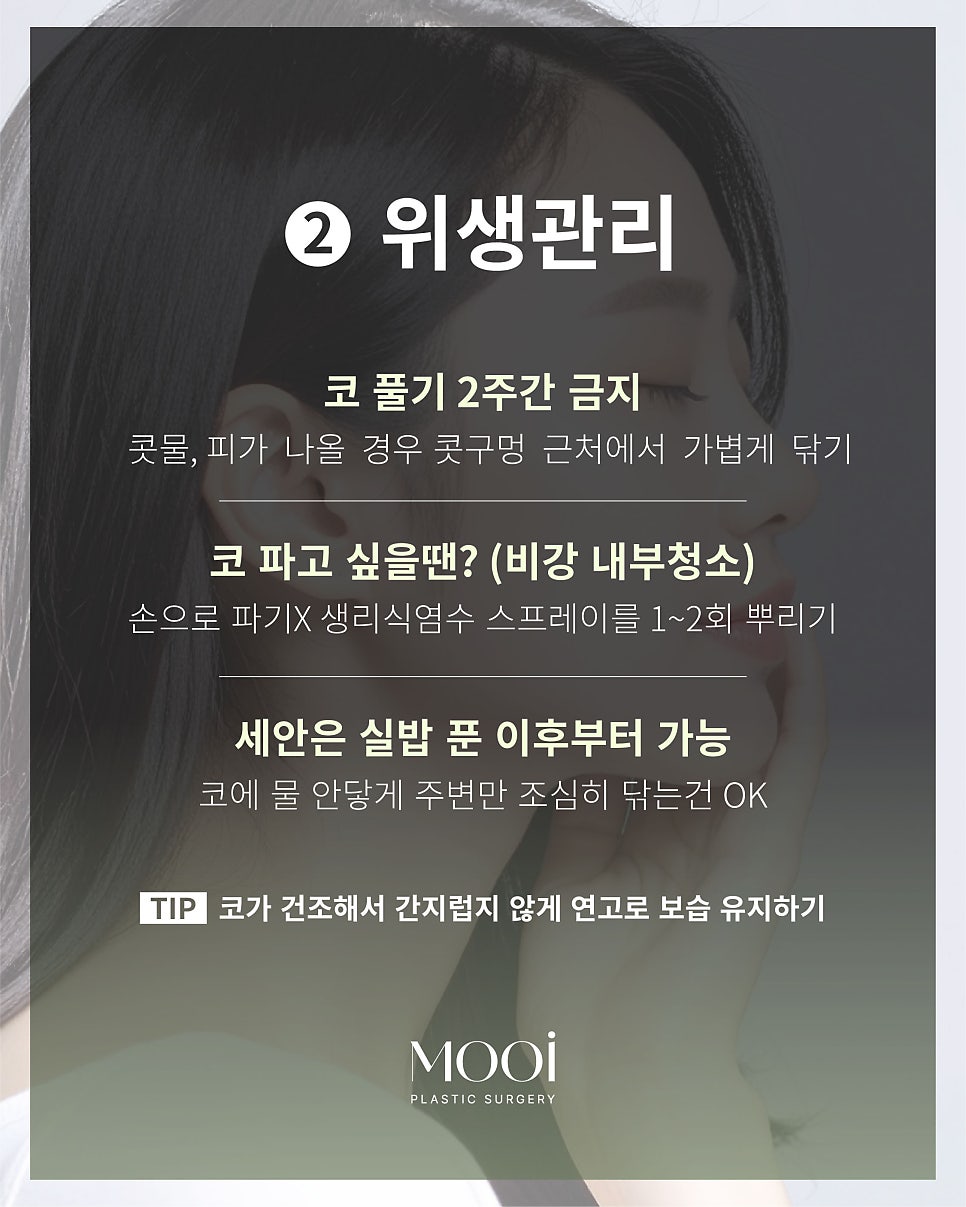
Hygiene care: instead of blowing the nose or touching it with your hands, saline spray-based care is needed
③ Habits to be careful about
Actions that happen unconsciously, such as yawning, coughing, and sneezing, can also be quite concerning in the early recovery period.
That said, forcibly holding them in can be even more uncomfortable and burdensome.
When yawning, rather than enduring it with your mouth tightly closed,
slightly open your mouth to reduce strain,
and when you cough or sneeze, it is better to open your mouth and disperse the pressure.
In particular, if you hold in a sneeze, internal pressure can increase suddenly, so you need to be extra careful.
It is also best to avoid drinking alcohol and smoking during the recovery period.
At MOOi Plastic Surgery, we usually advise that these are possible only after at least 4 weeks.
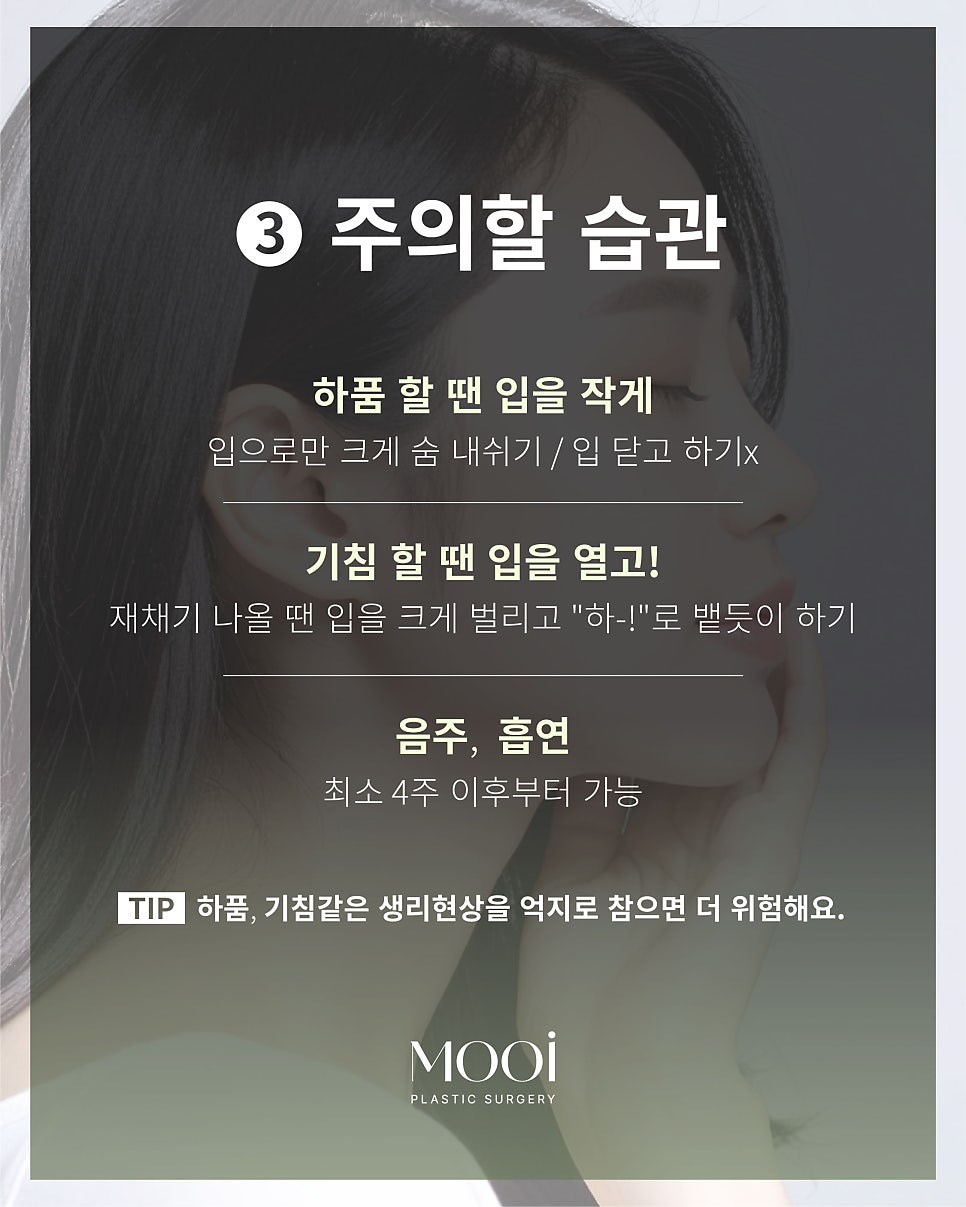
Habits to be careful about: rather than holding in yawns, coughs, and sneezes, we recommend opening the mouth to spread the pressure
④ Compresses
When, where, and how you use compresses matters.
Up to about days 2–3, cold compresses are recommended,
and after that, you can switch to warm compresses.
At this time, it is best to apply the compress within a range that does not press hard on the nose,
mainly around the start of the nose or the eye area.
Because the surgical area should not be strongly compressed,
we recommend wrapping the ice pack or heat pack in gauze or a thin towel and using it gently.
In particular, it is better to avoid direct pressure on the nose bridge and tip,
and please be even more careful around the nasal tip and columella area.
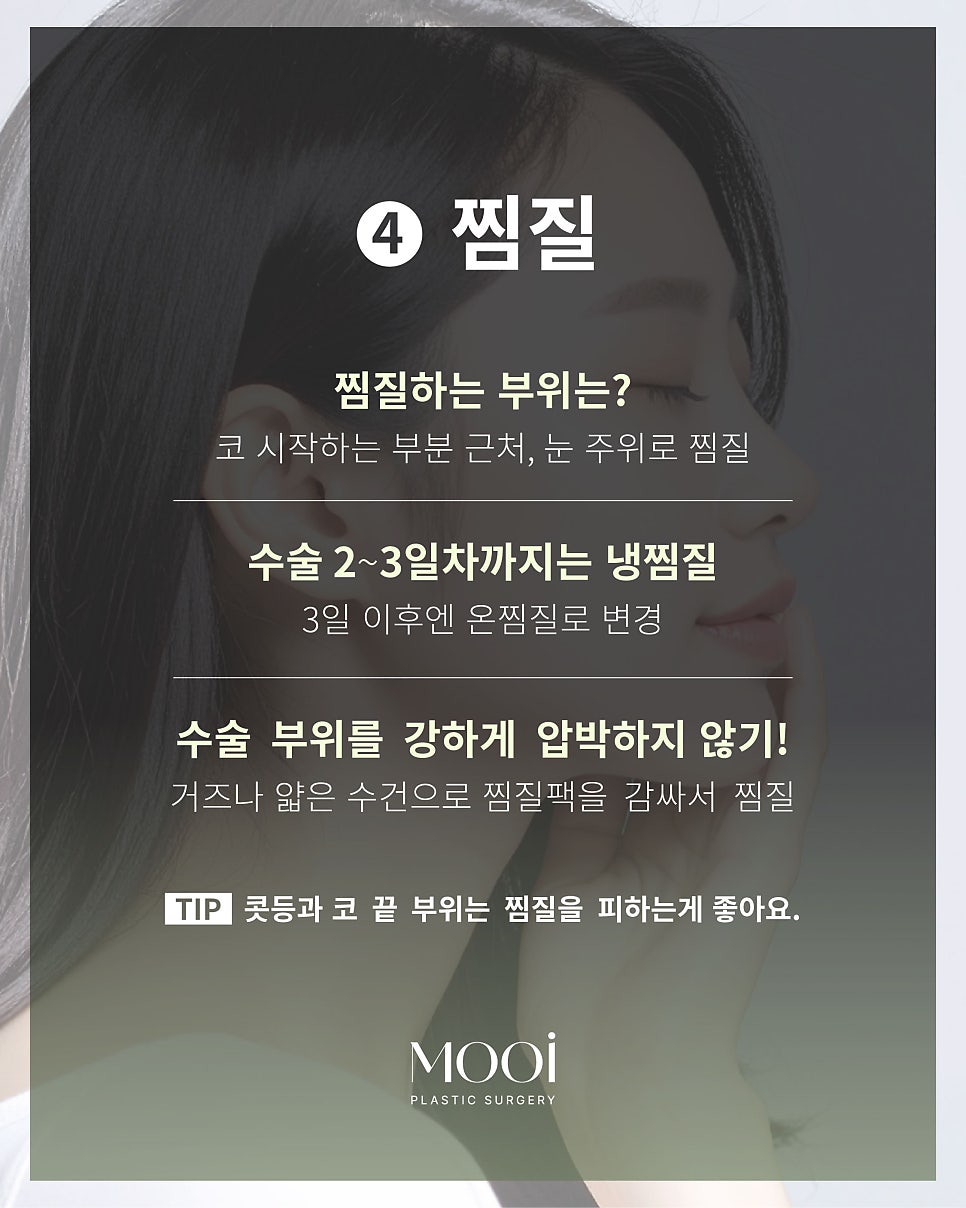
Compress care: use cold compresses at first, then switch to warm compresses, but be careful not to press hard on the surgical area
Frequently Asked Questions (FAQ)
Q. Is it really necessary not to wear glasses for 4 weeks?
The key is to avoid continuous pressure on the nose bridge.
The exact timing may vary depending on the surgical method and recovery status,
but at MOOi Plastic Surgery, we usually advise that glasses can be worn after 4 weeks.
Q. Is it better to hold in sneezing or yawning?
No. Rather than forcefully holding them in with your mouth tightly closed,
it is safer to open your mouth and disperse the pressure.
Q. The inside of my nose is very dry and itchy.
Please avoid touching or picking it with your hands,
and keep it moist with saline spray.
If dryness is severe, maintaining moisture with the ointment you were instructed to use can also help.
Q. When can I wash my face?
Usually, it is often allowed after stitches are removed.
However, this may vary depending on your recovery status, so please prioritize the guidance of your attending medical team.
In summary,
postoperative care during the recovery period after nose surgery is
less about how quickly you feel better and more about how carefully you get through it.
Small habits such as wearing glasses, blowing your nose, sneezing, and using compresses
can affect the recovery process,
so it is better to follow the instructions carefully in the early stage, even if they feel a bit inconvenient.
Even if it looks fine on the outside, the inside may still be recovering,
so please avoid overdoing it and manage your recovery step by step.
MOOi
MOOi Plastic Surgery
Beauty like No Other
MOOi, meaning “one and only,”
means that MOOi Plastic Surgery designs your very own face—one that exists nowhere else in the world.
🩷 Directions 🩷
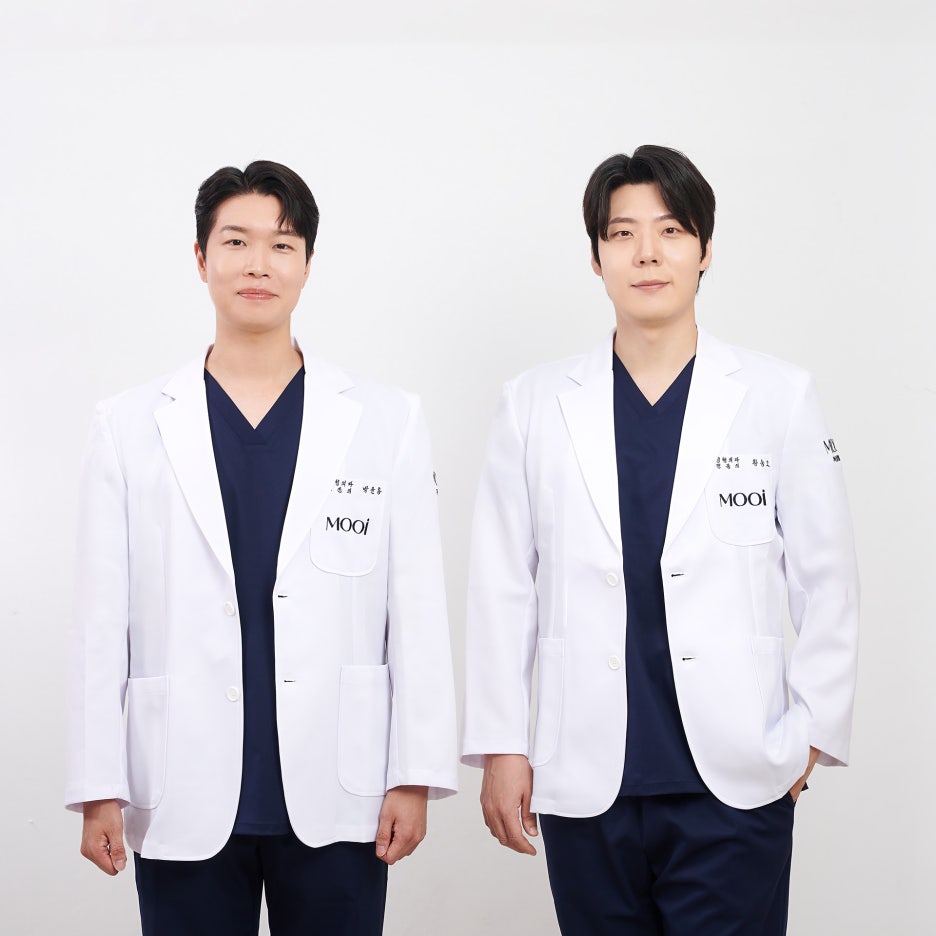
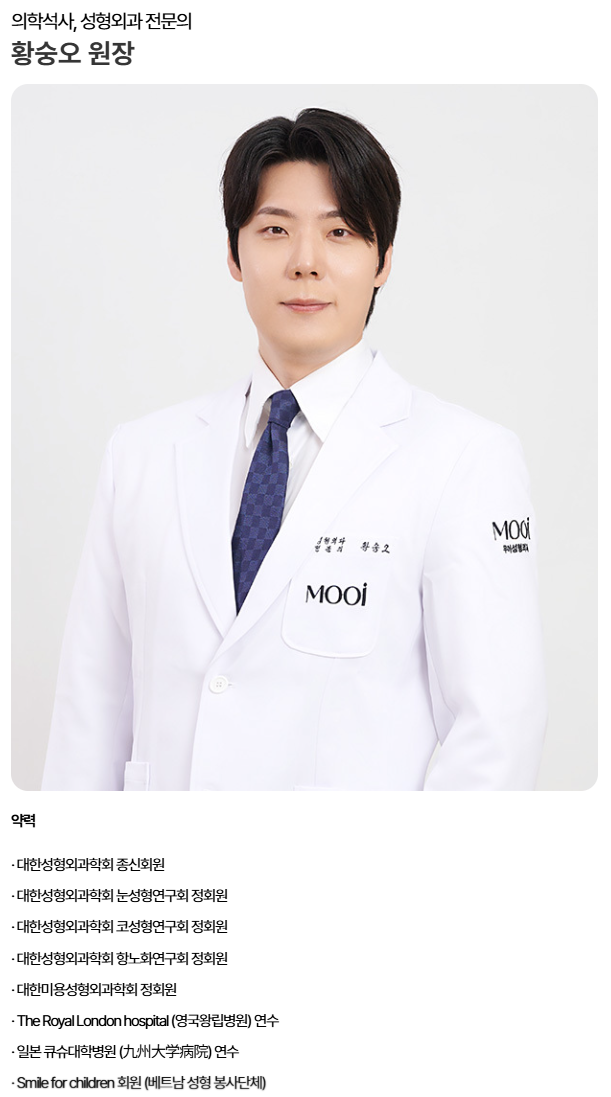
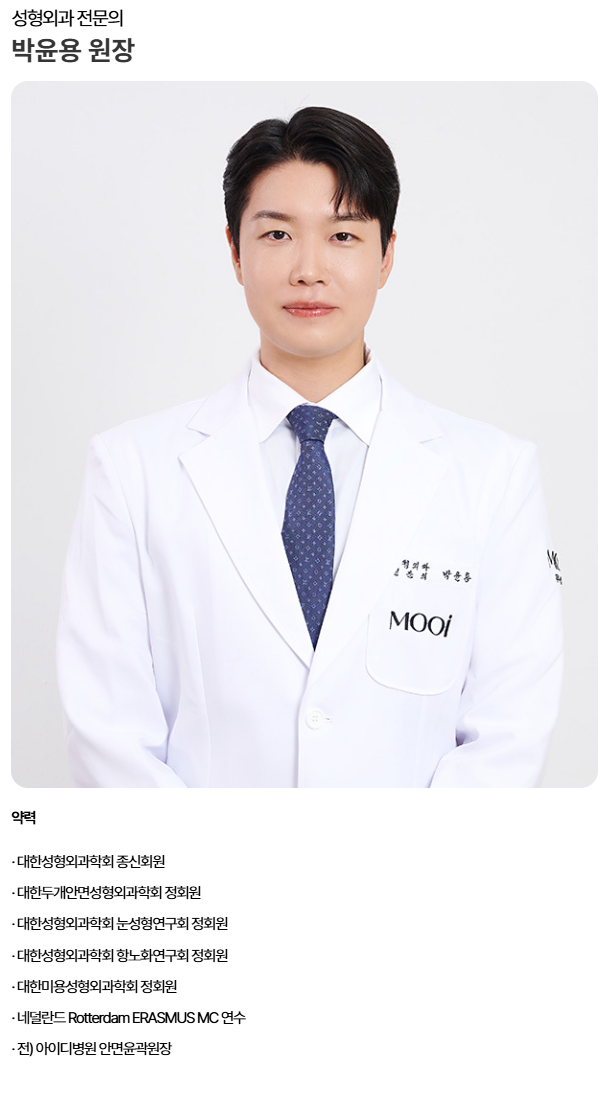
💖 Introduction to our lead doctors 💖
💛 Go to KakaoTalk Channel 💛
🧡 Go to Homepage 🧡
#NoseSurgeryRecoveryPeriod #NoseSurgeryAftercare #AftercareAfterRhinoplasty #RhinoplastyRecovery #NoseSurgeryPrecautions #FaceWashingAfterNoseSurgery #CompressesAfterNoseSurgery #NaturalLookingNose #NaturalNoseLine #NaturalLookingNoseSurgery #NaturalNoseLineSurgery #NoseSurgeryRecovery #NoseSurgeryRecoveryPeriod #GangnamRhinoplasty #MOOiPlasticSurgery #GangnamPlasticSurgery #GangnamMOOiPlasticSurgery
This content was written directly by MOOi Plastic Surgery in compliance with Article 56, Paragraph 1 of the Medical Service Act, for the purpose of providing information in an easy-to-understand way about procedures and surgeries. Since all procedures and surgeries can vary by individual and may cause side effects, we recommend consulting with your attending medical team before proceeding.