“Will my face look different if I only move my chin forward?”
“Would it be okay to get only chin filler for a receding chin?”
“I haven’t gained weight, but my profile looks like I have a double chin.”
People who seek consultation for a receding chin rarely discuss the chin alone.
From the front, the lower part of the face may look flat,
while from the side, the mouth may appear relatively prominent,
or the boundary between the chin and neck may look indistinct.
To give you the conclusion first,
chin advancement is not a surgery that simply makes the chin longer.
It is closer to a facial contouring procedure that moves the face’s foremost point of support to an appropriate position, enhancing the dimensionality of the lower face and refining overall balance.
Today, at MOOi Plastic Surgery✨, where we pursue one-of-a-kind beauty,
we will honestly explain how chin advancement can change facial impressions, based on an actual receding-chin case.

Why does a receding chin make the face look flat?
A receding chin is not simply a problem of the chin appearing short.
When the chin does not develop sufficiently forward,
it may appear set back along the profile line extending from the nose to the lips and chin,
and the point supporting the lower part of the face may also appear weak.
As a result, the area beneath the chin may stand out and feel like a double chin regardless of actual body weight,
or the lower face may appear to lack dimension from the front.
In particular, many men are concerned that their facial contours look soft and weak when they lack forward volume at the chin.
However, not everyone who looks as though they has a receding chin has the same underlying condition.
The length and thickness of the chin bone, dental occlusion, the location of the nerve canal, and the degree of projection of the lips and nose must all be examined together through CT and X-rays to determine the appropriate approach.
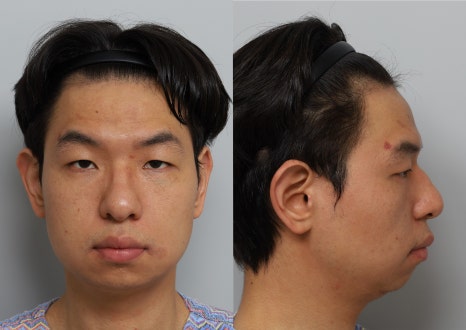
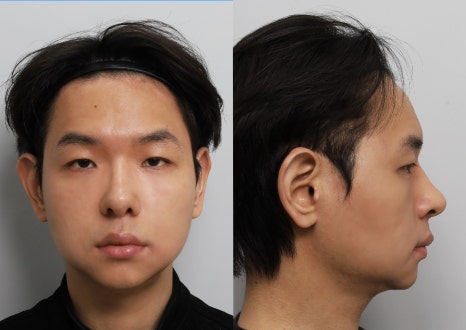
Preoperative front and profile views | Postoperative front and profile views | The changes in the center of the lower face and the profile line are assessed together. The appearance may vary depending on the photography conditions and the stage of recovery.
The key point in this case was “forward dimension” rather than “length”
In the preoperative photos, the central point of the lower face appears somewhat weak from the front,
while in profile, the chin is set back, creating an unsatisfactory balance between the lips and chin.
In such cases, approaching the procedure by simply making the chin longer may instead make the face look longer.
Therefore, in this case, the plan was to move the chin bone forward to secure the necessary anterior volume,
and adjust the position of the chin in accordance with the proportions of the entire face.
The key is not “how many millimeters to move forward,”
but finding the point where the aesthetic line connecting the nose, lips, and chin flows naturally into the lower-face proportions seen from the front.
How is chin advancement performed?
Chin advancement involves cutting the chin bone,
moving it forward to the planned position, and securing it in place.
Unlike adding volume with an implant,
this approach changes the front-to-back relationship of the chin by adjusting the position of the patient’s own bone.
In the video, a forward movement of approximately 6–8 mm is explained as an example of a male receding-chin case.
However, this figure cannot be applied to everyone in the same way.
The possible amount and direction of movement vary depending on the thickness of the bone, the nerve canal, the soft tissue, facial length, and occlusion.
A greater amount of advancement does not necessarily lead to a better result.
Excessive advancement can make the chin look too prominent or make the proportions of the lower face appear awkward,
so individualized planning within a safe range based on CT is important.
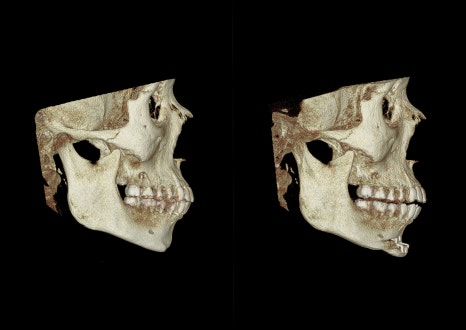
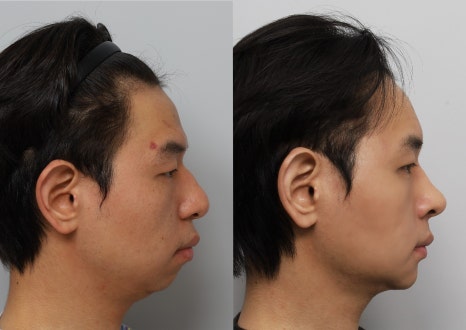
3D CT before and after surgery | The structure can be seen after the chin bone has been advanced and fixed in the planned direction. Front and profile views after surgery | The changes in the center of the lower face and the profile line are assessed together.
Why does the entire face look more dimensional when only the chin has changed?
Facial dimension is not determined solely by projecting areas such as the nose or cheekbones.
When the chin, the final point of the face, provides appropriate support in relation to the position of the nose and lips,
the profile line is completed, and the center of the lower face may also appear more defined from the front.
In this case as well, after surgery, the center of the chin became clearer from the front,
making the balance of the lower face appear more refined,
while from the side, the line extending from the lips to the chin and the boundary beneath the chin appeared more distinct than before.
In other words, the goal of chin advancement is not to create a “large chin,”
but to restore the insufficient anterior point of support and bring out the dimensionality of the original face.

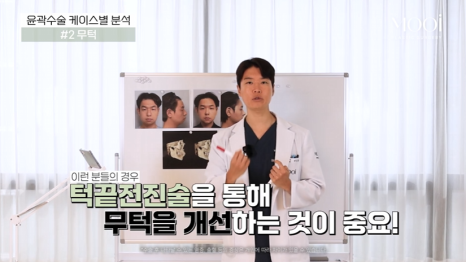
People who may consider chin advancement
-
People whose chin is set back, making the face look flat
-
People whose mouth appears relatively prominent in profile
-
People whose area beneath the chin looks like a double chin despite not having much excess fat
-
People who prefer correction using their own bone rather than filler or an implant
-
People who want to improve the balance of the lower face from both the front and the side
However, chin advancement alone may not be sufficient in some cases
Even when the face appears to have a receding chin, the cause may not lie solely in the chin.
If problems with the occlusion of the upper and lower jaws, severe protrusion of the mouth, chin asymmetry, or sagging skin and fat are also present,
it may be difficult to achieve the expected changes with chin advancement alone.
In addition, because facial contouring surgery involves the bone and areas around the nerves,
it is not possible to completely exclude the possibility of complications such as bleeding, infection, changes in sensation, asymmetry, or nonunion.
The surgical method and extent should be determined after an accurate CT and X-ray evaluation and a thorough consultation.
Frequently Asked Questions (FAQ)
Q. If I have a receding chin, should I start with chin filler?
A. Filler can relatively simply supplement forward volume,
but it may have limitations when a significant amount of advancement is needed or the position of the bone itself must be changed.
Whether an implant, filler, or chin advancement is appropriate is determined by considering the CT findings and facial proportions together.
Q. Will my face look longer if my chin is moved forward?
A. It is important to consider how the vertical length is adjusted along with the direction of advancement.
With appropriate planning, dimension and balance may be noticed before length,
but excessive movement can look unnatural, so individualized planning is necessary.
Q. How many millimeters is the chin usually advanced in men?
A. The video explains a range of 6–8 mm as an example of a male case,
but this is not a fixed figure that applies universally.
It varies depending on the bone thickness and nerve canal seen on CT, the aesthetic line, and the soft-tissue response.
Q. Can I see the final contour immediately after surgery?
A. In the early stages, swelling and tissue changes make it difficult to judge the final contour immediately.
The speed and course of recovery vary from person to person, so please prioritize the instructions provided by your medical professional.
In summary,
natural correction of a receding chin begins not with “moving it far forward,”
but with “finding the point of support needed by your face.”
The chin occupies only a small area of the face,
but it is an important point that simultaneously determines the balance of the lower face from the front and its dimensionality from the side.
At MOOi Plastic Surgery, we assess the proportions of the front and profile views, the aesthetic line connecting the nose, lips, and chin,
and the locations of the bone and nerve canal on CT before designing the direction of chin advancement needed for each individual within a safe range.
If you are concerned that your face looks flat or like you have a double chin because of a receding chin,
rather than choosing a method based only on your appearance, please visit us and receive an accurate evaluation from a specialist
to determine the appropriate correction plan for your face.
Recommended reading
- How to create a V-line with a receding chin, double chin, short chin, and chin contouring
https://blog.naver.com/mooips/224333520810
MOOi
무이성형외과
Beauty like No Other
Like the name 무이(無二), meaning “not two, but one,”
무이성형외과 designs the one and only face that belongs to you.
🩷 Directions 🩷
💖 Meet our chief directors 💖



💛 Go directly to the KakaoTalk channel 💛

🧡 Go directly to the website 🧡


#recedingchin #recedingchinsurgery #recedingchincorrection #chinadvancement #genioplasty #chincontouring #chinbonesurgery #facialcontouringsurgery #facialdimension #profileimprovement #doublechin #malechinaugmentation #contouringsurgery #Gangnamplasticsurgery #MOOiPlasticSurgery
This content was written directly by 무이성형외과의원 for informational purposes, to make information about procedures and surgery easier to understand, in compliance with Article 56(1) of the Medical Service Act. All procedures and surgeries may vary from person to person and may involve complications, so consultation with the medical professional in charge is strongly recommended before proceeding.