“I don’t know what I should do right now, but I feel like I should do something.”
“I had my eyes done in my 20s. What should I consider in my 30s?”
“Is it too late to start at my age?”
These are questions we hear very often in the consultation room.
When you listen carefully, many people are not actually concerned about which area to address,
but rather about the order in which to address it.
To give you the conclusion first,
there is no fixed answer chart for plastic surgery by age group.
However, there is a clear pattern in how the focus of people’s concerns shifts with age.
Once you understand this map, it becomes much clearer what you should consider first at your current age.
Today, at MOOi Plastic Surgery Clinic✨, where each person’s beauty is unique,
we’ll honestly explain how plastic surgery concerns change from your teens through your 50s.

A Complete Guide to Plastic Surgery Trends: An Introduction to Plastic Surgery by Age and Gender
An At-a-Glance Map of Plastic Surgery by Age Group
Let’s start by laying out the overall map.
The table below summarizes the areas of greatest interest commonly seen in the consultation room.
Please remember that it is not a recommended order of procedures by age group.
The order can vary considerably from person to person.
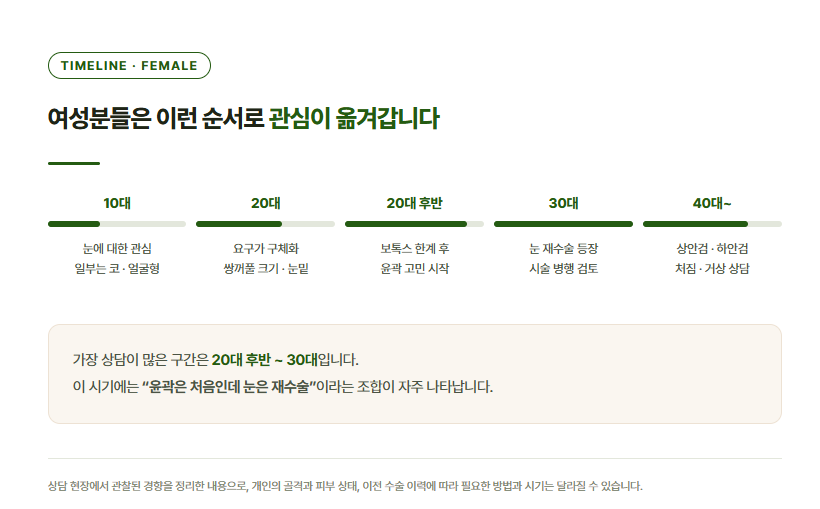
| Age group | Women | Men |
|---|
| Teens | Eyes (double eyelids); some also consider the nose and facial shape | Generally a period of limited interest |
| 20s | Eyes, square-jaw Botox | Double eyelids, ptosis correction, nose procedures (often prompted by dating) |
| Late 20s to 30s | First facial-contouring surgery + revision double-eyelid surgery, combined with aesthetic treatments | A relatively quiet period |
| 40s–50s | Upper blepharoplasty, lower blepharoplasty, facelifts — the point at which people feel the limits of aesthetic treatments | Upper blepharoplasty, lower blepharoplasty, and facelifts in the 50s |
Why Do So Many People Start with Eye Surgery in Their Teens and 20s?
For women, concerns often begin as early as adolescence.
While looking in the mirror with friends, you may have said things like,
“Double eyelids would suit you,” or “You’d only need an epicanthoplasty.”
Most people are especially interested in their eyes during their teens.
During adolescence, interest in double-eyelid surgery is often at its strongest,
and some people who take it a step further also start considering their nose.
They may even press the bridge of their nose with a cotton swab and give each other opinions.
Some begin to worry about their facial shape, such as a square jaw or prominent cheekbones, at this stage as well.


Stories from consultations about plastic surgery by age group: Many people already know which area of their face concerns them from their teens
What is interesting is that people often already know the answer at this age.
Whether the concern is their eyes, nose, cheekbones, or square jaw.
So a consultation is often less about discovering something new and more about getting confirmation.
If there is already an area that comes to mind, it is likely to be the area that concerns you most.
Once people reach their 20s, the overall concerns remain similar, but the details change.
That is because makeup becomes a tool they can use.
They can balance their facial shape with contouring and define their eyes with eyeliner.
As a result, their requests become much more specific.
“I want to make my double-eyelid crease a little wider because my eyeliner smudges,”
or “I want to tidy up my under-eye area. I’m considering lower-eyelid fat repositioning.”
Plastic Surgery in the Late 20s and 30s: A Period When the Combination Changes
Many people have already tried Botox for a square jaw when it comes to facial shape.
When they begin to feel that Botox has limitations, they start considering facial-contouring surgery,
and often look at the cheekbones together with the square jaw.
In practice, the late 20s to 30s is the period when we receive the most consultations for facial contouring.
Another concern that emerges at this stage is revision double-eyelid surgery.
A crease created through a non-incisional procedure may become lower,
or someone may be dissatisfied with the shape after an incisional procedure.

A common pattern in plastic surgery consultations among people in their 30s: first-time facial-contouring surgery and revision eye surgery
That is why consultations during this period often involve a distinctive combination.
Many people are considering facial contouring for the first time while seeking revision surgery for their eyes.
As people become more financially comfortable, they often arrive already familiar with information about treatments such as Ulthera and Thermage.
This is the period when they begin weighing surgery and aesthetic treatments together.
Plastic Surgery Consultations in Your 40s: Eyelids and Sagging Become the Main Concerns
In the 40s, upper and lower blepharoplasty begin to come up in consultations.
This is the age when concerns about sagging around the eyes, the eyelids, and drooping double-eyelid creases become more prominent.
Those who start earlier may also consider a facelift.
The trigger is usually similar.
People may have noticed a change when receiving around 300 shots of Ulthera or Thermage,
but after several years, they may feel that even 600 or 800 shots no longer produce the same change as before.


The progression after repeated Ulthera and Thermage treatments: feeling their limitations and beginning to consider upper blepharoplasty, lower blepharoplasty, or a facelift for sagging around the eyes in the 40s
This is when people first begin to consider surgical options, along with concerns about scarring.
They start considering various anti-aging surgeries, including upper and lower blepharoplasty.
If you find yourself thinking, “Treatments don’t make as much difference as they used to,”
that may be one signal to consider.
From this point on, it is important to take a long-term view from the perspective of ongoing care,
rather than expecting everything to be resolved at once.
Plastic Surgery by Age Group for Men: The Pattern Is Quite Different
Men tend to start later.
Plastic surgery usually first enters the picture in their 20s, most often prompted by dating.
They may have thought they looked fine by their own standards, but after encountering more objective feedback,
they begin talking about their appearance with friends.


Plastic surgery patterns among men by age: concerns in their 20s about monolid eye surgery, ptosis correction, rhinoplasty, and reducing the appearance of a square jaw
The topics that come up at this point include monolid eye surgery, ptosis correction, nose surgery, and ways to make the face appear more refined in size.
One characteristic is that men tend to be highly sensitive to feedback from people around them.
Women often continue in the direction they want,
whereas men are more likely to change direction after hearing a single comment such as, “That wouldn’t look good.”
In their 30s, things become quieter again.
As marriage becomes a consideration, appearance-related concerns tend to take up less attention.
Many men who come in for consultations during this period have accompanied a spouse or girlfriend
and ask, “Do my under-eyes look a little dark too?”
Then these concerns reappear in their 50s.
Upper blepharoplasty, lower blepharoplasty, and facelifts are discussed together,
and it is common for men to come in for a consultation with their spouse.
They also tend to make decisions quickly.
Once they have settled on a direction, they proceed without deliberating for a long time,
and more men these days are willing to undergo the recovery process as part of their ongoing care.


Decision patterns seen in consultations for upper blepharoplasty, lower blepharoplasty, and facelifts among men in their 50s: proceeding after accompanying women in their 50s to consultations for the same procedures
These People May Benefit from a Consultation
-
People who want to have something done but cannot determine where to start
-
People in their late 20s or older who are considering revision eye surgery and facial contouring at the same time
-
People who do not feel the same degree of change despite repeated aesthetic treatments
-
People who want to know when to consider upper or lower blepharoplasty after their 40s
-
People who want to have a consultation together with a family member or spouse
However, There Are Some Things You Should Know
Trends by age group are only general tendencies.
The appropriate method and timing can differ completely depending on each person’s bone structure, skin condition, and history of previous surgery.
In particular, when revision surgery is involved or when eyelid issues and sagging are interconnected,
it is difficult to determine the order without an examination and tests.
Therefore, determining the order ultimately begins with an accurate diagnosis.
Frequently Asked Questions (FAQ)
Q. Is there a fixed order for plastic surgery by age group?
A. There is no fixed chart.
However, in consultations, we tend to see interest shift from the eyes, to facial contouring and revision surgery, and then to the eyelids and sagging.
In practical terms, the order should be based on the area that currently feels most uncomfortable to you.
Q. Is having facial-contouring surgery in your 20s considered too early?
A. The criteria are not based on age alone, but on whether skeletal growth is complete and whether the concern can be addressed within the range of nonsurgical methods such as Botox.
It is difficult to make a judgment based on age alone without accurate testing. We recommend visiting the clinic for a detailed consultation.
Q. I keep receiving aesthetic treatments. When should I start considering surgery?
A. A point at which repeated treatments no longer produce the same noticeable change as before may be one signal.
However, the decision varies depending on the degree of sagging and the condition of the skin, so consultation after an in-person visit should come first.
Q. Do men also have many consultations for upper or lower blepharoplasty?
A. Inquiries tend to increase around the age of 50.
However, men’s eyelid thickness and skin characteristics differ, so the approach is not the same. The direction should be determined through an individual examination.
In summary,
plastic surgery by age group is not a matter of “what should I have done at what age?”
It is a matter of “where am I experiencing discomfort right now?”
Many people say that their main concerns are the eyes in their teens and 20s,
facial contouring and revision surgery from the late 20s onward,
and the eyelids and sagging after their 40s.
However, this pattern is only a reference map, and the actual order should be determined after accurately examining your face.
If you are wondering where to start,
rather than trying to determine the order on your own, we recommend confirming your priorities through an accurate diagnosis.
At MOOi Plastic Surgery Clinic, we do not look at only one specific area.
We review your overall facial proportions, history of previous surgery, and current skin condition together,
then help organize your priorities comprehensively.
Reference video:
Recommended Related Reading
-
How to create a V-line with a receding chin, double chin, short chin, and chin-tip surgery
-
Cheekbone reduction, square-jaw sagging: How can it be reduced? (Review of AI research findings)
-
Surgery for sagging eyes: How to find the method that suits you
MOOi
무이성형외과
Beauty like No Other
Like MOOi (無二), meaning “one and only, not two,”
MOOi Plastic Surgery Clinic designs your one-of-a-kind face.
🩷 Directions 🩷
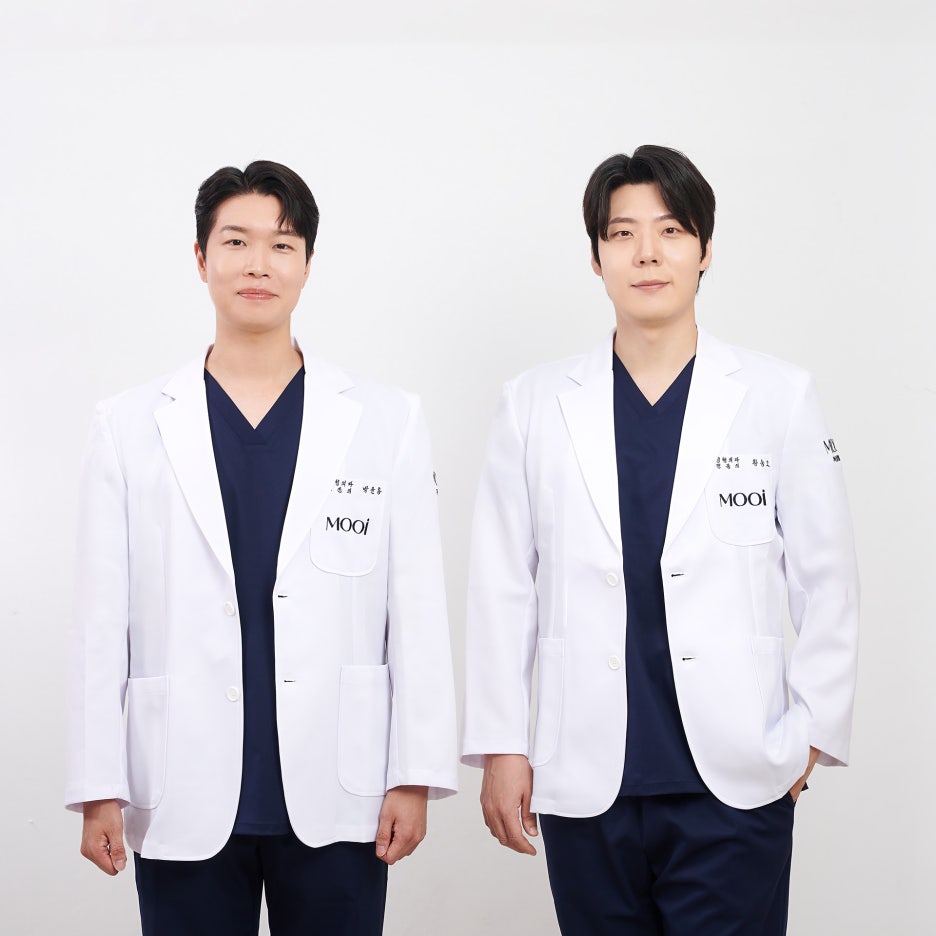
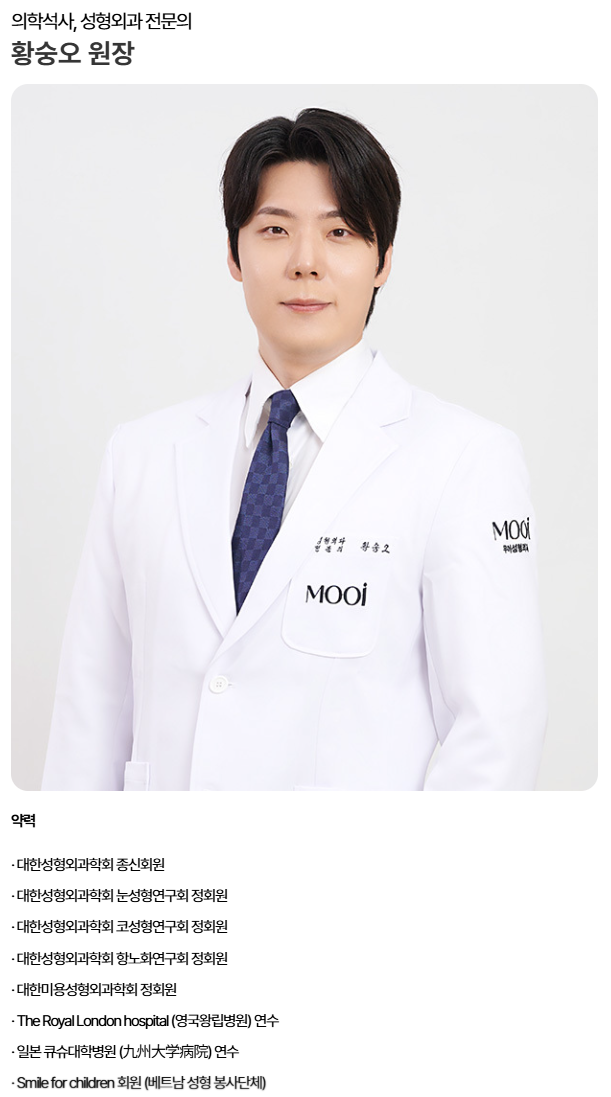
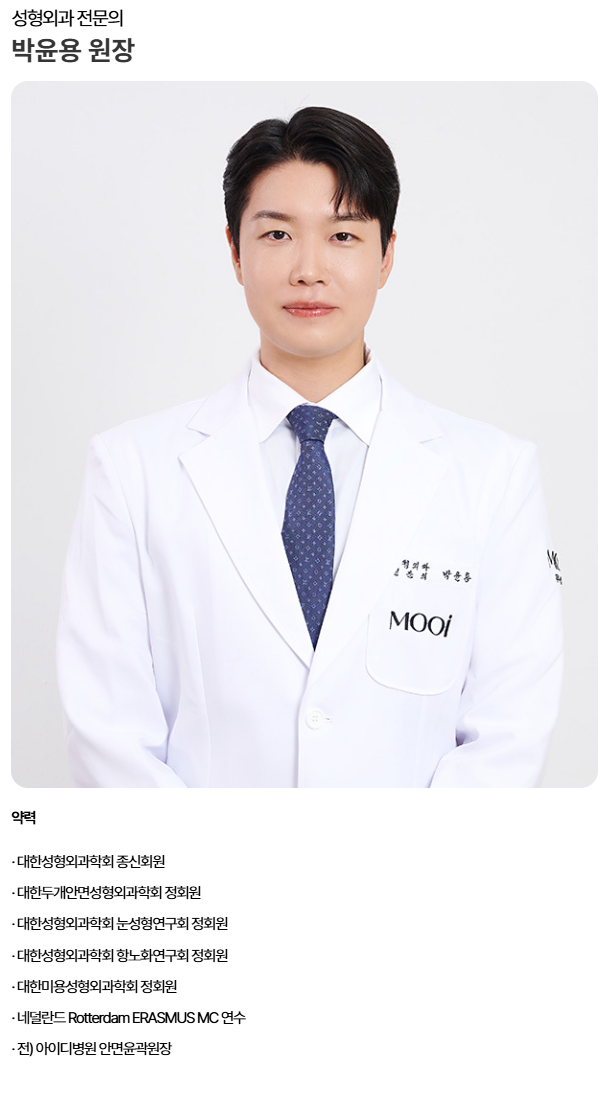
💖 Meet Our Lead Directors 💖
💛 Go Directly to the KakaoTalk Channel 💛

🧡 Go Directly to the Website 🧡

#PlasticSurgeryByAge #PlasticSurgeryInYour20s #PlasticSurgeryInYour30s #PlasticSurgeryInYour40s #RecommendedOrderOfProcedures #RevisionDoubleEyelidSurgery #EyelidSagging #UpperEyelidSagging #UpperBlepharoplasty #LowerBlepharoplasty #MensPlasticSurgery #GangnamPlasticSurgeryClinic #MOOiPlasticSurgeryClinic
This content was written directly by MOOi Plastic Surgery Clinic for informational purposes, to make information about aesthetic treatments and surgery easier to understand, in compliance with Article 56, Paragraph 1 of the Medical Service Act. All procedures and surgeries may vary from person to person and may involve side effects, so you are advised to proceed only after consulting with your attending medical professional.