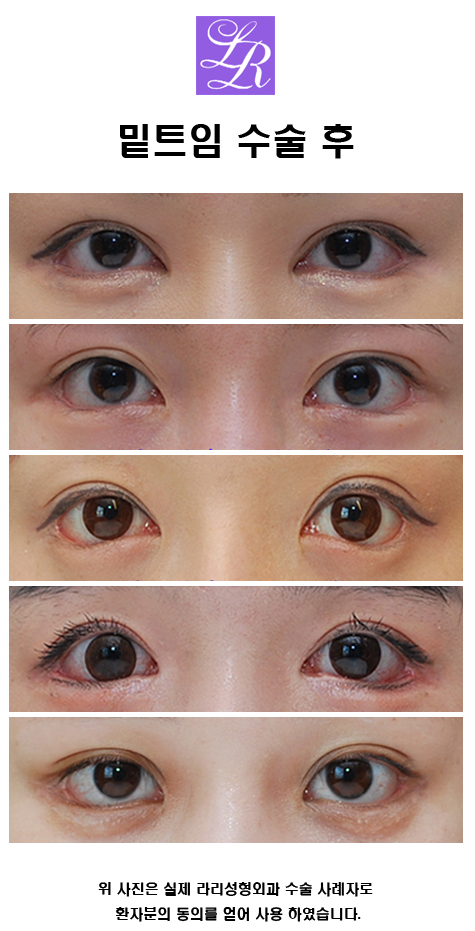
There are many eye surgeries, such as double eyelid surgery, epicanthoplasty, and canthoplasty, but today let’s take a look at lower eye corner surgery.
Lower eye corner surgery is an eye plastic surgery method that makes the lower eye line angular or rounded. Because lower eye corner surgery is performed on the inside of the eye, there is no visible incision scar on the outside, and compared with canthoplasty, there is less redness or conjunctival swelling, so the recovery period is shorter. However, unlike canthoplasty, which is fixed to the periosteum, it has the drawback of loosening easily because it pulls together tissues on the inside of the eye that stretch well.

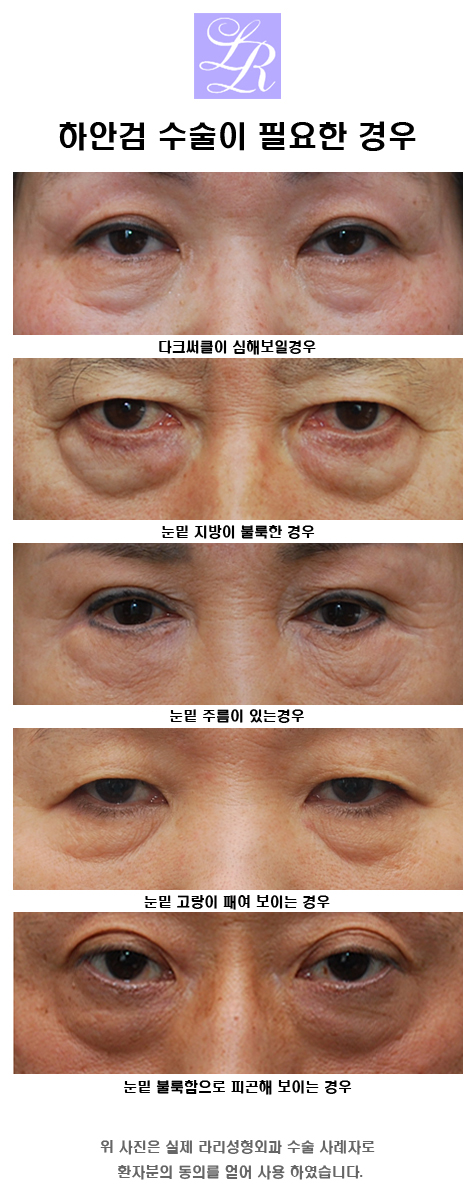
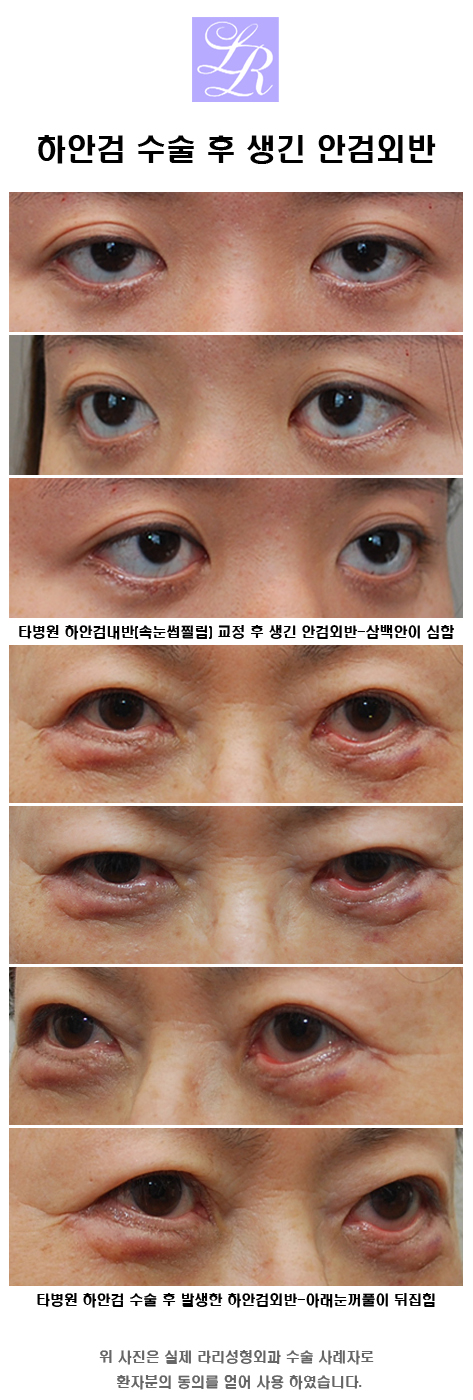
Lower blepharoplasty is a surgery that removes sagging skin under the eyes and removes or repositions protruding under-eye fat to create a younger and brighter impression. However, when performing lower blepharoplasty, if the sagging skin is removed excessively and the lower eyelid turns outward, this is called lower eyelid ectropion. It is a common side effect of lower blepharoplasty, to the point that every plastic surgeon has experienced it at least once.
Because the appearance of lower eyelid ectropion can be very stressful, it is usually better to correct it as soon as possible rather than waiting six months. Once it is corrected, it tends to improve much better than expected, so instead of worrying, it is important to quickly look for a plastic surgery clinic that can properly correct lower eyelid ectropion.
Some people wonder whether ectropion, a common side effect of lower blepharoplasty, can also occur after lower eye corner surgery. To conclude first, lower eye corner surgery is performed on the inside of the eye, unlike lower blepharoplasty, so the vector, the direction of the force pulling the lower eyelid, acts from inside the eye, and ectropion absolutely does not occur. Instead, entropion occurs, in which the eyelashes curl inward toward the eye.
Relatively speaking, lower blepharoplasty is performed through an incision on the outer skin of the lower eyelid, so the vector acts on the outer skin of the eye, causing ectropion in which the eyelid turns outward.

I saw a plastic surgery blog that posted about whether ectropion occurs after lower eye corner surgery, and I was really surprised because it seemed like it was written by a doctor who does not perform lower eye corner surgery often, or by a blog advertising staff member who knows nothing at all. Bringing up ectropion in relation to lower eye corner surgery itself means that the person knows nothing about the procedure or its aftereffects, so such a clinic should of course be excluded from any clinic consideration list for lower eye corner surgery.